
I believe the desire to make improvements is ingrained in our genes. It does not matter what you do, you always want to do it better. The advancement of computer engineering in the past several decades is a good example. Potters in the old days behaved in the same manner. I am sure they were striving to improve in every step of their way to produce a more beautiful product. A relevant example would be the transformation of pottery to ceramics. Ceramics have been with us for about a thousand years. We have no idea when the first ceramic ware was made. The same can be said about blue and whites. But the evolvement of the quality of ceramics over all those long years are obvious.
Let us forget all other ceramic types and focus on Blue and Whites. We have all seen the changes in Blue and whites over the years. Changes that would include the shape of the wares, the way the motif is drawn, the blue dye pigments and the glaze. We seldom talk about the glaze because though it covers the ware, we look at it as the background of the motif. And because it is mostly colorless, it does not attract our attention. The only feature we concern about the glaze is whether the reflection of the glaze in daylight is shiny or mellow.
Shiny or mellow? What do you mean, I am sure you want to ask? It is something not well defined, and very difficult to explain. All that I can say is that, with blue and white, and ceramics in general, the newly made ones would emit a shiny reflection that is glaring, somewhat uncomfortable to your gaze. With a mellow reflection, the ware would emit a soft glow that is very pleasing, and you enjoy looking at it. Ceramic collectors have a consensus that as a ware grows old, the shiny reflection, after years of oxidation and other chemical reaction on the glaze layer, would become less shiny and more mellow.
Whether this is true or not, it is difficult to say. After all, a good part of of this perception of shininess is totally dependent on the subjective feeling—it all depends on how you look at it. But for me, to say that the glaze would grow old is not true. There is no truth in this. We can all recall our own experience with the ceramics we have, both old and new. After thirty years or so, do they change a bit? No, they have not. Well, you may say that thirty years is a short period of time when we are talking about a length of period of hundreds of years, and this is not a good example. In which case, let us have another example. We have all seen B & Ws of the mid to late Ming periods. Is the glaze color of wares of those periods better than those wares of Yongzheng and Qianlong? Is the glaze color of Chenghua wares any worse than the best in Yongle, Xuande and late Yuan period? We all know the answer. It only shows that glaze color is not a function of how long ago the ware was made. I have a feeling that the glaze color of a ware DOES NOT change with time. If there is any change at all, it would be so minimal that it is hardly noticeable.
I believe that the glaze color is entirely dependent on the material with which the glaze is made. In a way, this is similar to the blue coloration of a blue and white. The blue color in a B & W is totally dependent on the blue dye pigment. The lay public who is interested in B & Ws may not pay any attention to the glaze of a ware. But for a savvy collector, the glaze is very important. He knows that for each particular period, it has a somewhat characteristic glaze. In the beginning of this article, I talked about advancement and improvement of technology, and as a result, a better product as we go along. Following this argument, the glaze of wares in Wanli should be better than that of Xuande. This is obviously not true. And this is not the only example. There are many more, and many a time, we cannot tell which period has the best glaze color.
The fact is, this argument does not apply in the making of ceramics in at least two areas, the dye pigment and the glaze. There are good reasons for this. When I talked to you about the Sumali Blue dye pigment, I have told you that the only thing we know about the dye is that it is imported. We have no idea from where the dye was imported, nor its basic ingredients. What we can do today is to find a way to determine if the dye belongs to the broad category that we label as Sumali Blue dye. That is why, even as potters in the old days know that the Sumali Blue dye represents the pinnacle in terms of blue dye quality, they have no way to find a replacement once the exporters discontinued their product. That is why, even with technology advancement, potters of subsequent periods cannot make B & W wares to match the blue dye quality of those in Yongle and Xuande period. The limitation factor here is the quality of the blue dye pigment, and no amount of technology advancement can do anything to make a better product.
I suppose something very similar is happening with the glaze. Potters right from the beginning knew that the glaze was very important. The general principle in making a glaze may not be a secret, but those finer points that really make a difference are guarded with top secrecy. The Ru wares are good examples. Though ceramic experts like to talk about the beautiful color, we all know that what makes Ru ware unique is the glaze. Without the beautiful glaze, Ru ware would not have had the distinction and accolade that it has now. And yet, Ru ware, from its beginning to its end, lasts little more than 20 years. Why? we do not know. But to me, one of the reasons is that the potter decided that he wanted to keep the formula of the glaze a secret.
Potters engaged in the making of B & Ws in those periods must have shared a similar thinking. We know that potters cannot make everything secret. There are some basic ingredients and procedures that potters know and follow. Improvement in these would lead to, without a doubt, a better product. But many potters would keep certain ingredients and methods to themselves, and would not tell even their own sons the secret. That is why the glaze color varies even among Yongle B & Ws. I can give you another example. Chenghua wares are known to be beautiful with very fine glaze. But potters in Hongzhi, the emperor that succeeded Chenghua, were not able to make wares that are nearly as beautiful, and that would include the glaze. The point that I am trying to make is that in preparing the glaze, there must be a lot of secrets, and technology advancement is often offset by this secrecy. And in many cases, instead of advancement, there might actually be regression.
It is unfortunate that we have not yet found a marker for a good glaze. The best that we can manage is to bank on our subjective feeling and decide for ourself what is a soft, subtle glow that is pleasing to our eyes. However, savvy and wise collectors can easily tell a good glaze from a bad one.
With all these said, I am going to show you a Yuan B & W bowl that I think was made very early on, and probably one of the earliest B & W that we have seen. I’ll explain why.
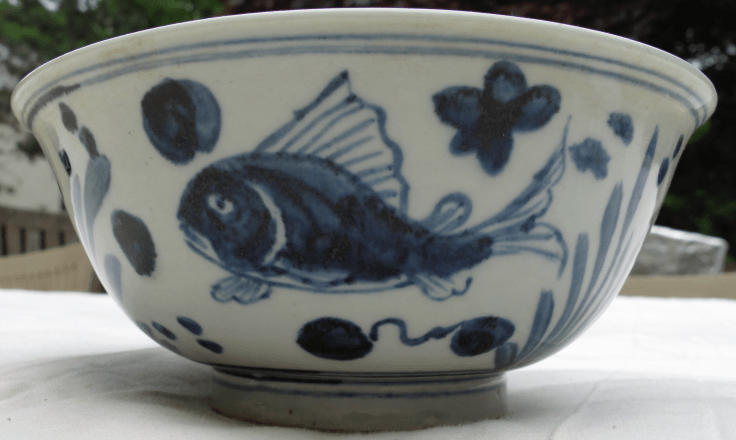 Figure 1
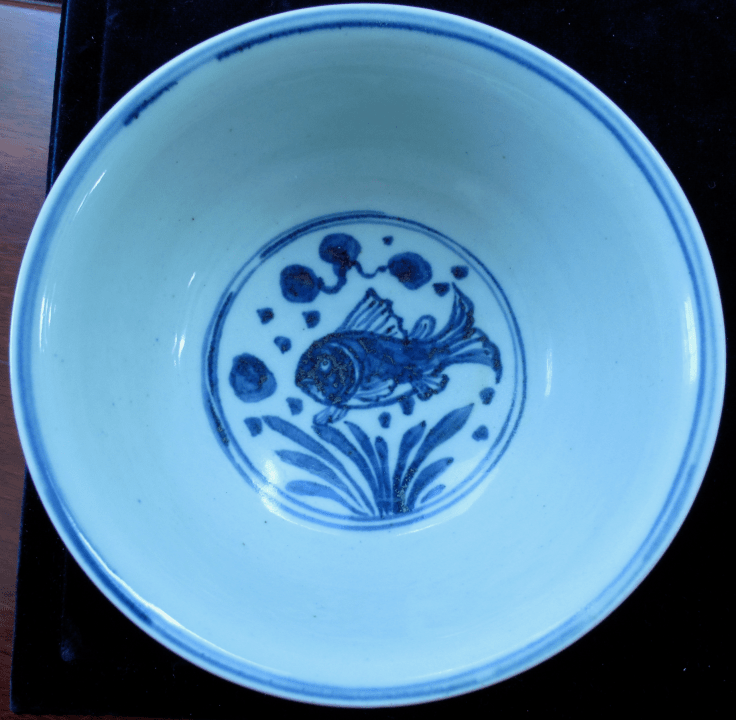 Figure 2
This Blue and White Yuan fish bowl measures 6 3/8 inches in diameter (Figure 1 and Figure 2). I am sure you will agree with me that the glaze is a little dull. It lacks a beautiful glow. The way the motif is drawn is lively—both the fish and the sea weed. You will also note that the fish is quite unlike fishes that are found in Yuan wares. That alone makes it an interesting bowl. The blue dye does not stand out when you are looking at the bowl even at close range. However, if you are looking at the dye with a magnifying glass, it is a totally different story.
The blue dye is, in fact, most beautiful. When you hold the bowl in your hands, you do not see the blue dye pigment very well. The nature of the glaze that is not exactly crystal clear has partly obscured the blue coloration. That is why the beautiful blue color does not show up instantly when you pick up the bowl. This less than perfect nature of the glaze must represent something primitive, when potters making the earliest blue and white first developed their glaze. However, if you are going to look at the dye pigment under a magnifying glass, the beautiful dye pigment definitely would more than compensate the slight defect that the bowl has with the glaze.
Let me first show you some very nice color this bowl has.
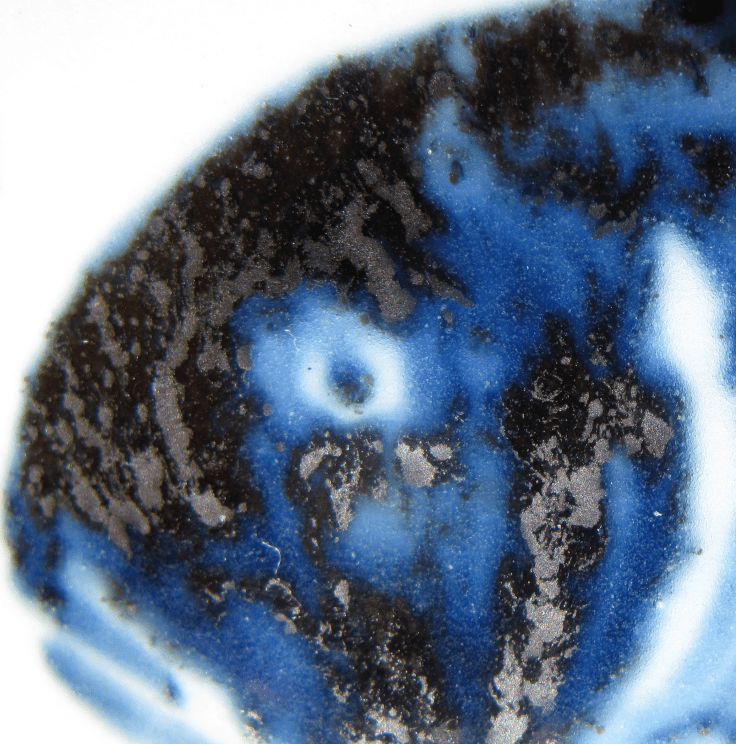 Figure 3
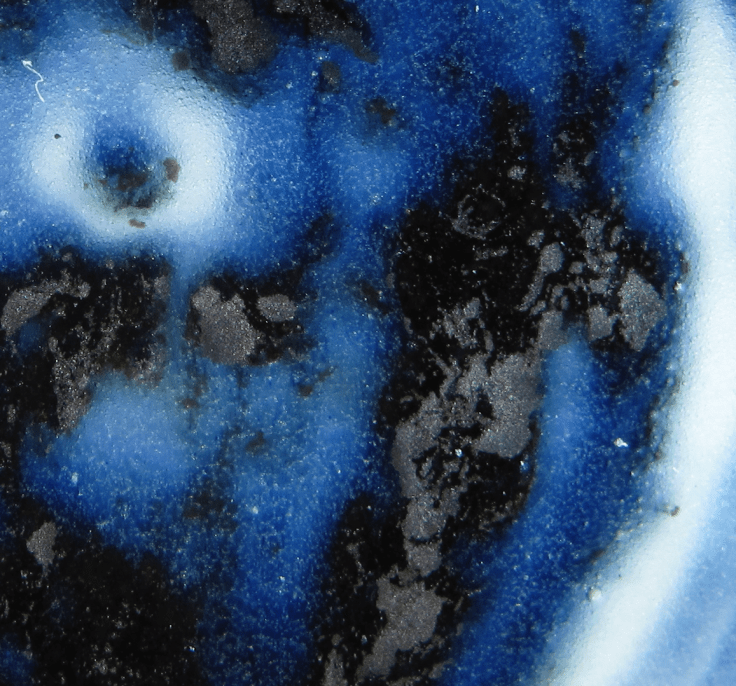 Figure 4
 Figure 5
 Figure 6
 Figure 7
 Figure 8
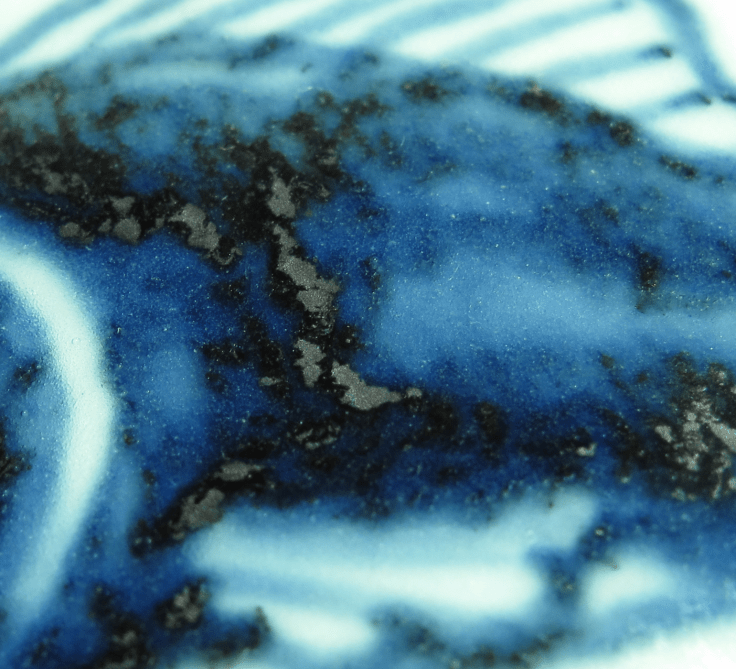 Figure 9
I have told you many times before that the sapphire blue color is about the best blue color you can see in the Sumali Blue dye. Not just any sapphire, but the best sapphire. If you have a sapphire that carries this blue, I am sure you will like it. And this bowl no doubt has this nice blue. Here, the blue color all follows the same pattern. In the center is the plaque. It is surrounded by some very dark blue, almost black coloration. further out, the dark color lightens, with many shades of beautiful blue as it fades out, until it becomes a light blue.
In these photos you can also see the typical Yuan plaques and bubbles. But I’ll show you the plaques under the sun (Figures 10-15).
 Figure 10
 Figure 11
 Figure 12
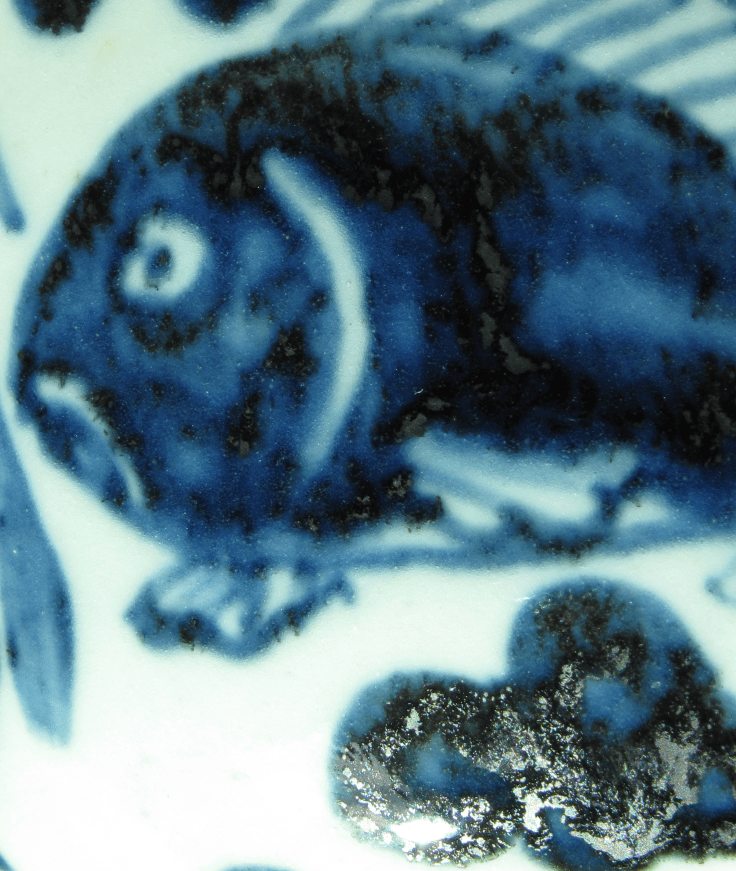 Figure 13
 Figure 14
 Figure 15
Look at these plaques under the sun, and compare them to Figures 3-9, you will realize how beautiful the plaques are. They are typical Yuan plaques. I have included Figure 15 where a big plaque is out of focus. But it is here that you appreciate the multi-color nature of the plaque better.
In these photos, When you enlarge them, you can see the bubbles well. Note the large and small bubbles. Many of the large bubbles are pearly white. They are not too large, definitely smaller than those in the Yongle era. The small bubbles are not tightly packed, but you can see lacunae formation very well in many places. But I’ll show you a few photos of the large pearly white bubbles, and small bubbles in lacunae formation (Figures 16-20).
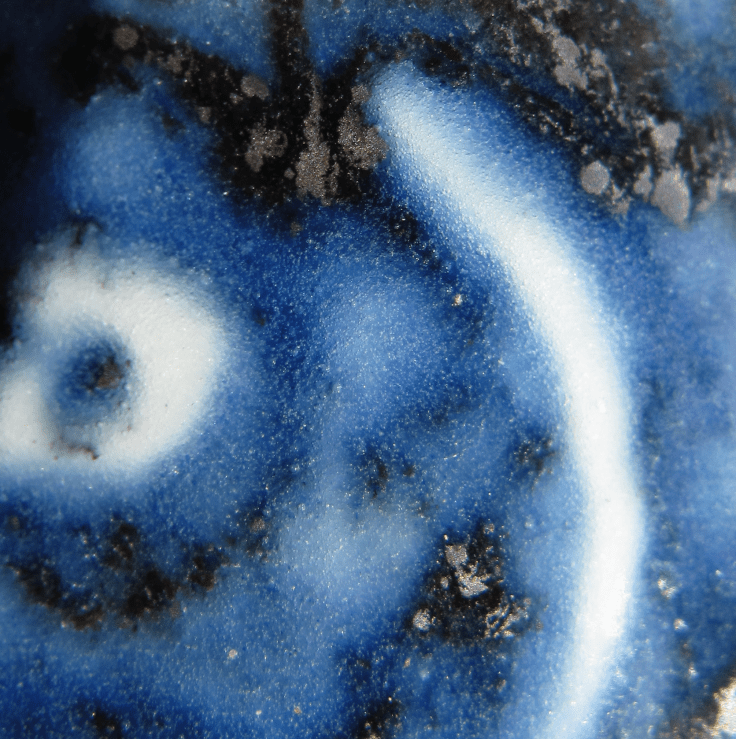 Figure 16
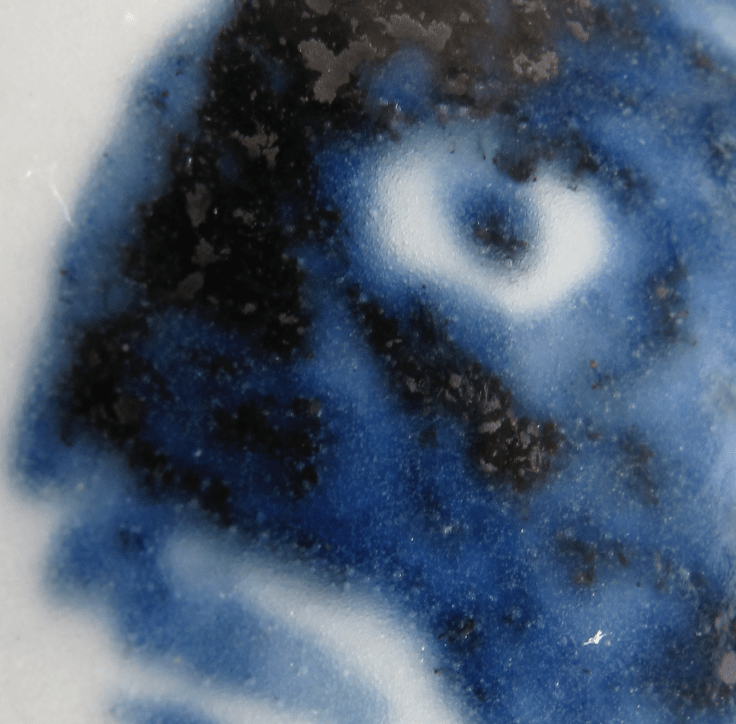 Figure 17
 Figure 18
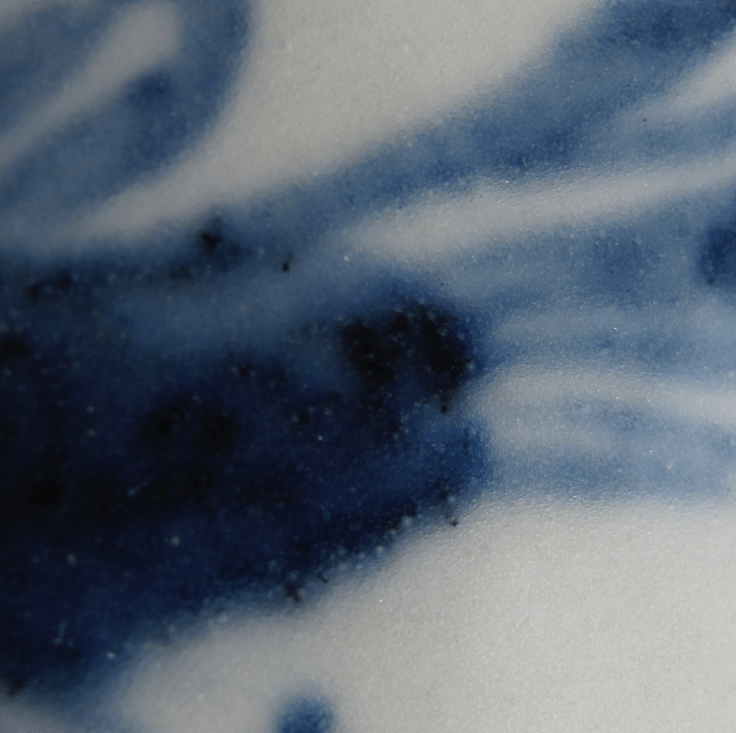 Figure 19
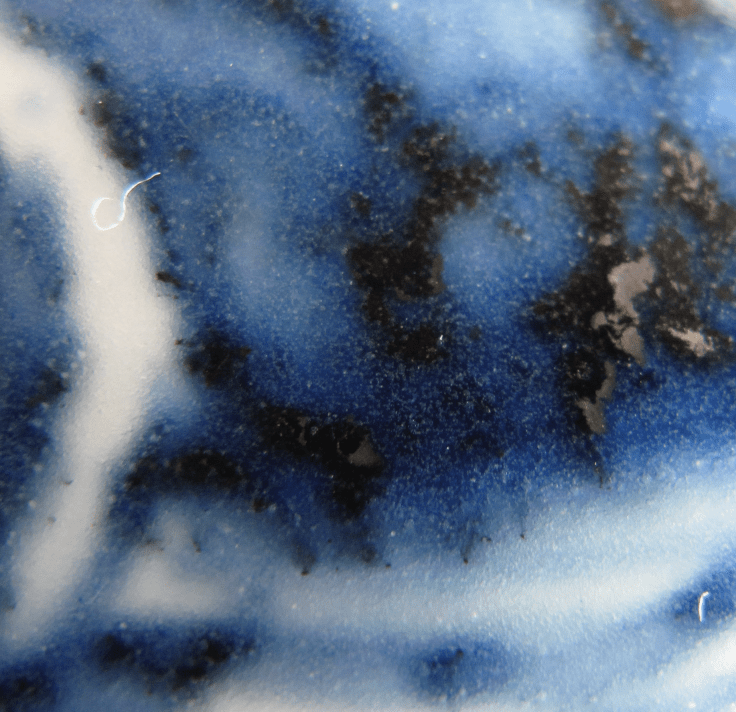 Figure 20
You will note that the pearly white large bubbles are particularly abundant here in this bowl. I have always considered pearly white bubbles beautiful. In Yongle and Xuande B & Ws, these pearly bubbles have become less common. You can see them, but not as many as here.
But, in this bowl, I think the most eye catching, and I try not to use the word spectacular, feature is the flare and the dripping. Look at Figure 20, these flares are obvious. They represent the heavier components of the plaque that drips down more rapidly under gravity than the rest. And their presence always make the appearance much better. In this bowl, there are many places that show similar flares. Look at all the photos I have shown you here, every single one of them has flares that take different form. I have told you previously that flares of this nature indicates that the dye is of superb quality, and looking at these, would you agree with me?
Let me show you more photos that have such flares and drippings (Figures 21-26).
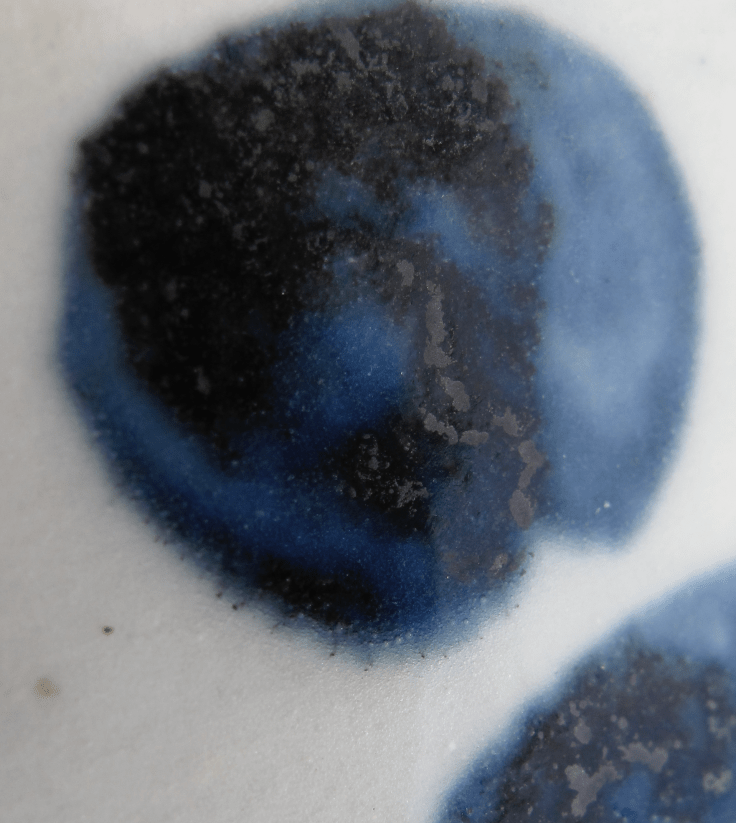 Figure 21
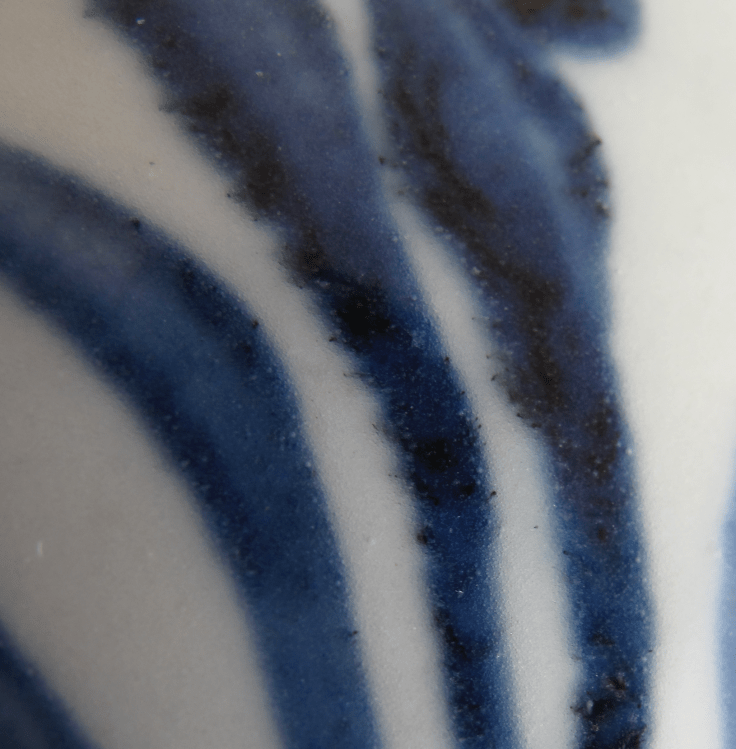 Figure 22
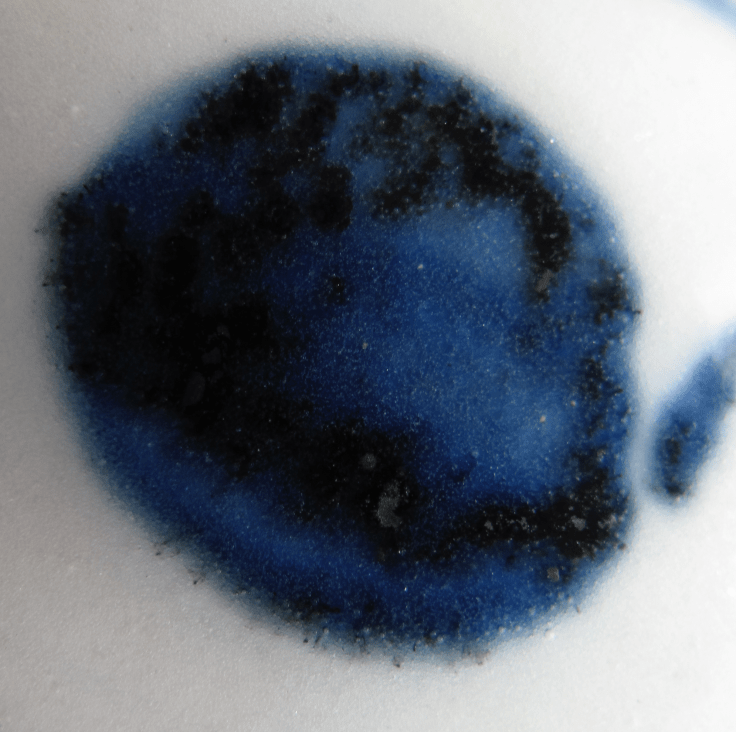 Figure 23
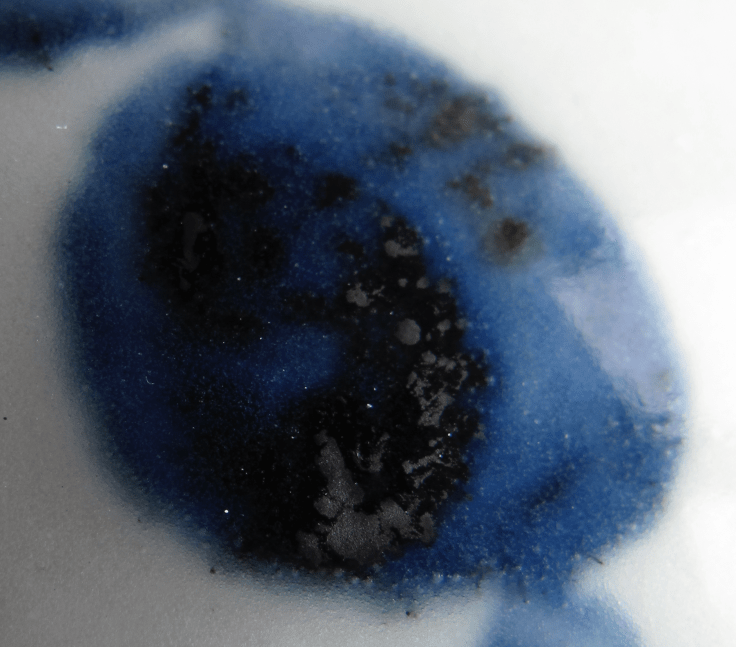 Figure 24
 Figure 25
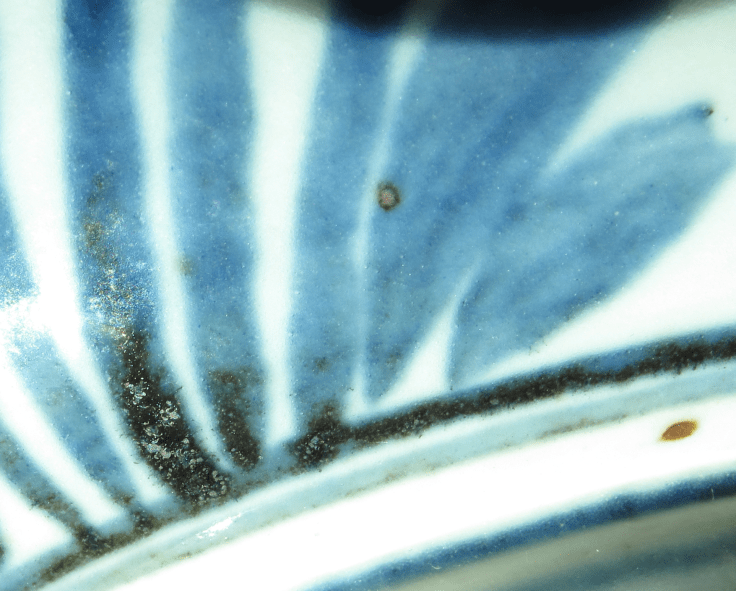 Figure 26
These photos, showing the flares and drippings, together with photos that show the colorful plaques, the pearly bubbles indicate that the dye pigment is of a very high standard. We cannot say if the dye belongs to the earlier batches of dye that made their way into China from the exporters, but we should not be surprised if this is really the case. Exporters, when they tried to established a trade relationship with the buyers, often made extra efforts to promote the product by using the best ingredients possible. This can well be the case. And taking into account of the less than perfect glaze, which is likely to be produced when it was first invented, this bowl may very well be one of the earliest B & Ws.


You appear to have a good many period B+W pieces. Are you a collector, appraiser, or someone working in the auction industry? Your blog is the single best source of information on the identification of Yongle and Xuande B+W that I have come across on the web. Do you offer appraisal / referral services?
LikeLike
I am a collector, period. I am hoping, in writing these articles, that other collectors would do the same with their collections. This way, in a very short period of time, a standard to evaluate the B & W of Yongle and Xuande will be established. The secrecy of evaluating a B & W in those periods will, once and for all, be removed. Evaluation of wares of those periods will become a science.
LikeLike