
This is a large Yongle bowl, B & W, measuring slightly less than 50 cm (49.6 cm) in diameter. The height is 15.25 cm. It is quite rare to see a Yongle bowl of this size (Figure 1).
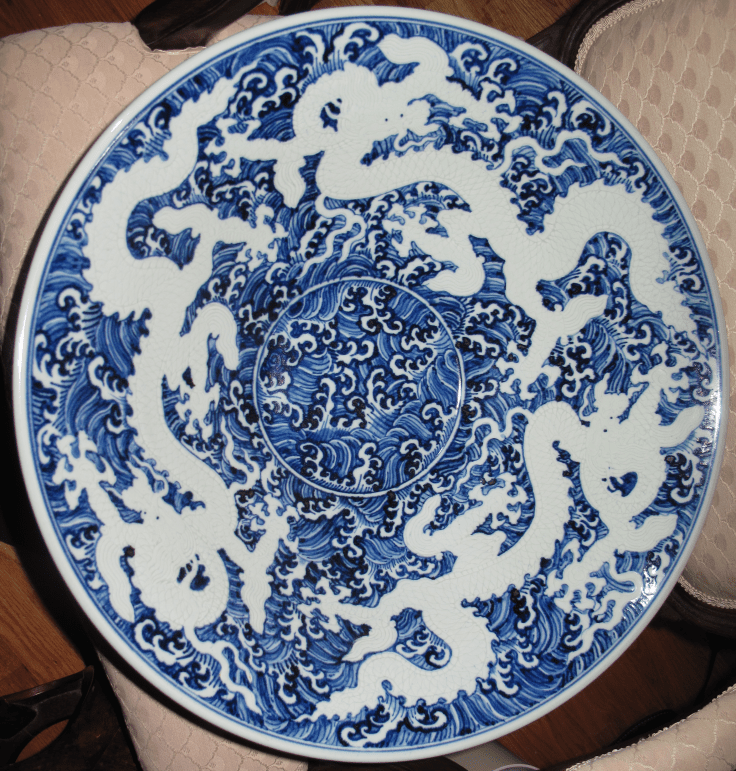 Figure 1
The rather uncommon feature of this large bowl is that the main theme, the three white
dragons, are carved out in a background of waves painted in blue and white. As is the tradition in those periods, the eyes of the dragons are also painted in small blue dots.
I label this bowl a Yongle because the characteristic features of the blue dye conforms perfectly to special features of the Sumali Blue dye of the Yongle period. Normally, if the dye pigment is of that period, the other features that are important in the classical way of evaluation will just fall into place. I do not doubt experts in Yongle B & Ws will dispute that this bowl is a Yongle. I am now going to show you these features.
I have told you that plaques are very important in late Yuan and Yongle periods, a little less so with Xuande wares. And many a time, the plaques in Yongle wares is a little different from those of Yuan and Xuande periods. So let me first show you the plaques in this large plate.
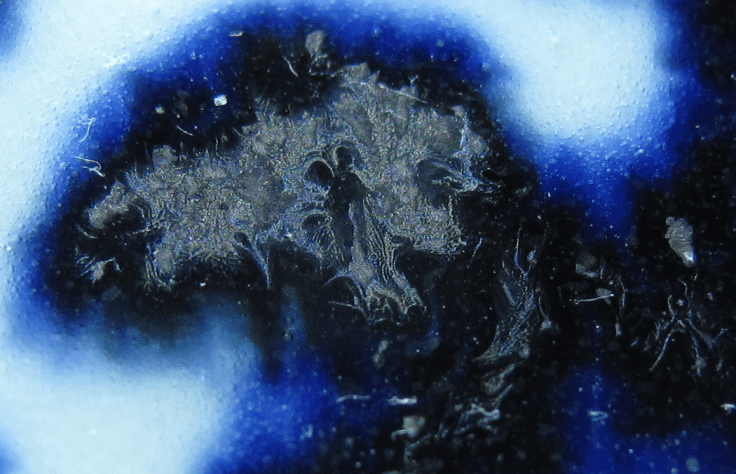 Figure 2
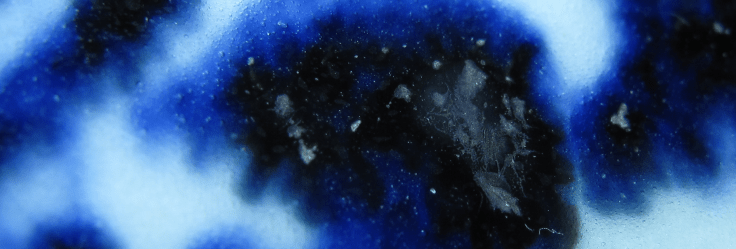 Figure 3
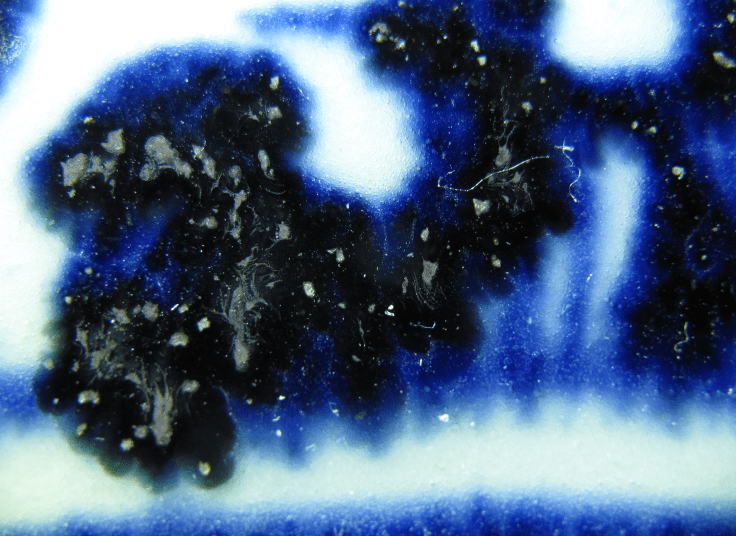 Figure 4
Look at these photos carefully (Figures 2, 3, and 4). Are the plaques not beautiful—both the shapes and the color? Note also the sizes of the plaques. That is why, I have often said that the variations in plaques are much more than the bubbles.
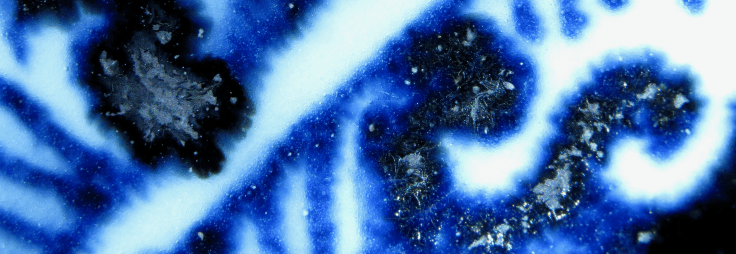 Figure 5
You will also note that plaques adjacent to each other can look quite different.
 Figure 6
Here in figure 6, aside from the plaque in the bottom, I want to show you the other features of the Sumali Blue dye. I’ll first talk to you about the bubbles. Please refer to both Figure 6 and Figure 7 at the same time, Figure 7 being an enlarged portion of Figure 6. You’ll note that the very dark part of the blue represents the majority of the blue area. If you look at Figure 7, you’ll note that there are many large bubbles, the majority lie in the dark blue shade. This is always the case. Whenever there are large bubbles lying within a small pool of rather deep blue color, if there is a very dark, almost black area nearby, inside that particular area, you always have a lot of large bubbles. The trouble is that the area is so very dark that you cannot see them, unless you shine a very bright light on that area.
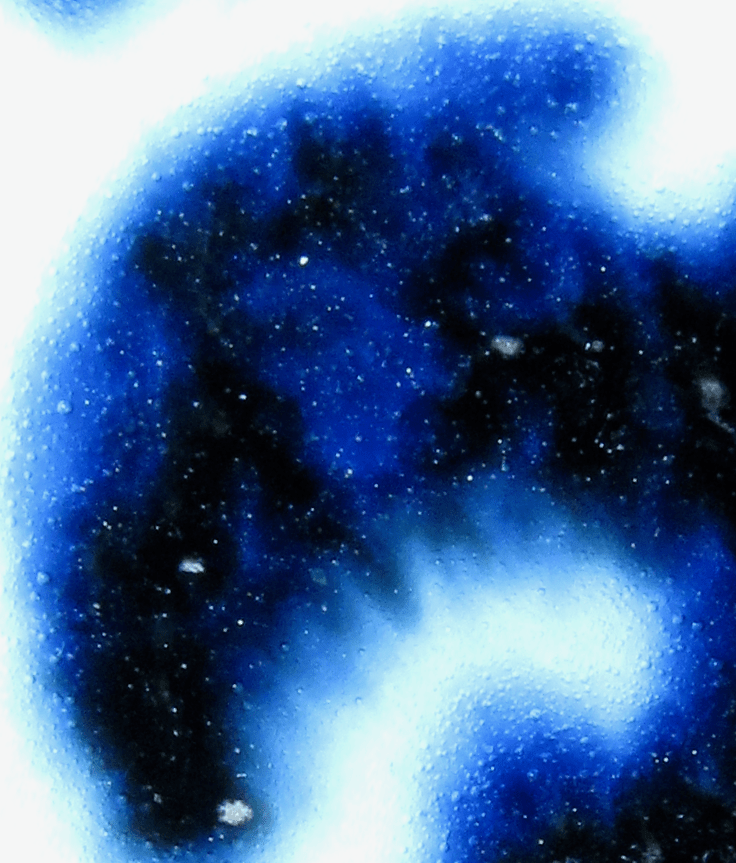 Figure 7
Also, in this photo, if I were to tell you that the bubbles are either large or small, I don’t think you’ll find that statement convincing. You need to understand that when people say that Yongle B &8 Ws only have large and small bubbles, it is only true in certain wares. the statement does not apply universally. You’ll also note that the small bubbles are not very closely packed. That is why, I keep saying that the variations in bubble presentation is quite significant and large in different wares. You need to remember that and get used to that. All that I can say here is that bubbles in these two photos are quite normal in Yongle B & W, quite within the acceptable range.
 Figure 8
To prove my point, I’ll show you another photo (Figure 8) that does not have much dark blue areas. You can easily see some large bubbles in a small pool of blue. The large bubbles, you must note, is semi-transparent, not completely opaque, but semi-opaque. This is quite characteristic of Sumali Blue dye. Look at the small bubbles again, and carefully. they are not tiny, not very closely packed. You may also note another feature here. There are small numbers of bubbles, 10 or so in a group, that, together, sort of map out an empty space, sometimes an incompletely enclosed space. Such spaces are everywhere. I call these spaces lacunae. Lacunae are found in almost any blue and white, but if the dye pigment is not Sumali Blue, you do not see many of them. If you see many many lacunae, far more than in here, it is definitely Sumali Blue dye. Here, the number is large enough to be consistent with Sumali Blue dye. Taken with other special features, you can be sure you are dealing with this special dye.
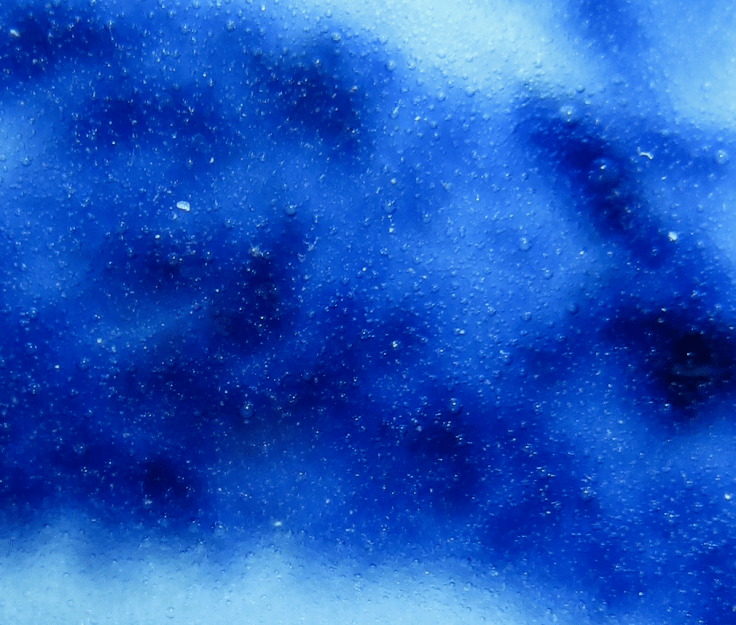 Figure 9
Here is another photo showing you another aspect of bubbles in Yongle B & W. Note the size of the bubbles, note that the large bubbles are semi-opaque and sitting in a pool of darker blue. The small bubbles are far from tightly packed, so that the lacunae are not well formed. But one thing I have not told you is that in here, you can see a phenomenon where two or three bubbles seem to link together, with a bond that can actually be seen. With the presence of these, again you are dealing with something beautiful, and that the ware is genuine.
Let us now deal with another special feature of the dye, dripping, which is well shown in Figures 8 and 9. Considering the fact that the dye is not very thick, the dripping is quite significant. You’ll also note that the dripping here is not too faint, and is seen clearly.

Figure 10
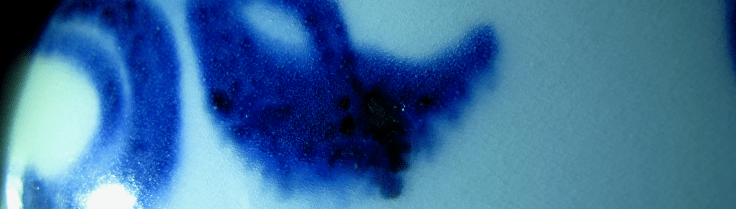
In figure 10 here, it shows clearly that the severity of the dripping is very much related to the thickness of the dye.
 Figure
Here in Figure 11, it is just another example. I would advise you that in all these photos, it is best if you can pay attention to every aspect of the dye features, just to get conversant with them.
 Figure 12
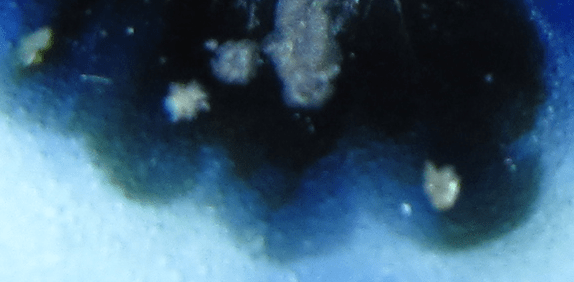
Figure 13
There is another point that I want to make about flare and dripping of thick dyes (Figures 12 and 13). Note that at the margin, the lowest part of the dripping, there is a faint greenish hue. This appearance not only indicates that the dye is Sumali Blue dye, but that the dye is of good quality.
With all these special features that are consistent with the Sumali Blue dye, there is no doubt that the ware belongs to either the Yuan or early Ming period. But the bubbles and plaques are not those of Yuan’s, so the ware is either Yongle and Xuande. And in the literature, critics have often said that it is difficult to tell if a ware is a Yongle or a Xuande, and most people agree with that. But here, the very sharp edge plaques, and very many of them, make it more like that it is a Yongle rather than a Xuande.
Finally, I must not forget the white carved dragon. Figure 14 shows what it is like.
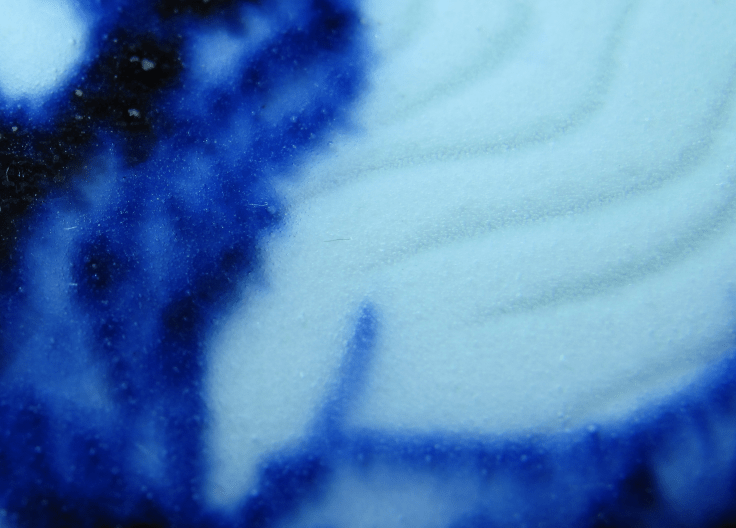 Figure 14
Note that there are a lot more bubbles over the carved out groove. It should be noted that this kind of B & W with the motif being carved out in a white glaze is rather uncommon, if not rare.
 yongleandxuande.com
Leave a comment