
Let me, right from the start, show you a most beautiful Yongle Blue and White charger (Figure 1). I don’t want to say that it is the best B & W of Yongle, but it certainly is the best that I have ever seen. It measures 40 cm in diameter. The motif is beautifully drawn. We have seen similar motifs before, but are they as elegantly drawn? You’ll have to decide for yourself. But the most eye-catching feature is the color. It is the classical sapphire blue, a color that makes you think that it is made from sapphire itself.
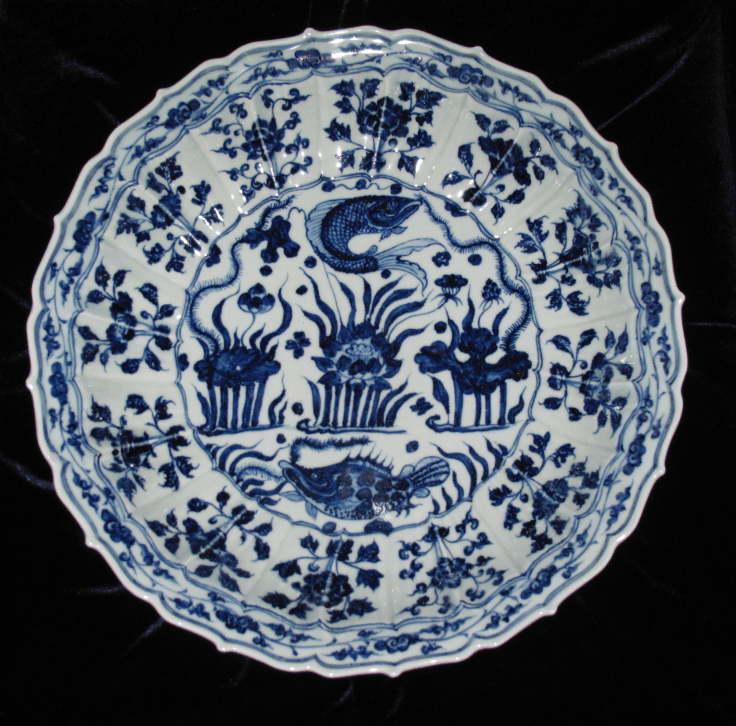 Figure 1
Now, one may say, no matter how beautiful you may want to describe it, and you can go on and on with that for pages and pages, how does one know that it is genuine and of the Yongle period. To me, this is the most sensible and logical question to ask. What are the good reasons to say that it is a Yongle B & W? Here, I don’t want to follow the traditional way to evaluate it—by its shape, its style, its painting, the motif, the color and so on and so forth. I just want to tell you that it is a Yongle because the features and characteristics associated with the dye pigment and the blue color are Yongle.
The Sumali Blue dye pigment that was imported to China spanned from the late Yuan period to at around the end of Xuande, a total of half a century or so. But we must not assume that the Sumali Blue dye pigment has very good quality throughout all those years, and that the composition of the dye constant, and the ingredients the same. This is very far from the truth, as the presentation of the blue dye shows. I would imagine that the import of the dye is in batches. When a batch was about to finish, the potters imported another batch. We have no idea who the suppliers are, nor where they live. But more than 600 years ago, the world was technologically very primitive, we cannot expect too much from the suppliers. It is only natural that the product they exported varies, and varies over a rather wide range of quality. It follows that when we examine the special features of the blue dye of these periods, they also showed significant differences. Any collector of ceramics of those periods will understand this.
Here, I will show you these specific features and tell you why the charger is a Yongle, without even telling you the traditional way of evaluating such a ware.
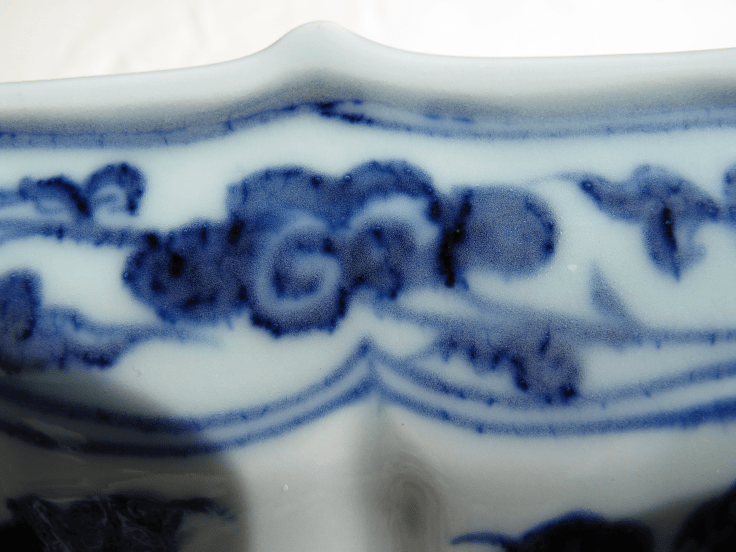 Figure 2
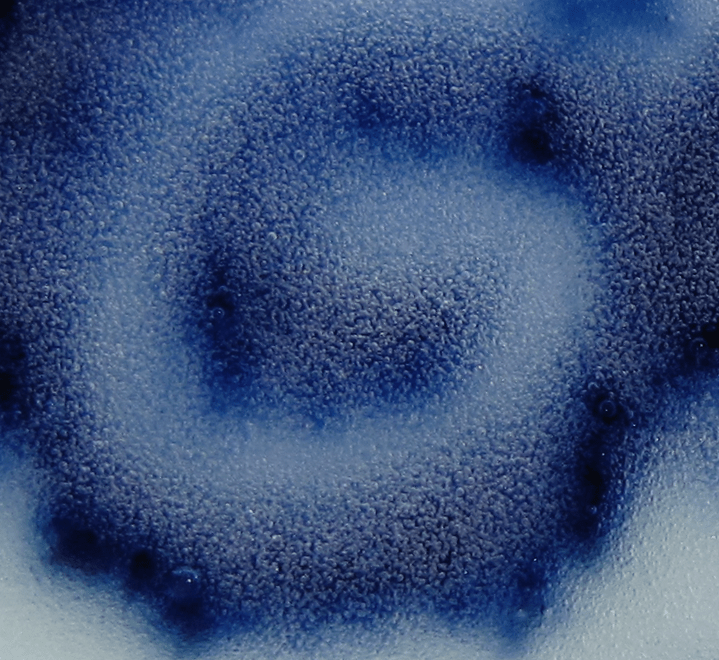 Figure 3
Bubbles are one of the most important feature of the Sumali Blue dye. We always look at the bubbles first. Beautiful bubbles are a pleasure to look at. Some appearances of the bubbles are unique to the Yongle period, as shown in here. Critics in the old days did mention about bubbles of Yongle wares. One characteristic is about the size of the bubble. They have only large and small bubbles, critics used to say. For a beginner, they do not understand why there are no medium size bubbles in between. With only writing that is not supplemented by illustrations, reader might get confused, and doubt if there is something wrong somewhere. But there you are, as shown in these two photos, figure 3 being an enlargement of part of Figure 2, the bubbles are either large or small. The large bubbles many times the size of a small bubble, while the number of small bubbles are many, many times more than the large ones.

Figure 4
Figure 4 is just another photo showing you the relayive sizes of the large and small bubbles. You will also note that the small bubbles are tightly packed, and they seem to be rising in that
rather thin layer of glaze, trying to get to the surface. This is not shown very well here because the enlargement of the photo is still not enough. But in the future, I definitely will show you this feature in some other photos.
You will also note that most large bubbles are sitting in a small pool of dark blue dye. Some of these dark blue areas are without any bubbles, though many a time, a large number of large bubbles would cluster in such blue pools, but will not be seen clearly because of the deep blue color. Please also take note of the varied appearances of the large bubbles. Typically, they are not transparent, but rather semi-transparent, as shown here.
The deep blue coloration is note-worthy too. This is about the best blue color that one can see in a B & W. Even in Yongle wares, you rarely see this beautiful blue.
But, don’t ever imagine that small bubbles always out number the large ones, in that relative ratio, as in the photos that I just showed you. The relative number, the distribution of these bubbles vary immensely, as Figure 5 and Figure 6 will tell.
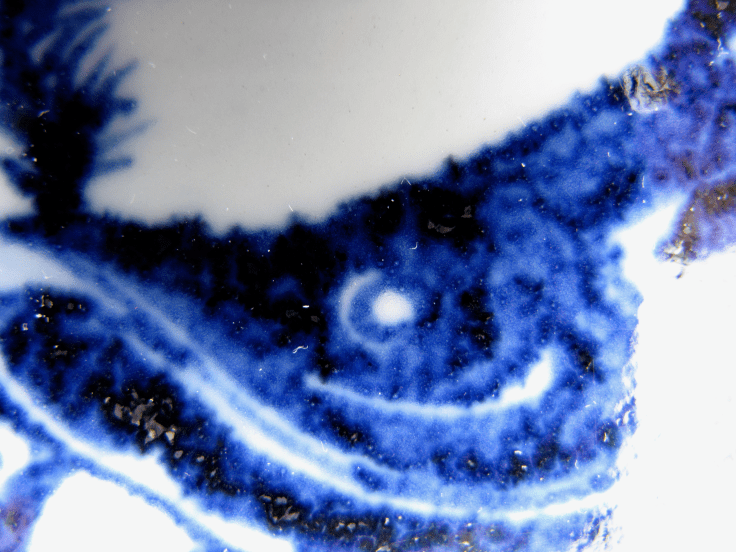
Figure 5
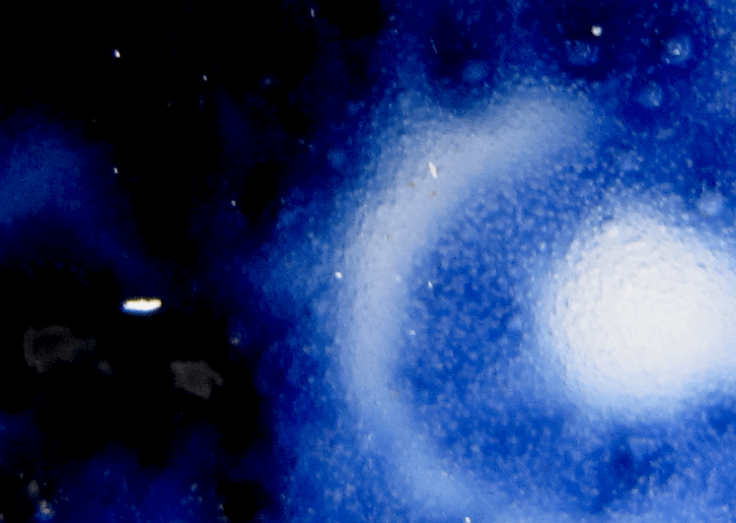 Figure 6
In Figure 5, aside from the bubbles, there are a few special features of the Sumali Blue dye that I want to draw your attention. Look at the plaques that lie along the longish patch of blue. I call them plaques, but in books, they are called heap and pile effect, or if you want to translate directly from Chinese, these are called rusty iron marks. Whatever you may want to call them, they are constant features in Yongle B & Ws. In Yuan ware, many a time, there are plentiful of plaques. I’ll show you when we come to the Yuan wares. In Xuande B & Ws, this feature varies quite a bit, from a lot to the almost complete absence of these plaques. Then, look at the upper margin of the head of the fish. Note the very uneven and rugged edge. It is caused by the phenomenon we call flare, which is another noted property of the blue dye. It is quite similar to dropping a drop of ink onto rice paper, the paper on which Chinese painters paint their paintings. Finally, I want you to pay attention to the mottling in the light blue part of the photo. This mottling in fact is quite uncommon in Yongle wares, more common in Yuan wares, and much less so in Xuande B & Ws. My experience with this mottling effect in Yongle wares is that, its presence normally indicates the dye is of good quality, and the wares are extremely likely to be very nice ones. Mottling is not something deliberately done by the potters that drew the motif. It is a random deposition of blue dye pigments on the bluish background. It relates to the nature of the dye rather than any conscious effort by the potters.
Figure 6 shows you the relative number of the large and small bubbles. By contrast to previous photos, the relative number is much reduced.
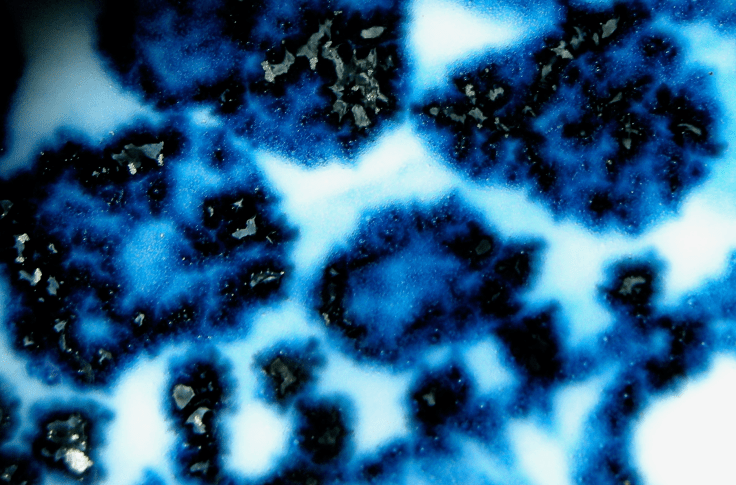
Figure 7
Figure 7 is another photo showing all the features that we have just described—the bubbles, the plaques, the flares and the mottling. It is worthwhile for collectors to get used to these features, and know them well by examining any wares that they can get hold of. The variation of these features, I say it once again, is limitless. At this stage, I must not forget to tell you that examination of these wares is best done under sunlight, and try to observe any differences in indirect sunlight.
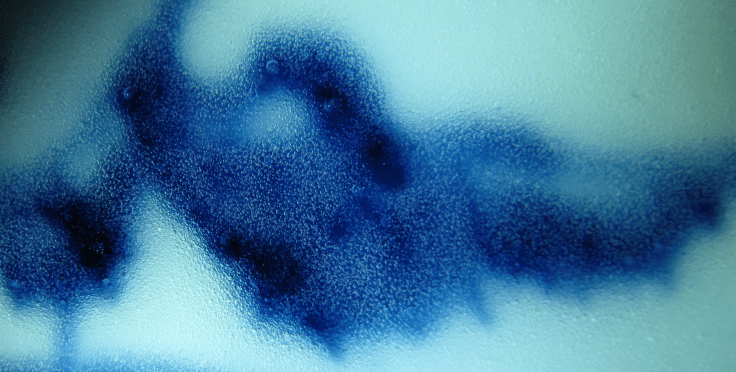 Figure 8
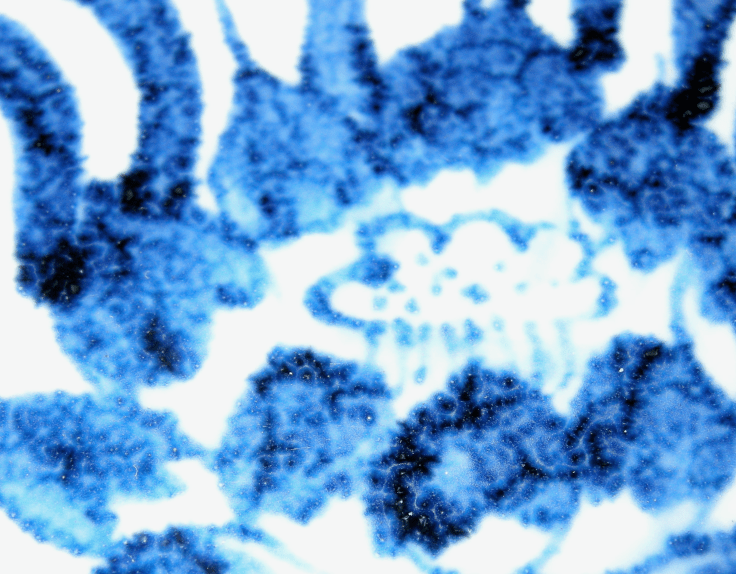 Figure 9
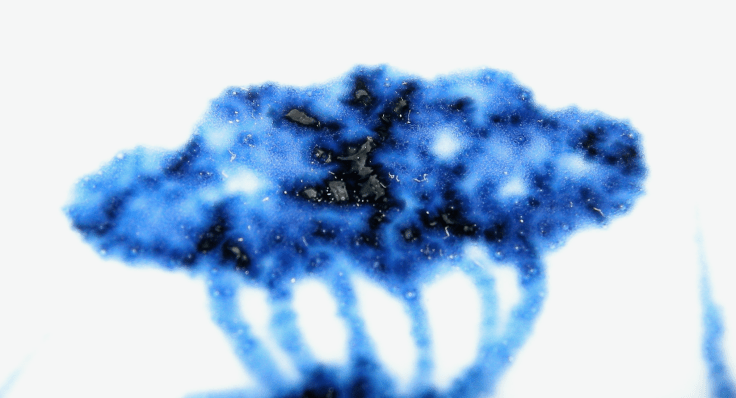 Figure 10
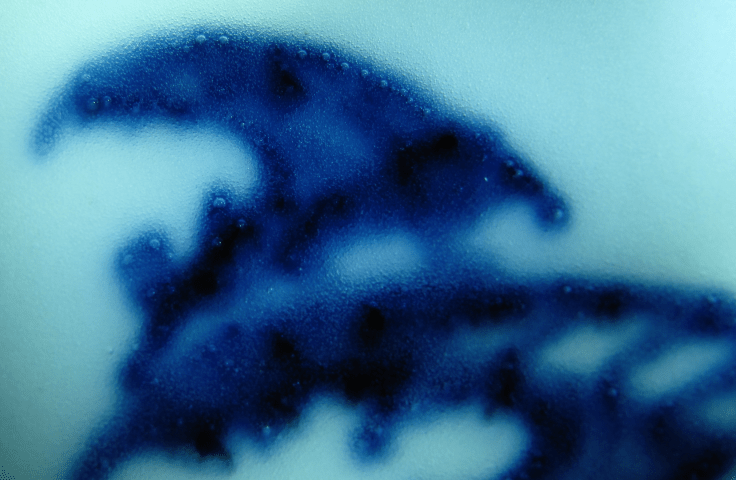
Figure 11
Like Figure 7, Figures 8, 9 and 10 are three more photos showing you the specific features of
the Sumali Blue Dye, just to let you get acquainted with their appearances. In Figure 11, on
the upper margin of the leaf, you can see quite a number of large bubbles
arranged in a manner as though they are strung up by a piece of string, a string of bubbles, I
call it. Not a common seen phenomenon, but its presence again normally indicates that the dye is very good, and the ware beautiful.
From these photos, you will note that the plaques show a lot of variations.This is also true with bubbles, as I have told you. But, I would say, the variations in plaques are much more than with bubbles. You should bear that in mind. Many a time, plaques in The Yongle period have features that are not shared by Xuande and late You B & Ws. They often have rather sharp contours, and a lot finer than plaques in the Yuan period.

Figure 12
 Figure 13
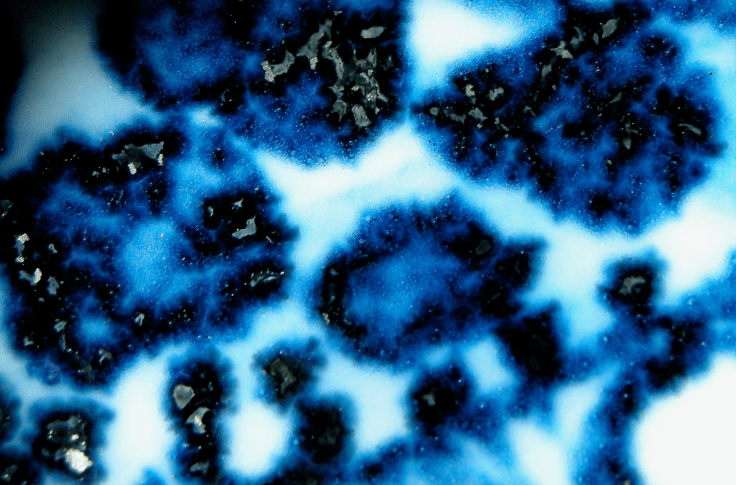 Figure 14
Figures 12, 13 and 14 illustrate my point of a sharp, jagged edge. In Xuande and Yuan wares, such edges are very rare.
Under the sun, the reflection of the plaques can be very colorful, as in Figure 15, and Figure 16 and Figure 17 on the following pages show.
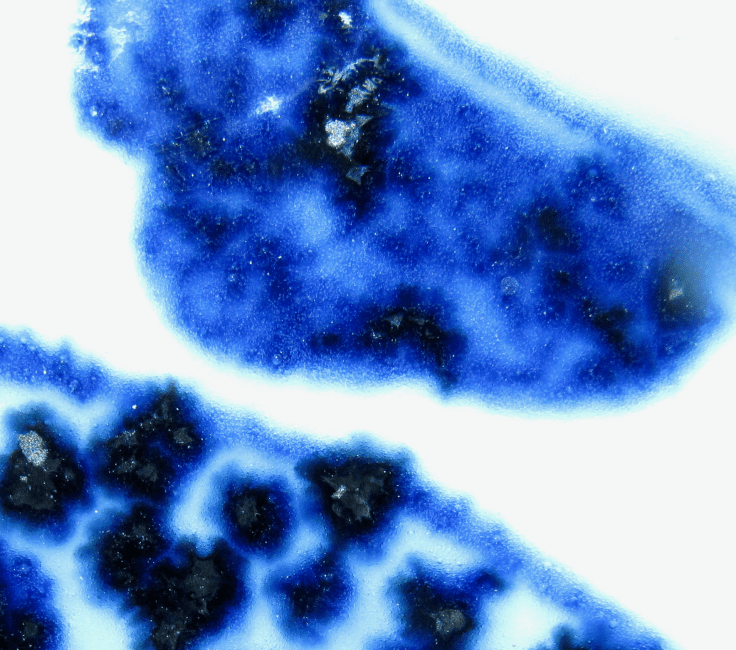 Figure 15
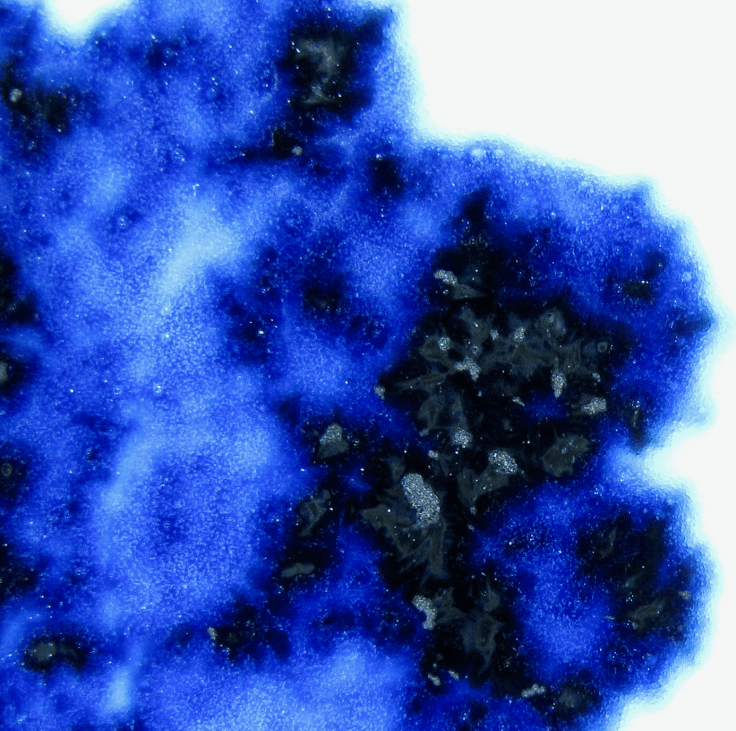 Figure 16
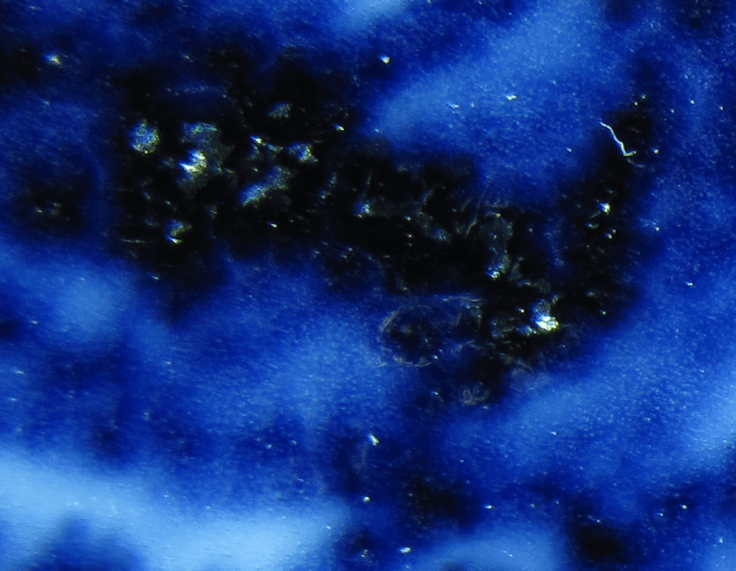 Figure 17
Now, All the features that I have shown you are on the flat surface of a plate. Some of these might change as the contour of the ceramic ware alters, as over and near a ribbed edge (Figure 18).
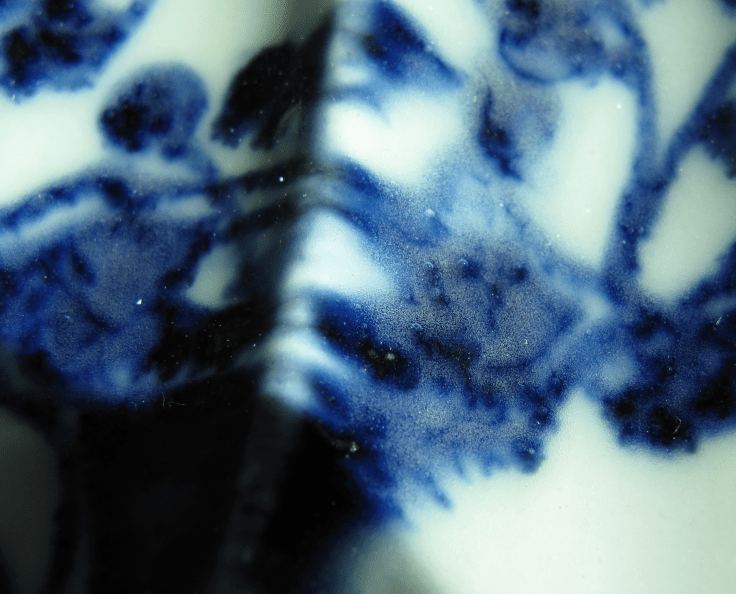 Figure 18
Right at the center, the rib extends from top to bottom. From its appearance, you know something about the dye that the potters used to draw the motif. The dye is, of course, a liquid. But in that liquid there is a lot of granules in suspensions—some are fine, others are of a more coarse nature. The two prominent features of the dye, the bubbles and the plaques, are both from the suspension granules. The fine granules would give rise to small bubbles. The coarse granules, which obviously have a different composition, give rise to the large bubbles and the lovely bluish hue. When the dye is painted over a rib, as in here shown, the suspended granules, obeying the law of gravity, all fall along the sloping edge of the rib, leaving very few bubbles, both large and small, on the top and the upper portion of sloping rib. In fact you never see large bubbles on the top of the ridge. At the base of the slope, where a lot of small granules accumulate, small bubbles are abundant.
From this observation alone, we can tell that the suppliers, when they exported their goods to China, tried to do a good job by removing as much coarse granules as possible, leaving only very few larger granules. And when I show you the plaques, which are from the coarse granules, of the Yuan wares, you know that the these coarse granules are far more abundant than in the Yongle period. This is, in fact, an indication of improvement of the manufacturing process, or, an improvement of technology, a term that we are now addicted to today, over that short period of perhaps around three to four decades.
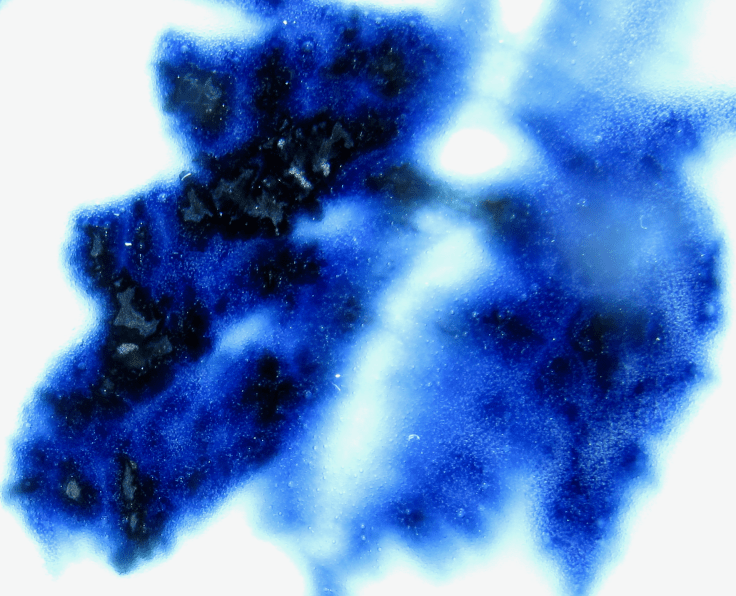 Figure 19
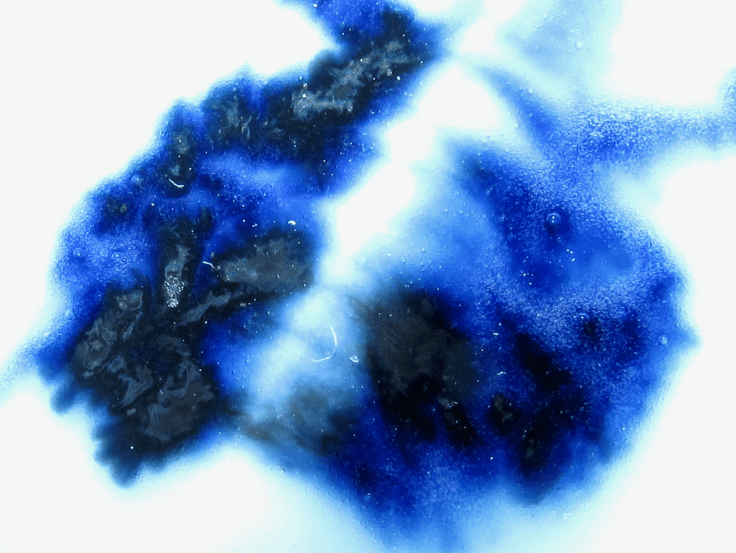 Figure 20
Both Figure 19 and Figure 20 are additional photos showing the effect that the rib has over the dye. But note that in Figure 20, at the lower left hand corner, the flare, which is at the base of the slope of the rib, is exaggerated. As I have said, these darker blue colorations are generated from granules suspended in the liquid dye, though we can be sure that the granules here must be very small. As such, they are subjected to gravitational force, and the flare extends for a longer distance than they would have been if the surface is flat. That is why, on the vertical portion of a ware, the flare turns to a dripping, as shown in the following photos (Figures 21, 22, 23 and 24).
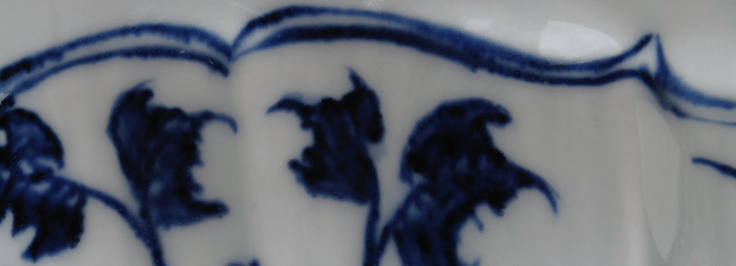 Figure 21
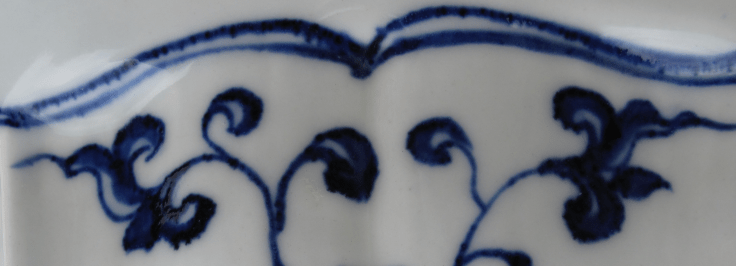 Figure 22
 Figure 23
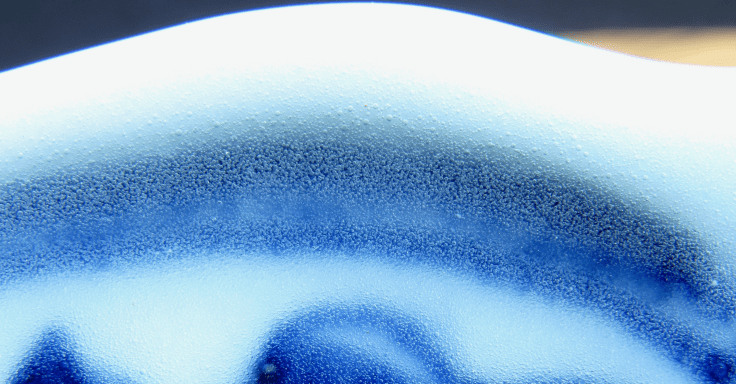
Figure 24
Look at the decorative lines here. The dripping varies. The gravitation force is equal, but the granules in the liquid dye is not evenly distributed. That is the only reason.
As you can see, I can go on showing you more photos of each and every aspect of the special features of the Sumali Blue dye. But I think you will learn more if I am going to show you other wares. Before I leave here, I just want you to understand that description of these features in very accurate terms is not possible by words, and that past critics had their reasons why they did not do that. They could only do that in broad strokes with nothing very specific. That is all that they can do. Modern technology has redeemed this, and most of the fine features of the dye can be recorded and shared by those who are interested in the topic. What is more important is that these specific features allow one to say if the ware is genuine and of the period.
 yongleandxuande.com
Leave a comment