Many ceramic collectors have heard of the Cup that presses against your palm. There are three of them. They are all in the Old Palace Museum in Peking. These are very well known cups because it is often said that these are the only three Yongle B & W that bear the mark ‘Yongle Nin Zhi”. No other B & W of the Yongle period bears the same mark. Any other similar cups bearing the mark are fakes, so are other B & W wares with such a mark. To me, these are nothing but myths and they always remind me of the old Chinese saying: For those who sit deep inside a well, and comment that the sky is small, it does not mean that the sky is really small, it only means that their views are very much limited.
But how many of you have seen anyone of the three cups? Even in the Internet, it is difficult to see the image of the cups, not to say an official photo of the cups from the Old Palace Museum. I am not sure if the three cups are on display there. I would presume not. Otherwise someone would have taken photos of them and post them on the web. These cups belong to a special category of the Museum’s collection ,and will not easily be shown to anyone. So, unless you are very well connected, the chances are you will never see them, not to say to hold them in your hands and look at them with a magnifying glass.
So, when it comes to encounter such a cup on a chanced occasion outside China, say in America, are you just going to dismiss it as a fake? Or can you tell that it is the real thing by looking carefully at the blue dye under a magnifying glass? I have explained in my introduction that many extremely precious artifacts, for a good many reasons, have drifted to America and ended up almost homeless. After several hundred years, in a land where almost nobody recognizes them, they are, instead of being put on a pedestal in a museum and be admired and adored, they are cast aside in an antique mall or some flea markets, mired there and worth close to nothing. I am sure a siblings of ‘the three cups that press against the palm’ would meet the same fate, unless it has the good fortune of meeting some very knowledgeable collectors.
Here is such a cup (Figure 1). It measures 9.2 cm in diameter at the mouth, and its height is 4.8 cm. The reason why I say it is genuine is by the special features of the Sumali Blue dye.
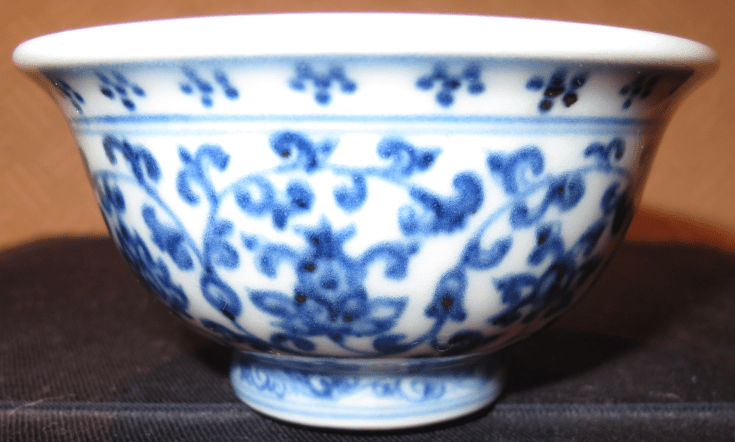 Figure 1
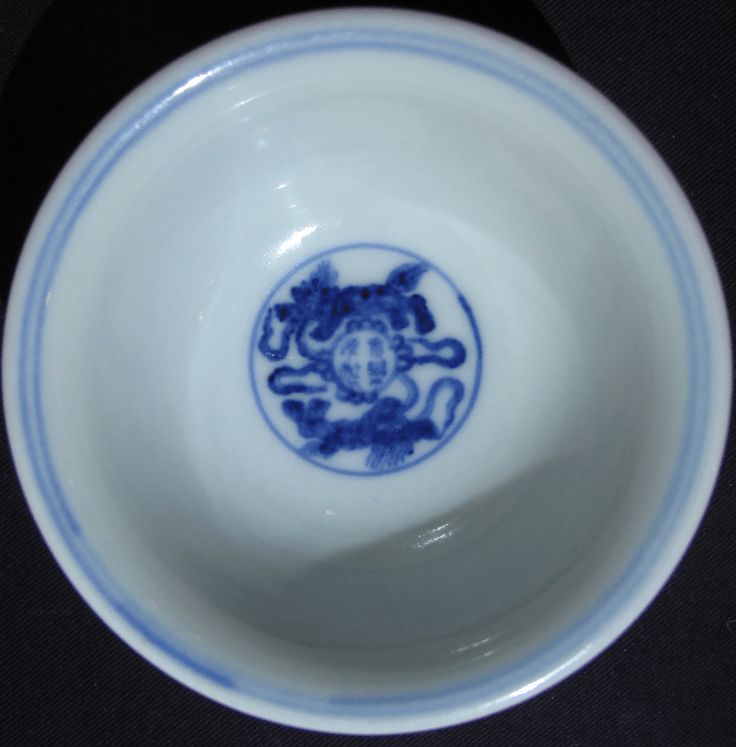 Figure 2
You can see that, inside the cup, at bottom and right at the center is a design with two lions playing with a ball of silk thread. Inside that ball is the mark that says ‘Yongle Nin Zhi’. Now, according to literature, these cups, when they were made, had three different designs—two lions, two mandarin ducks and a flower. The two-lion design is the one that is preferred. So here we are, a cup with the preferred design. How do we know that it is not a reproduction?
The very fact that very few people have actually seen the real cup, and that would include most experts, it is futile to turn to an expert and ask their opinion. How do they tell? The only way for you to tell is from the dye.
Let us first look at the design at the center of the bottom (Figures 3, 4, 5, 6 and 7).
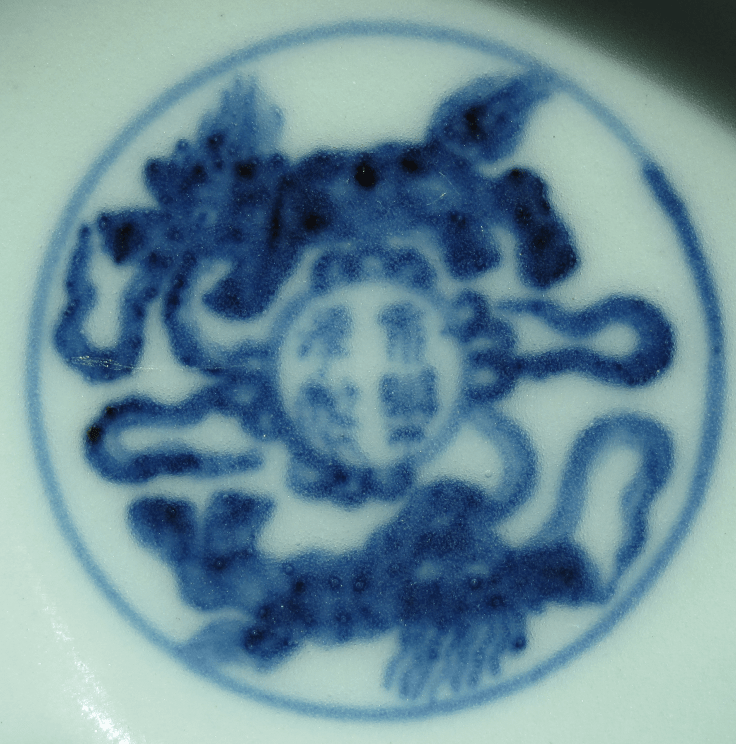 Figure 3
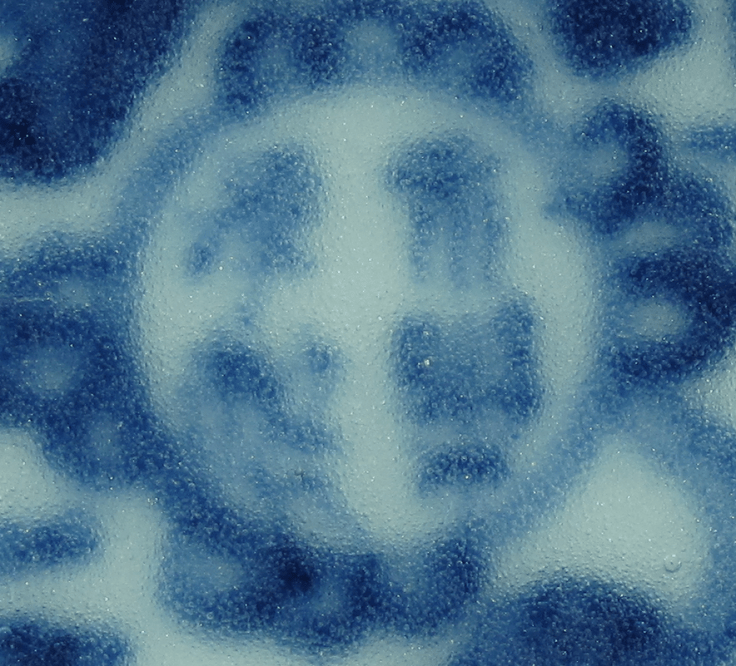 Figure 4
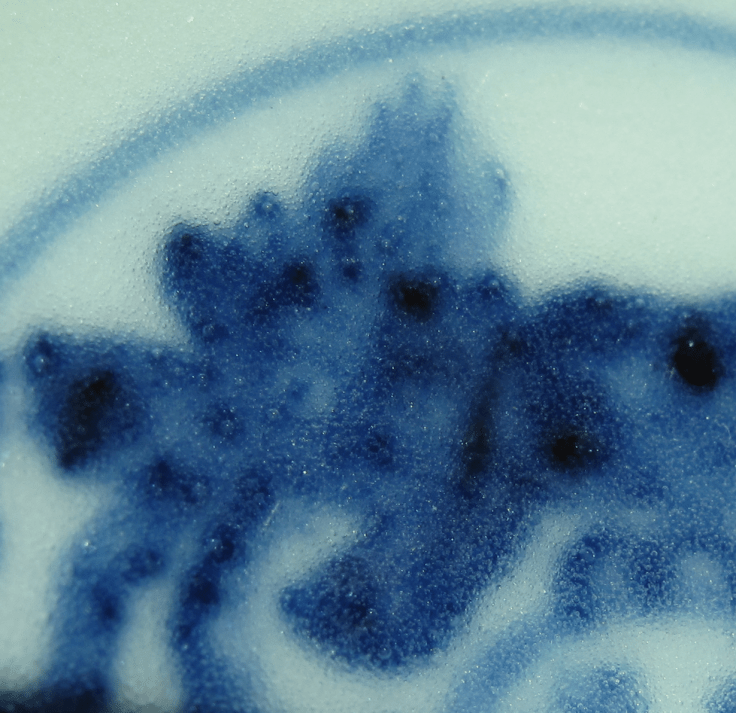 Figure 5
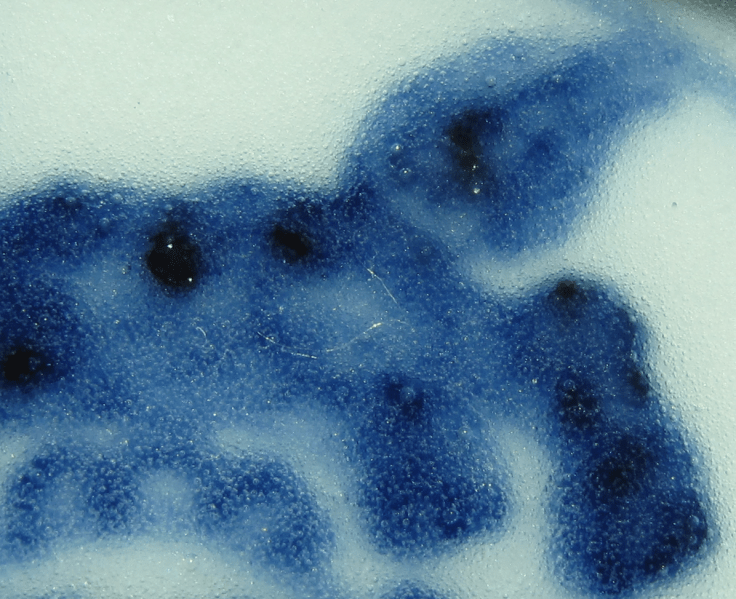 Figure 6
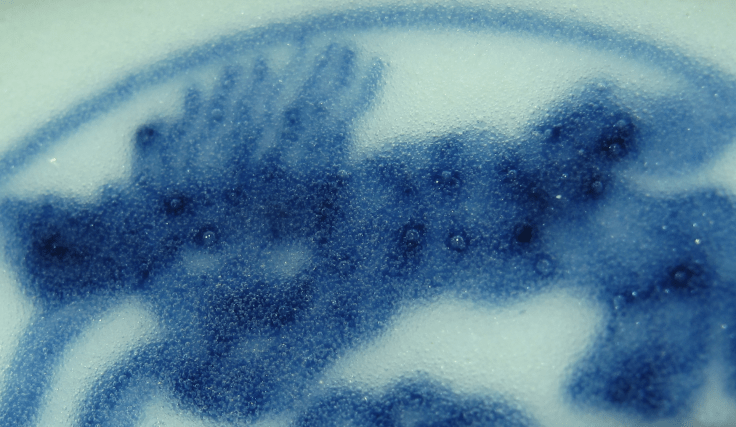 Figure 7
Let us first look at the bubbles. Here is the typical pattern of large and small bubbles of Yongle. Most of the large bubbles are sitting in a rather small pool of darker blue color. You can also see the lacunae everywhere. What about the plaques? You do not actually see plaques here in this small design except on the right hand side of Figure 5 where there is the indication that there is a rudimentary plaque. This is not unusual. In some Yongle B & W, plaques are not abundant. Note also the large bubbles, they are semi-opaque in appearance.
About the design itself. Considering the fact that the four characters ‘Yongle Nin Zhi’ are written within a circle the diameter of which is perhaps less than 8 mm, they are very clearly written. The design is perhaps drawn within a circle of 3 cm in diameter, but it is so beautiful that the potter who drew it has to be a great artist. No wonder the critics put this design as their first preference.
Now, let us come to the cup itself. Today’s critics, in commenting on a ceramic ware, pay a lot of attention to the motif and the way it is drawn. Many wares are dismissed just because the motif is not right, and the drawing too stiff, and not professional enough. When they decide that the ware is right, the drawing is always good, outstanding. But we understand that the impression on the drawing is subjective, whether it is good or bad depends entirely on the state of mind of the one who is making the comment. To me the motif does not count too much. But I’ll make an exception here. I think the motif is beautifully drawn here, the strokes natural and smooth. There is little doubt that it is drawn by a master. Still, I do not want to make a claim that the cup is genuine because of the drawing, rather, I’ll stick to the blue dye itself.
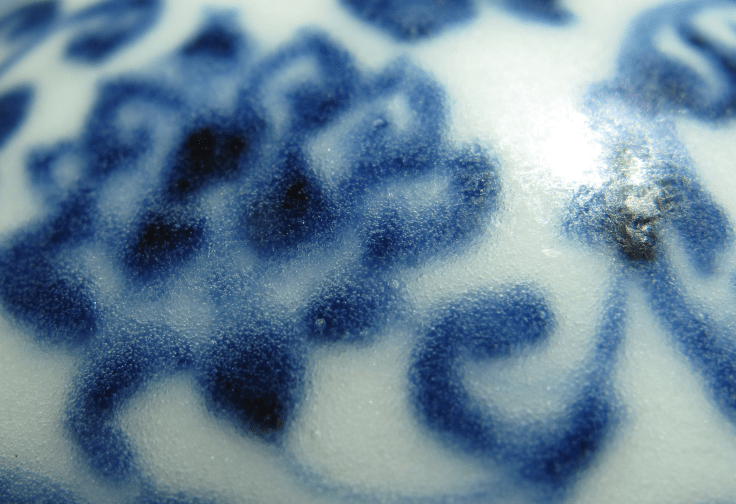 Figure 8
This photo shows a plaque in its formation in the tip of the petal on the lower part of the flower, while on the right is a few plaques with colorful reflections under the sun. Note also the bubbles and the lacunae, all consistent with those of a Yongle B & W.
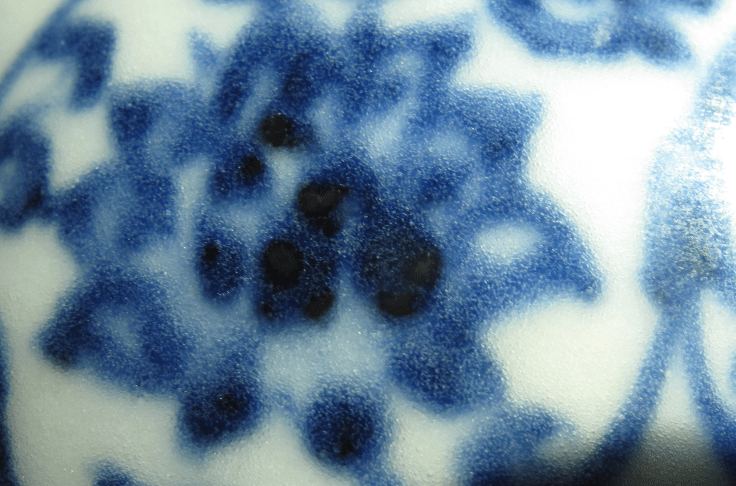 Figure 9
Figure 9 is another photo showing the same features. Note the plaques in the very dark blue areas and some faint drippling on the lower margin of those dark areas.
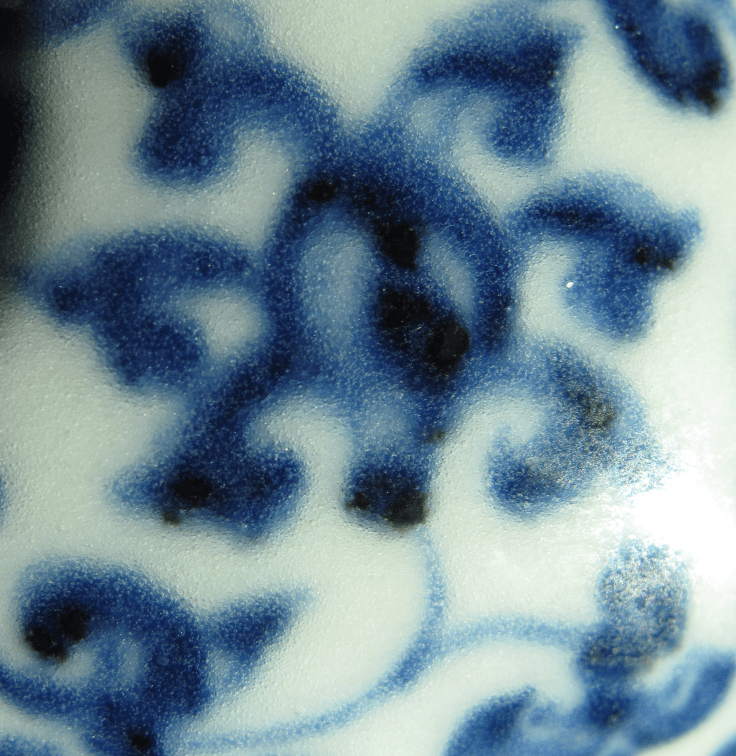 Figure 10
Here in Figure 10 the flare and dripping are more obvious. Please also note other special features of the Sumali Blue dye.
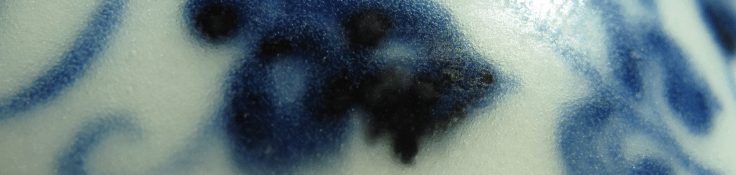 Figure 11
Here in Figure 11, a better view off the flare and dripping effect.
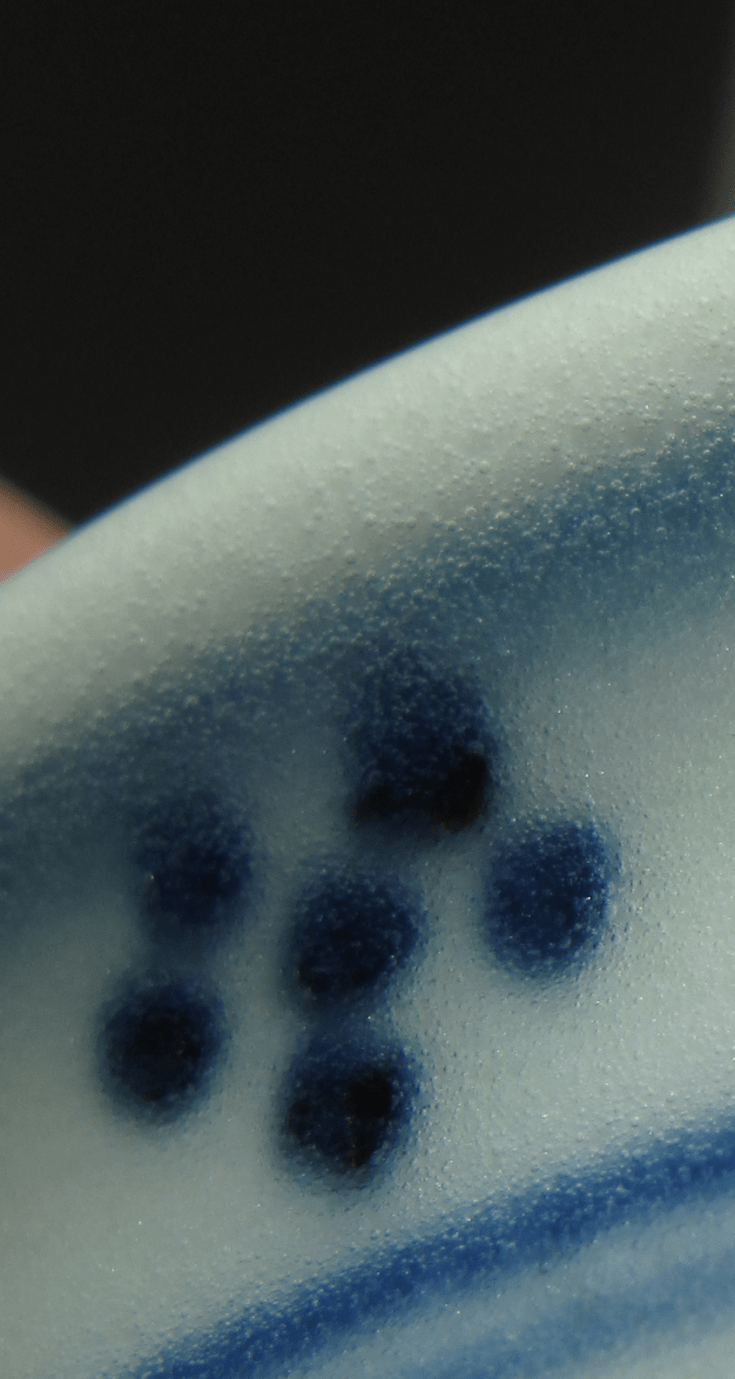 Figure 12
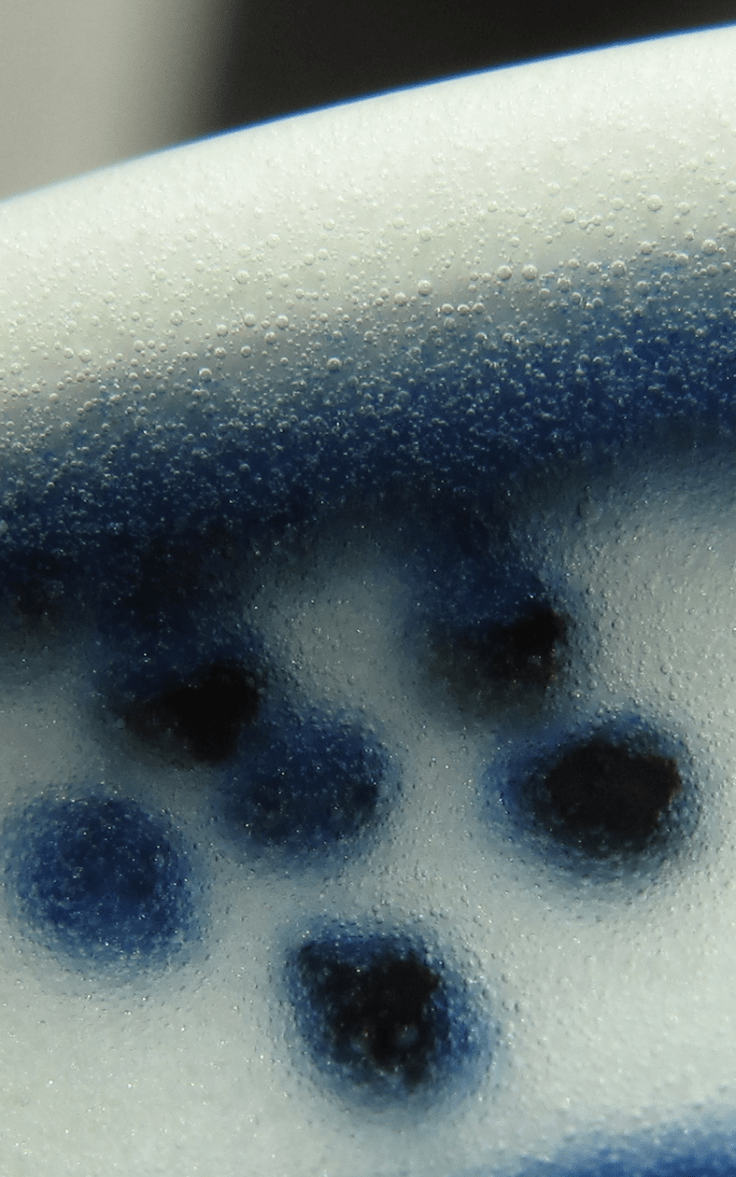 Figure 13
You may wonder what the dye looks like at around the mouth and the foot rim. At the mouth here, every six dots—one at the center and five around it, represent a flower. Pay attention to the bubbles and plaques. Also the decorative blue line at the top is also very telling. In Figure 12, part of the line seems to fade away at some area. It is one feature of the Sumali Blue dye. The fading is alleged to the washing away (bleaching effect) of some dye pigment by the glaze. In Figure 13, the dark color is exaggerated at the bottom because of the dripping effect.
In Figures 14 and 15, I am going to show you how the foot rim looks like.
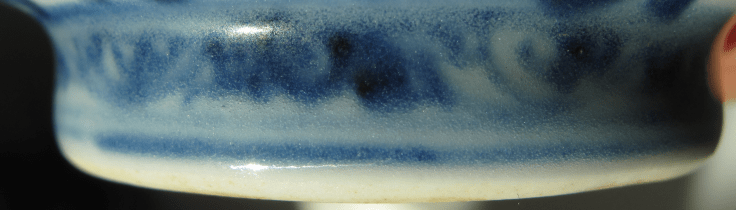 Figure 14
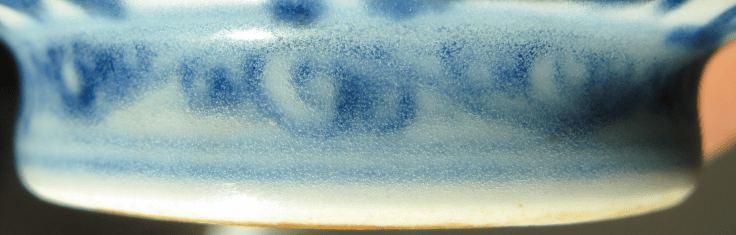 Figure 15
Pay attention to where the foot rim joins with the cup proper. There, the glaze is always thicker than elsewhere. On enlarging the photo, you can easily see the phenomenon of bubbles trying to get out to the surface. This, you’ll remember, is a feature of the Sumali Blue dye.
Look at these photos carefully, every single feature the dye here shows that it is consistent with the Sumali Blue dye. You may get a cup liked this in a flea market, or in a garage sale. That does not matter, that does not diminish the value of the ware. It is still a genuine Yongle cup—the cup that presses against your palm. It is a cup that is treasured very much in the Old Palace Museum in Peking, and it is a cup that is renowned to ceramic collectors of the Yongle period all over the world.
 yongleandxuande.com