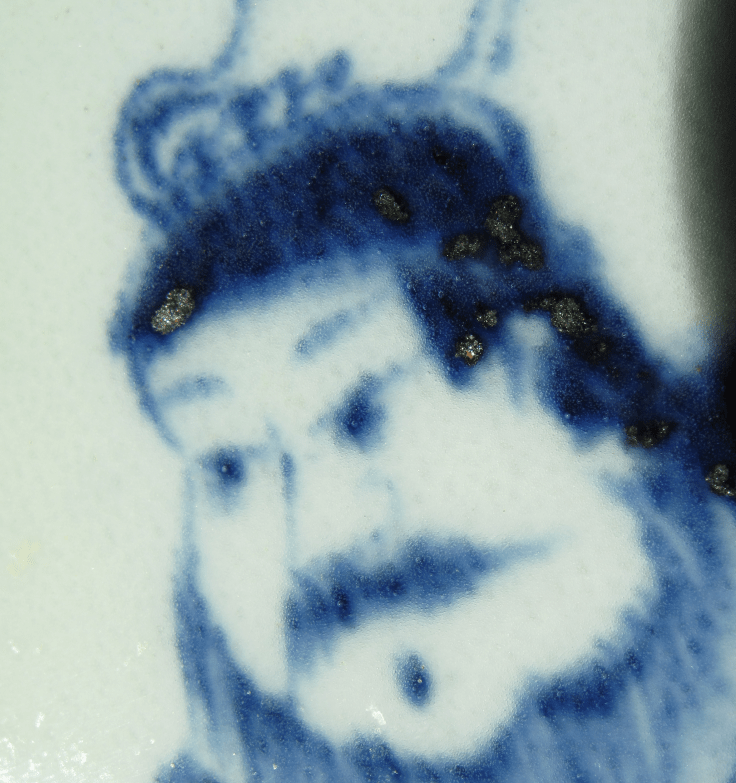
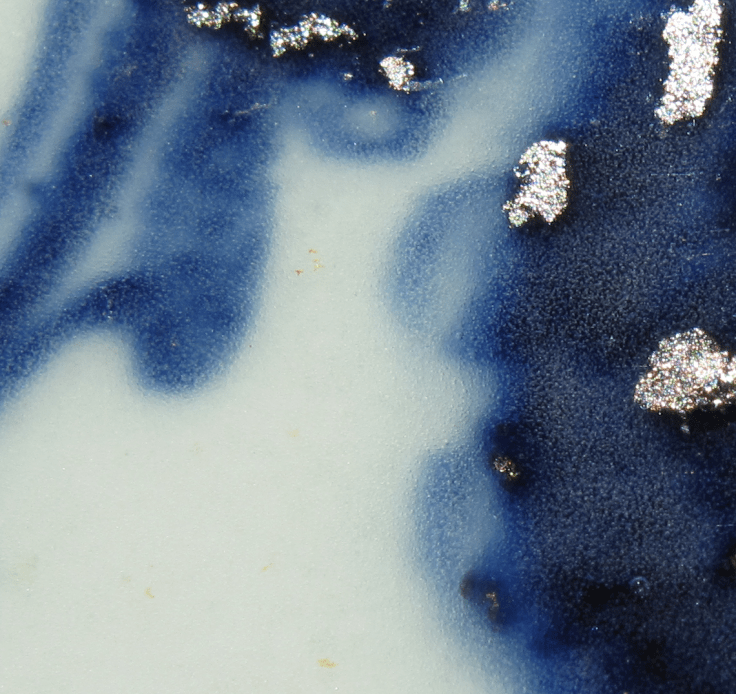
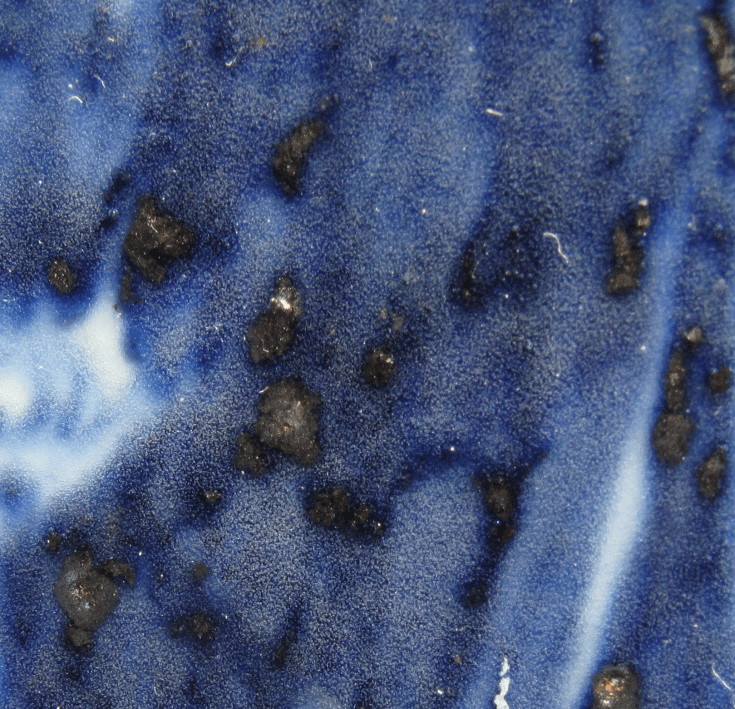
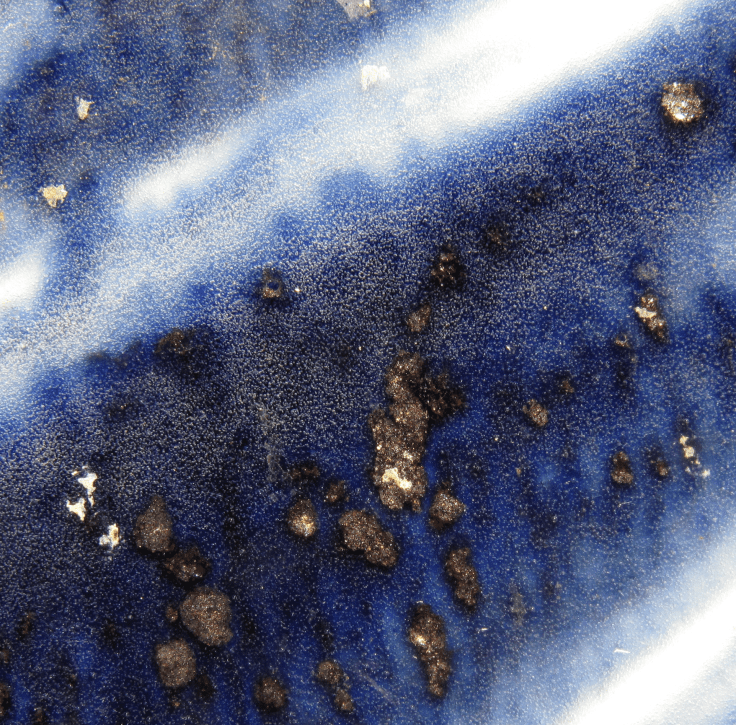
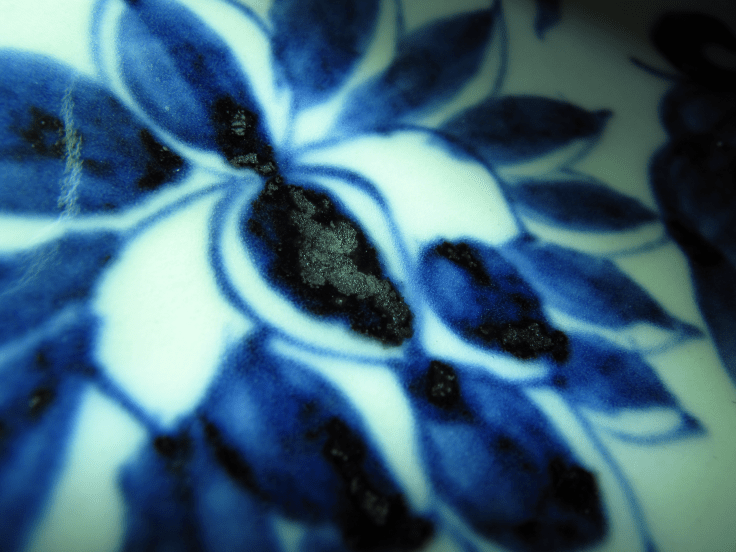
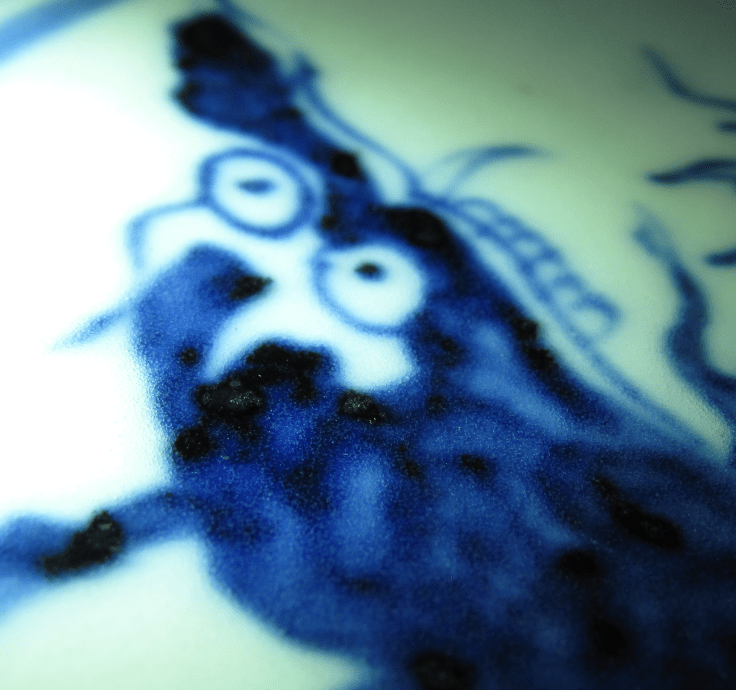
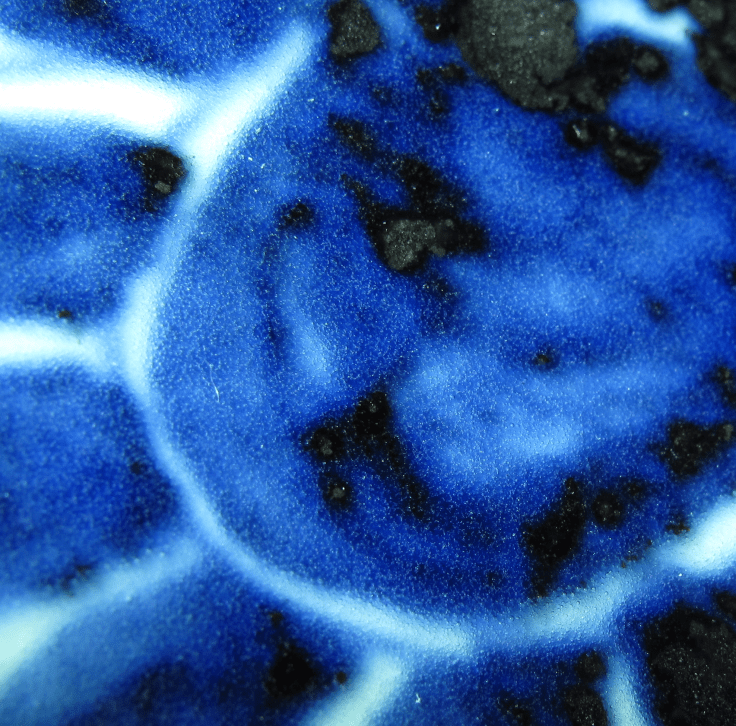
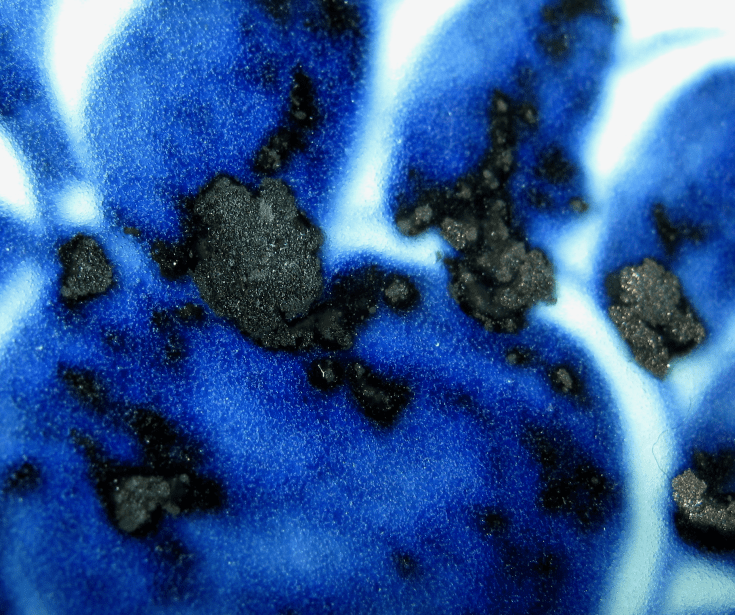
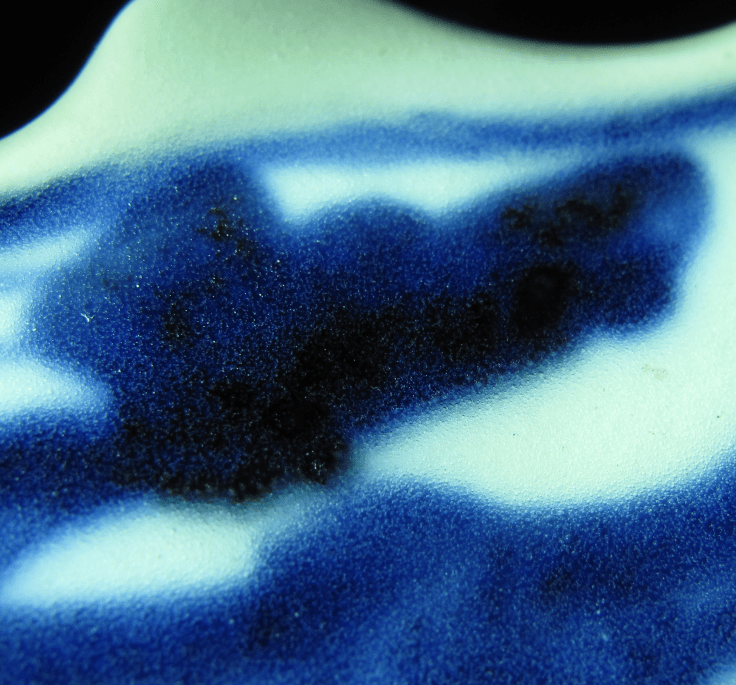
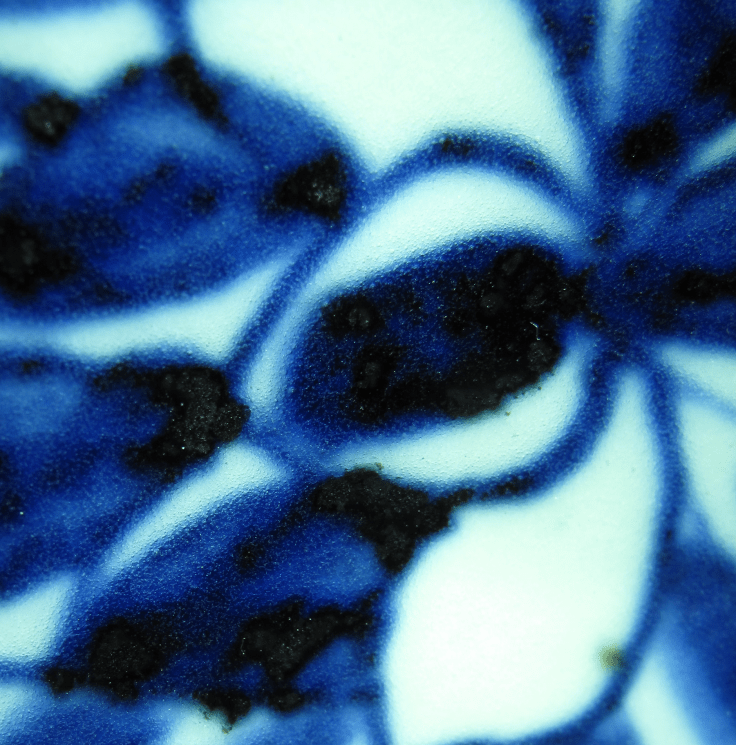
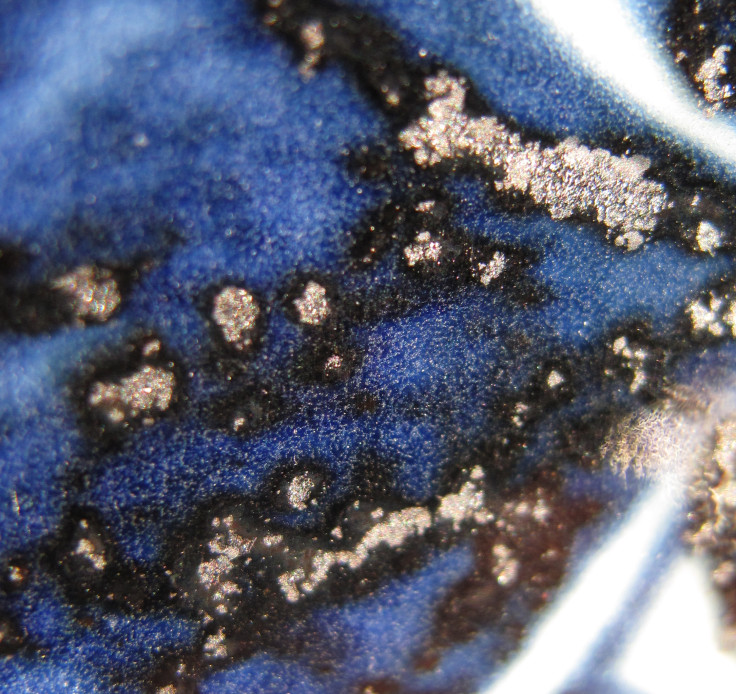
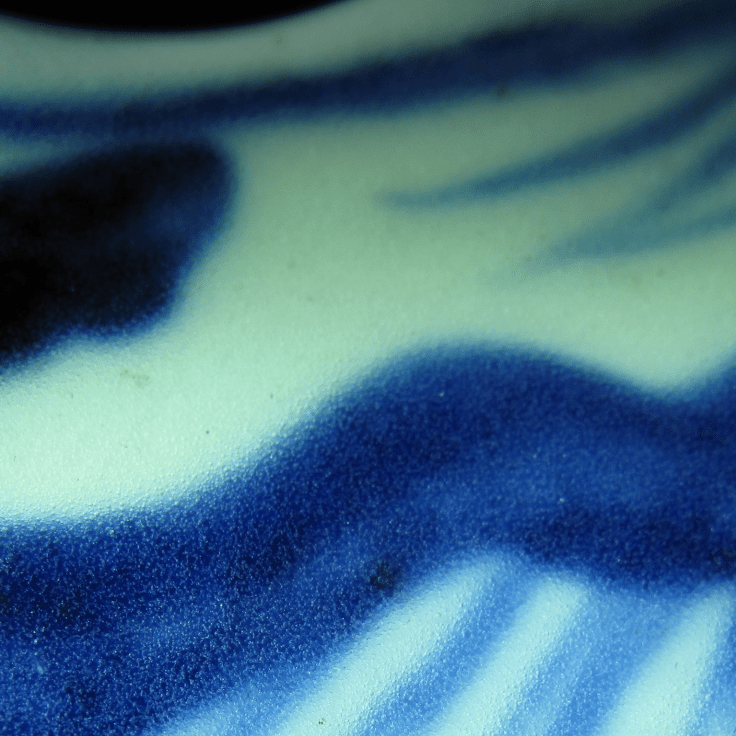
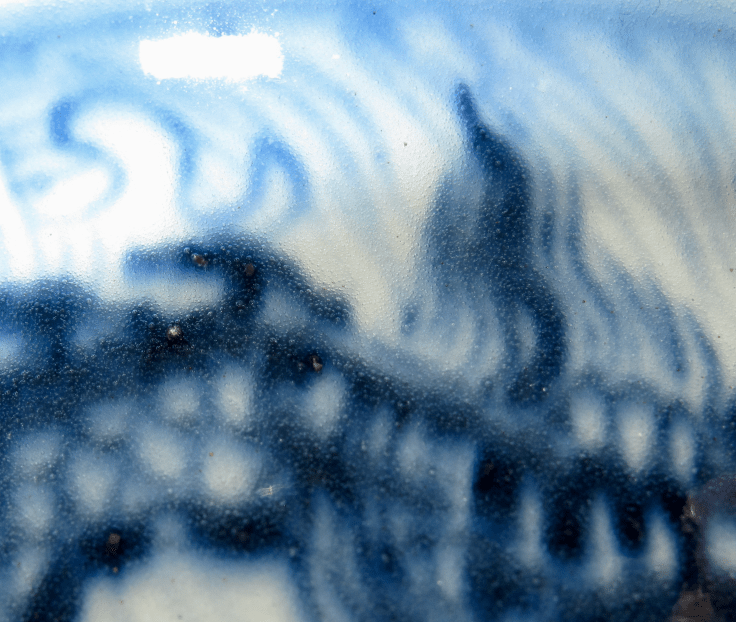
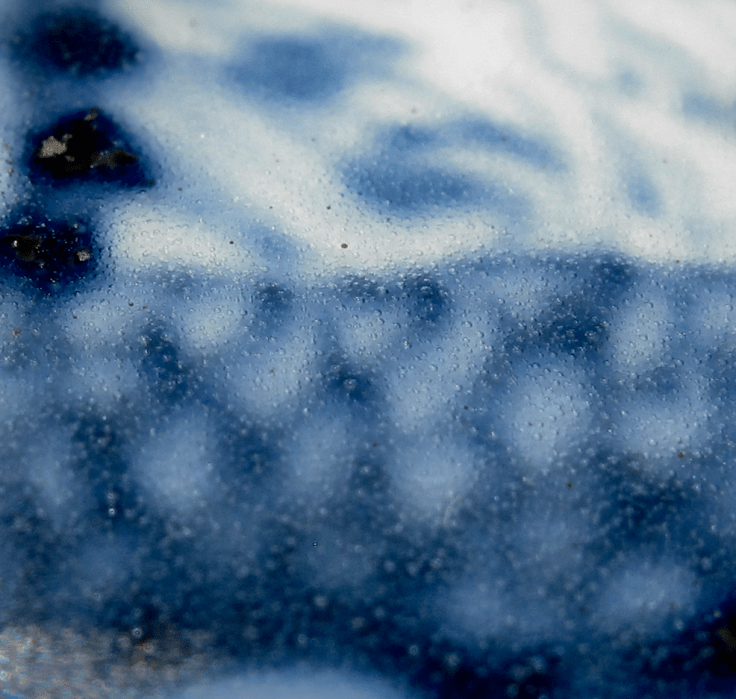
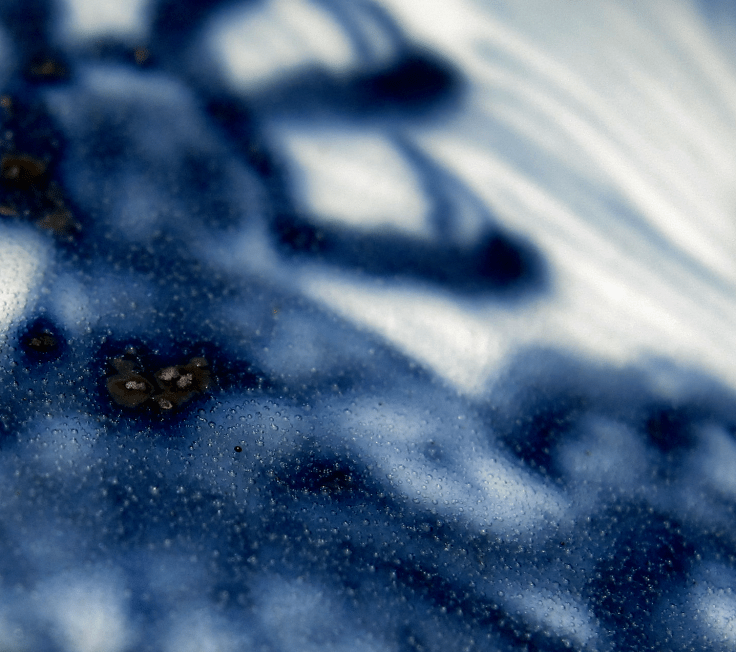
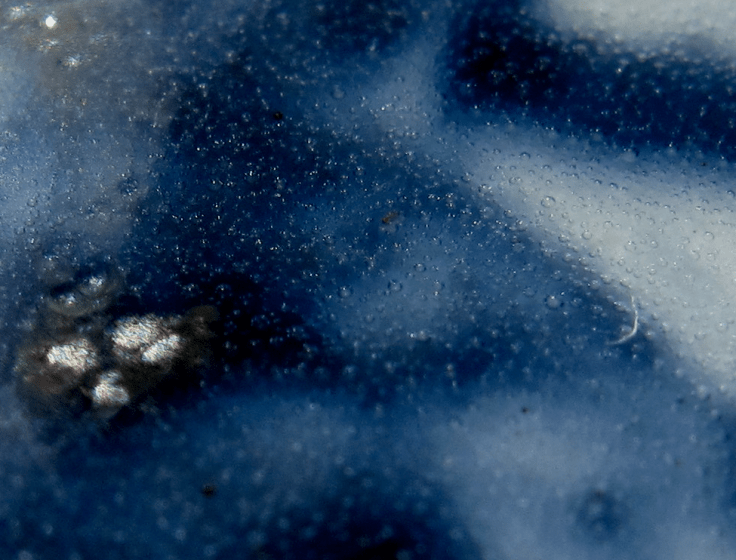
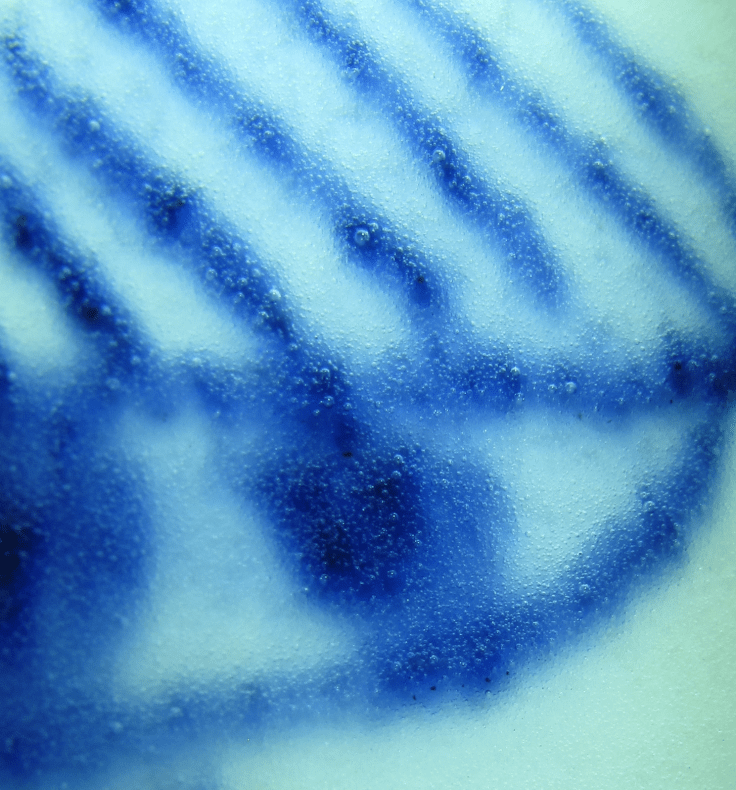
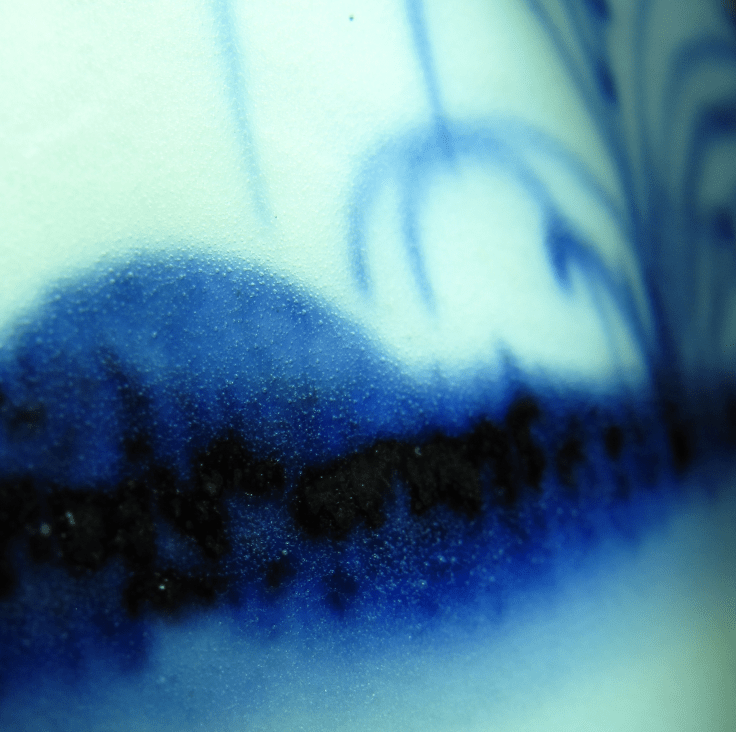
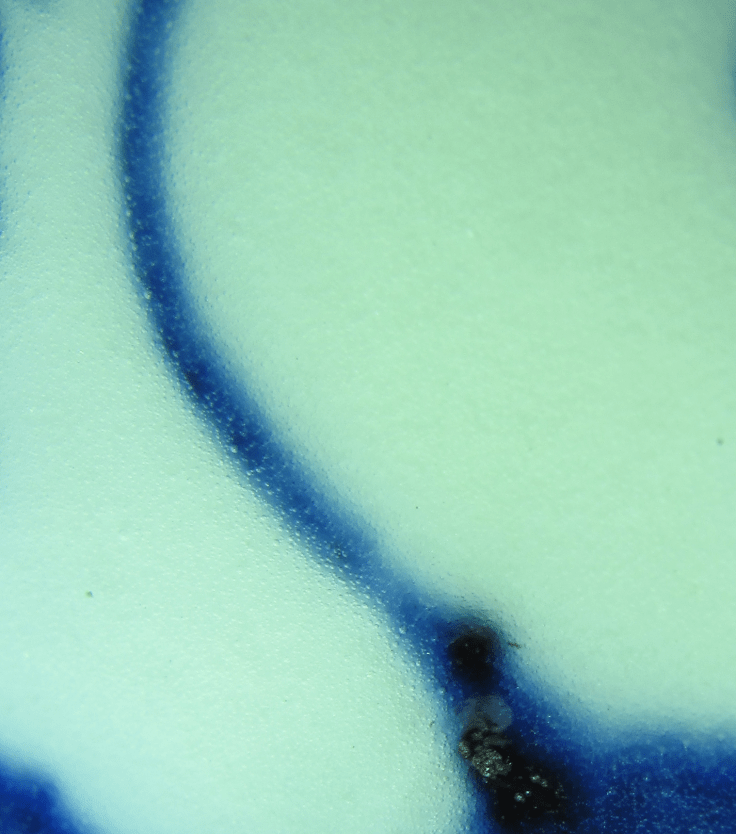
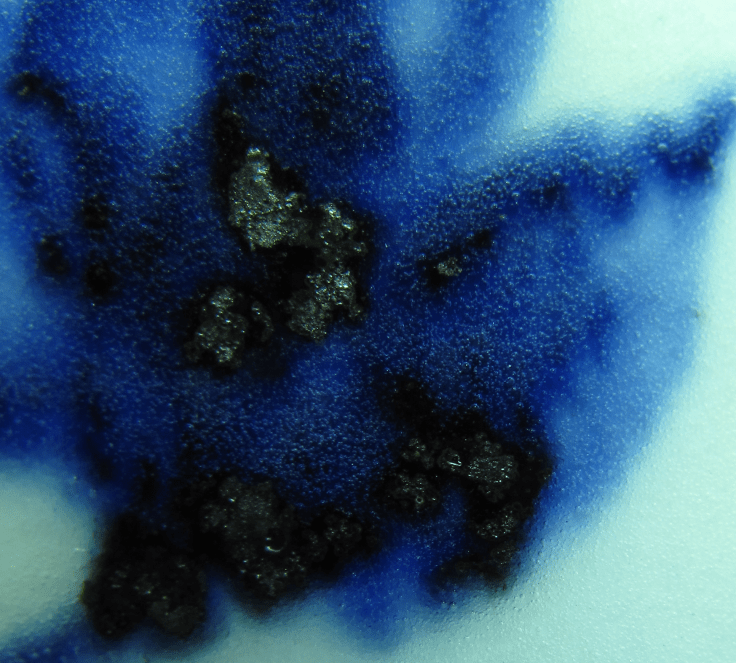
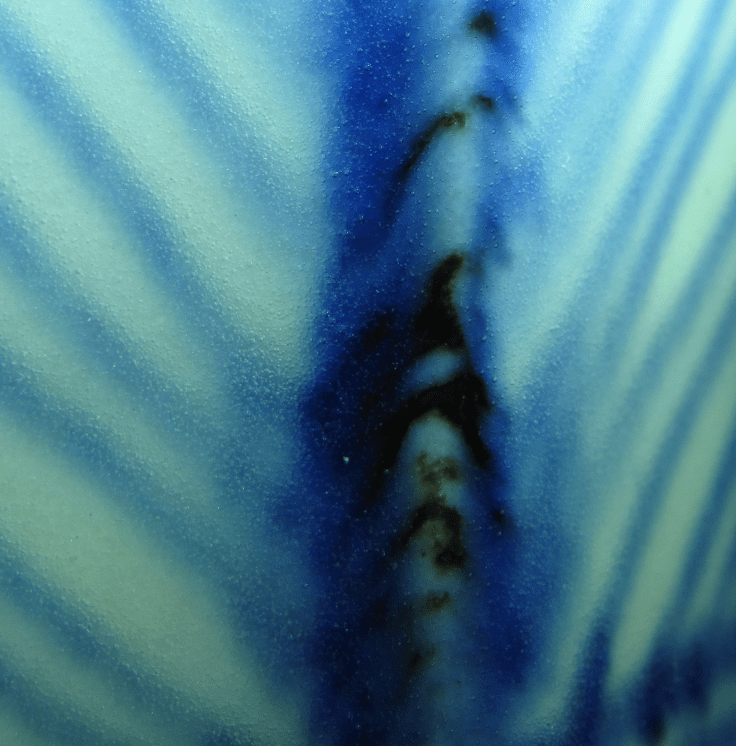
Magnificent Plaques, Wonderful Glaze under the Morning Sun—the Yuan Charger with a Lohan in Relief Revisited

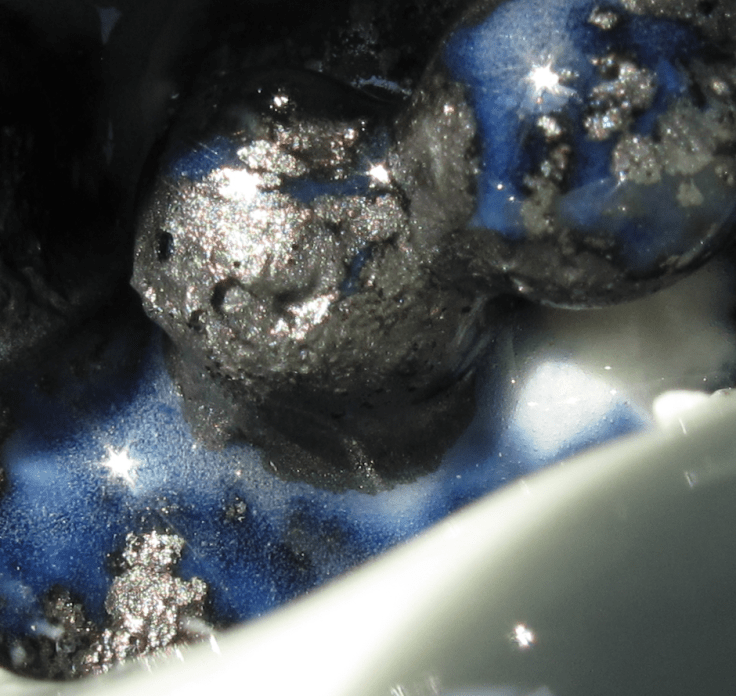
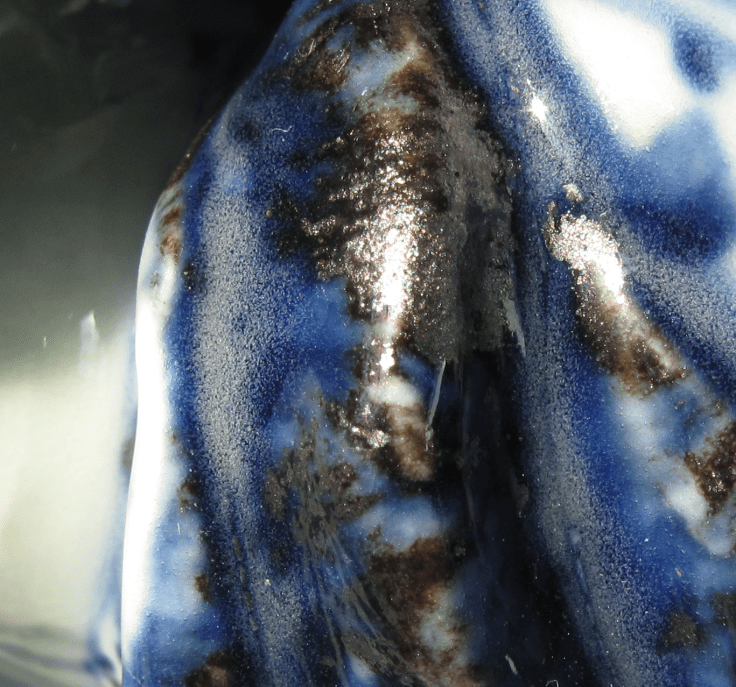
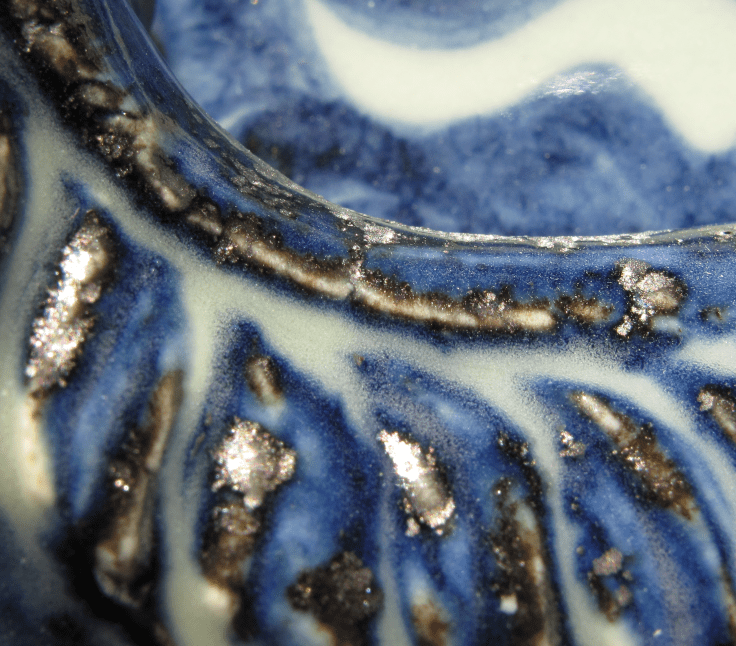
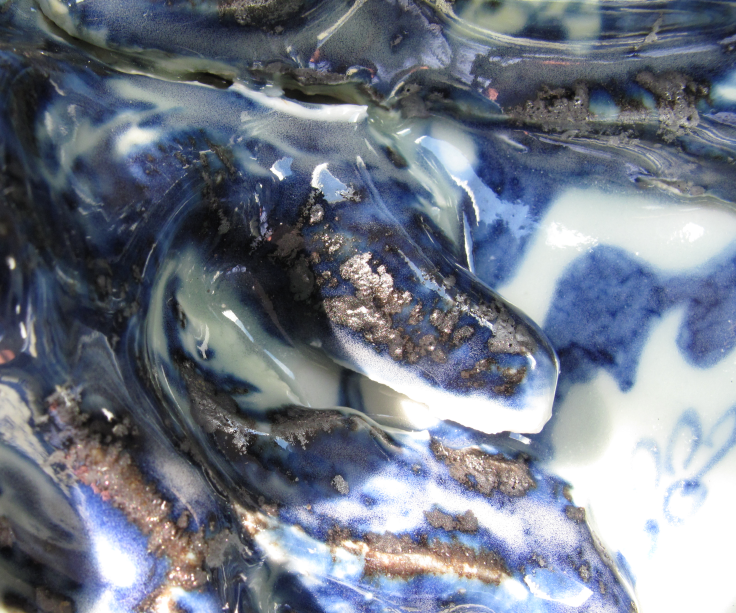
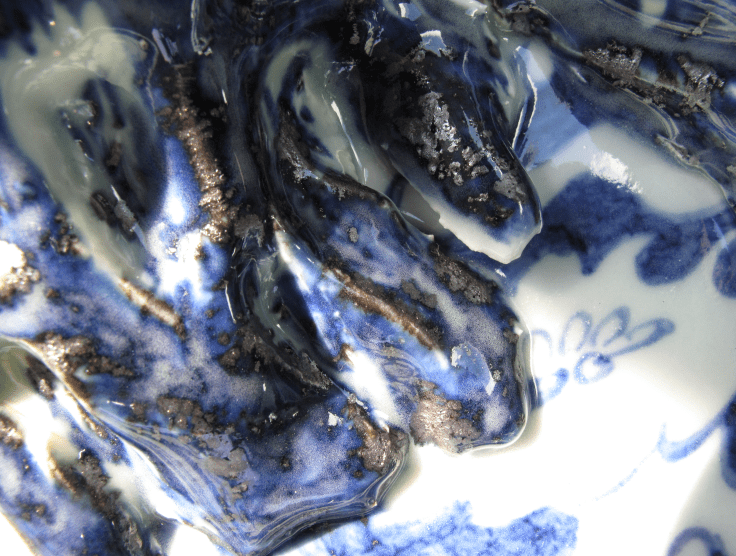
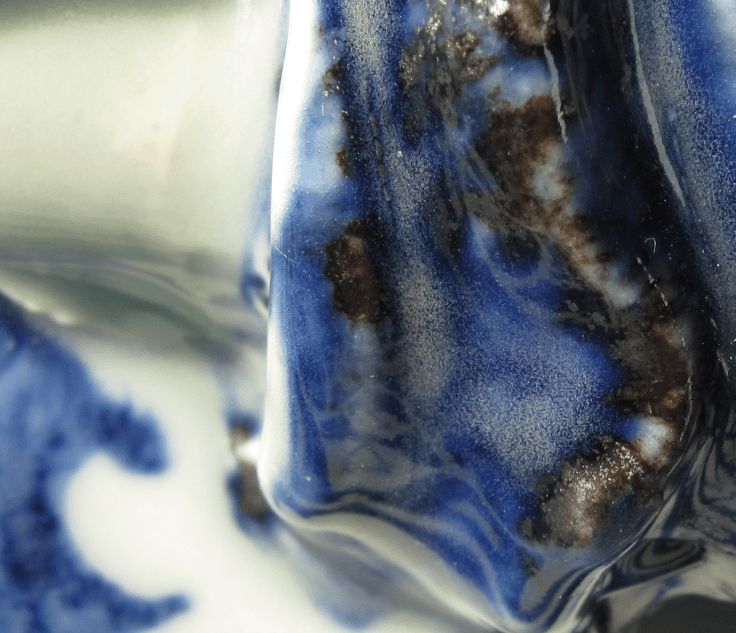
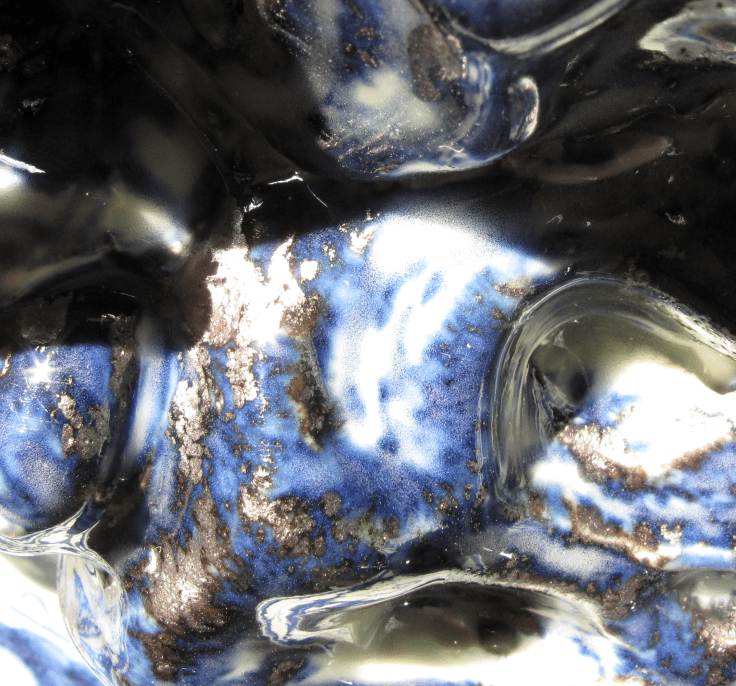
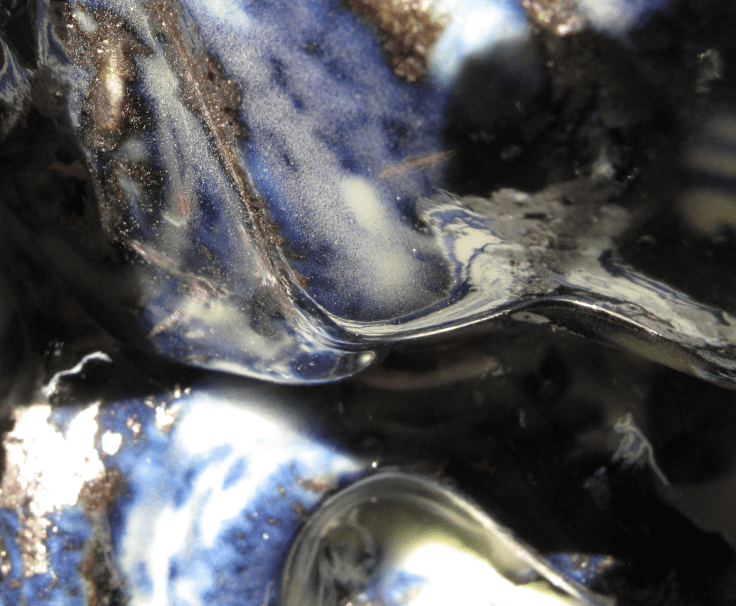
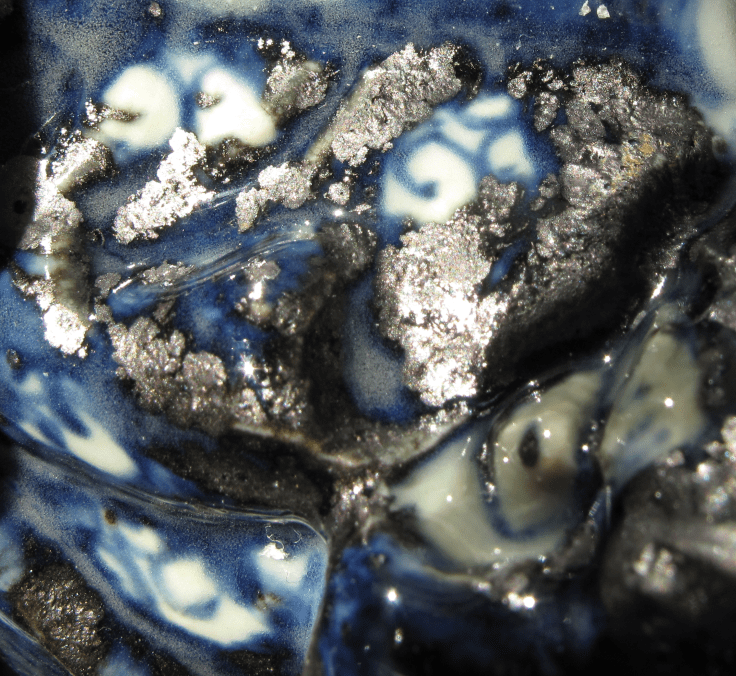
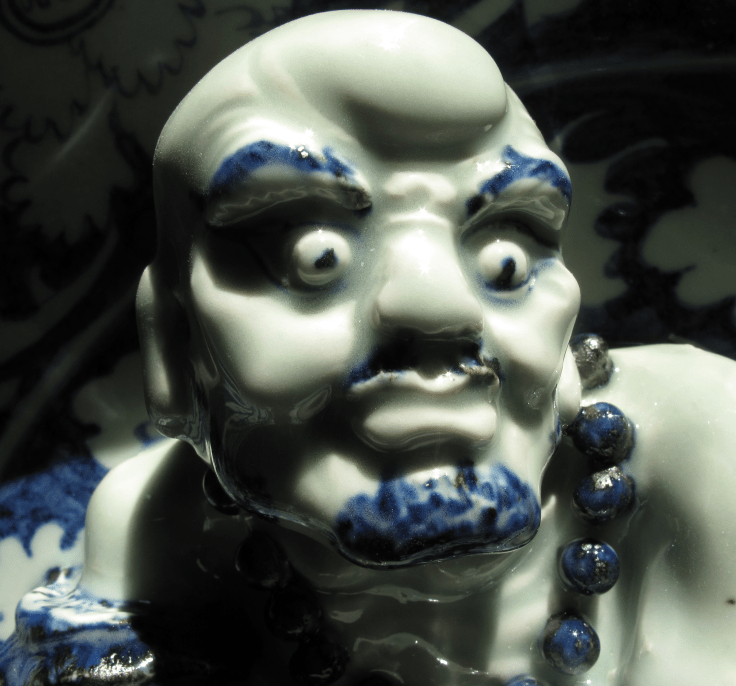
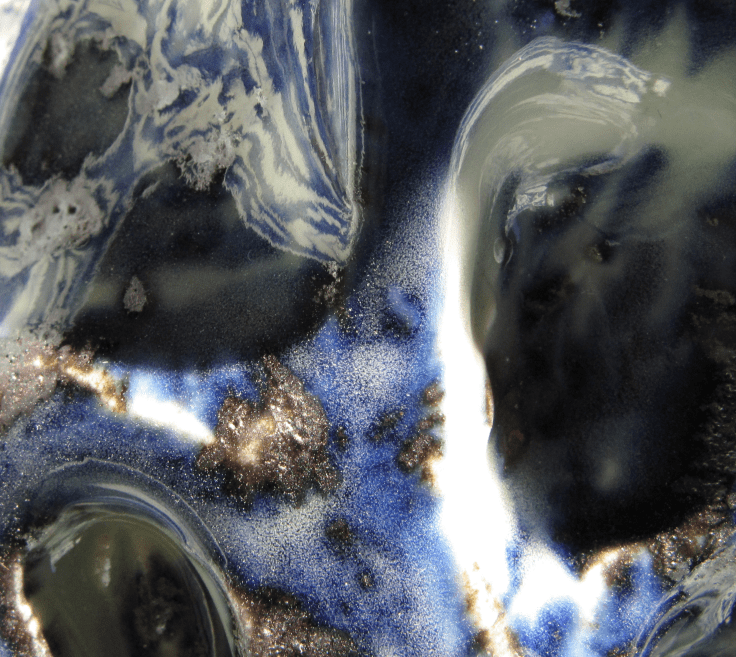
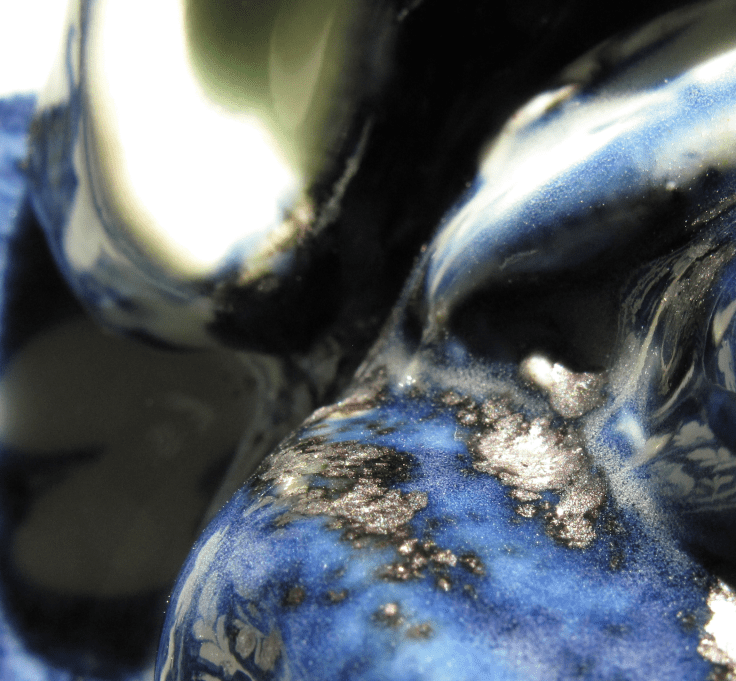
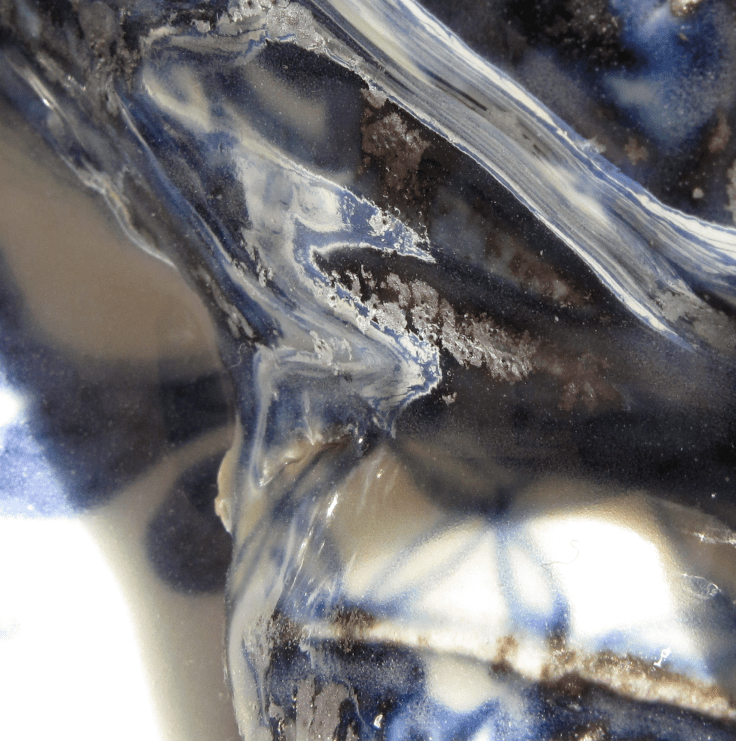
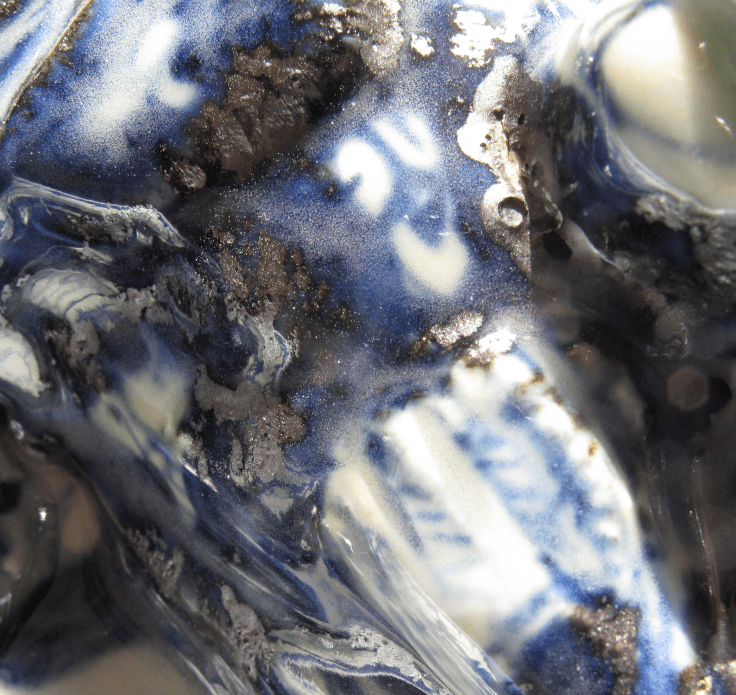
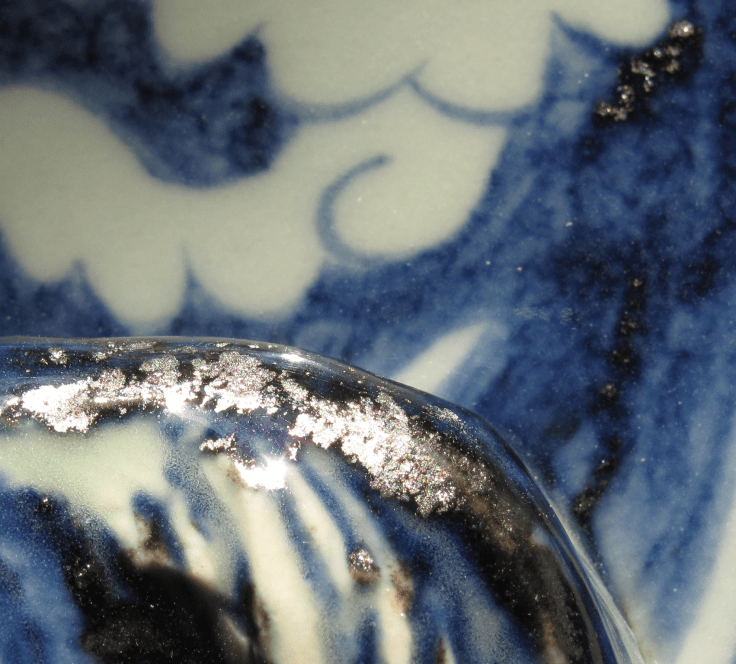
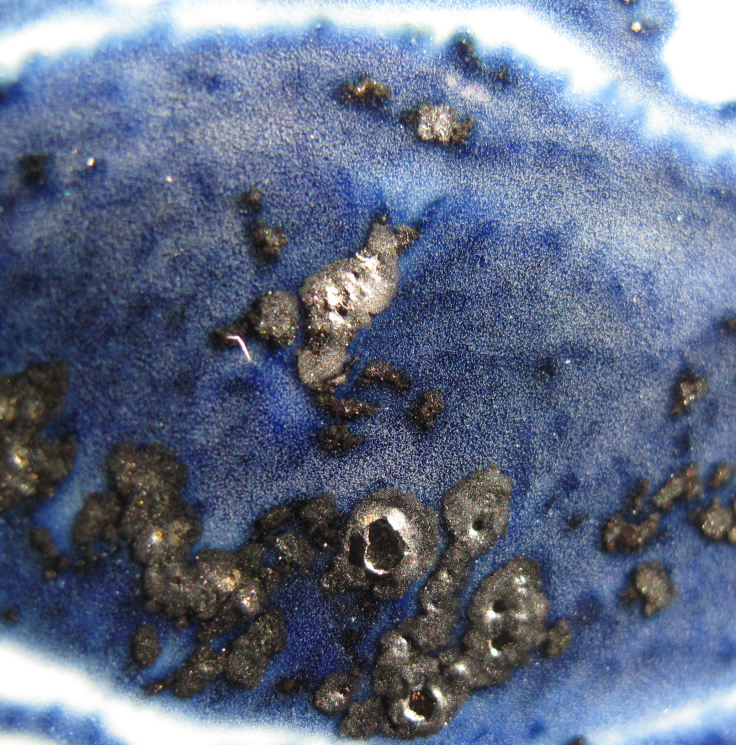
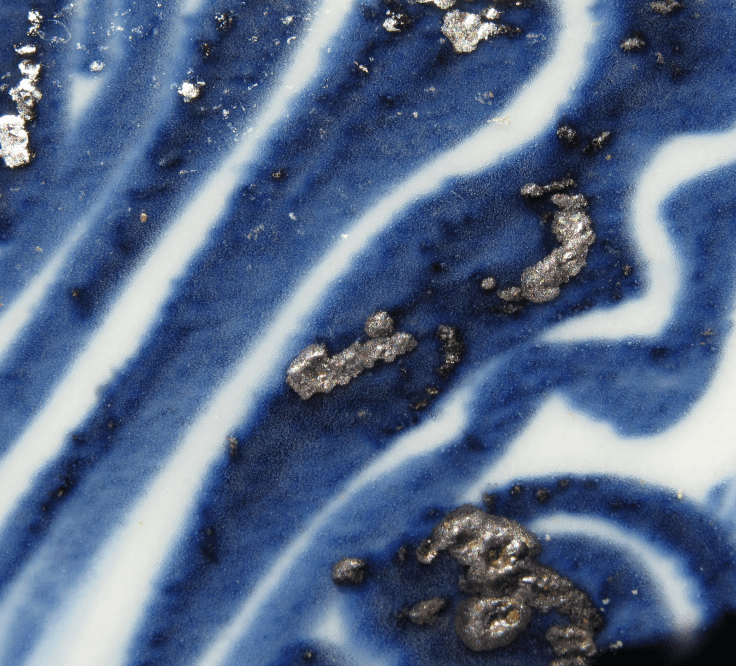
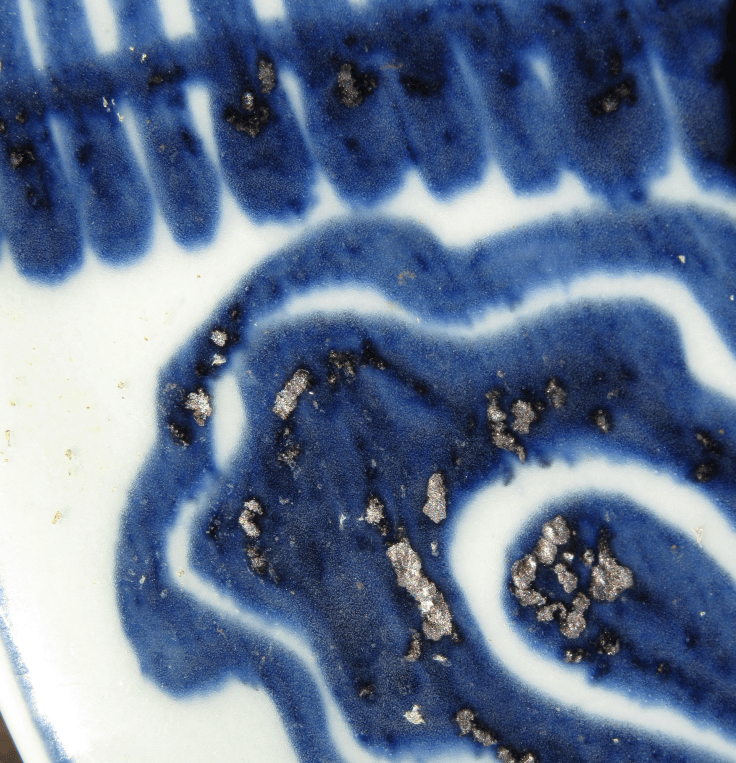
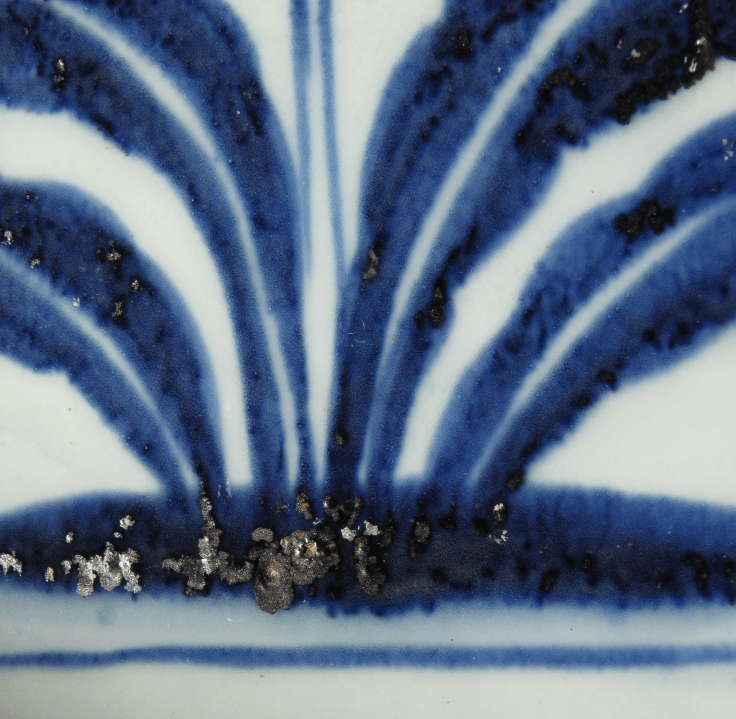
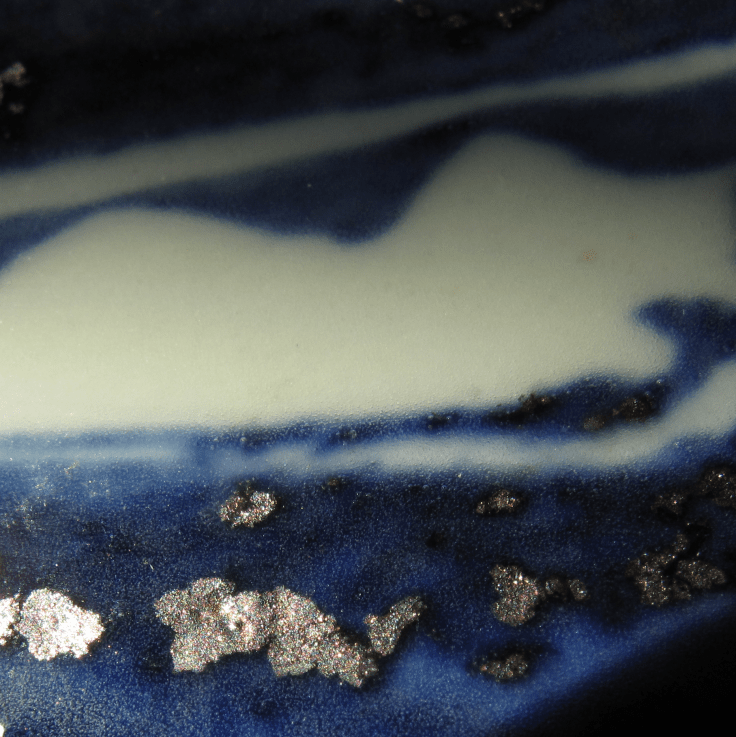
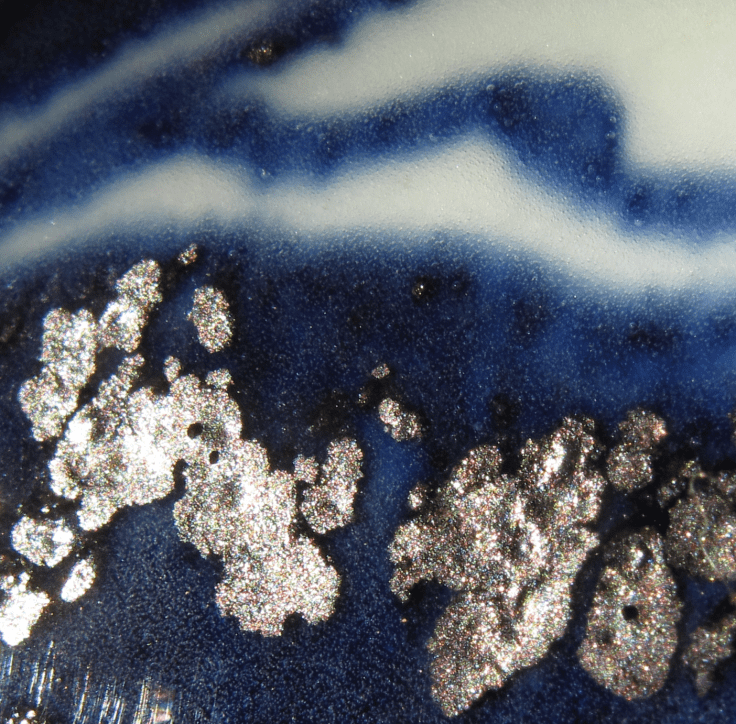
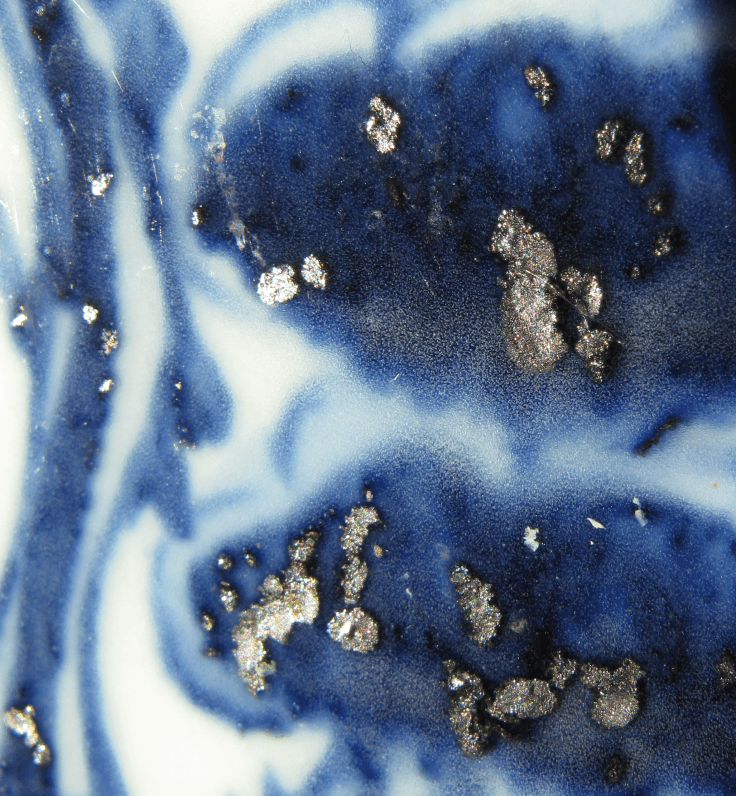
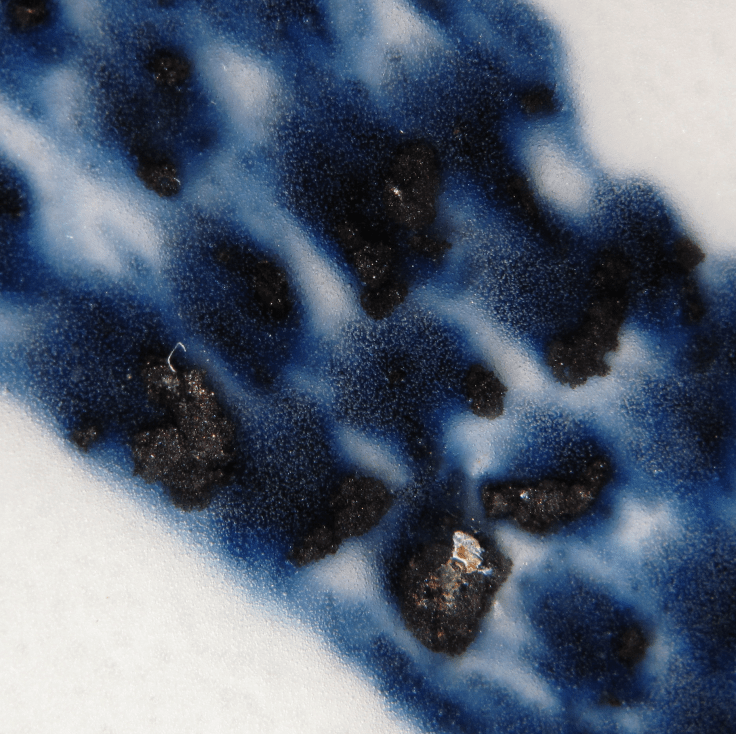
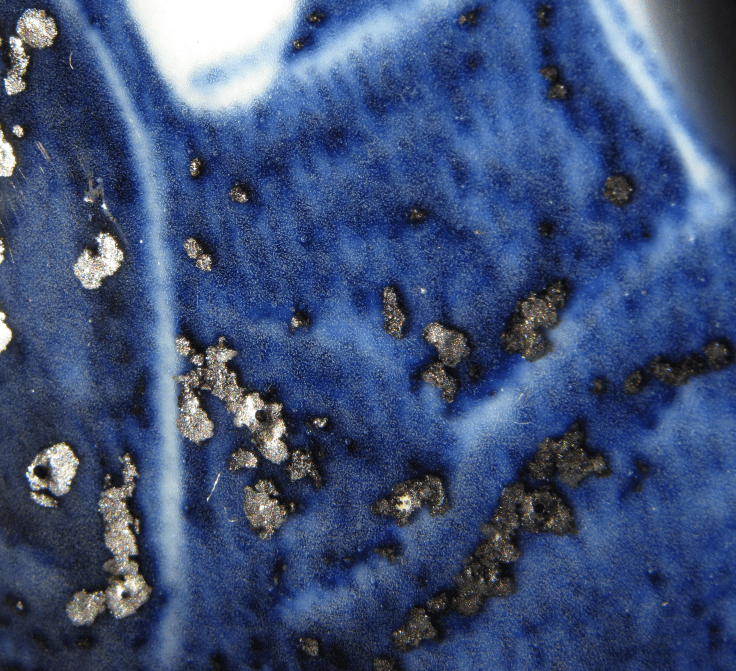
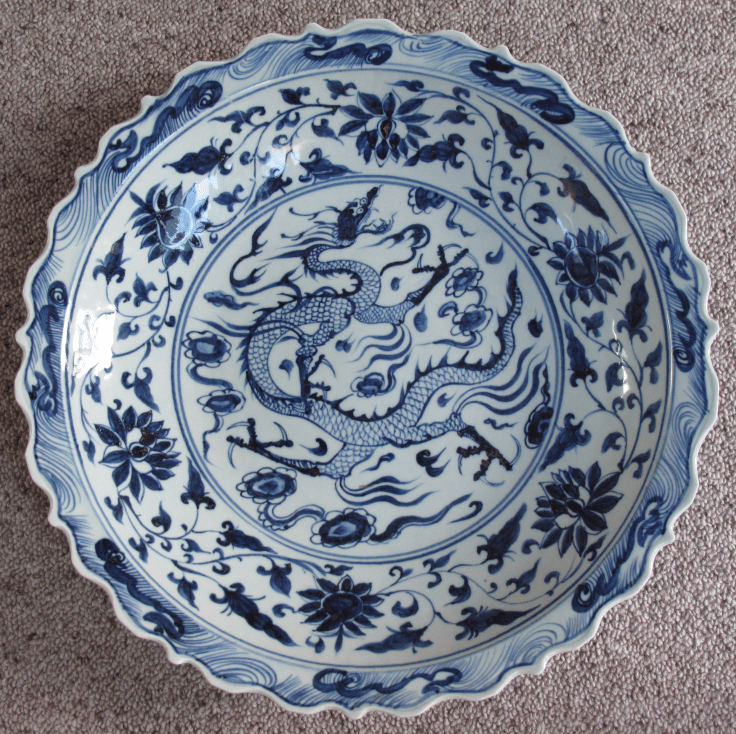
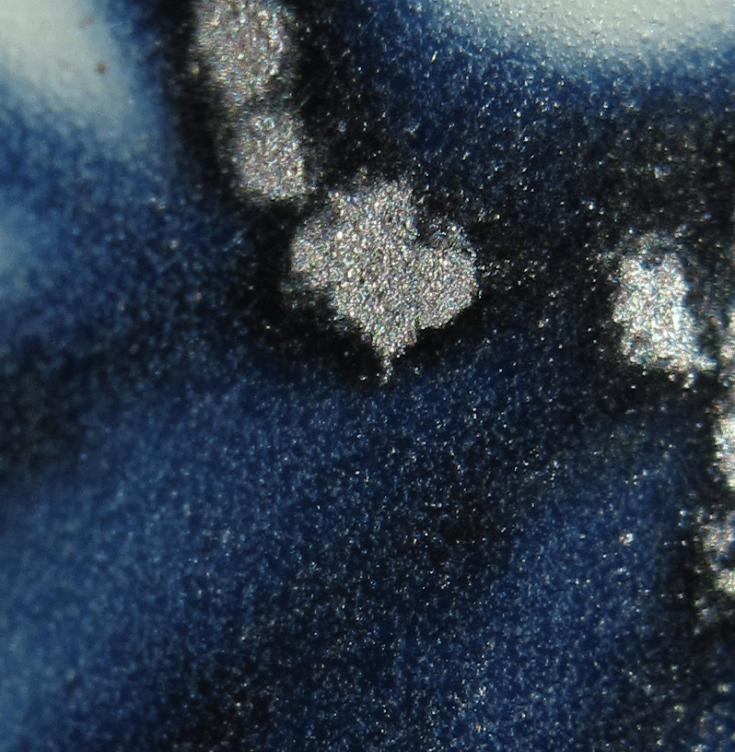
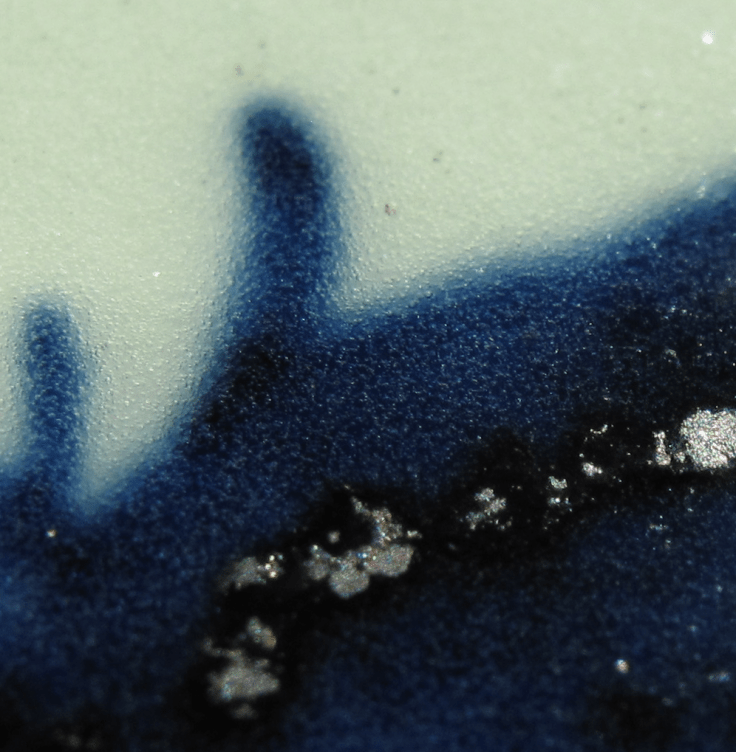
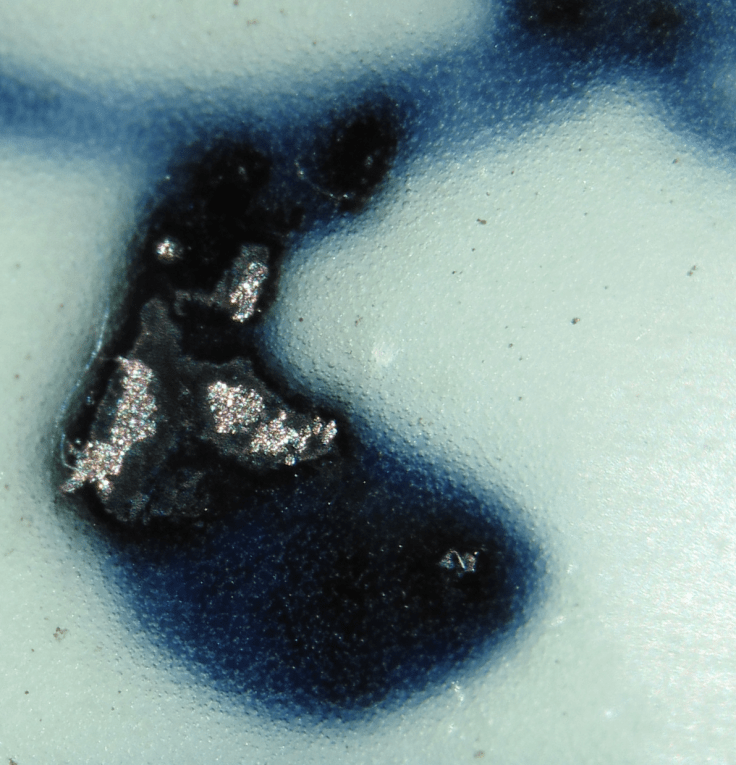
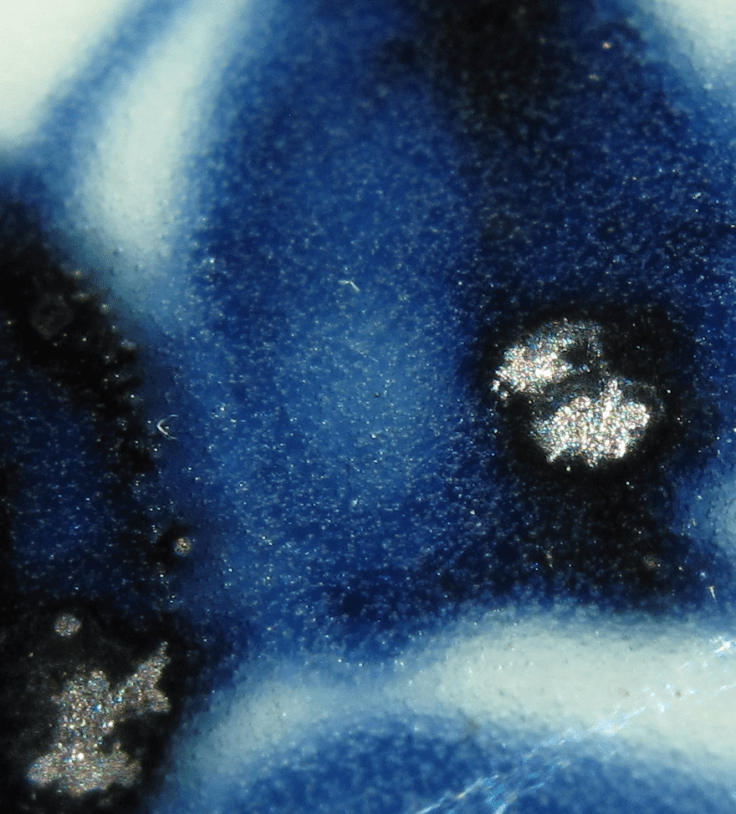
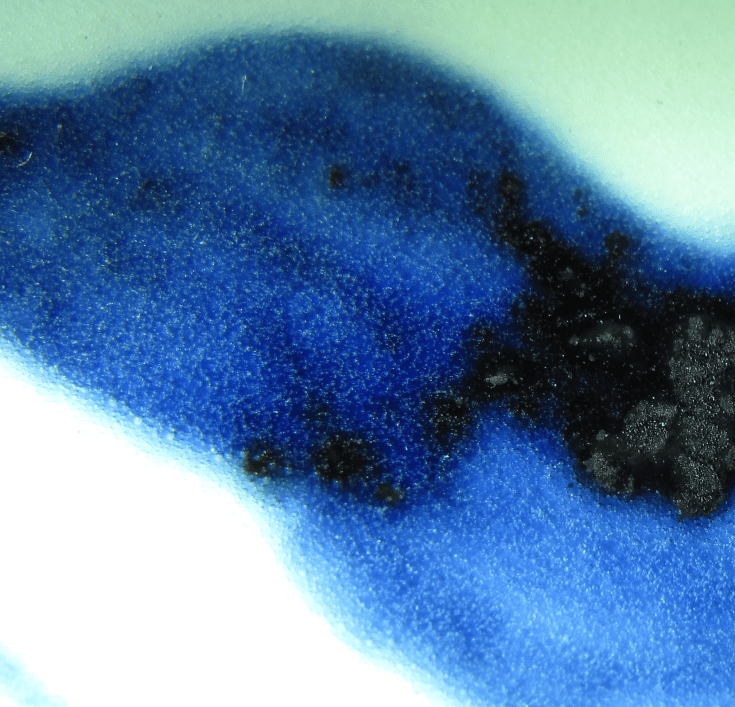
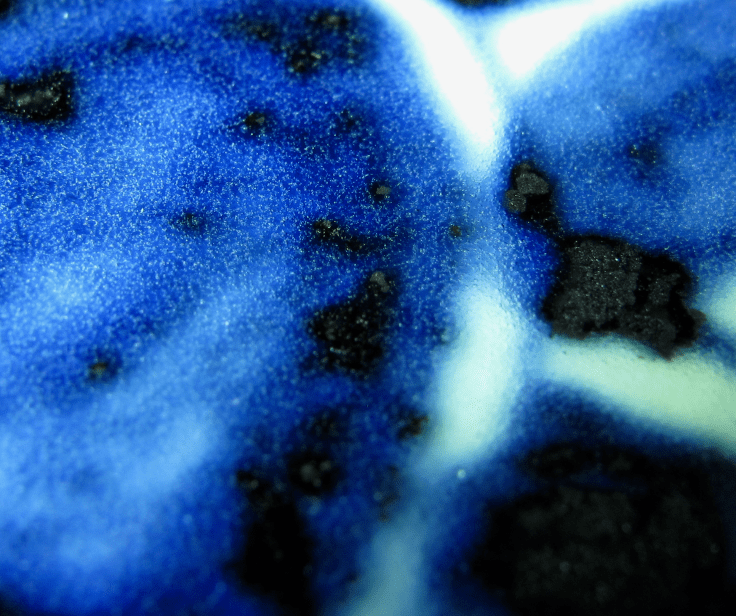
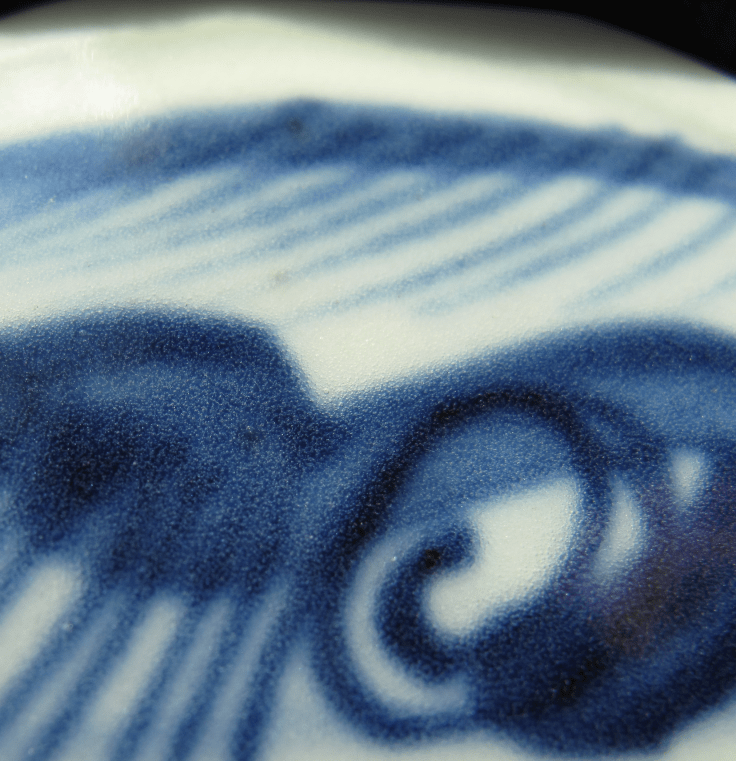
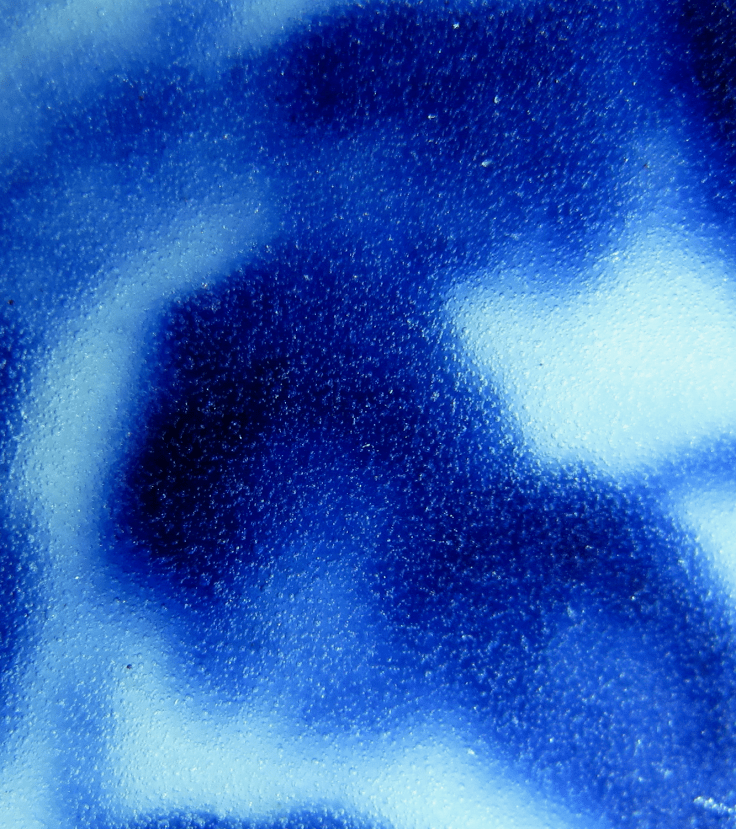
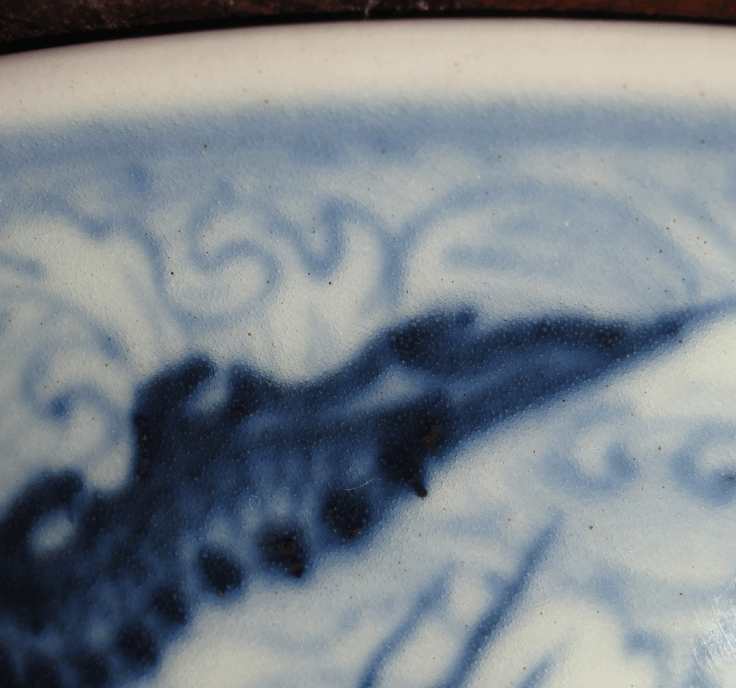
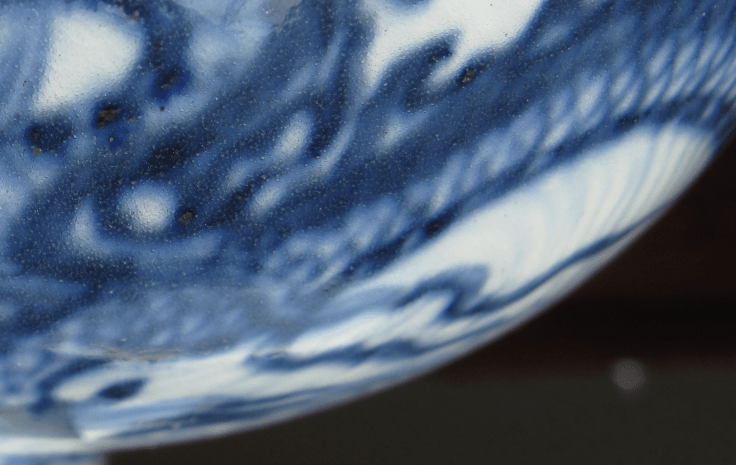
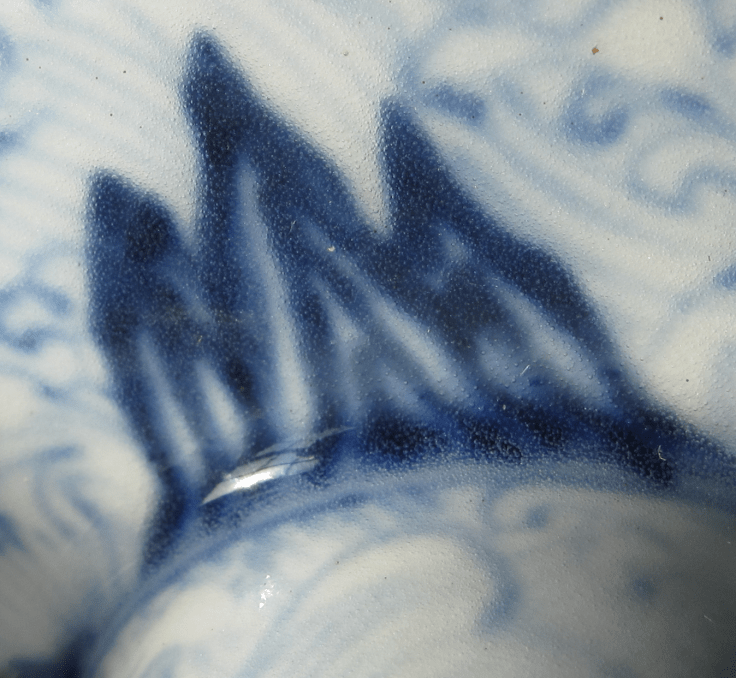
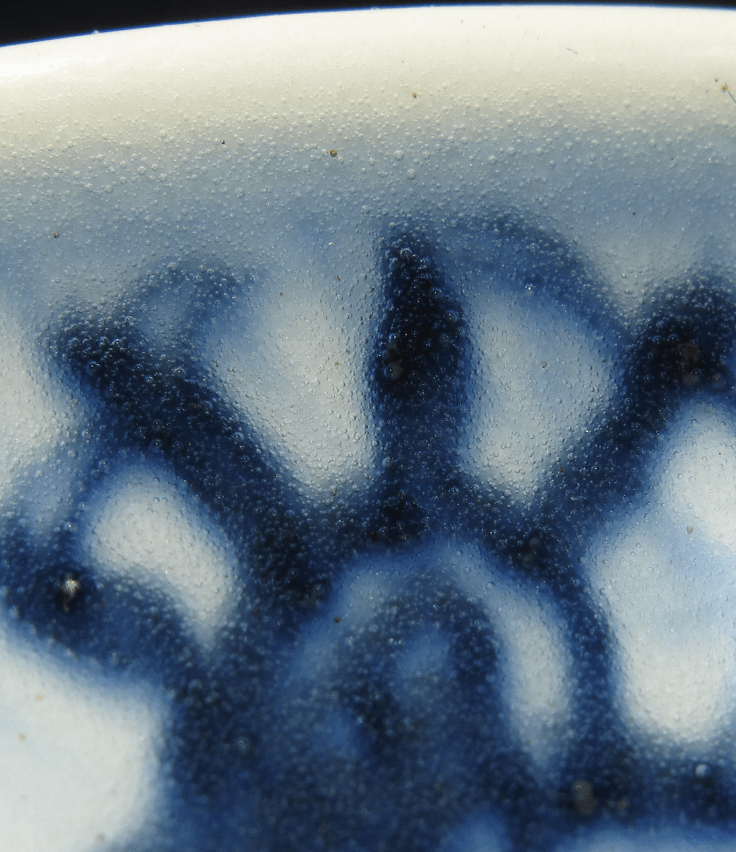
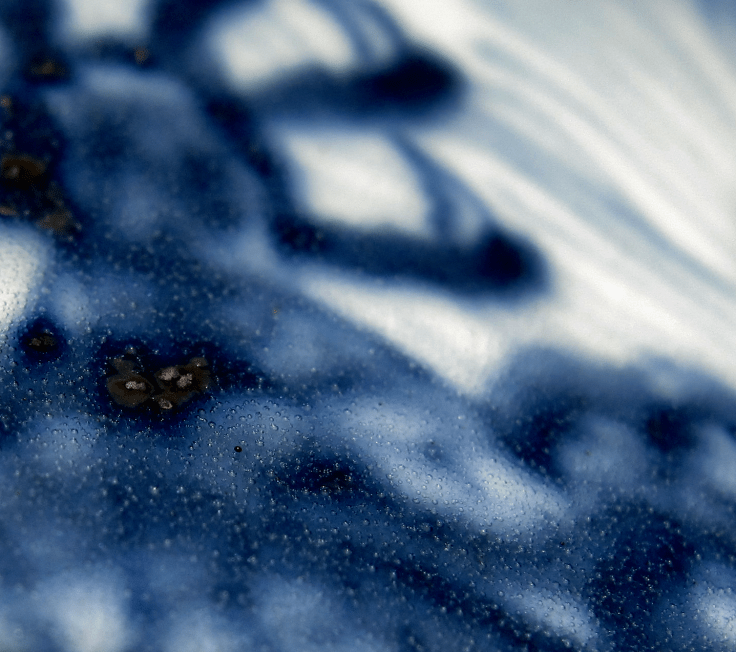
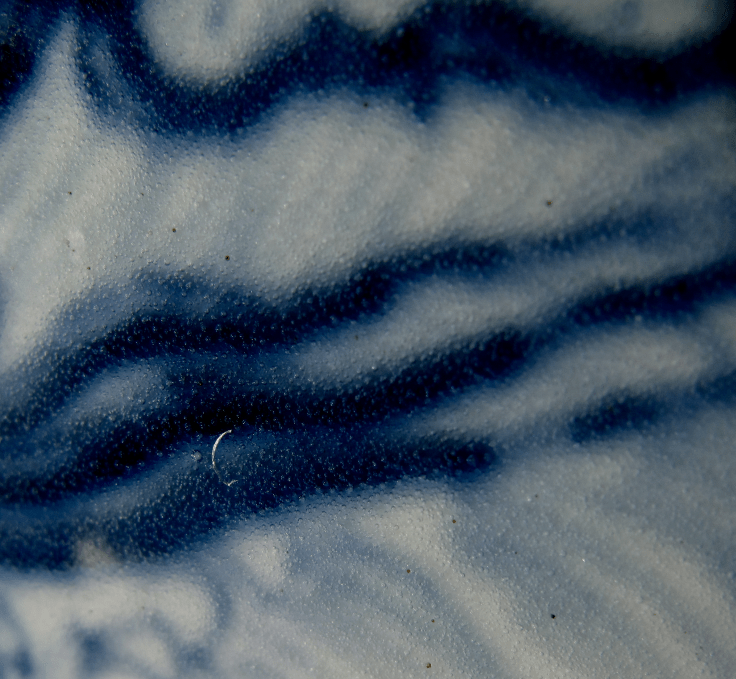
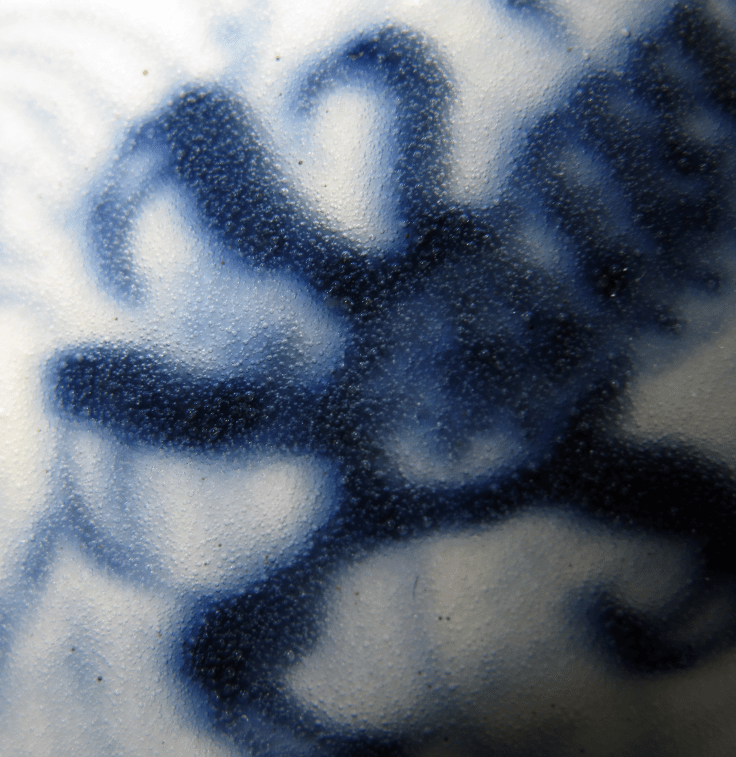
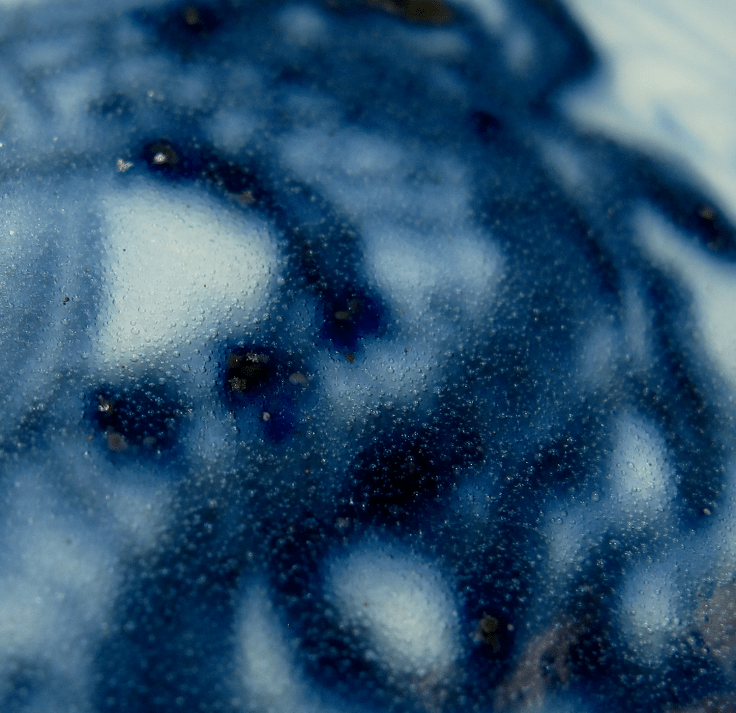
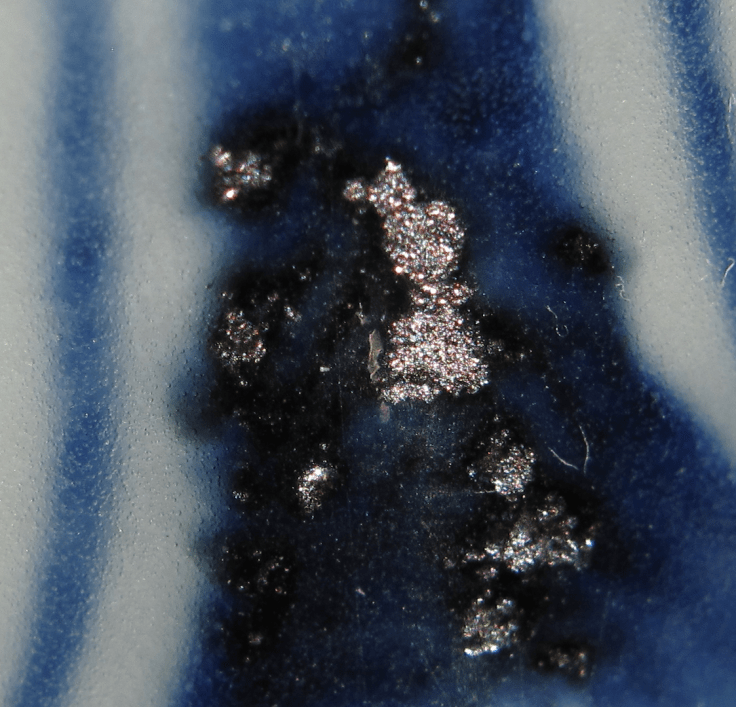
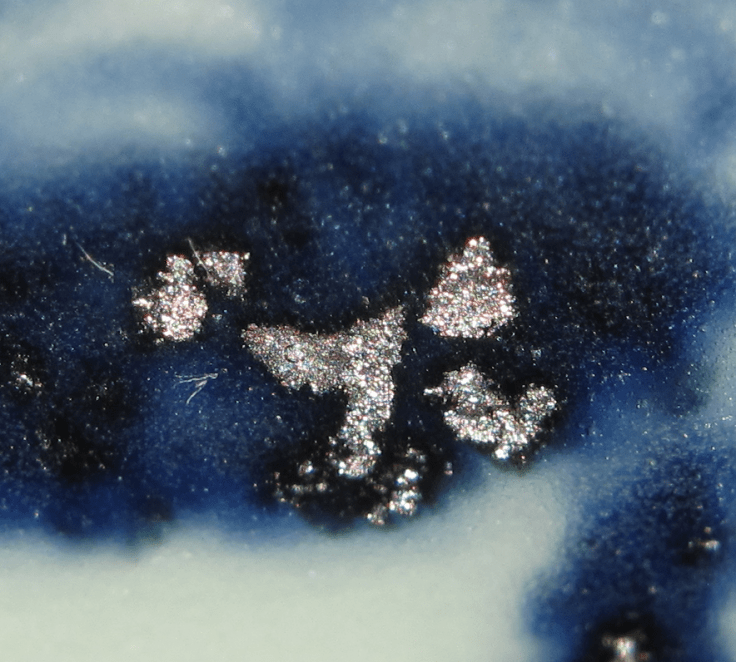
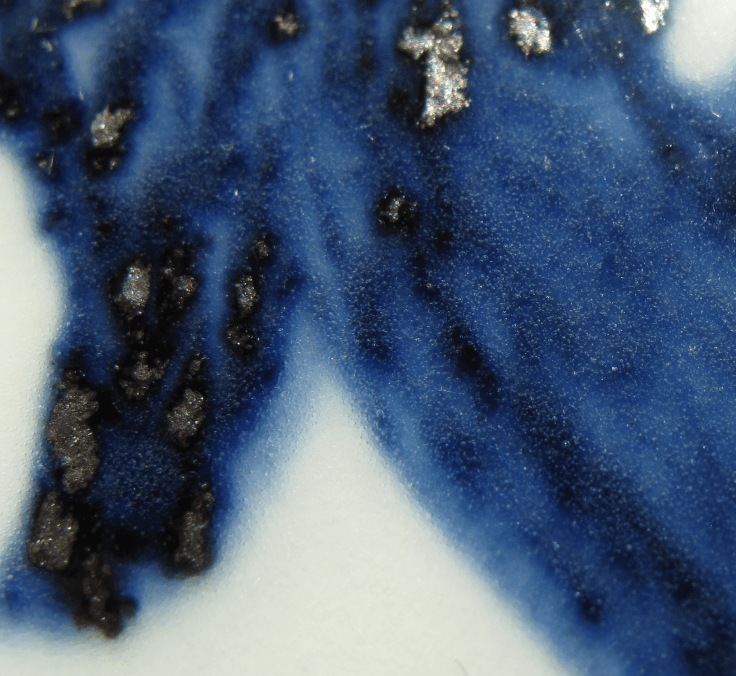
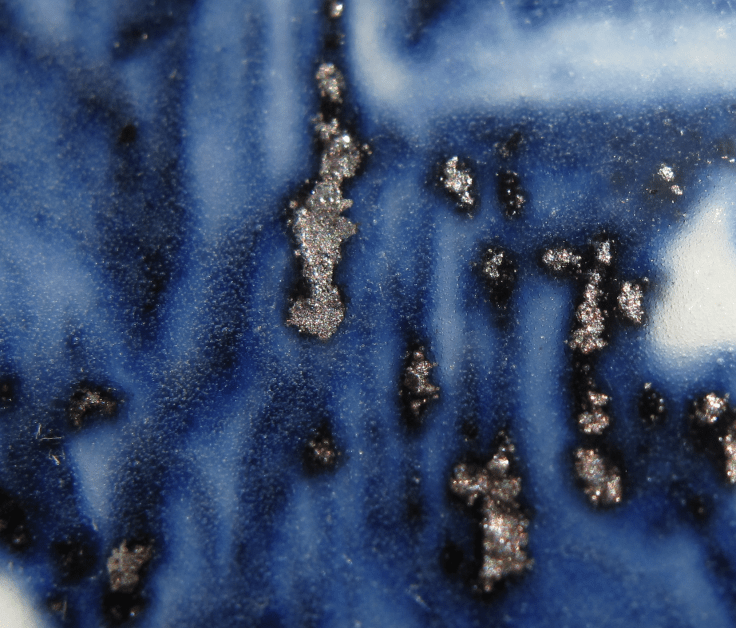
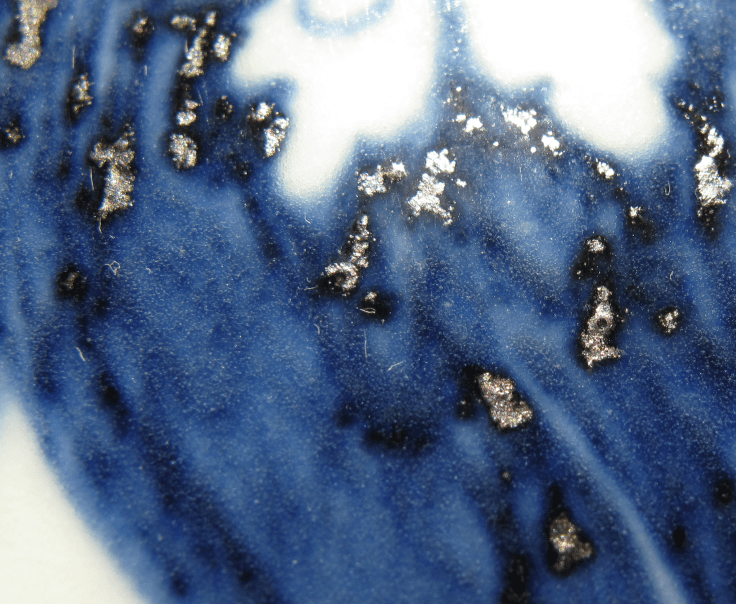
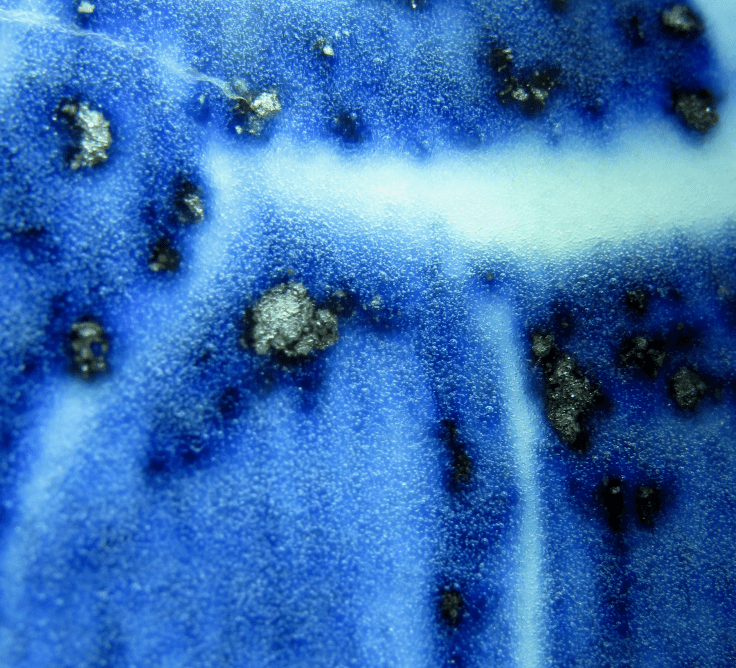
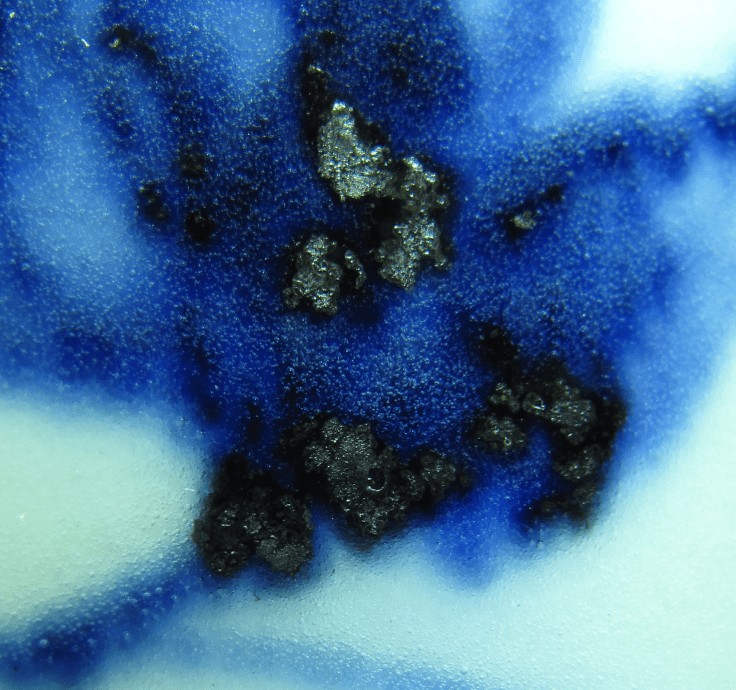
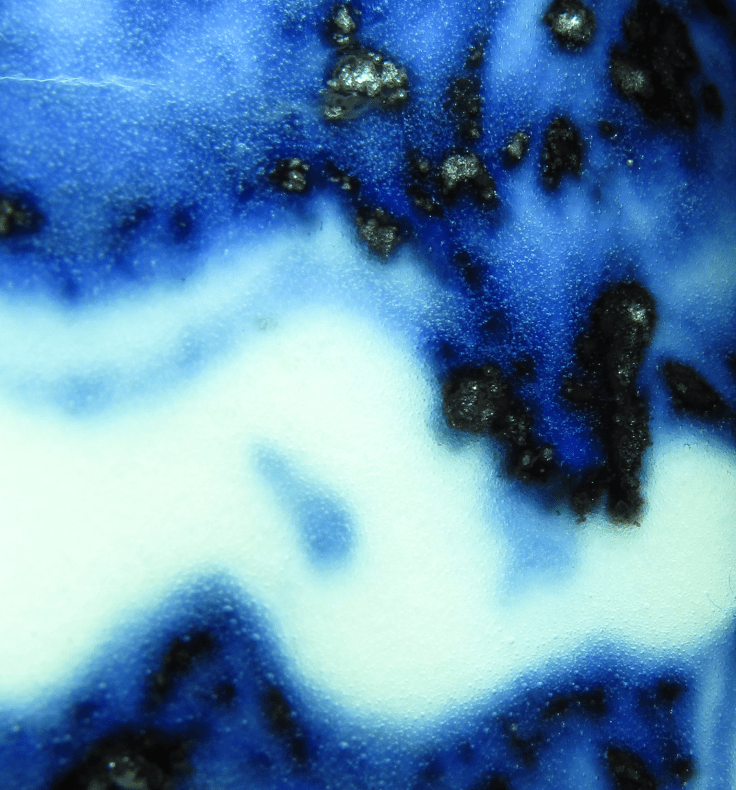
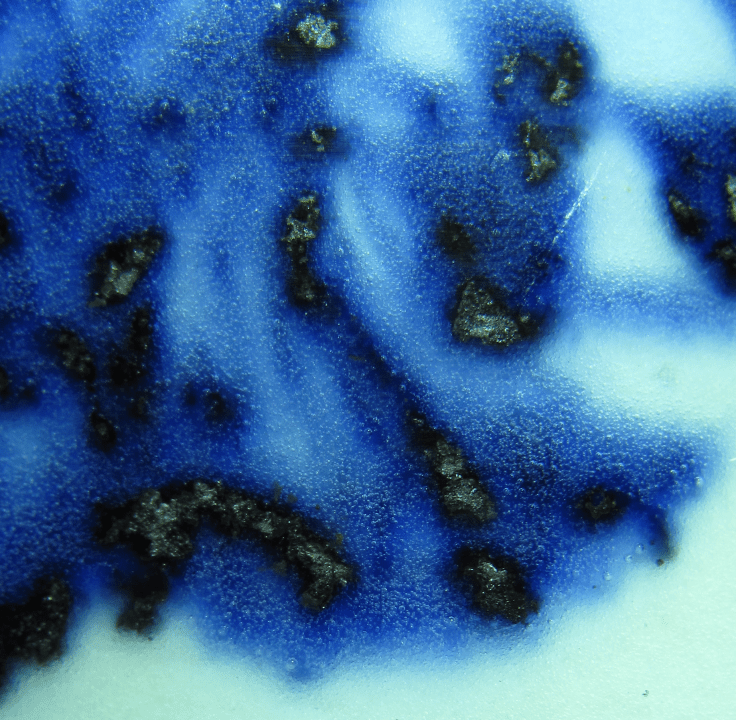
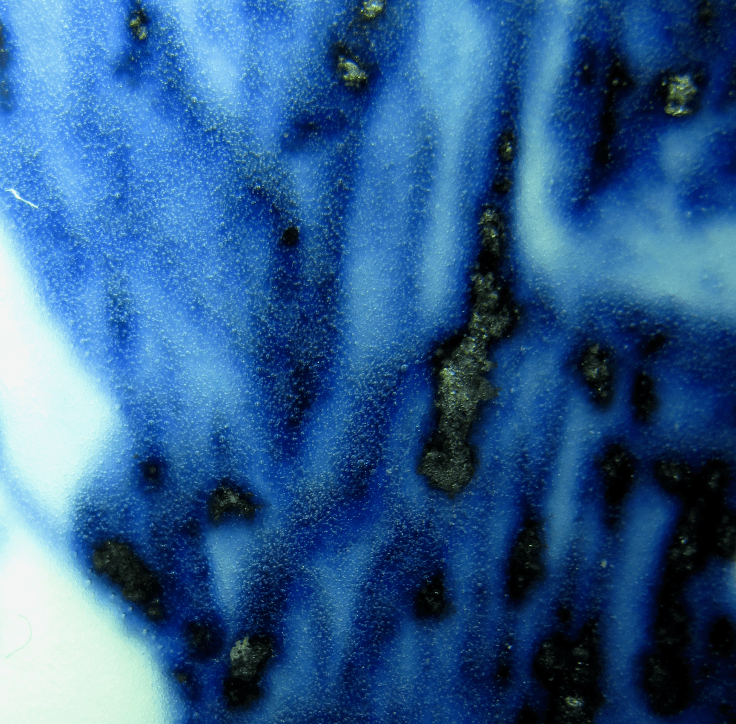
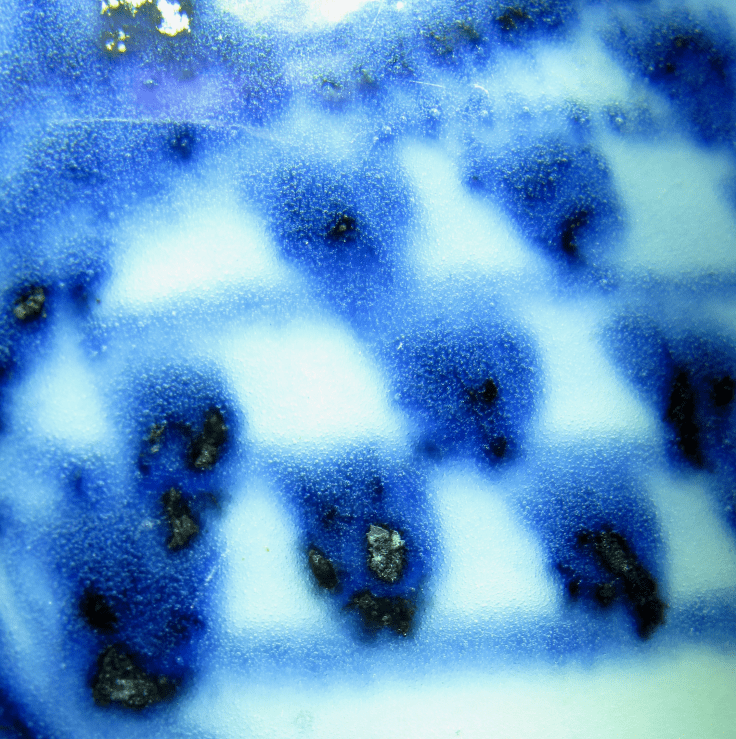
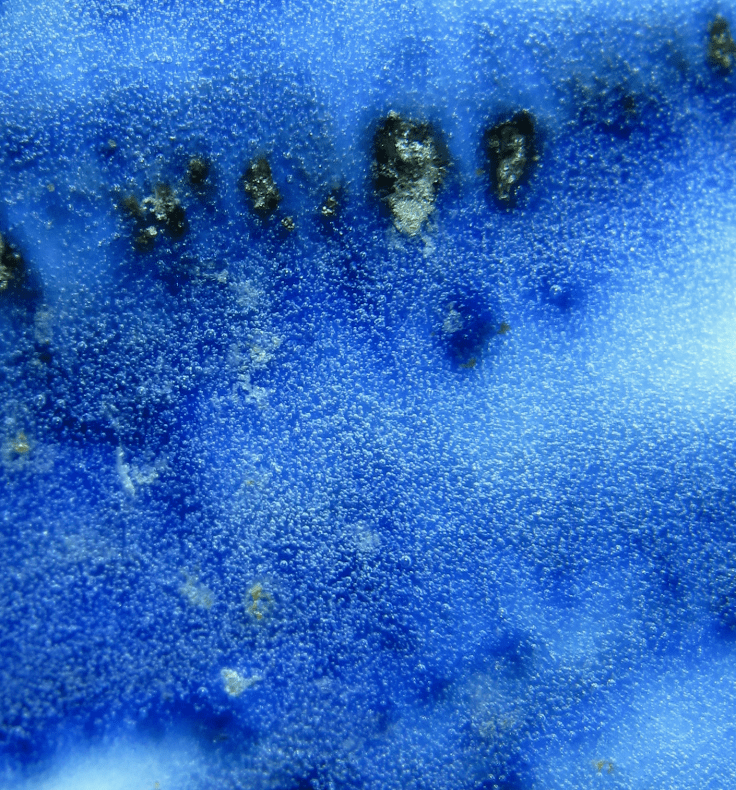
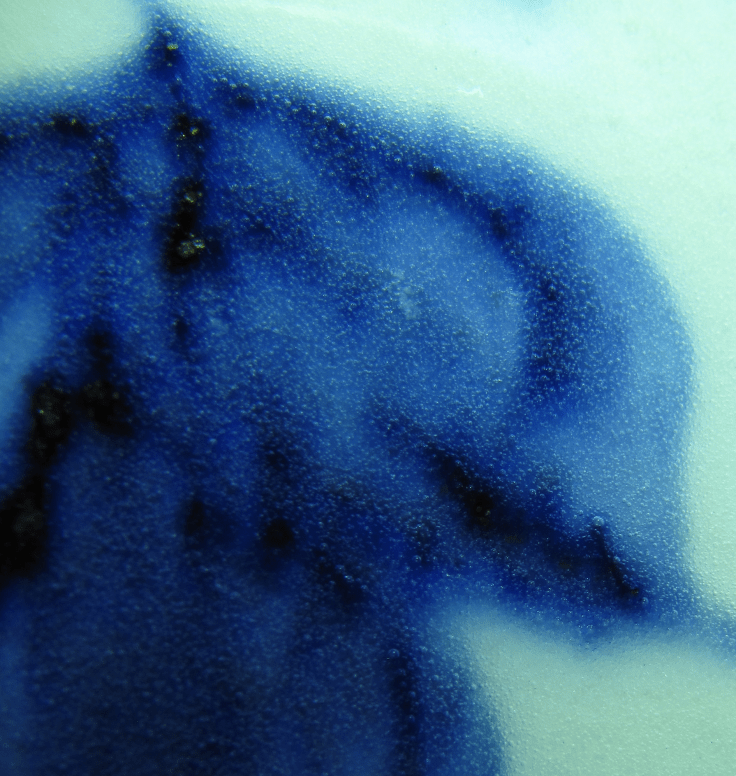
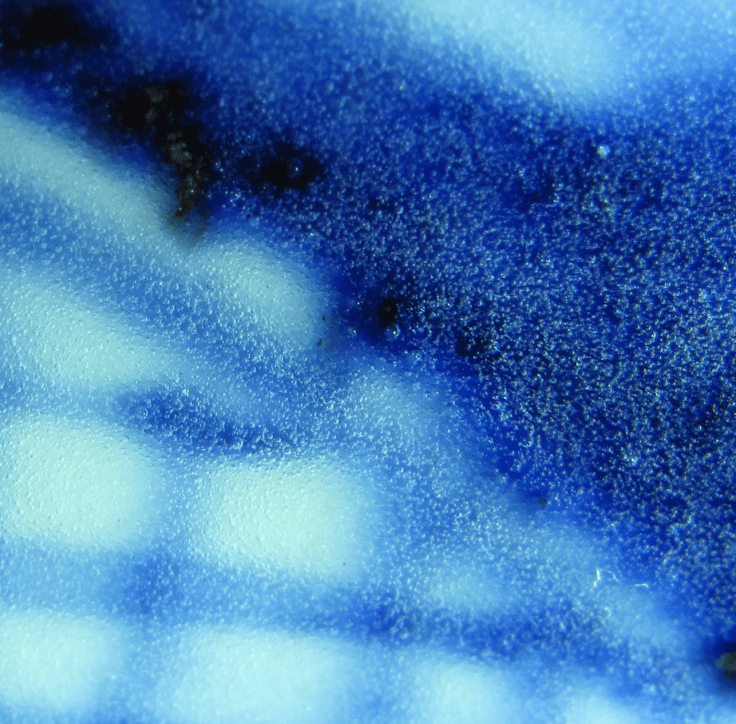
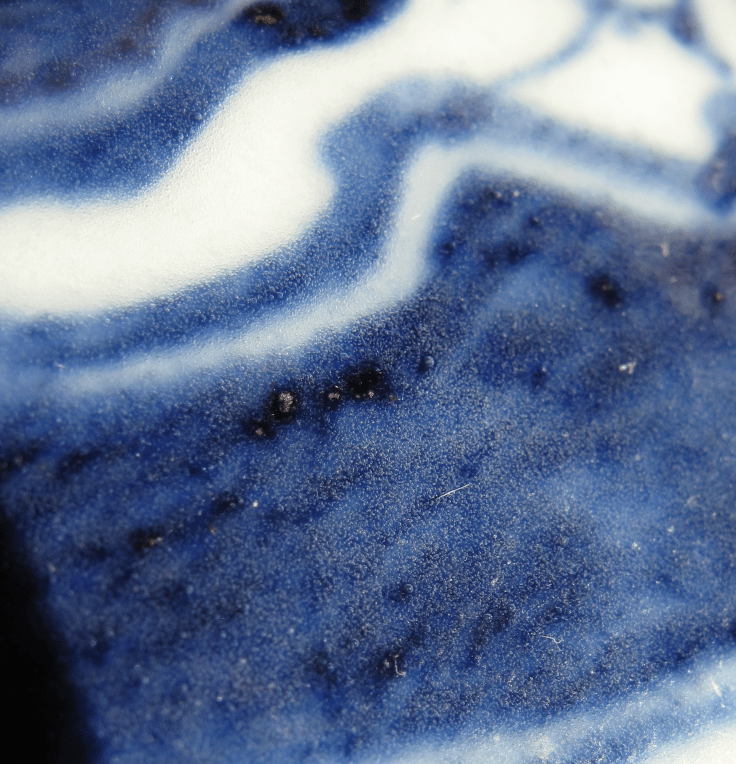
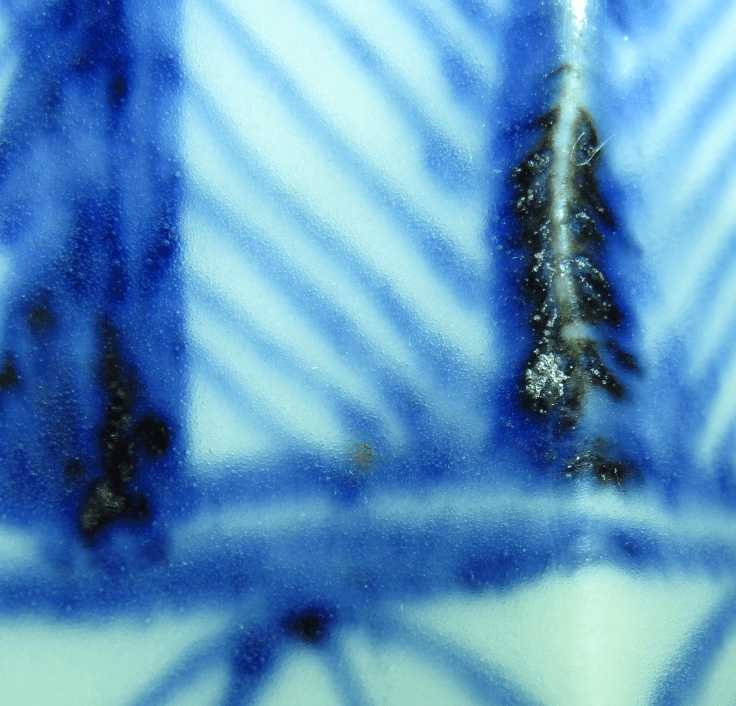
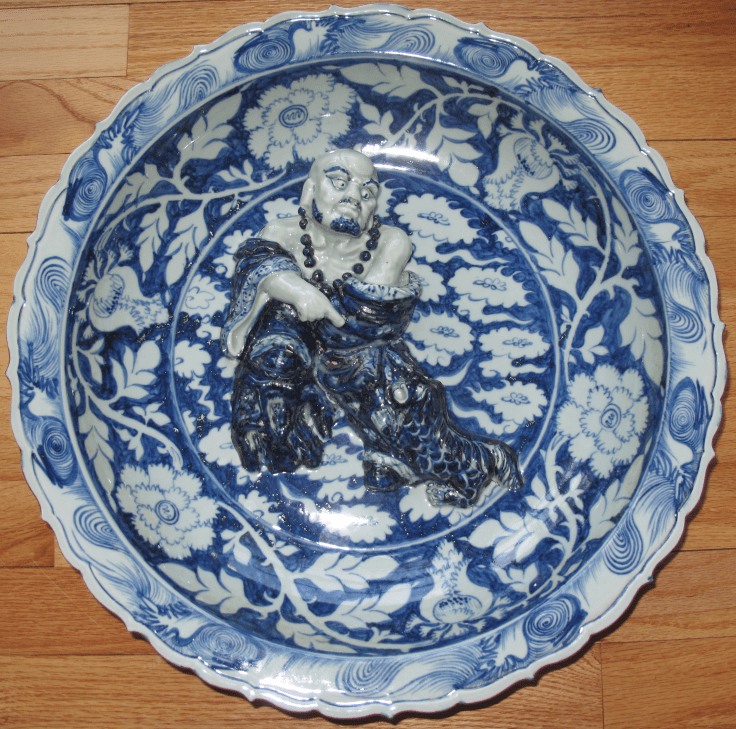
In January 2018, I wrote an article on a Yuan Blue and White Charger with a Lohan molded in relief at the center in the flat part of the charger. Like most Yuan B & Ws, it is a charger with plenty of plaques on the Lohan. I am going to show you this charger again, taking advantage of the morning sun to shoot some photos showing-casing the reflections of the plaques, and what is more, the beautiful glaze that this charger has.                      .

Now, ceramics and glaze are inseparable. It is like the body and the soul. Yes, glaze is the soul of ceramics. Nothing can be more important than the glaze. To me, the value of a ceramic ware rests largely on the glaze. When a ceramic ware is beautiful, it is the glaze that contributes most to its beauty. Imagine a well potted ware with very nice shape and attractive motif and beautiful color, but with a glaze that is either very dull, or emitting glaring reflections, would the ware be valued greatly? No, I don’t think so. 

You may wonder why I have never talked on this most important subject? I have a good reason, and it is a simple one. When we say a ware has a beautiful glaze, what exactly does it mean? In fact, it means very little. It all depends on your experience. Here, experience overrides everything simply because there is no definition as to what is a good glaze. It is quite unlike the Sumali Blue dye. There, I can show you the color, the plaques, the bubbles and the drippings and flares. With glaze, there is really little to show.  One needs to look at many, many wares and accumulates the experience before one can sense what is good and what is not good. That is all that I can tell you. As you will understand, this practice will undoubtedly involve a lot of subjective feeling. And subjective feeling is often very biased, so much so that the conclusion can be very different from person to person. Until the day when someone can come up with a definition for a glaze in a measurable term, this problem will remain.

Meanwhile, I would like to tell you what I think is a good glaze. Of course, it is all adjectives that  are up to the interpretation of the reader, and at the end of the day, it might mean very  little. It is a nice and soft luster, with a mellow glow. When you look at it, it is very pleasing to the eyes. It should never be very bright, nor should it be glaring. The Chinese use the term 寶光 to describe a beautiful luster, a luster that is similar to the reflection emitting from the most treasured jewels. As for the very glaring glaze, they use the term 賊光 to describe it, for whatever reason. 

There is another point that I want to make about glaze. Most people will say that newly made ceramic wares have bright and glaring glaze. But with time, the brightness and glare would fade away, and the glaze would become more mellow. I think this is a myth. A good ceramic ware with a good glaze is born that way. Time does not change the glaze at all. Nor will a glaring glaze turn to a mellow glaze over a long period. Glaze does not change. Its beauty is all related to the constituents of the glaze. To be sure, the composition of a glaze is always a top secret. Potters keep the formulae to themselves. The general composition is of course well known, but ingredient that would make the glaze beautiful is another matter, and there probably are many such ingredients involved in minute quantities. That is why, the various famous kilns in China starting more than a thousand years ago have glaze that is quite different one from the other. The one thing that is in common is that they are all marvelous and appealing. It only shows that potters of different kilns have their own secret formulae. And forgers of today have no way to crack their secrets.
 

IMG_7929.pngFigure 1  

When you read this article, you should also read the article I wrote in January 2018. There, I showed you the beautiful sapphire blue coloration of the dye, together with the mottling, and the small and large bubbles. And in the Lohan, I showed you the plaques and other features that would leave no doubt as to the authenticity of the charger. Here, I take advantage of the morning sun, and would show you the colorful reflections of the plaques, and what is more important, the glaze of this charger. The glaze is well seen here because of the molding and folding of the sculpture of the Lohan. These would allow the glaze to accumulate in such a manner that it is much thicker than in a ware where there is no foldings.

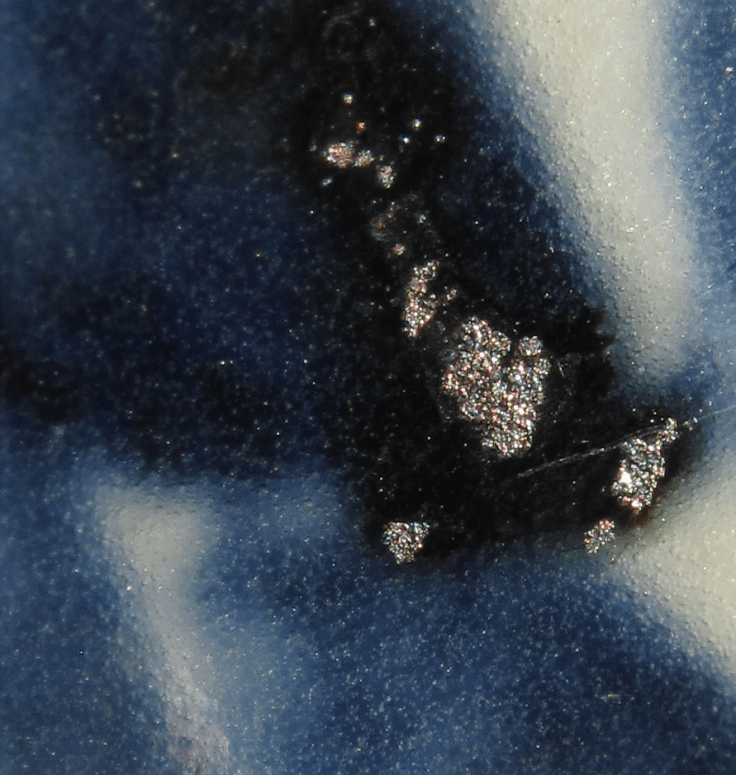
Now let me first show you the reflections of the plaques under the sun. You will note that the reflection is not as colorful as when the plaque is on a flat surface when the plaque is necessarily flat. One needs to know that the reflection has a lot to do with the angle that the sunlight strikes on the plaque surface. It is only at the correct angle that the reflection will be particular reflective. A little alteration in the angle, and the reflection will  not be as colorful. So, when most of these plaques are mainly on a contoured convex surface of the Lohan, the sunlight can hardly strike all the surface at the correct angle at any one time, making the brightness of the reflection less. Another thing that you need to do  is  to enlarge the photos somewhat, and the colorful reflection will be better  seen (Figures 2-13).


IMG_7882 (1).pngFigure 2


IMG_7880 (1).pngFigure 3  


IMG_7879 (1).pngFigure 4  


IMG_7877.pngFigure 5   


IMG_7874 (2).pngFigure 6  


IMG_7903.pngFigure 7   


IMG_7902.pngFigure 8   


IMG_7901 (2).pngFigure 9  


IMG_7883.pngFigure 10


IMG_7807.pngFigure 11   


IMG_7810.pngFigure 12  


IMG_7811.pngFigure 13  

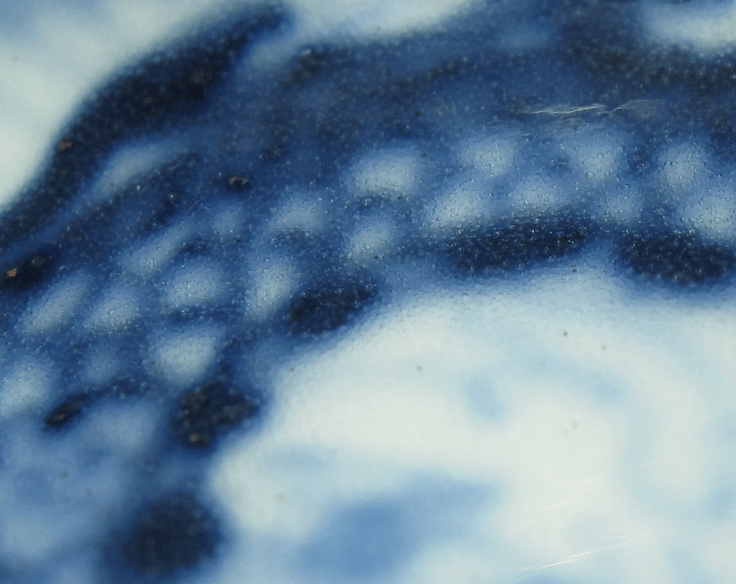
If you are going to compare these photos with those that I posted in January 2018, you will notice that the reflections are a lot more colorful, thanks to the morning sun. You will also note the small bubbles are all very densely packed, and you can discern the lacunae very clearly. At where there is a groove, the small bubbles are more than tightly packed. The whole area is overwhelmed with bubbles. Still, instead of giving you a feeling of confusion, it is rather nice to look at. Figure 12 and figure 13 are taken from the same spot, with Figure 13 a bit out of focus at certain areas. There, the tiny pinpoint colored spots become a small round circle, enabling you to see the various colors more clearly.

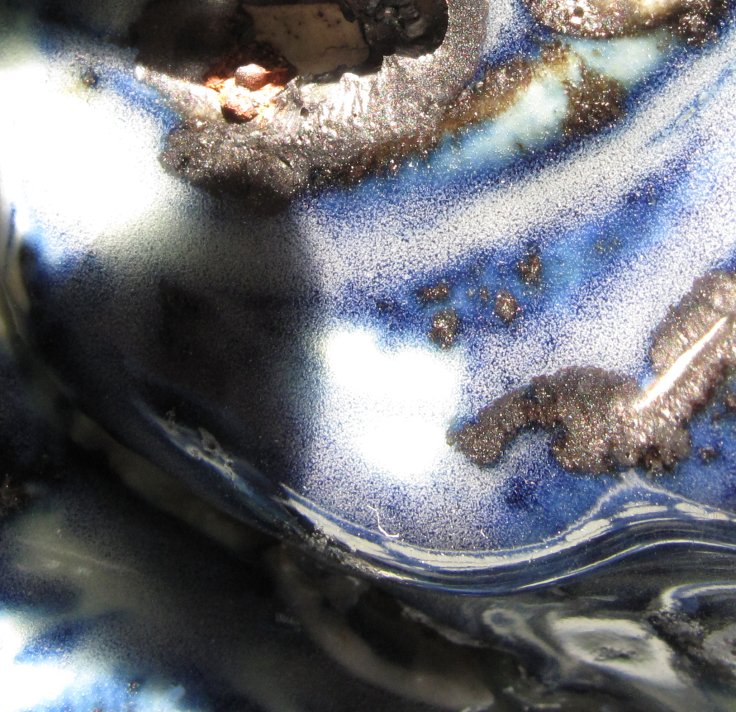
Now, I am going to show you the very beautiful glaze of this ware. Look at the photos carefully, and try to remember what the glaze is like  (Figures 14-29).
 

IMG_7805.pngFigure 14   


IMG_7884 (1).pngFigure 15


IMG_7886.pngFigure 16 


IMG_7872.pngFigure 17  


IMG_7875.pngFigure 18


IMG_7888.pngFigure 19   


IMG_7838.pngFigure 20   


IMG_7837.pngFigure 21


IMG_7829.pngFigure 22    


IMG_7826.pngFigure 23   


IMG_7822 (1).pngFigure 24  


IMG_7818.pngFigure 25 


IMG_7819.pngFigure 26    


IMG_7816.pngFigure 27    


IMG_7817.pngFigure 28   


IMG_7814.pngFigure 29  

As I have told you, the beauty of the glaze of a ceramic ware is very subtle. You cannot define it. It is mostly a subjective feeling, yet a feeling that is shared by connoisseurs and experts. You can only tell with experience after you have seen many many pieces of ceramic wares. Here in this Yuan charger, I think the glaze is not only thick, but very beautiful. And I can tell you that many of my collector friends share the same thought. They all like it. 

It is interesting to note that after Xuande, beautiful glaze in a ceramic ware is seldom seen. But why? Technology is always getting better, why not the glaze? I suppose it has a lot to do with the ingredients. Potters do not want to tell their secret formulae, particularly the essential constituents. But to me, that is only part of the answer. The real answer might be that the ingredients are extremely expensive and rare, and potters at a later period simply cannot afford the exorbitant price. And after a while, the names of these ingredients are simply forgotten. Nowadays, even our very capable forgers are not able to figure out the formulae and reproduce a glaze that is half as good.

Magnificent Reflections of Magnificent Plaques in a Yuan Blue & White Rectangular Flask

I am not a good photographer. In my attempt to make more beautiful photos of the ceramic wares, I have tried many methods, but the results are not very satisfactory. I have recently discovered that to take better photos, the morning sun and the setting evening sun are probably the best time to do the shots. This is particularly true with the plaques when you want to high-light the effect of sunlight on the reflections of these plaques. The photos that I am going to show you were all taken under the early morning sun or the setting sun in the evening. You must pay attention to the reflections of these plaques. The ware is a Yuan Blue and White Rectangular Flask, measuring 15 1/8 inches tall.

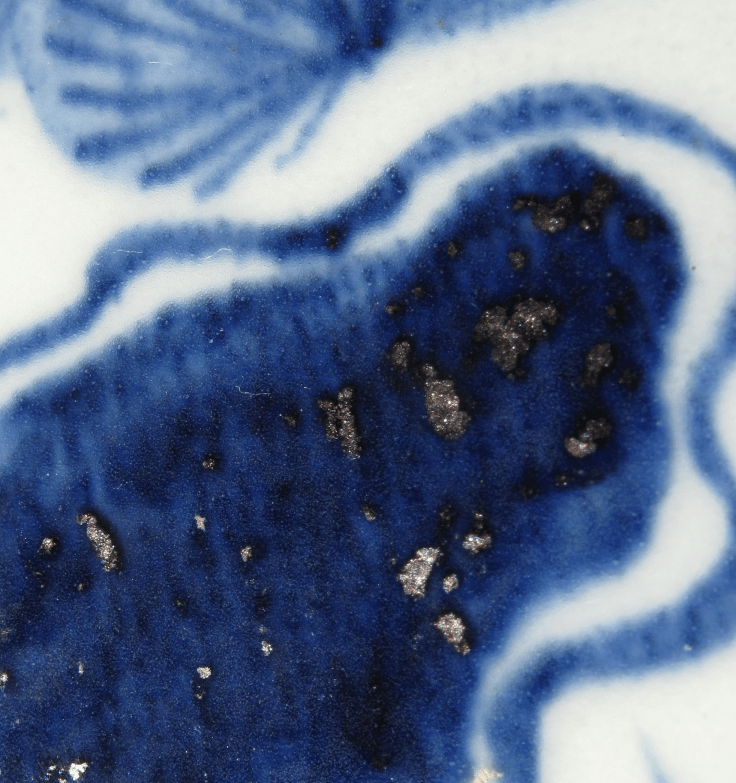
Plaques are important feature of the Sumali Blue dye, and in Yuan B & Ws, I have told you many times previously, the plaques are particularly extensive. They are rather coarse when you look at them with your naked eyes. Many a time, they just appear to be aluminum foils floating on top of the blue dye where the color is dark. But under the sun, the reflection is remarkably colorful. When photos are taken, and when you can capture the reflection, you will be amazed at the beauty of the color of the reflections.


IMG_7530.pngFigure 1  

 Let me first show you the plaques. They are so beautiful that you do not feel you need to doubt the authenticity of the ware, for no forgers can ever mimic any plaques like these.


IMG_7605.pngFigure 2


IMG_7684.pngFigure 3   


IMG_7685.pngFigure 4 


IMG_7773.pngFigure 5  


IMG_7774.pngFigure 6   


IMG_7775.pngFigure 7   


IMG_7776.pngFigure 8   


IMG_7780.pngFigure 9    


IMG_7784.pngFigure 10


IMG_7785.pngFigure 11    


IMG_7786.pngFigure 12  


IMG_7791.pngFigure 13  


IMG_7800.pngFigure 14   


IMG_7762.pngFigure 15  


IMG_7767.pngFigure 16   

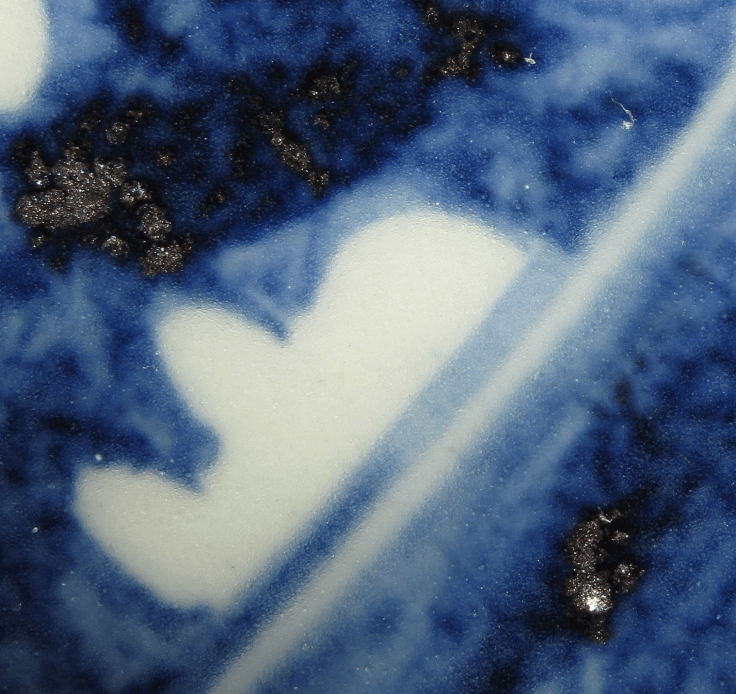
In these photos (Figures 2-16), you have to look at not only the beautiful colors of the plaques, but the bubbles nearby, which many a time, are also colored by the reflection. The plaques are but colored particles aggregated together, and they need not to be uniform. that is why some part of the plaque is thicker than the other. Where the plaque is particularly thin, it might break apart and something that looks like a crater is formed. The blue dye pigment that has this feature must be quite different from those in the Yongle and Xuande periods, when this particular feature is almost not seen.

The colored bubbles seen here are in fact commonly seen in B & Ws that have plentiful of plaques, not only in the Yuan period, but also in Yongle and Xuande. It only means that in the glaze, there are many, many tiny colored particles floating around. Most of them would aggregate together to form a plaque. But there are still many that are still wandering freely. Some would attach to nearby bubbles. If there are enough of them attaching to a bubble, that particular bubble would be colored. If your photo can captured that feature, it would be very beautiful.

Now, in case you are looking for the flare and dripping effect, you can see them in any of these photos, but Figure 8 is one photo that you don’t want to miss.

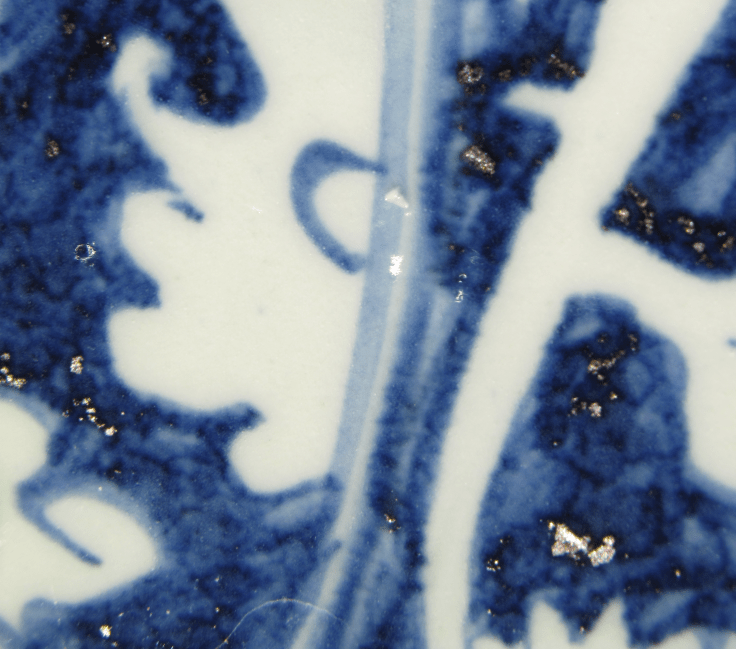
You will also note the large and small bubbles. Most of the time, the large bubbles are rather few, and they are, like large bubbles in the Sumali Blue dye, lie within a pool of dark blue dye. But in certain areas, the large bubbles are more abundant (Figure 17). This only serves to support my theory that potters in those times had something like a palette to hold their different types of blue dyes, and they used different dyes to suit their purpose when they drew their motif.  The small bubbles, on the other hand, are very tightly packed, and rather small. that is why lacunae formation is very obvious. Examples are plentiful in all these photos, and you do not have to look hard to find them. But I’ll show you more (Figures 18-22).


IMG_7764.pngFigure 17   


IMG_7790.pngFigure 18 


IMG_7656 (1).pngFigure 19   


IMG_7628.pngFigure 20 


IMG_7627.pngFigure 21   


IMG_7655.pngFigure 22   

In these photos, even without enlarging them, the lacunae are already very obvious. But if they are enlarged just a little bit, the lacunae stand out even better. I think lacunae like these are very charming and delightful. What do you think?

If you look at the blue patches of these photos, you will note that the blue background is not homogeneous—across the blue areas, there are streaks of deeper blue coloration spreading around here and there. They are more noticeable in Figures 19, 20, and 22. But if you look at all the blue patches carefully, you will see the same phenomenon. The potters, when they painted the ware, have no control over these. These are dye pigments deposited randomly in the blue patch. I call this mottling. And I have told you before that blue dyes showing mottling are dyes with very good quality. Let me show you more of these mottlings.


IMG_7771.pngFigure 23  


IMG_7777.pngFigure 24  


IMG_7779.pngFigure 25    


IMG_7799.pngFigure 26  


IMG_7609.pngFigure 27  

Look at these mottlings again. Are they not wonderful? Are they not splendid?

I’ll add one more point here. The blue coloration of this flask, a peculiar kind of deep blue, is very typical of a good Yuan B & W.

With all these features, do you need an experienced expert to evaluate if the ware is genuine or not?

A Yuan Blue & White Charger


When a ceramic collector comes across a ceramic ware that he likes, the first natural thing he would do is to see if it is real and genuine. This is not easy, even for an experienced expert. It is easier if the collector only collects Blue and White of the Yuan era and the early Ming period. We all know that potters in these periods use the Sumali Blue dye pigment to draw their motif. Once the collector can identify the blue dye as Sumali Blue, he can be sure that he is dealing with a genuine ware. The only problem here is that the Sumali Blue dye is not something that is very uniform. As we have seen in the previous articles, it is quite the contrary. 

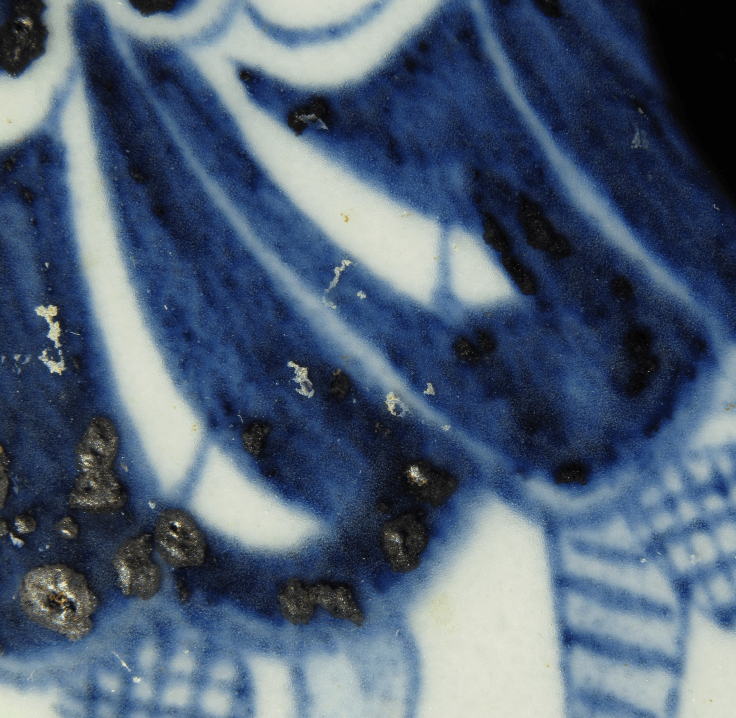
I don’t want to make a generalized statement here, but in Yuan B & Ws, most of the time, there are a lot of plaques. In Yongle B & Ws, you don’t expect that many plaques, and in the Xuande period, they are even less. And in the evaluation of Yuan B & Ws, the plaques are very important. In many instances, I can go so far as to say that just by looking at the plaques, you very much know whether you are dealing with a Yuan ware or not. In this Yuan charger that I am going to show you, I’ll focus on the plaques. They have very distinctive features that are characteristic of Yuan plaques. In examining these plaques, I have told you before, but I’ll repeat it here, it is essential that you do it under direct sunlight. Not in daylight, but directly under the sun. That is when you can see the reflections best.


IMG_7305.pngFigure 1  

This charger measures 17 1/4 inches in diameter. Let me begin by showing you some of the very characteristic plaques (Figures 2-10).


IMG_7452.pngFigure 2  


IMG_7454.pngFigure 3  


IMG_7457.pngFigure 4  


IMG_7463.pngFigure 5


IMG_7506.pngFigure 6  


IMG_7511.pngFigure 7


IMG_7489.pngFigure 8  


IMG_7490.pngFigure 9   


IMG_7494.pngFigure 10  

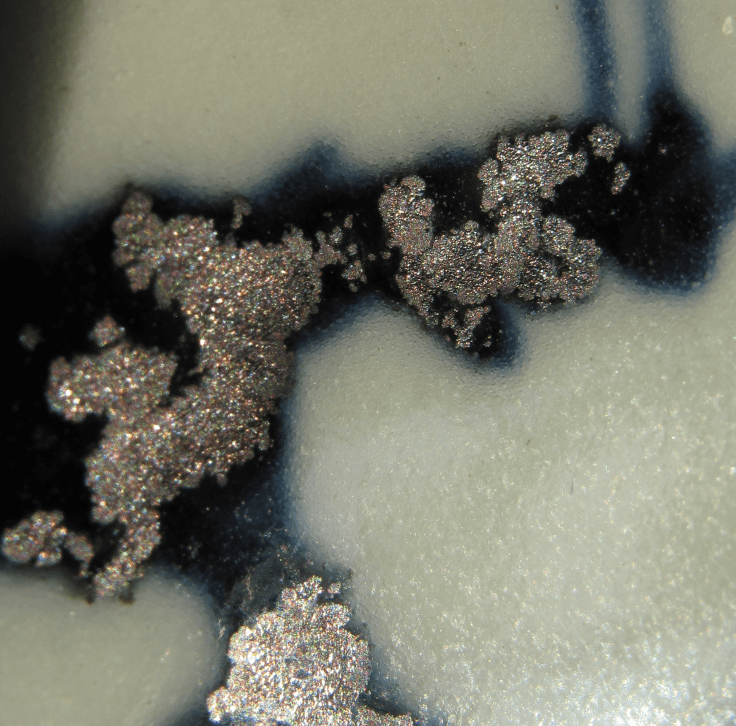
Look at these photos carefully. The plaques are vey colorful. Particles of highly reflective index dotted the main plaques here and there. Many a time, these highly reflective particles drifted beyond the margin of the main plauqe, and become brightly lit dots in nearby territory of different colors. In Figure 6, these color particles are so extensive that many bubbles in adjacent areas are all colored. In Figures 8-10, these drifted away color particles coalesced partly together as to form a thin veil around the main plaques. Are they not unique?

 I suppose all these brightly colored particles that flow around the plaques should have been part of the main plaque, but for whatever reasons, they fail to form part of it. You must note that this phenomenon is not unique to Yuan B & Ws, and you do see such appearances in Yongle and Xuande wares. But then, they are much more uncommon, and the particles not so colorful.

I need to point out to you that these plaques, when you look at them with the naked eye, appear to be rather coarse aluminum foils. You do not get the very refine feeling that you have when looking at plaques of Yongle and Xuande wares.

 What do you think will happen when these plaques are examined in daylight, but not under the sun? Or when they are photographed under LED light. Figures 11-16 are taken under LED light, and you can tell the differences.

IMG_7334.pngFigure 11    


IMG_7332 (1).pngFigure 12


IMG_7340.pngFigure 13


IMG_7339.pngFigure 14  


IMG_7336.pngFigure 15   


IMG_7345.pngFigure 16

 Now, in all these photos, try to pay attention to the flares, drippings and the bubbles. You will note that the features of all these fall conveniently into what I have previously described to you. The large bubbles, sometimes forming a string (figure 10) all lie within the dark blue coloration, many a time, right next to the plaque. The large bubbles, like typical Yuan B & Ws, are not particularly large. They are obviously not as large as some of the Yongle ones. And they do not have very small bubbles immediately surrounding them, like satellites. They are also typically pearly, translucent rather than transparent.  

Look at the flares, and the drippings. And look at some of the small blackish spot that are break-aways from the mainly blackish mass. They break away from the main mass because the components of the tiny spot has constituents that have a greater specific gravity, allowing them to fall under gravity faster than the main mass. As I have told you before, dyes showing these break-away spots tend to be dyes of very good quality, and you need to take note of this too.

Another rather spectacular phenomenon seen in Yuan B & Ws is with the small bubbles. Small bubbles are small in Yuan wares, and often very tightly packed. But these tightly packed small bubbles do not give an impression of chaos or disarray. There is no feeling of a disoriented state. The only reason is that these small bubbles are arranged in lacunae, tightly packed lacunae. Let me show you photos of these (Figures 17-23).


IMG_7317.pngFigure 17 


IMG_7337.pngFigure 18  


IMG_7348.pngFigure 19  


IMG_7356.pngFigure 20   


IMG_7322.pngFigure 21  


IMG_7393.pngFigure 22   


IMG_7449.pngFigure 23  


IMG_7436.pngFigure 24  

In some of these photos, the lacunae are not immediately obvious. Enlarge the photo slowly bit by bit, there is a point when you can see the lacunae stand out, and you’ll be amazed how beautiful these lacunae are, and it is in the Yuan B & Ws that this phenomenon of beautiful lacunae occur most frequently.

If you look at all these photos again, and note their specific features, would you be totally convinced that you are dealing with the Sumali Blue dye. Even without looking at the motif, which is plainly Yuan, you are quite certain that this is a Yuan B & W.

A Xuande Blue & White Stem Bowl

By now, I am sure you realize that the key to evaluate a Blue and White of the early Ming era is the recognition of the Sumali Blue dye. Not that the shape of the ware, the way the ware is potted, the way the motif is drawn are not important—they are very important. They are the cornerstone in the conventional evaluation process. The only problem here is that, with modern technology, and the rapidly expanding information industry, forgers have the knowledge and means to imitate everything they want to imitate. Collectors have a hard time in telling the real thing from the forged. 

The only area where forgers cannot imitate is the dye—the Sumali Blue dye. The reason is that we have no idea of the composition of the dye, not even for the well informed forgers. It is the characteristics of the dye that forgers cannot copy. That is why we need to know such characteristics and how they present themselves. The troubling issue here is that the presentations of the dye varies so much that it is almost impossible to categorize and classify them. We can certainly do that up to a point. But beyond that, the only way to recognize the dye and its characteristics is by looking at as many wares as we can lay our hands on, and to expand our knowledge and experience on this aspect. That is why I am showing all these photos of special features of the dye here in this blog. I hope that more collectors will do the same, so that those who are interested in evaluating ceramics of the early Ming period will have something to help them to start.

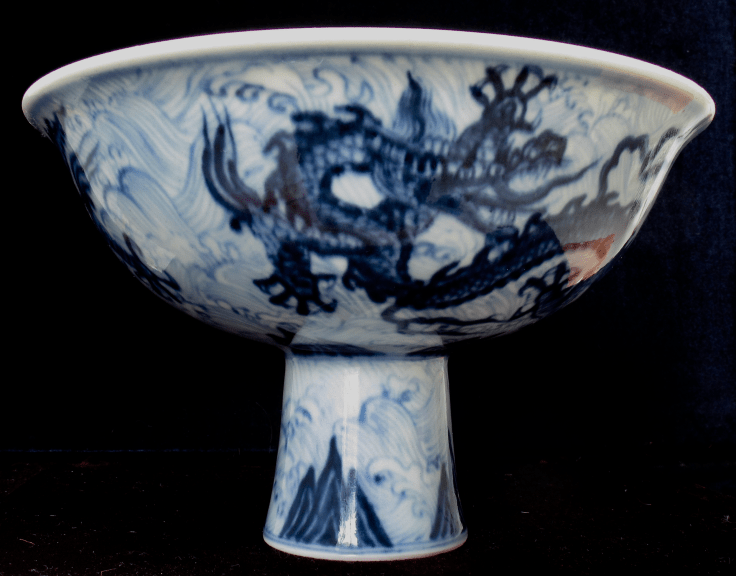
In the last two articles, I have shown you the plaques in the two Yuan wares. Yuan Blue and Whites have a lot of large plaques. That is no longer true in Yongle B & Ws. In Xuande period, some of the B & Ws have rather small plaques, as in this Xuande stem bowl that I am going to show you. Look at the plaques in these wares, and you will understand how different they are, and the extend of the variation in presentation.

IMG_7201.pngFigure 1

This stem-bowl is 4 inches tall, and its diameter is 6 3/16 inches. Now let me show you the plaques of this bowl (Figures 2-12).


IMG_7102.pngFigure 2   

IMG_7105.pngFigure 3   

IMG_7111.pngFigure 4   

IMG_7112.pngFigure 5  

IMG_7120.png

Figure 6   


IMG_7121.pngFigure 7  


IMG_7127.pngFigure 8 


IMG_7128.pngFigure 9   

IMG_7106.pngFigure 10


IMG_7130.pngFigure 11  


IMG_7143.pngFigure 12   

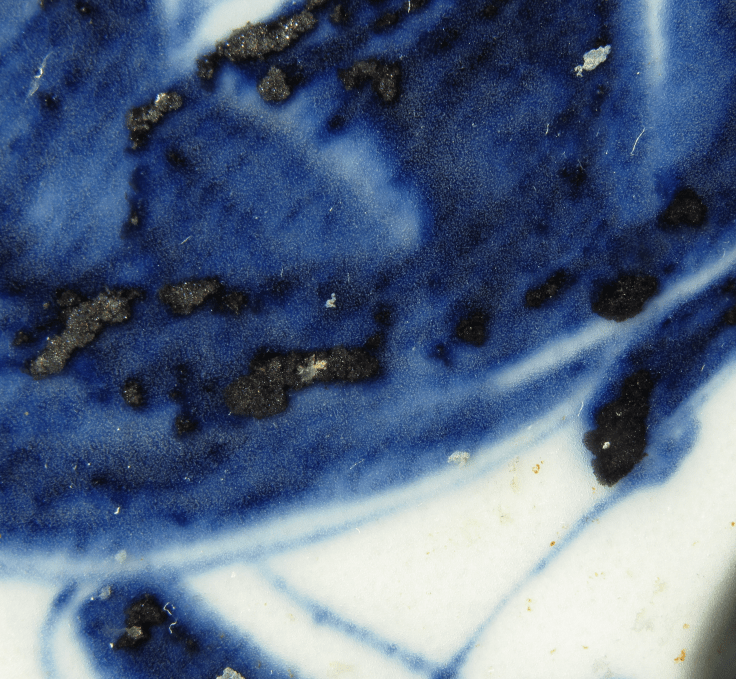
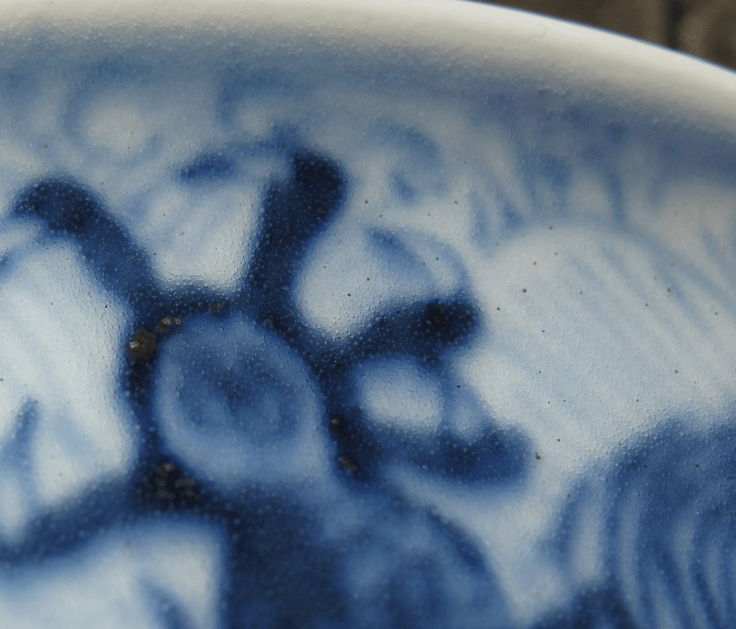
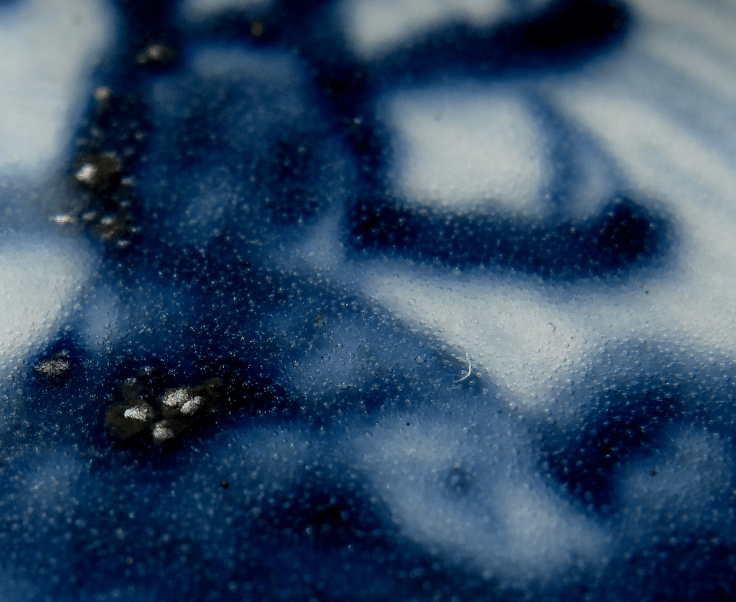
Note the size of the plaques here. Compare to the size of the bubbles, and you know that they are small. Note also that these are plaques without a floating metallic layer on top, that is to say, they are not mature plaques. They only have the muddy layer. Please also note that many plaques are not reflective of the colorful sunlight. And in plaques where there is a reflective element, it is only a small portion of the plaque that is reflective. The rest is non-reflective. We have seen that in some wares the muddy layers have very colorful reflections, and we can only surmise that the muddy layer is a very complicated structure. Some of the structure contains rich components that is highly reflective to sunlight, whereas in other structures, the constituents are simply not reflective to sunlight. 

There is one further point that I want to make here. In a ware such as this with small plaques only, and there is no reflective elements in any of the plaques, I would have the tendency to be very wary. I would think thrice before I can say if the ware is real and genuine.

In all these photos, try to look for the flare and dripping effect. Every photo has this. This stem-bowl has almost no horizontal surface, so that the effect is mostly caused by gravity and dripping. I’ll show you a few more photos where the dripping is more intense, as in so many other B & Ws of that era (Figures 13-16).

IMG_7179.pngFigure 13   


IMG_7187.pngFigure 14   


IMG_7125.pngFigure 15  

IMG_7194.pngFigure 16  

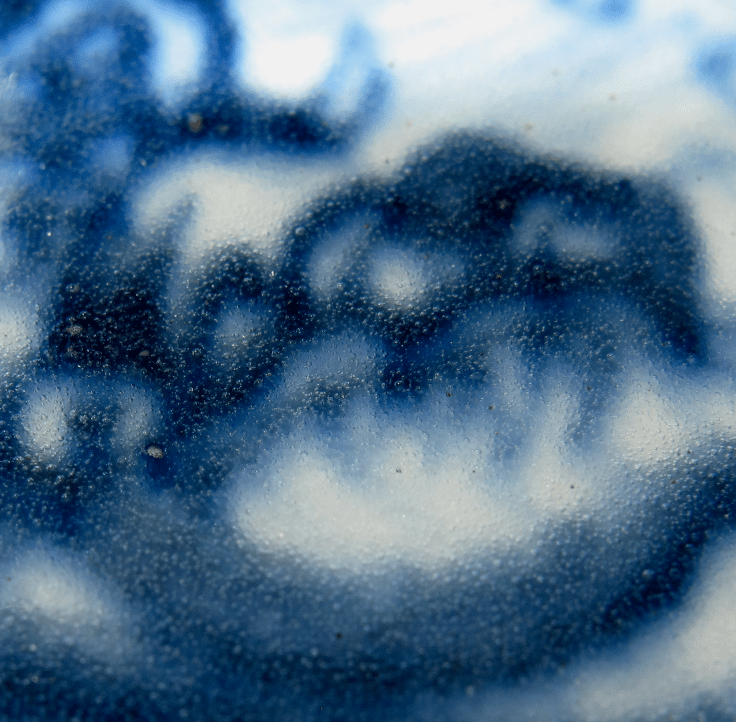
In figure 13 and figure 14, you can see the intense small blackish spots dripping down from the main deep blue mass. Whereas in figure 16, the dripping is most obvious at where the bowl joins the stem. There, at the point where they join, you can see the bubbles are particularly abundant. This is almost a constant feature in any ware. If you enlarge the photo a bit, here you can see some lacunae very clearly. In this stem-bowl, the small bubbles are not very small, and they are not closely packed together, that is why, lacunae formation in most areas are not vey obvious, though, if you look more carefully, you certainly see them in many of the photos.

This brings us to another important feature of the Sumali Blue dye, the bubbles. Here in this stem-bowl, the bubbles conform to the very basic pattern of the Sumali Blue dye. The bubbles are basically very well arranged.  There is no area where the bubbles appear to be in disarray. You do not feel any disorder, confusion or chaotic arrangement of the bubbles anywhere. The large and small bubbles are well proportioned, and the large bubbles are typical of large bubbles of the Sumali Blue dye. Look at them carefully, and you will agree with me. And I’ll show you more photo just to illustrate this point (Figures 17-23).


IMG_7138.pngFigure 17


IMG_7156.pngFigure 18  

IMG_7183.pngFigure 19  


IMG_7199.pngFigure 20  


IMG_7128 (1).pngFigure 20


IMG_7191.pngFigure 21   


IMG_7190.pngFigure 22

IMG_7131.pngFigure 23  


Before we leave here, let me show you the mark (Figure 24).


IMG_7158.pngFigure 24   

A Blue and White Yuan Vase


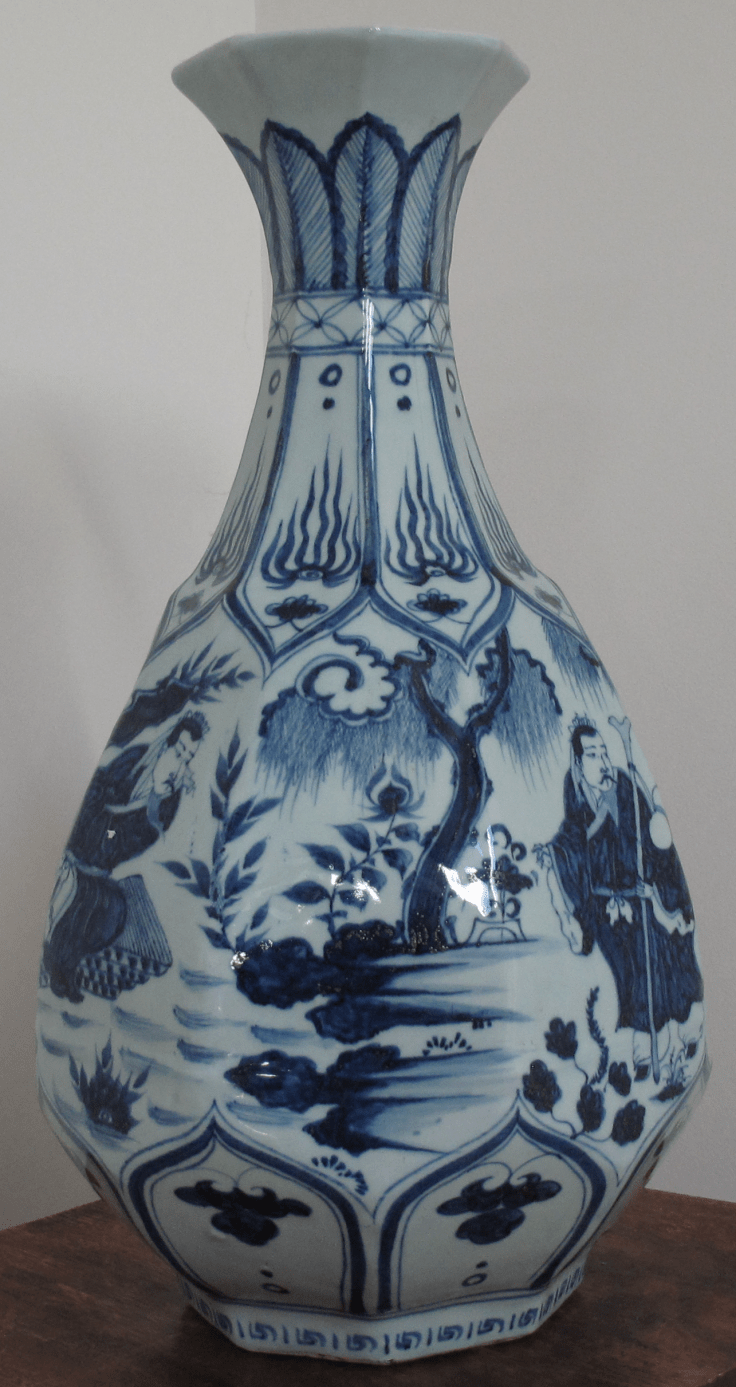
In the past I have shown you quite a number of Yuan Blue & Whites. In the last article, I showed you a large Zhihu, and in the process, I showed you the plaques and bubbles of the Zhihu. The plaques and bubbles are not exactly the same as those plaques and bubbles in the other Yuan B & Ws. They are all similar, but not exactly the same. Every ware has its own characteristics. This has a lot to do with the nature of the Sumali Blue dye pigment. But the fundamental problem here is that we do not have a clue as to the composition and constituents of the dye. We do not know even its place of origin. So, for us to understand more of the variations of the dye, the best approach is to look at more wares that are painted with the Sumali Blue dye. We need to know that the dye has a clear pattern of presentation, and certain characteristics. So here, again, I am going to show you another Yuan B & W, a vase, and you can compare the characteristics of this vase with the Zhihu in the last article, and the other wares that I have shown you here in this blog. It does not matter if the ware is a Yuan, a Yongle or a Xuande. Just look at the characteristics and you will know more about the presentation of the plaques and bubbles of the Sumali Blue dye.

This Yuan vase is also quite large. It stands at 19 1/4 inches tall.


IMG_6838.pngFigure 1

Let us first look at the plaques of this vase (Figures 2-8).


IMG_6859.pngFigure 2  


IMG_6846.pngFigure 3


IMG_6849.pngFigure 4   


IMG_6851.pngFigure 5   


IMG_6870.pngFigure 6   


IMG_6869.pngFigure 7   


IMG_6856.pngFigure 8  


IMG_7040.pngFigure 9

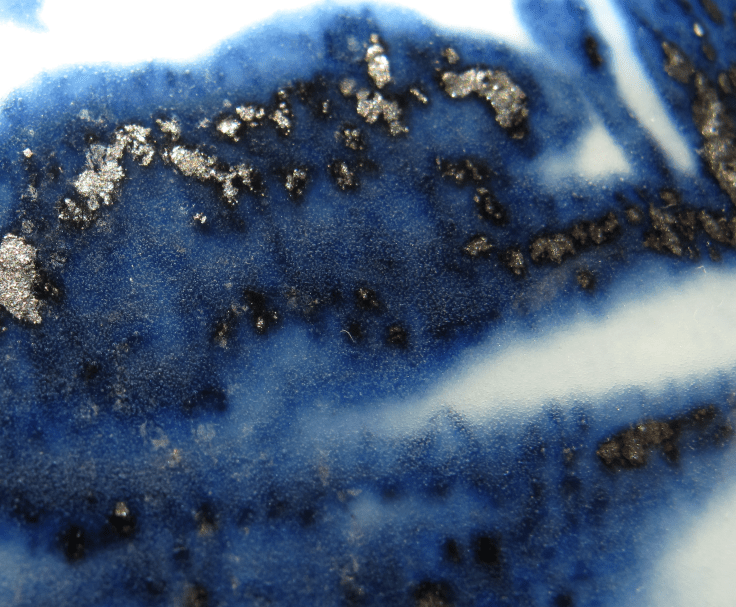
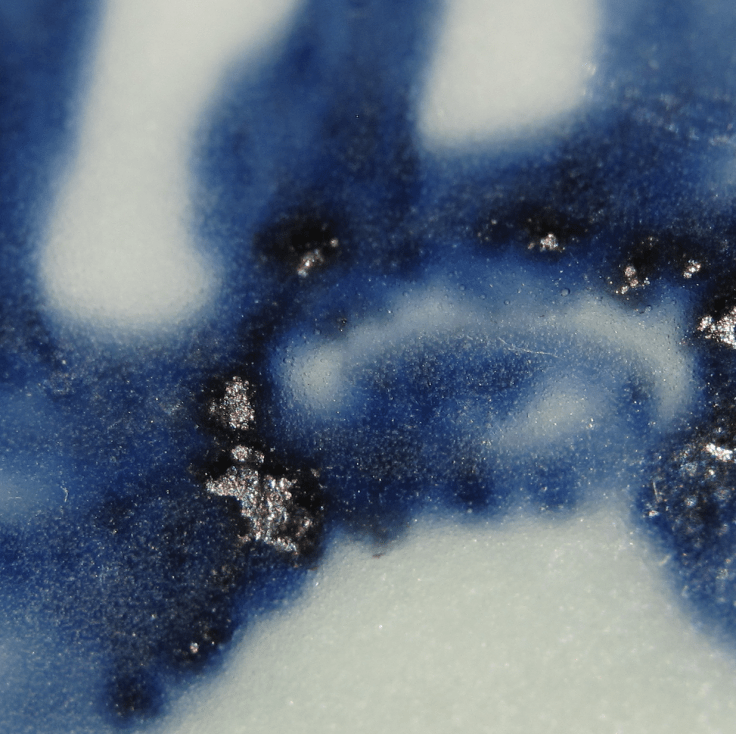
Look at these plaques carefully. They have the common features seen in Yuan wares. The plaques are large and you have quite a large number of them. They are quite colorful, though much less so when compared to some of the plaques with muddy layers only in the Yongle and Xuande wares. And they give you a feeling of coarseness, quite unlike those floating foils in Yongle era, which are much finer. They are rather like coarse sands in some beaches as compared to very fine sands in other beaches. The shiny metallic foil floating on top tends to be large in one continuous sheet. In figure 2, figure 8 and Figure 9, one can actually see holes in some of the sheets. I suppose the holes are created when the gas bubbles trapped below the sheet become too large, and they have no way to go except to burst through the weakest part of the foil. These photos are all taken under sunlight.

When photos are taken under LED light, or LED light combined with sunlight, the plaques reflect the colors differently. They are no longer as colorful. And you can tell that the photo is taken with the LED element in it by the shade of the blue coloration—it is a different shade of blue.


IMG_6956.pngFigure 10  


IMG_6958.pngFigure 11  


IMG_6966.pngFigure 12   


IMG_6977.pngFigure 13


IMG_6980.pngFigure 14  


IMG_6994.pngFigure 15    


IMG_7001.pngFigure 16   


IMG_7012.pngFigure 17   


IMG_6935.pngFigure 18  


Note that in these photos (Figures 10-18), the coarse granules become less obvious. They look as though they become coalesced together with a lot of denting on top. When granules reflect colors that are not distinguishable from one another, this is the result.

You must have also noticed that these plaques are all sitting in a small pool of blackish dye that is a typical characteristic of the Sumali Blue dye. The amount of dye applied must have been very liberal for the blackish color to be so intense. Look at the dripping effect and you know what I mean, particularly at the edge of the dye. Good example can be found in Figures 12, 13, 15, and 17. In many of these dripping, you can also find small blackish dots breaking away from the main plaque/dripping. These are beautiful and I’ll say it again that the occurrence generally indicates that the quality of the dye is good.

In these photos, you can also see that the bubbles behave in a typical manner of the Sumali Blue dye. You have large and small bubbles, though the large bubbles here are, to me, just a little bit smaller than the large bubbles in other Yuan wares, not to say those in the Yongle era. The small bubbles are also smaller, and very tightly packed, basically allowing the formation of very beautiful lacunae. Enlarge some of these photos, at some point of the enlargement, nice lacunae can be seen very well. Again, note the large bubbles sitting in a pool of dark blue dye, and many a time, lurking around the plaques. I’ll show you more photos of these features (Figures 19-30).


IMG_7010 (1).pngFigure 19  


IMG_7002.pngFigure 20  


IMG_7004.pngFigure 21   


IMG_6997.pngFigure 22   


IMG_6987.pngFigure 23  


IMG_6985.pngFigure 24    


IMG_6976.pngFigure 25    


IMG_6972.pngFigure 26  


IMG_6970.pngFigure 27   


IMG_6866.pngFigure 28   


IMG_6939.pngFigure 29


IMG_6943.pngFigure 30    


Look at these photos carefully, and look at the plaques, the drippings, the bubbles and the lacunae, and the peculiar features that are associated with these. Compare these photos to photos of other ware and note the similarities and differences. Figures 29 and 30 shows you how the dye behaves over a ridge, how the plaque, and the plaques that are in the formative state look like. These features are very specific to the Sumali Blue dye. When you see these features, you have no doubt that the dye is Sumali Blue dye, and that the ware is genuine and real.

Blog at WordPress.com.

Up ↑