Blog

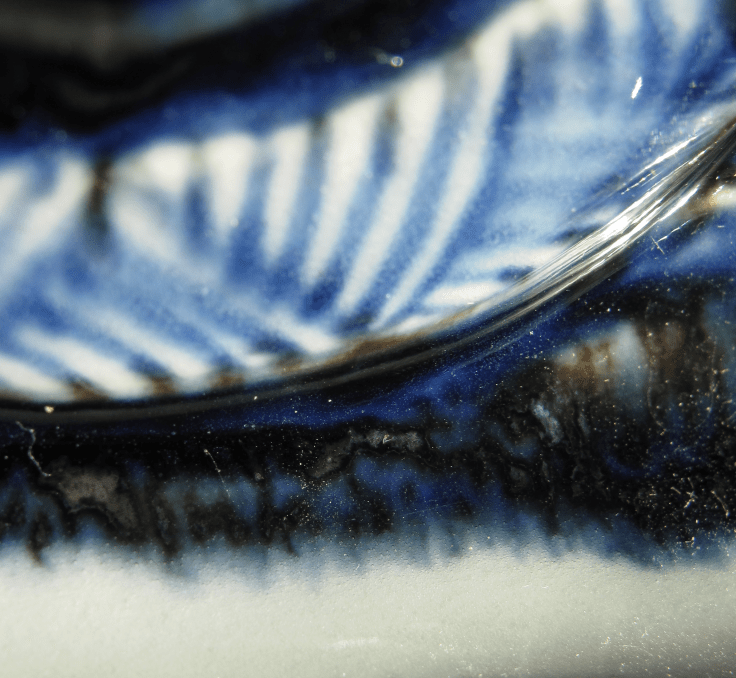
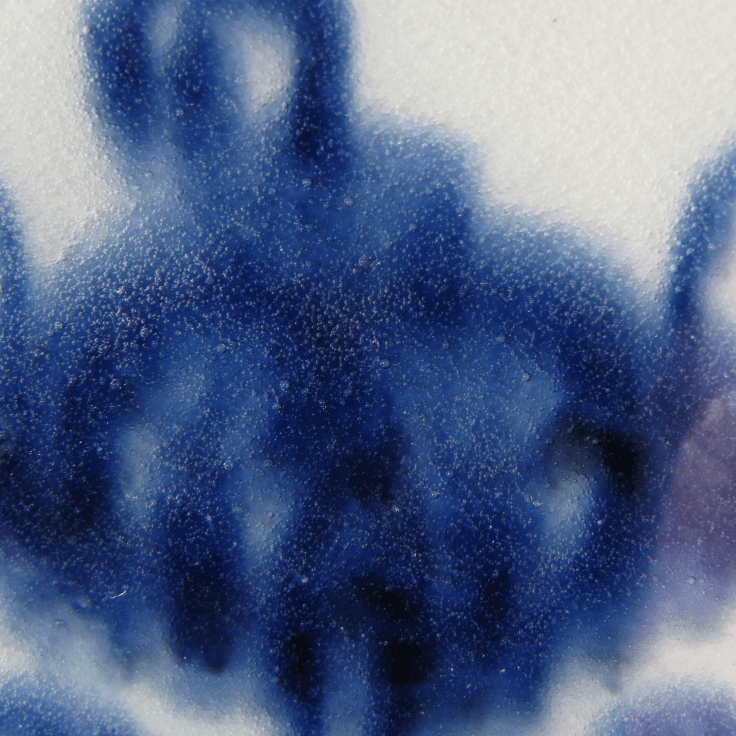
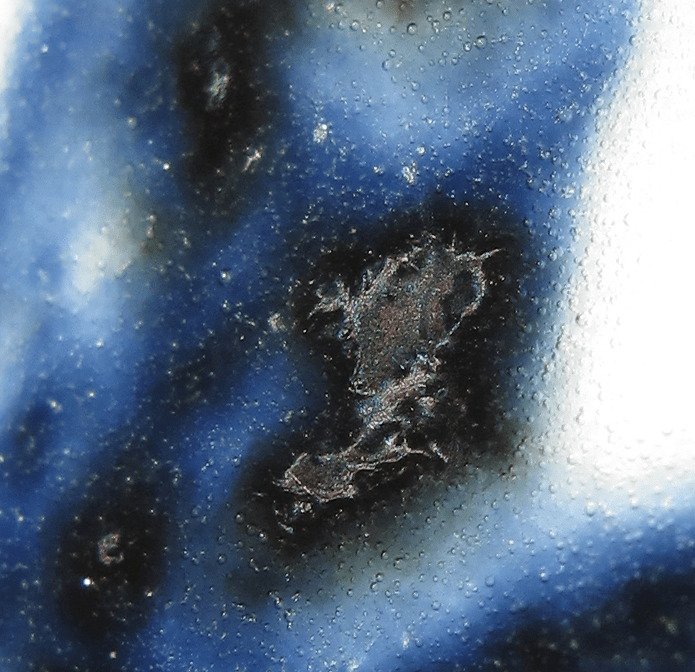
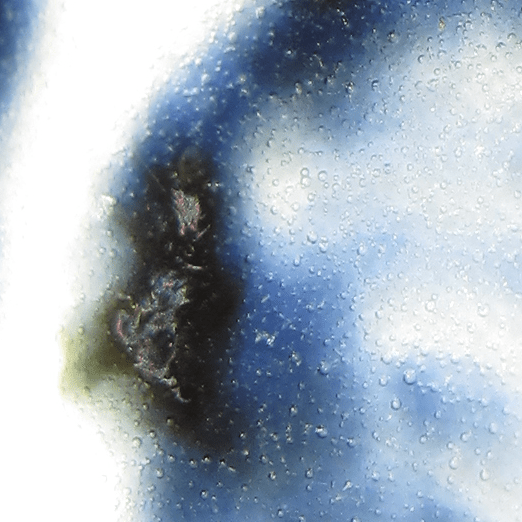
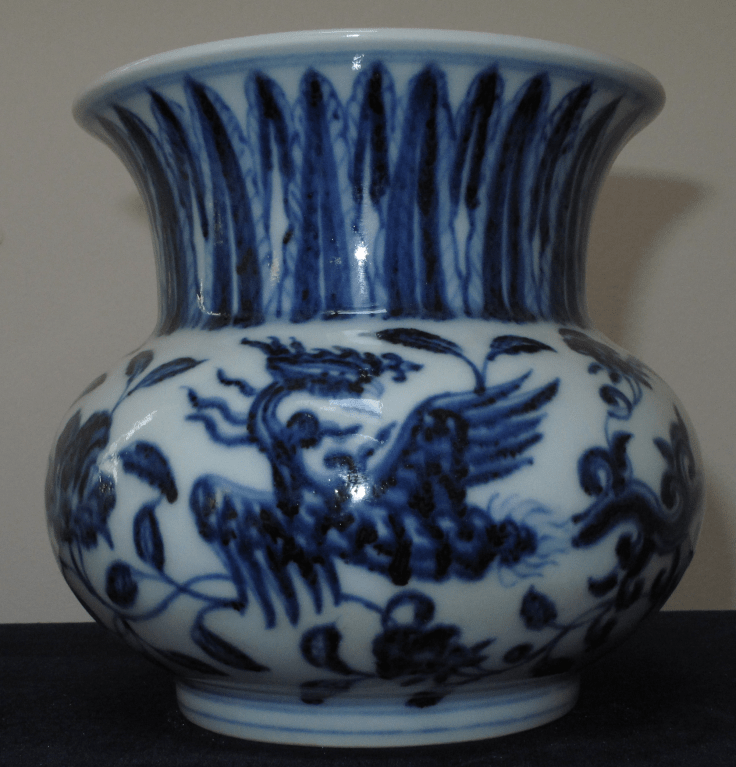
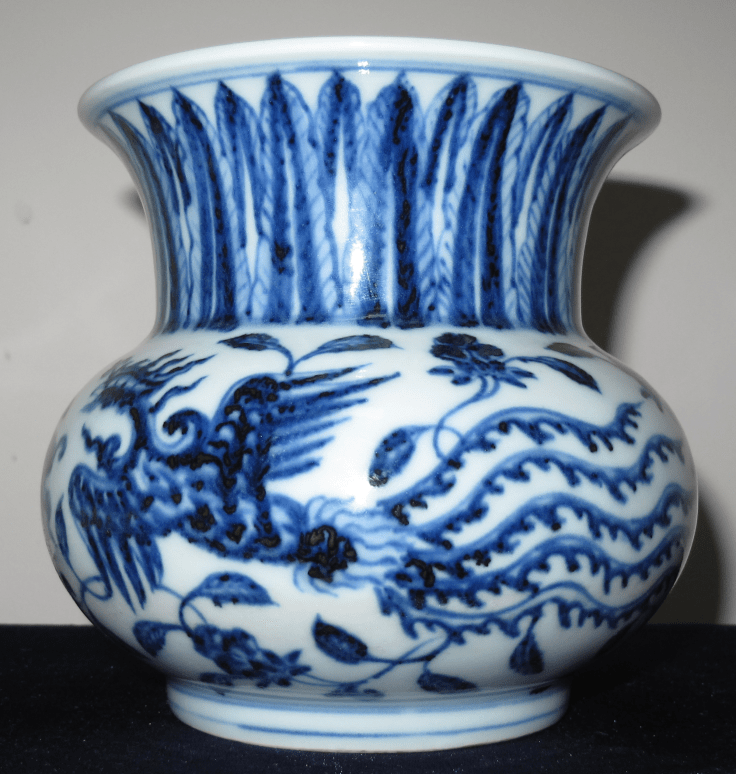
A Large Blue & White Yuan Zhihu 執壺


During the eighty years, from the late Yuan Dynasty to the end of Xuande, when The Sumali Blue dye pigment is imported, ceramics in China have undergone a series of changes. It is easy to understand they evolve all the time, if we were to compare them to the technology that we have today. The shape of the ware, the size, the design and the material used change from time to time. Even the nature of the Sumali Blue dye, and the way it is applied  in the motif differ from one period to the other. We have observed these changes in our study of the wares in those periods.

A good example would be the size of the ware. Yuan Blue and Whites are known to be large. They are larger than those in the Yongle and Xuande period, not to say the Chenghua era. The blue coloration in Yuan Blue and Whites is, generally speaking, of a deeper blue. The potters apply the dye so very liberally that sometimes the blue color is very dark, so dark that it might look like blackish. The Sumali Blue dye is well-known to be very expensive, and we are sometimes puzzled why potters use the dye so very freely. My speculation is that when the sellers first export the dye, they never realize the demand for the dye would increase in an exponential manner. They market it with a great promotion. The first potters using the dye do not find the cost to be prohibitive, and they use the dye lavishly.

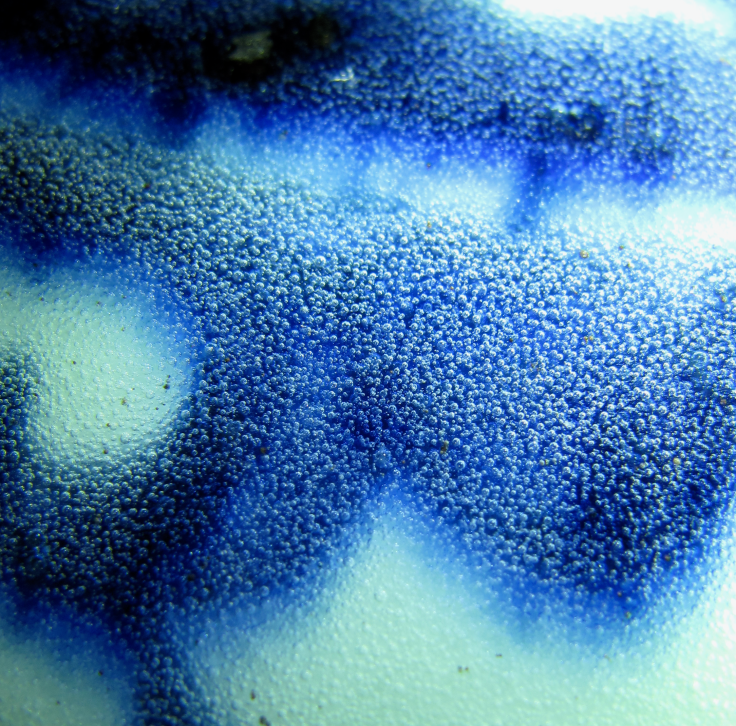
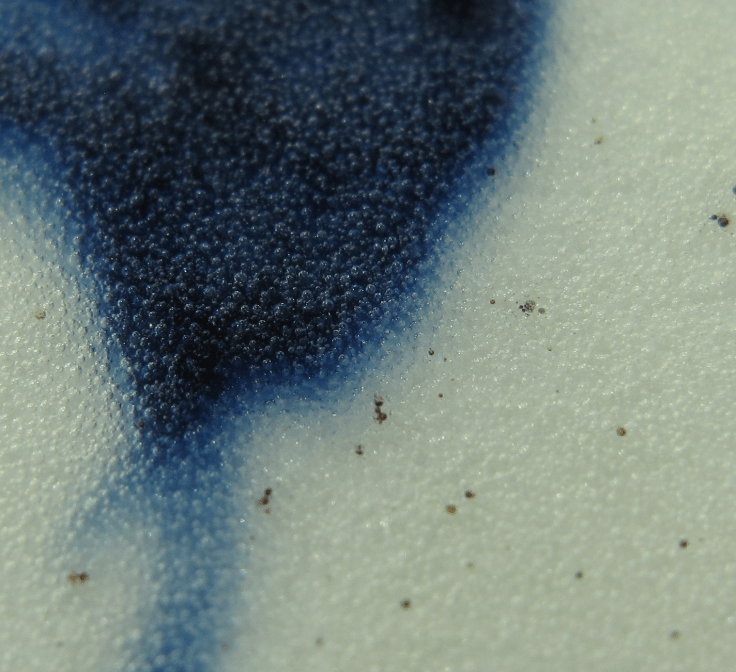
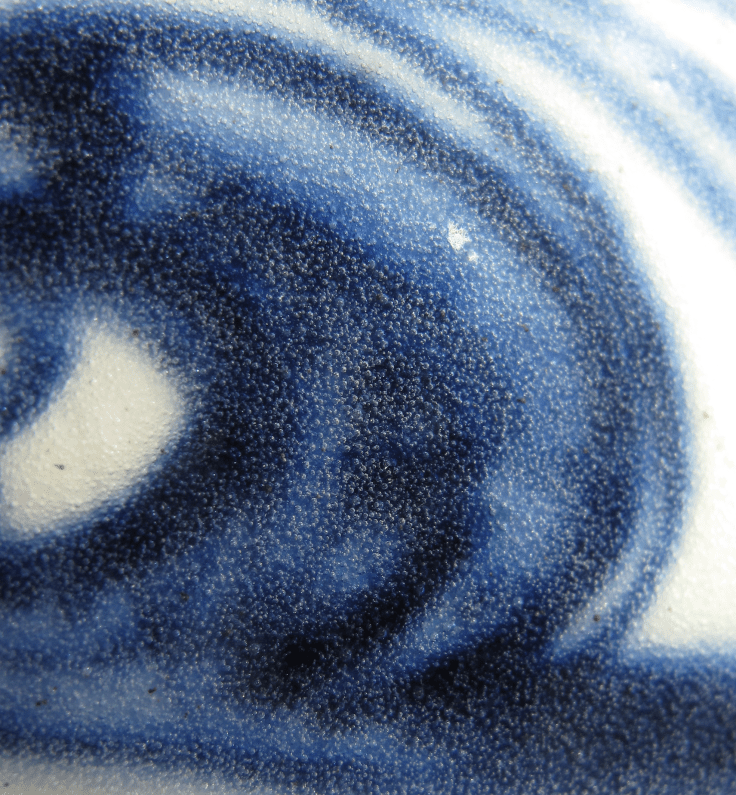
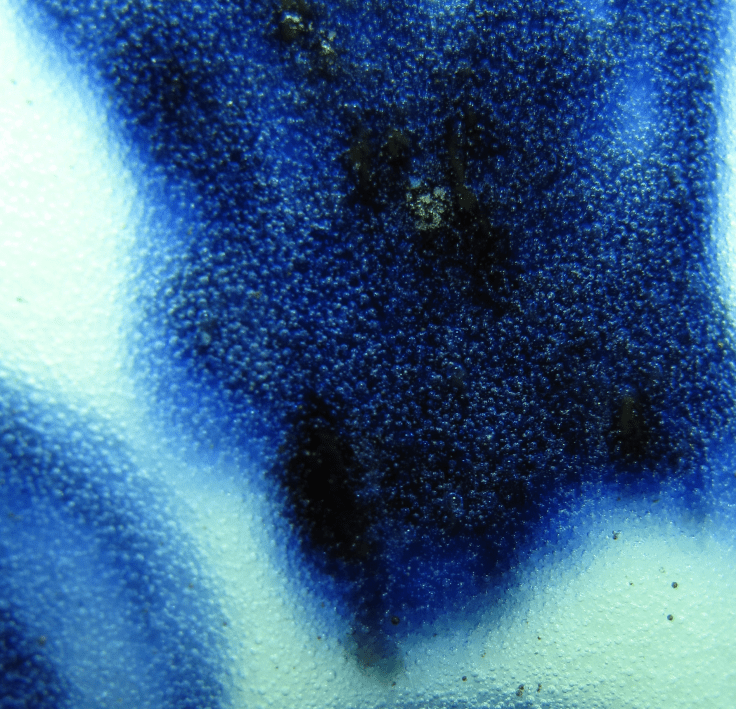
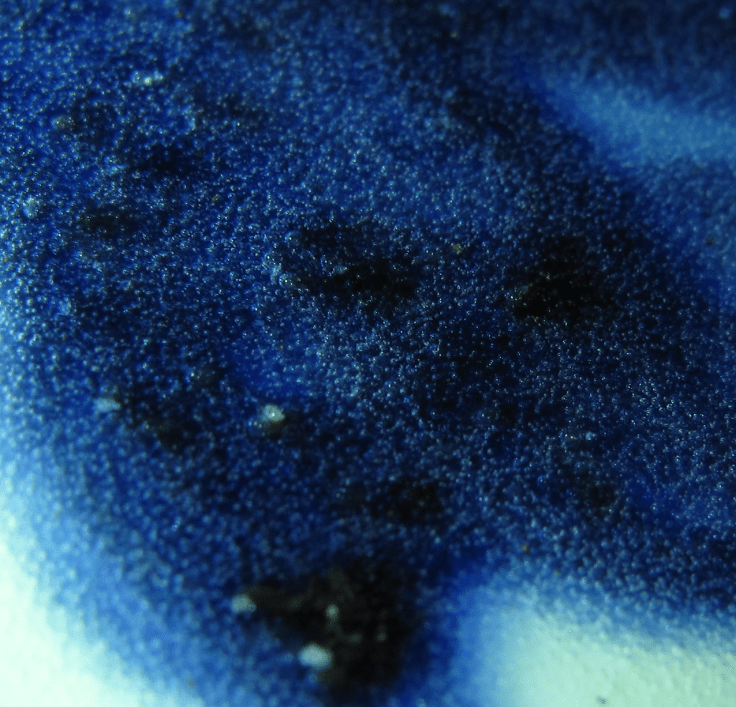
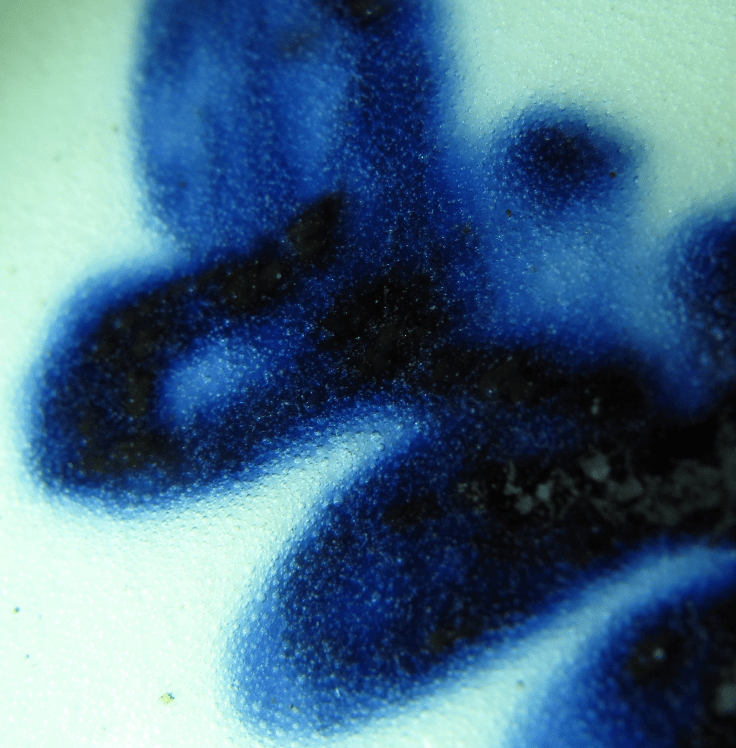
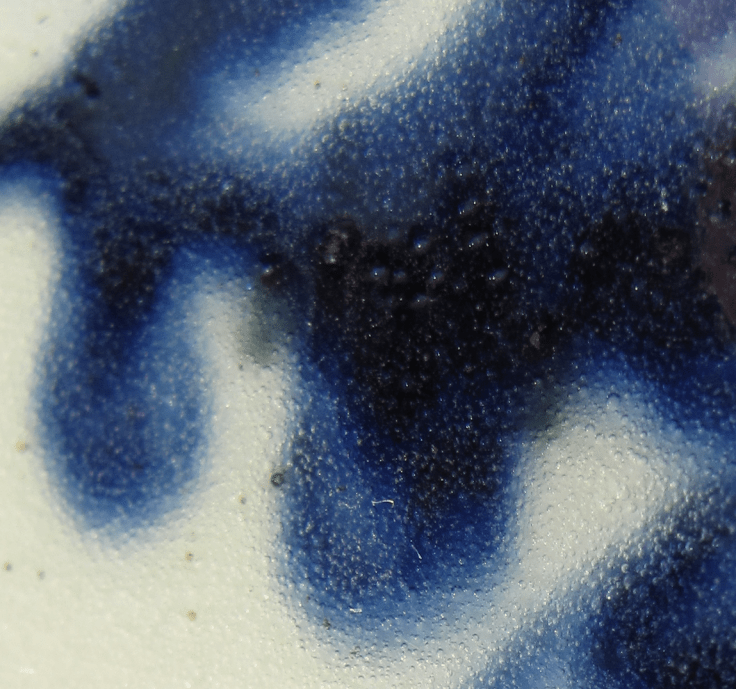
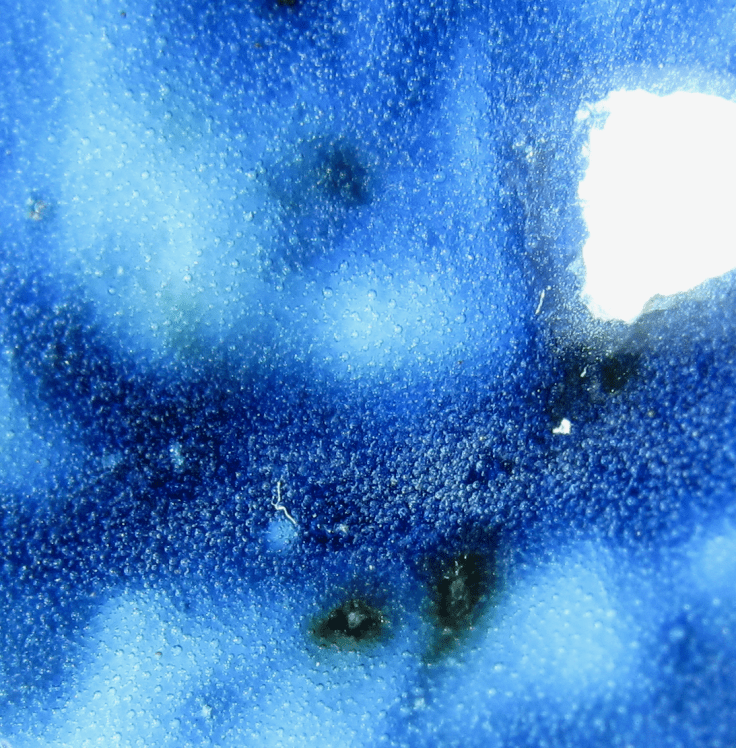
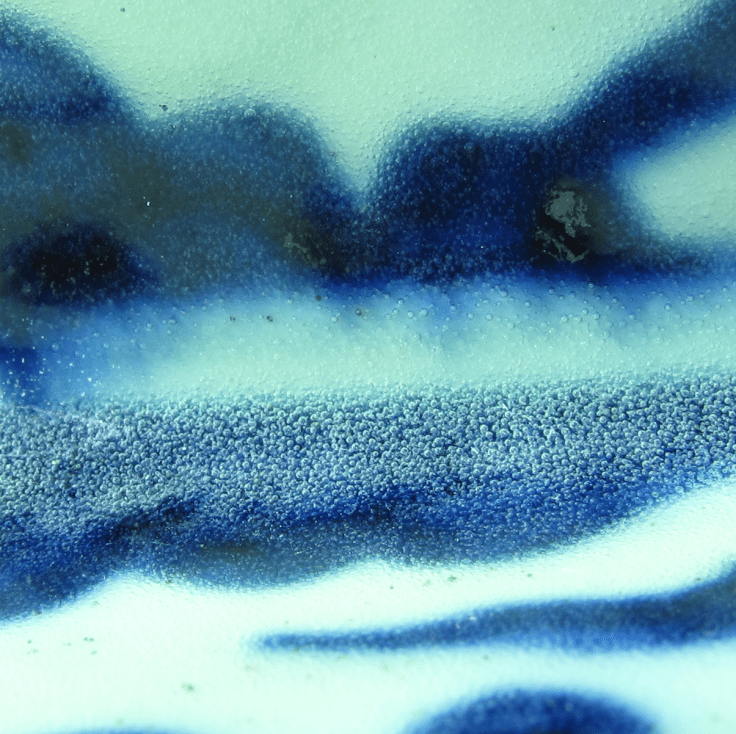
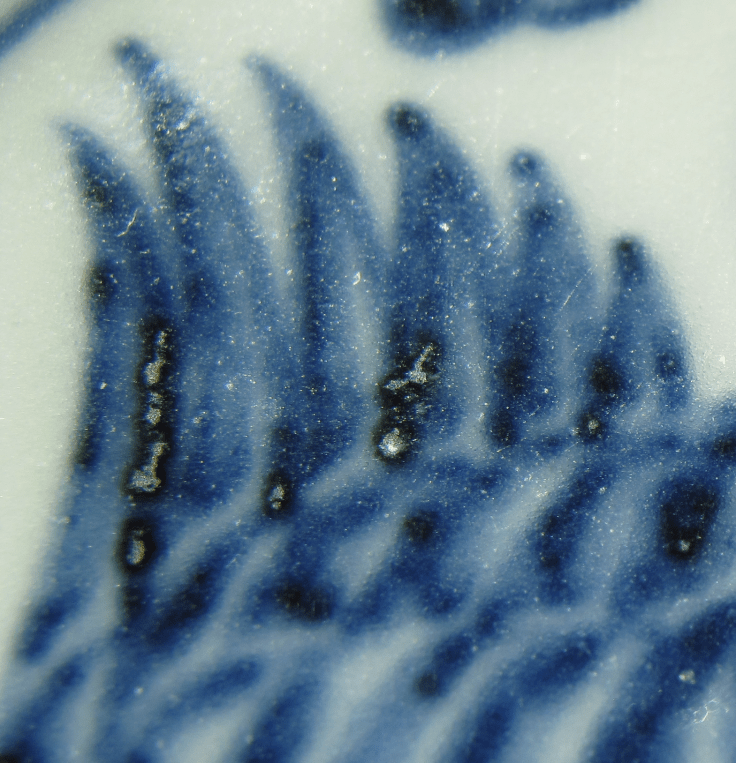
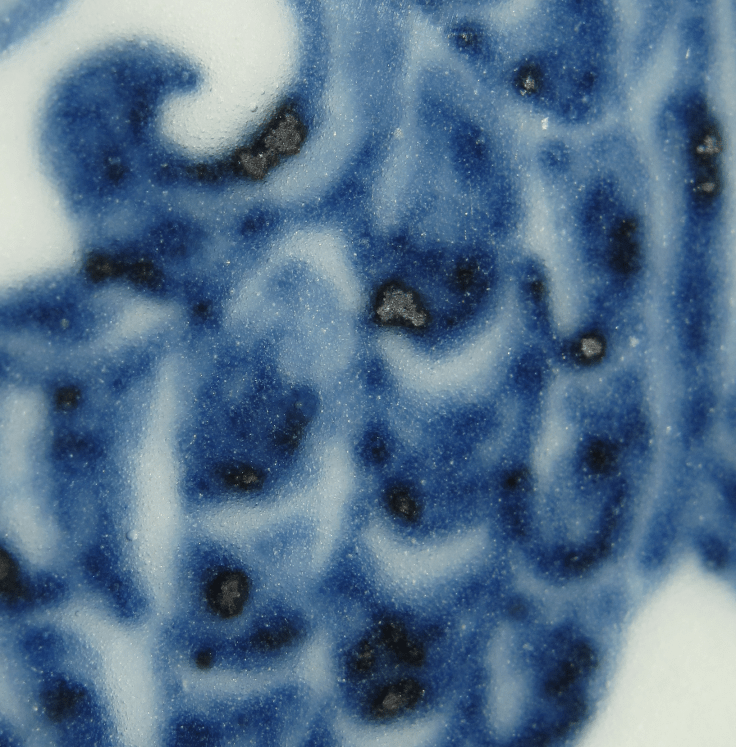
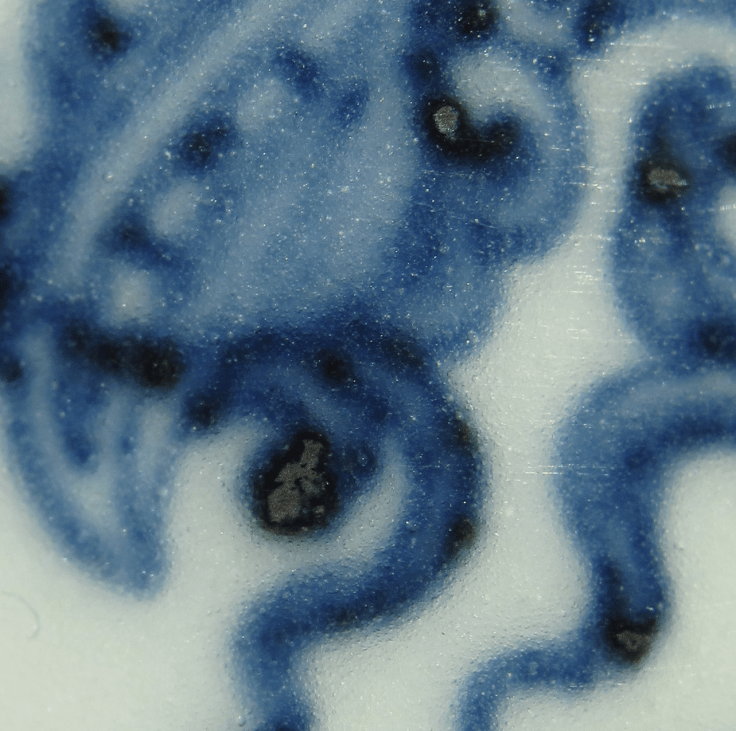
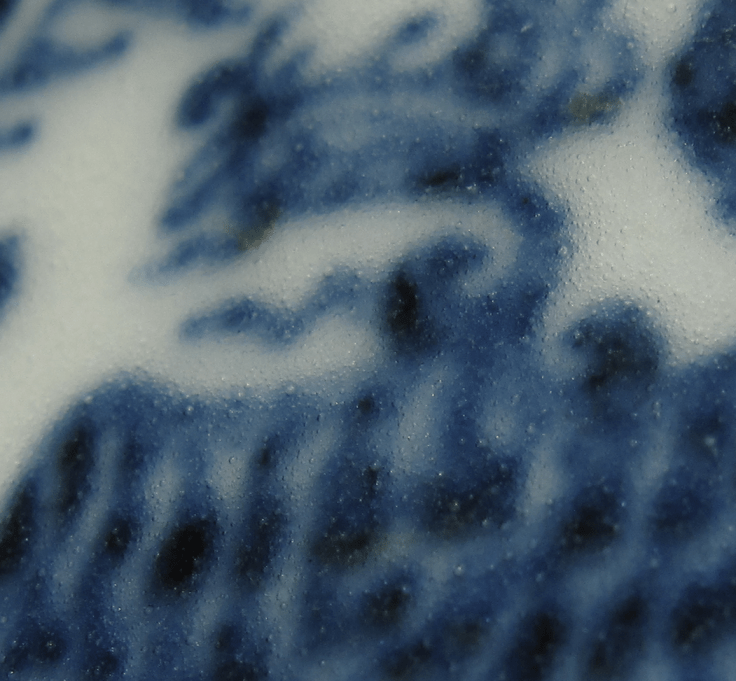
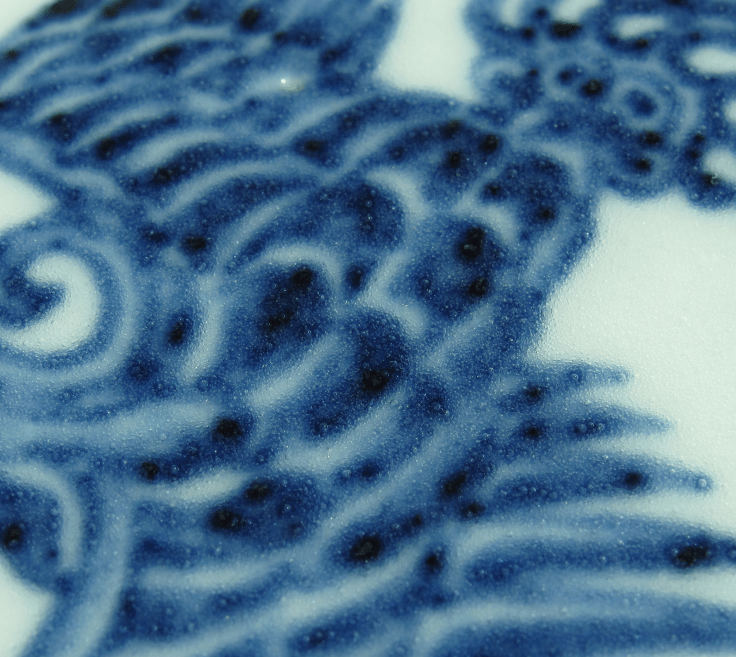
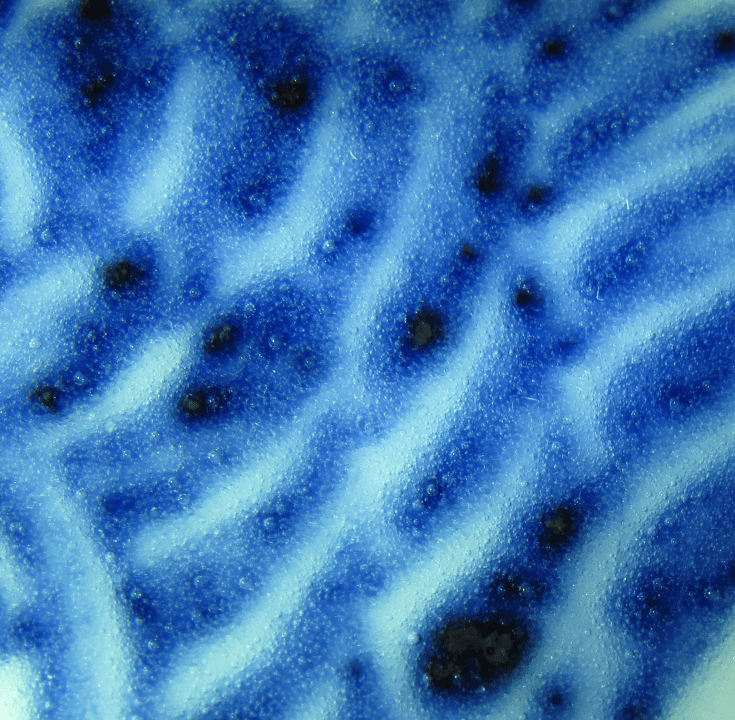
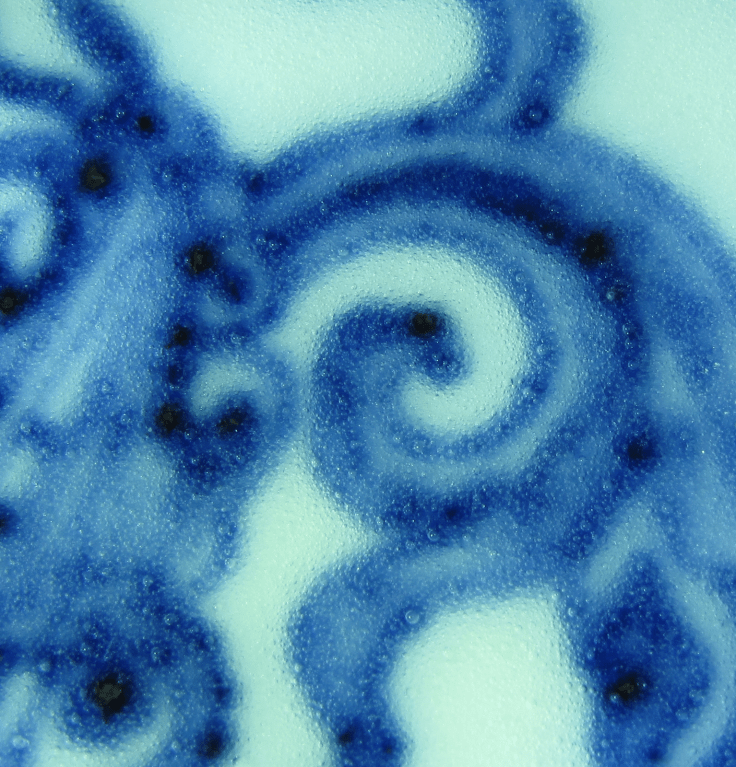
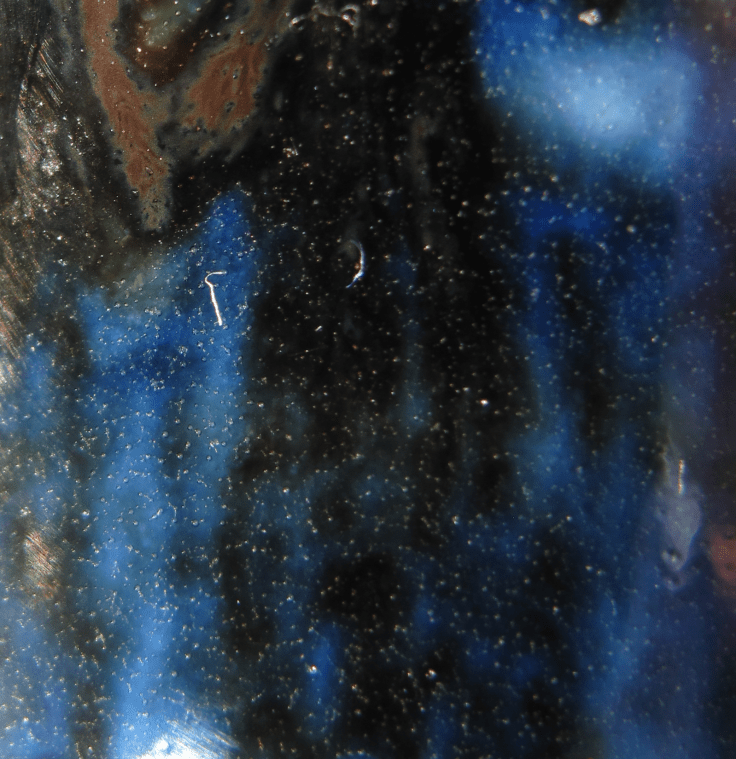
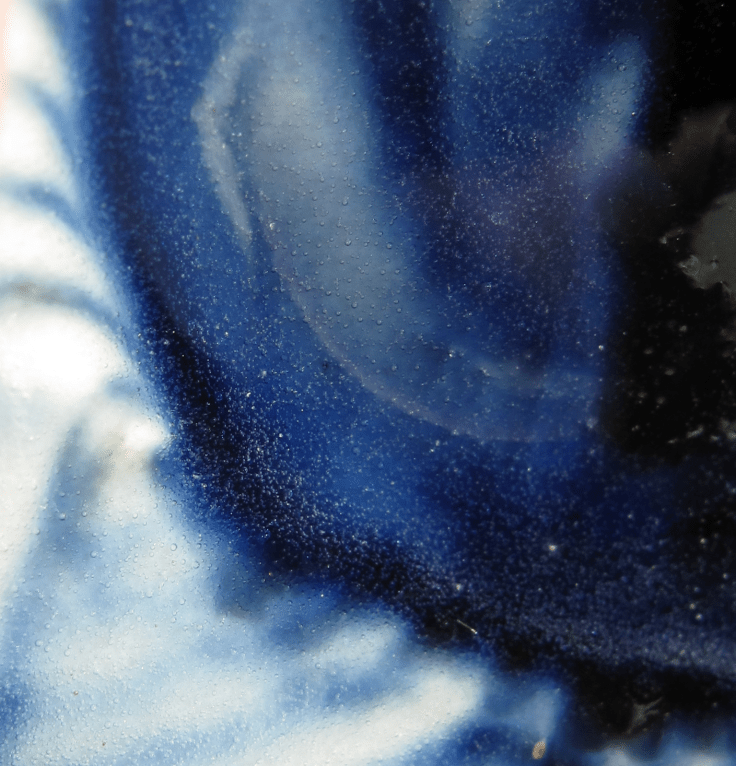
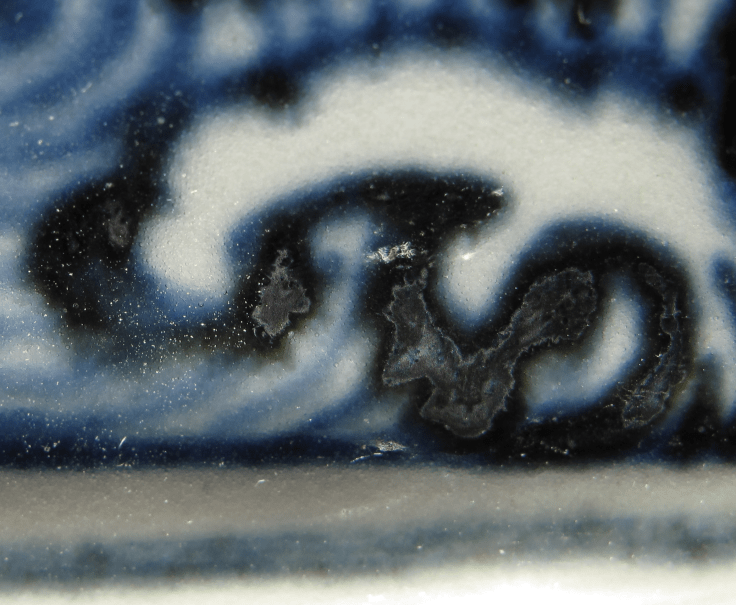
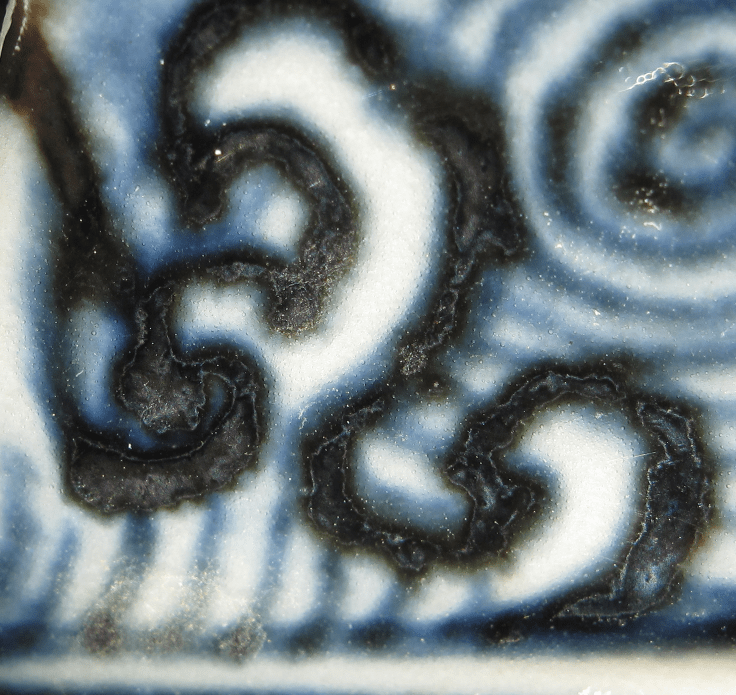
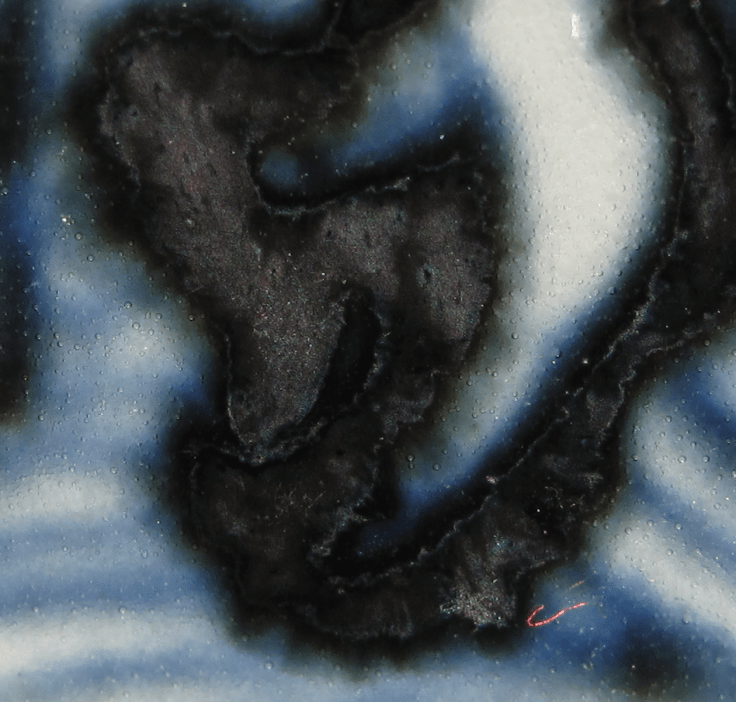
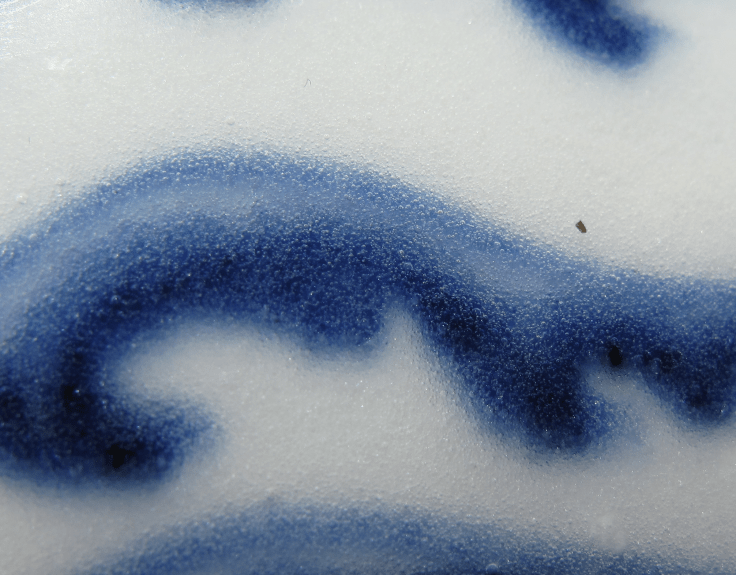
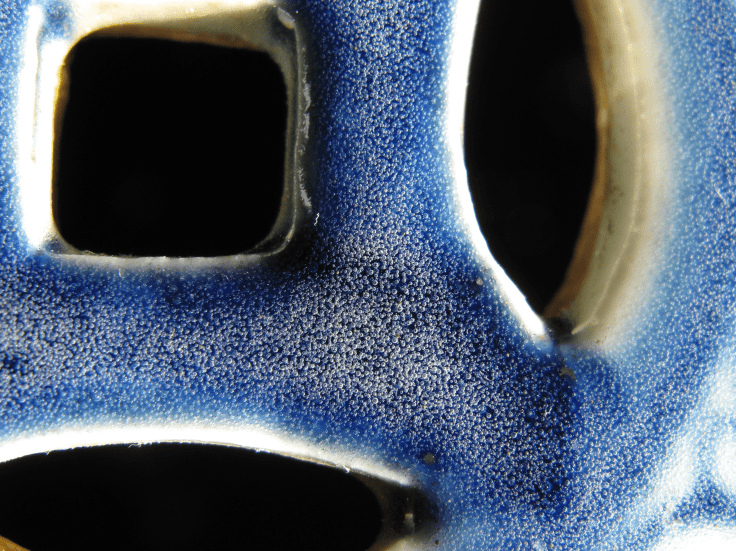
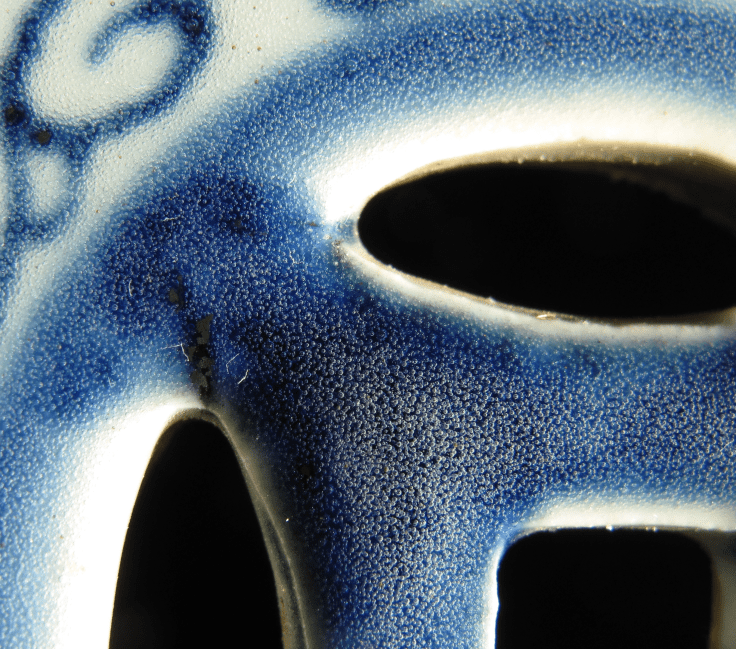
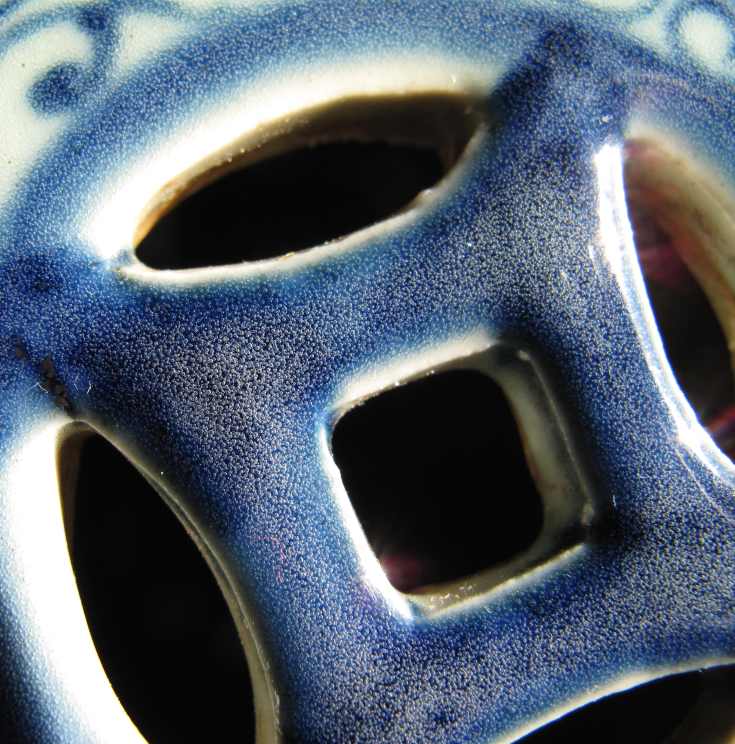
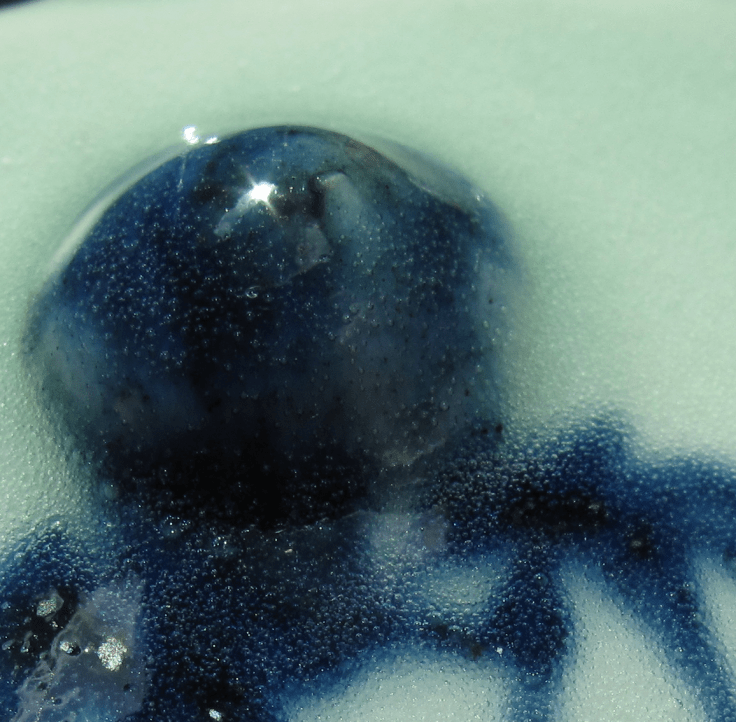
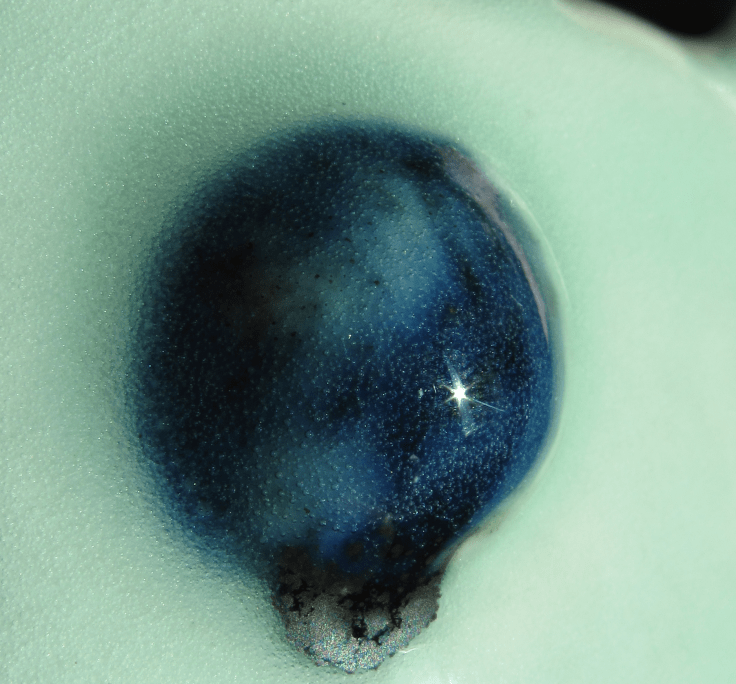
When the sellers find out that the product is in good demand, they naturally increase the price sharply. The potters in Yongle and Xuande have already found the dye expensive, and they want to cut the cost of production by using less dye—diluting it and applying it in a controlled manner. The blue color in those two periods are noticeably less dark in color. From an aesthetically point of view, it is difficult to say what is a better color—the very dark blue and the lighter blue. But there is one effect that we can observe in the bubbles. The bubbles in the Yuan B & Ws are much more tightly packed, no doubt due to the deeper color. I’ll show you this in this Yuan Zhihu, or ewer.


IMG_6680.pngFigure 1

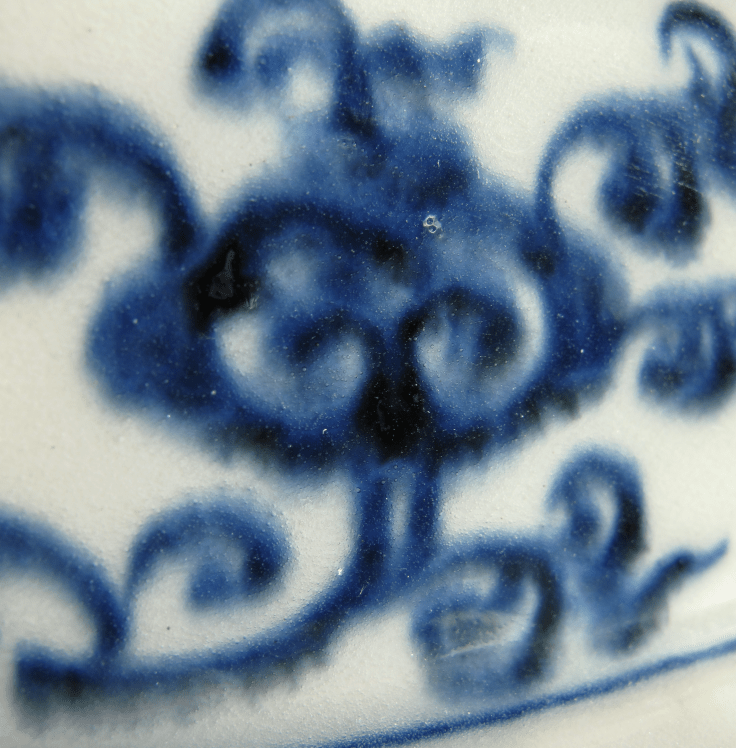
As I have told you, Yuan wares are generally large. This Zhihu is large. It measures 19 1/2 inches in height. The motif is clearly Yuan, and the way the motif is drawn is also Yuan. But that has nothing to do with the authenticity of the ware. The evaluate it, and to say for sure that the ware is a Yuan, the only way is to look at the characteristics of the dye, and see if the characteristics are consistent with the Sumali Blue dye. We will now do that.

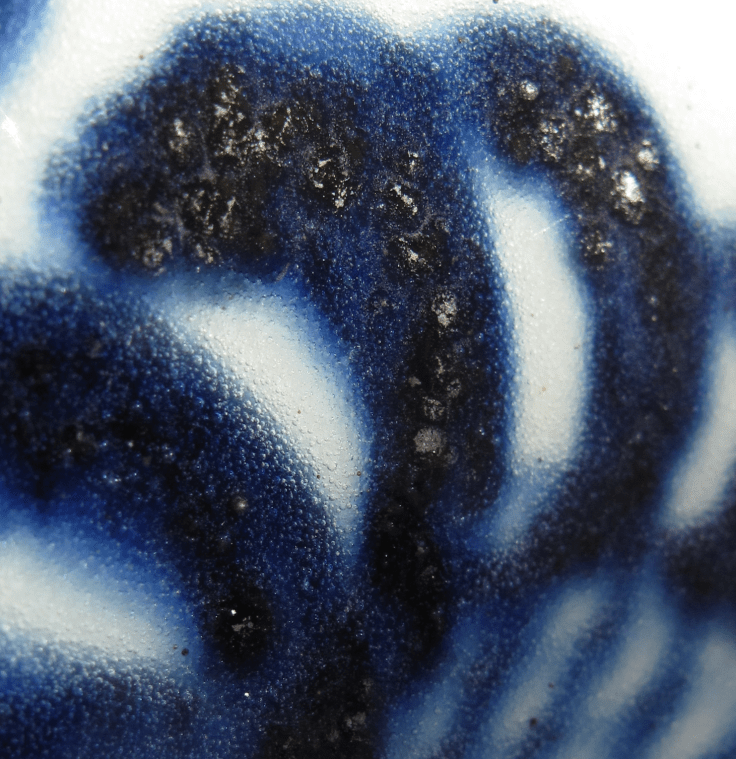
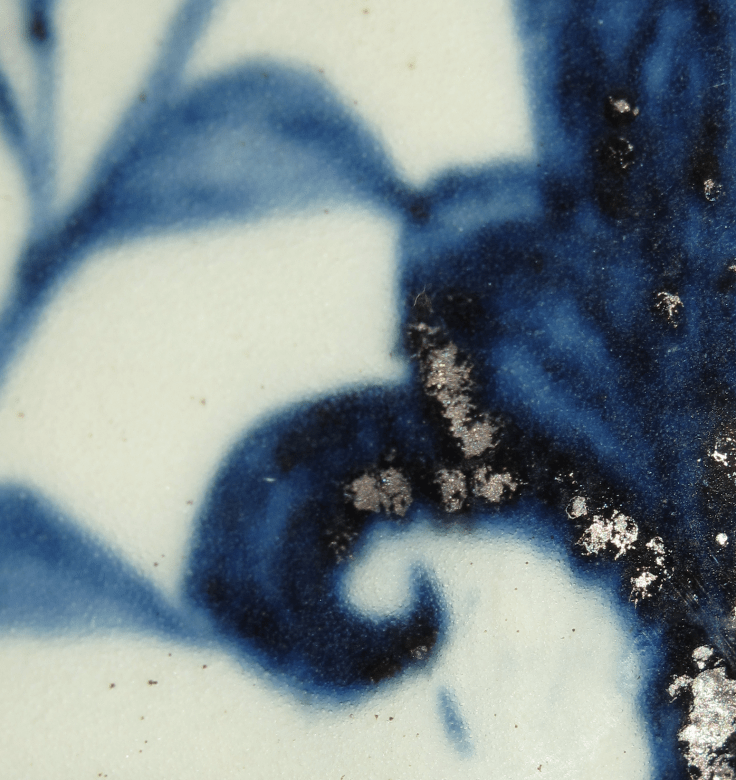
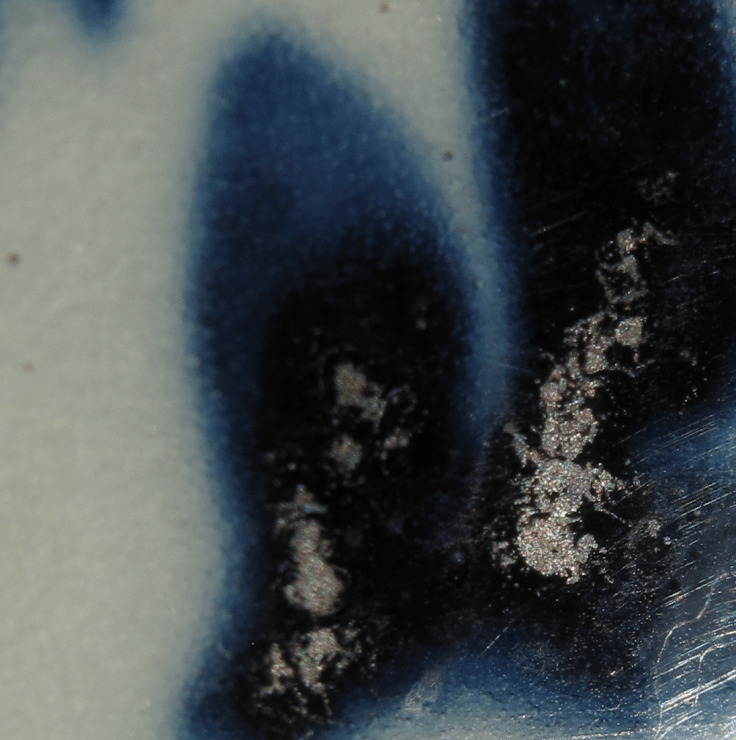
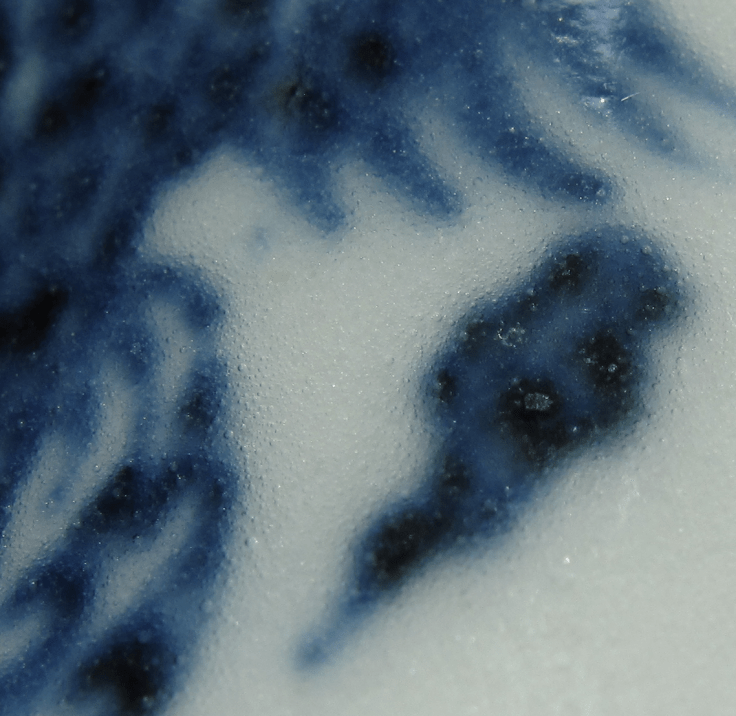
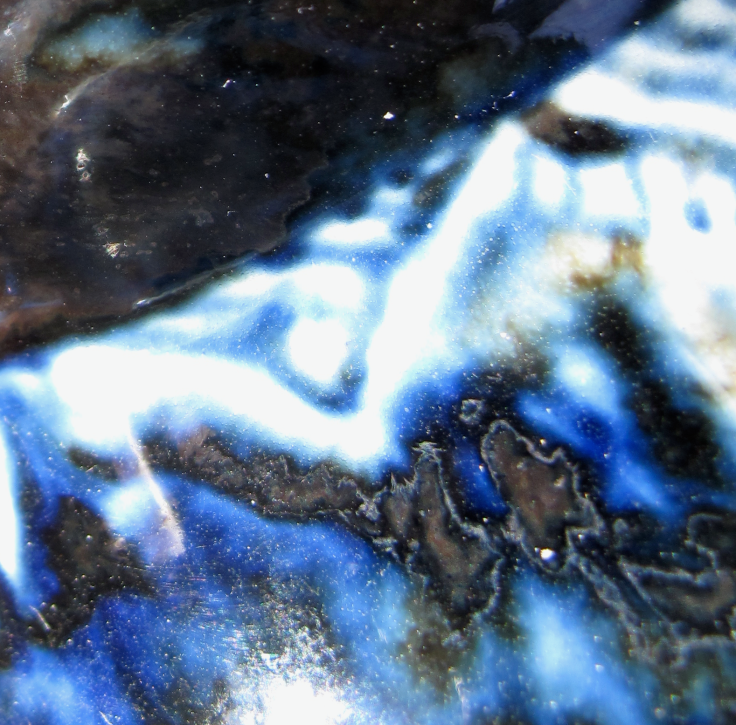
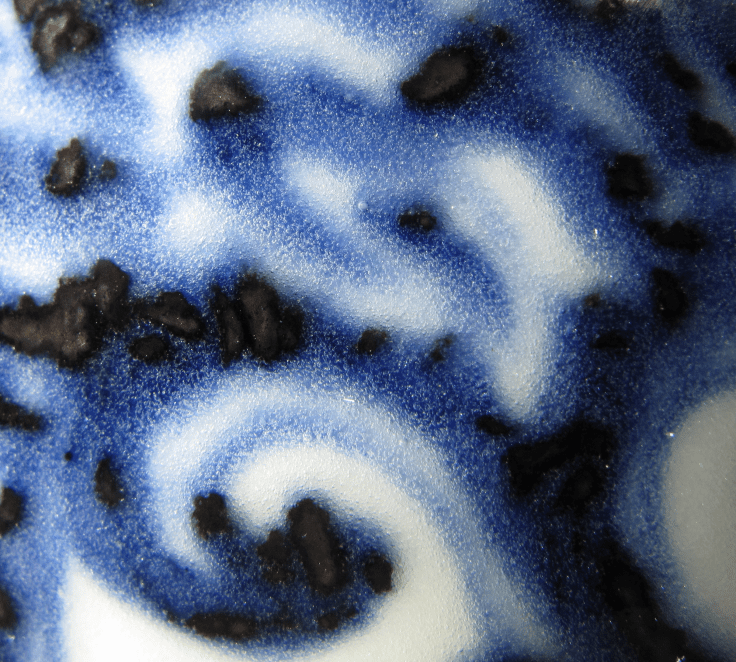
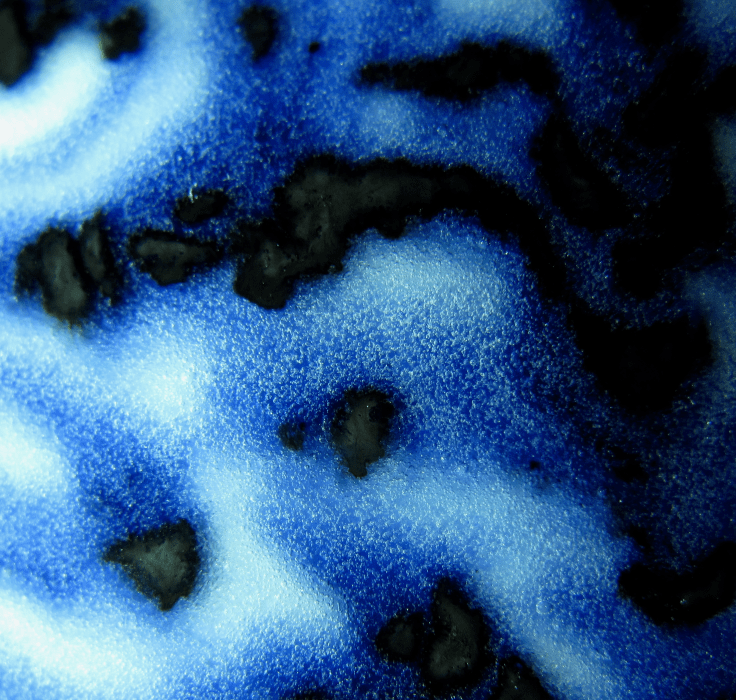
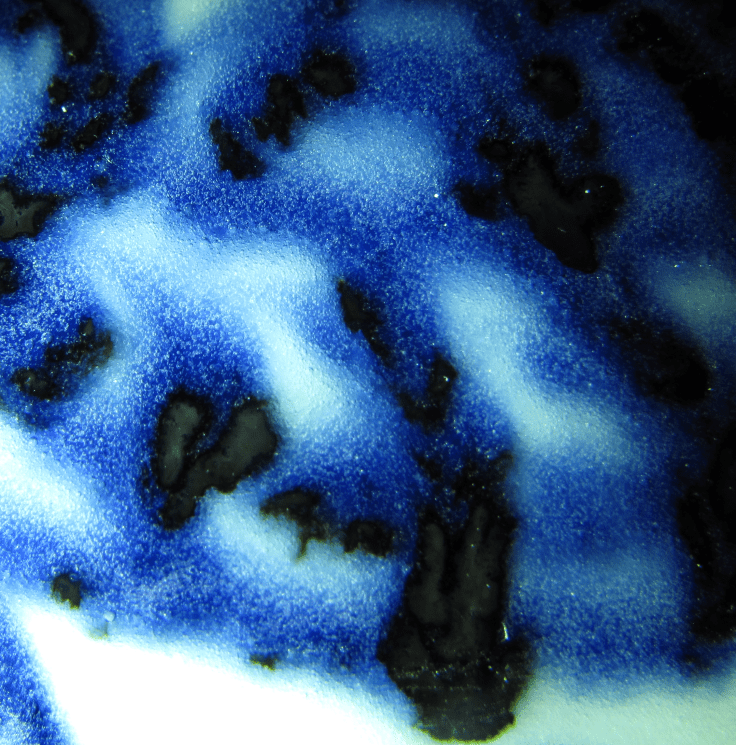
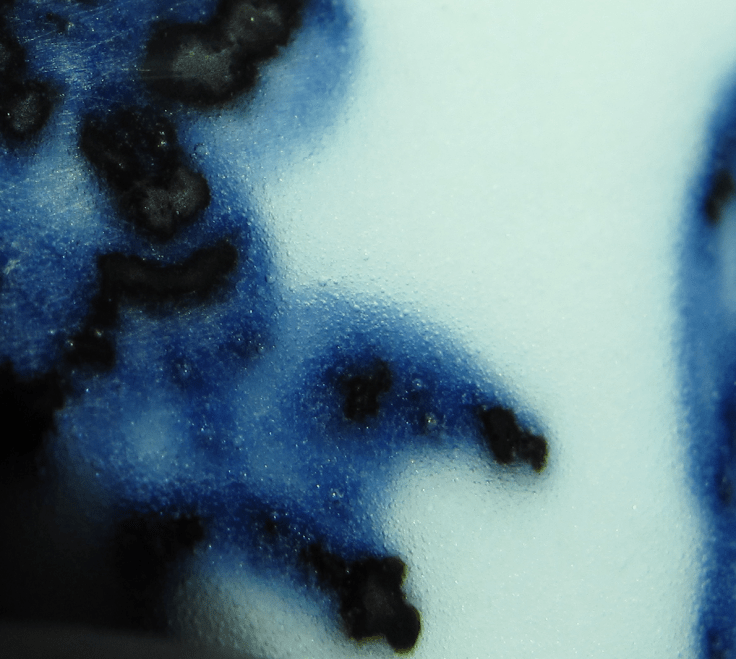
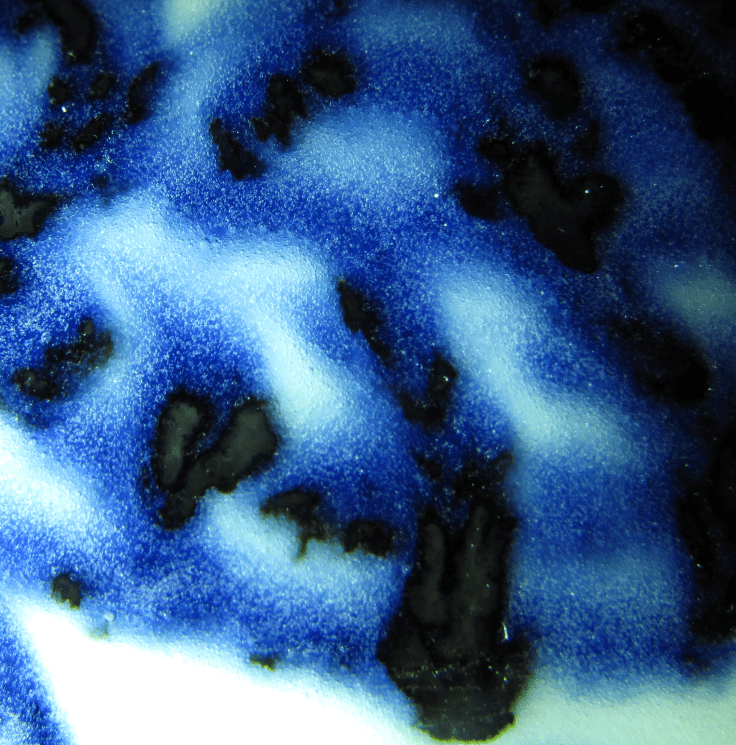
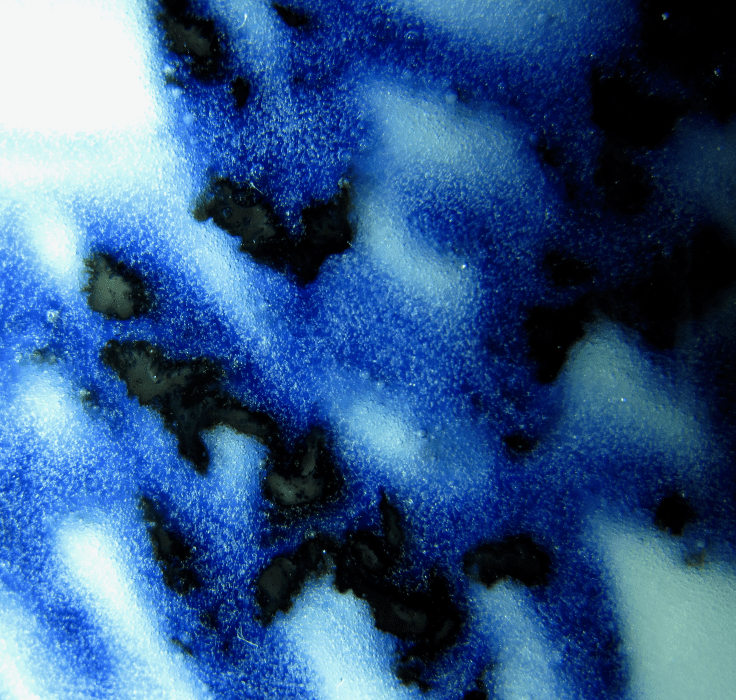
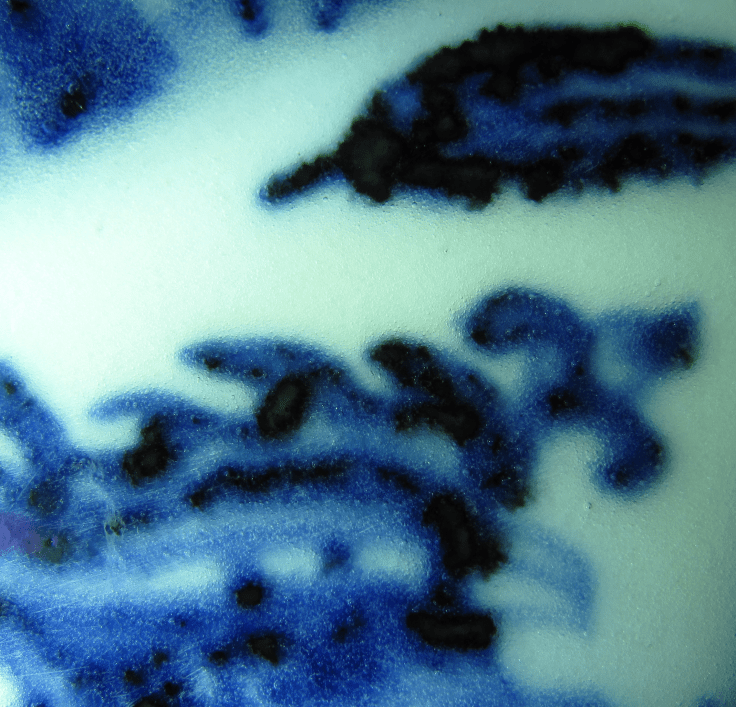
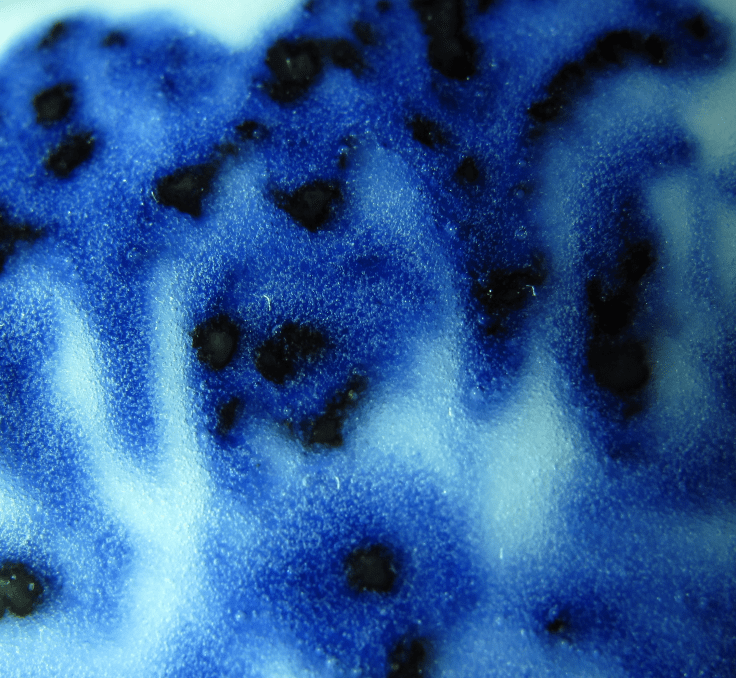
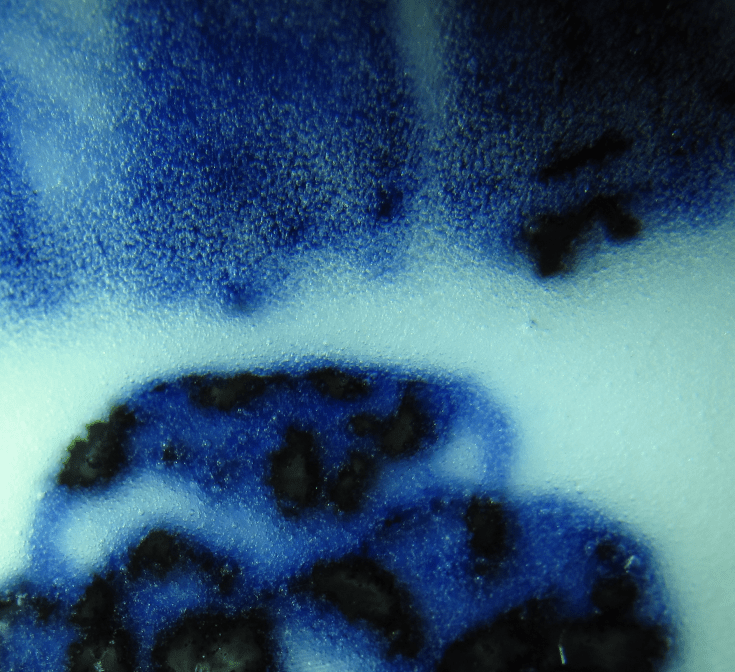
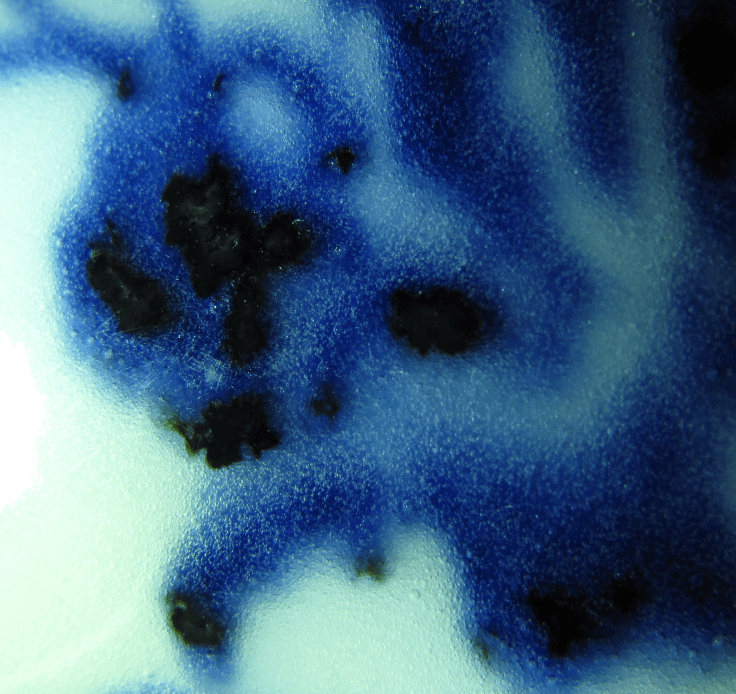
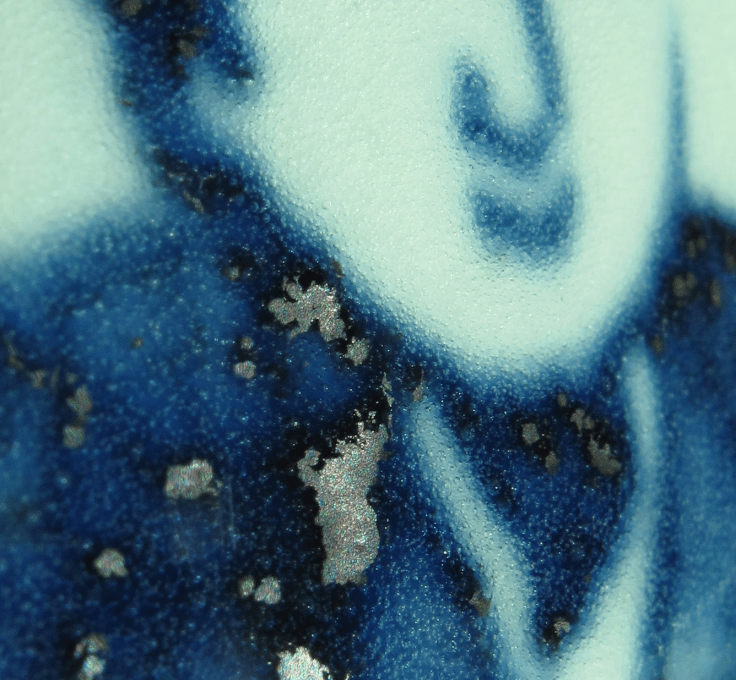
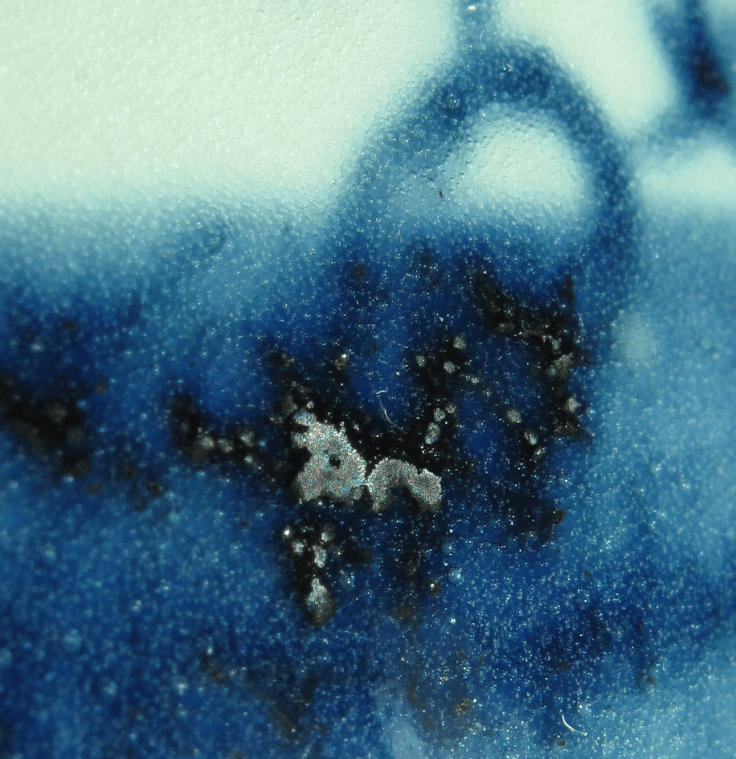
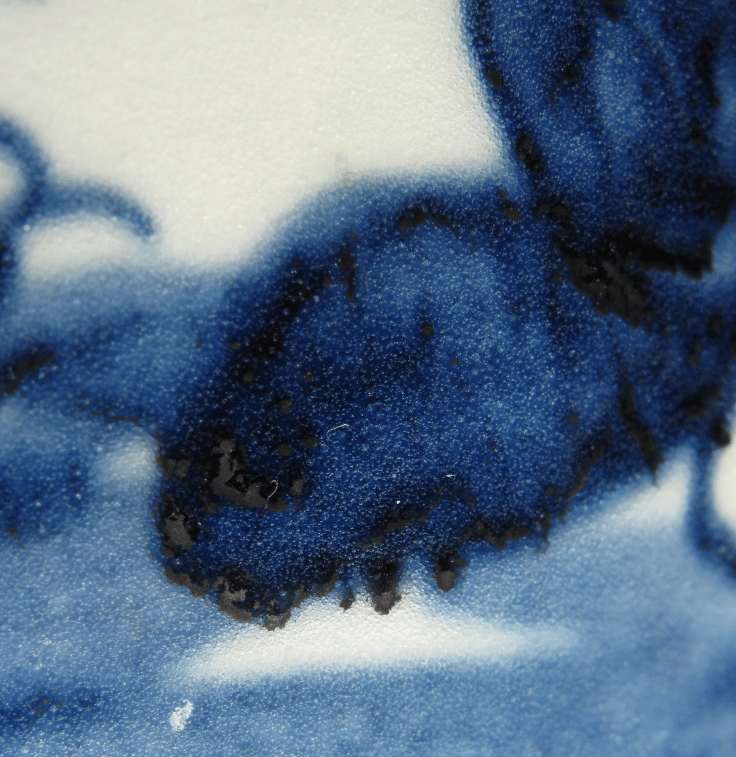
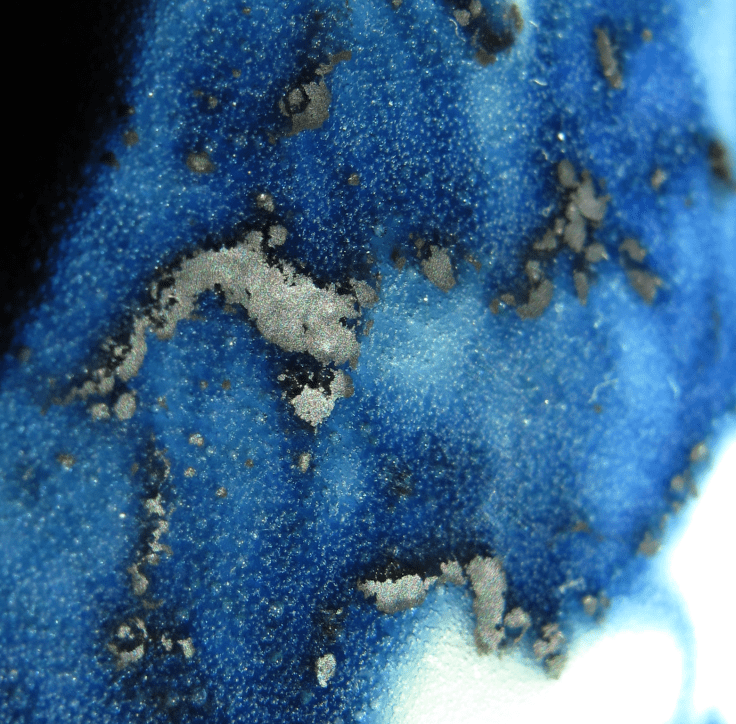
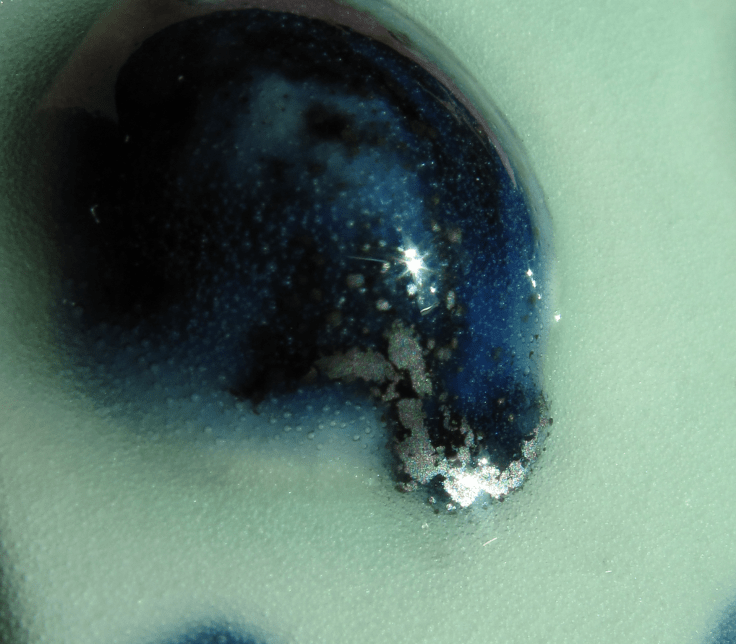
Before going into the bubbles, let us first see another prominent feature of the Sumali Blue dye, the plaques. By now, you must know that plaques of B & Ws in Yuan period are, most of the time, mature plaques. That is to say, a plaque with a metallic foil floating on top of a muddy layer at the bottom. We have seen that the muddy layer in some Yongle and Xuande wares are extremely colorful when seen under the sun. This, I suppose, is due to the very complicated structure of the muddy layer, with a lot of very reflective compounds in it. The metallic foil is mainly aluminum and its compounds, so that the structure is relatively simple, and the reflection under the sun is not as colorful (Figures 2-8). Not only that, the presence of the metallic foil somehow makes the muddy layer reflect no color. Its presence is only represented by some blackish shadows around the metallic layer in a photo.


IMG_6472.pngFigure 2


IMG_6433.pngFigure 3   


IMG_6685.pngFigure 4  


IMG_6687.pngFigure 5     


IMG_6686.pngFigure 6   


IMG_6689.pngFigure 7   


IMG_6667.pngFigure 8    

Note the shape of the plaques. They are typical of those of the Sumali Blue dye, and they all lie within a pool of very dark blue color. In many of these photos, small flakes of plaque breaking away from the main one are also seen. These small flakes of plaques probably have a different density, and are denser and heavier than the main plaque, thus falling faster under gravity than the rest. This is particularly noticeable in Figure 8. When such flakes of small plaques are present, it generally means that the dye pigment is of good quality. In the same figure 8, which is taken under LED light, the bubbles are seen more clearly, because of the brighter light. You can see the bubbles are tightly packed. I’ll show you more of these bubbles in the following photos.
 

IMG_6556.pngFigure 9  


IMG_6549.pngFigure 10   


IMG_6510.pngFigure 11   


IMG_6501.pngFigure 12  


IMG_6554.pngFigure 13


IMG_6552.pngFigure 14  


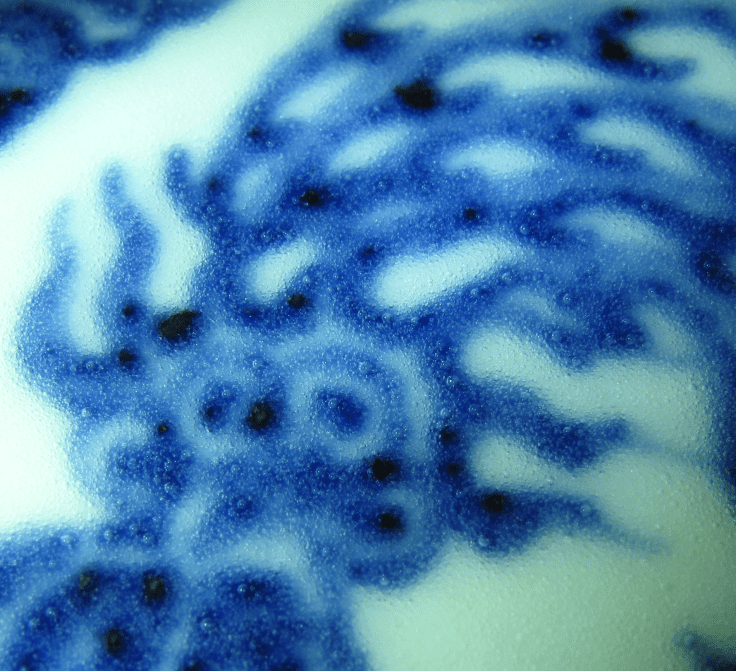
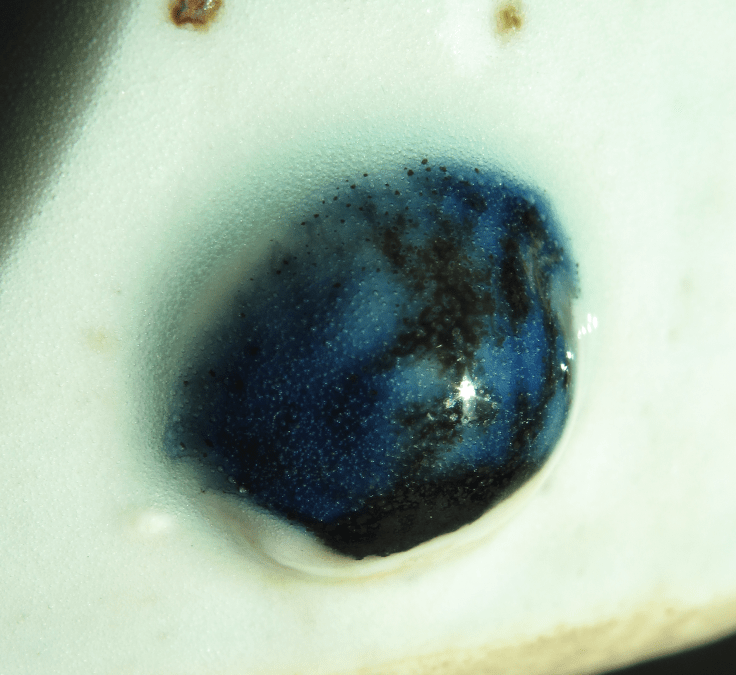
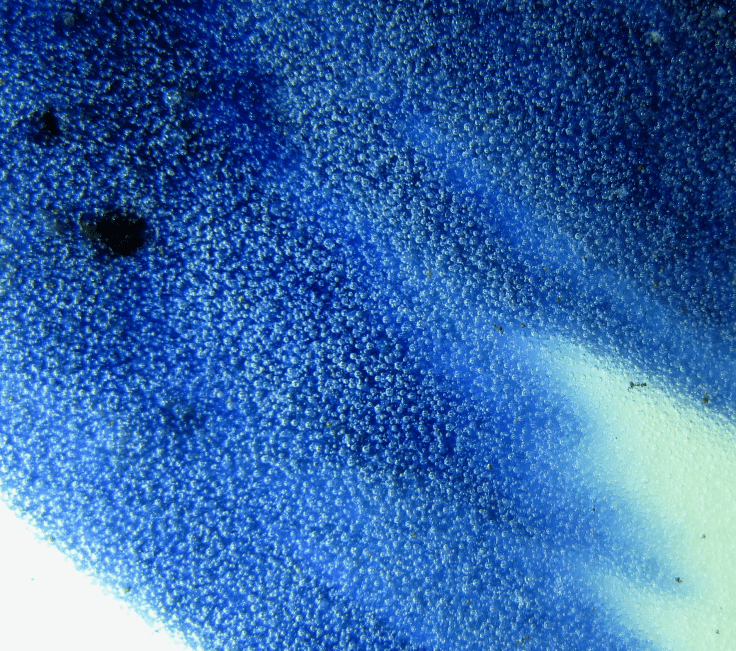
Look at these six photos (Figures 9-14). Are not the bubbles tightly packed? But the interesting thing about the bubbles is that they do not seem to be disorganized. You do not have an impression that everything is in disarray. You also need to look at the drippings—the lower edge seems to be flaring out. And look at figure 13 and 14 again. Can you find quite a number of large bubbles hiding in the blackish area? This is typical of Sumali Blue dye—large bubbles lurking in plaques and plaques that are not yet fully formed, which only show up as blackish patches. I’ll show you a few more photos presenting in this manner (Figures 15-18).
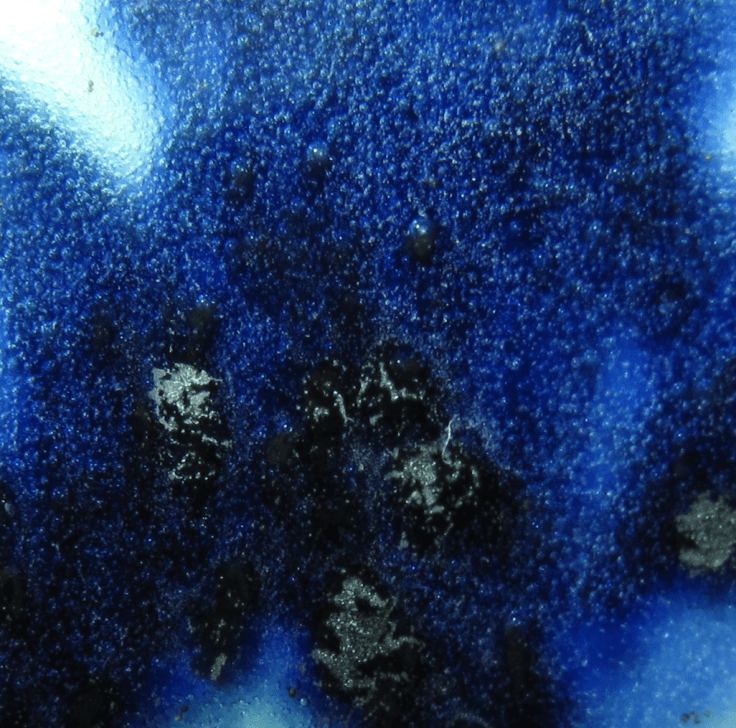
 

IMG_6663.pngFigure 15   


IMG_6644.pngFigure 16   


IMG_6457.pngFigure 17  


IMG_6458.pngFigure 18  

Look at these large bubbles, all hiding in a pool of blackish patch. In figure 18, the large bubbles are almost like a nest of eggs. This kind of bubbles is only seen in Sumali  Blue dye. No other dye in Chinese ceramics will give you this kind of picture. When you see them, the dye has to be Sumali Blue dye, and the B & W is genuine and real.

In other areas where the dye is not so liberally applied, the bubbles are different.


IMG_6443.pngFigure 19


IMG_6520.pngFigure 20  


IMG_6678.pngFigure 21  

Figure 19 is from the mouth of the Zhihu, and Figures 20-21 are taken from the bridge connecting the spout to the body of the ewer. In figure 21, at where the bridge has a depression, the bubbles would all go there, resulting in a high concentration of bubbles. In the lighter blue areas, you can see bubbles linking up as though by a piece of short string, another familiar phenomenon seen in the Sumali Blue dye. 

At where the two main pieces of the body joined together, the bubbles are also highly concentrated (Figures 22-23).
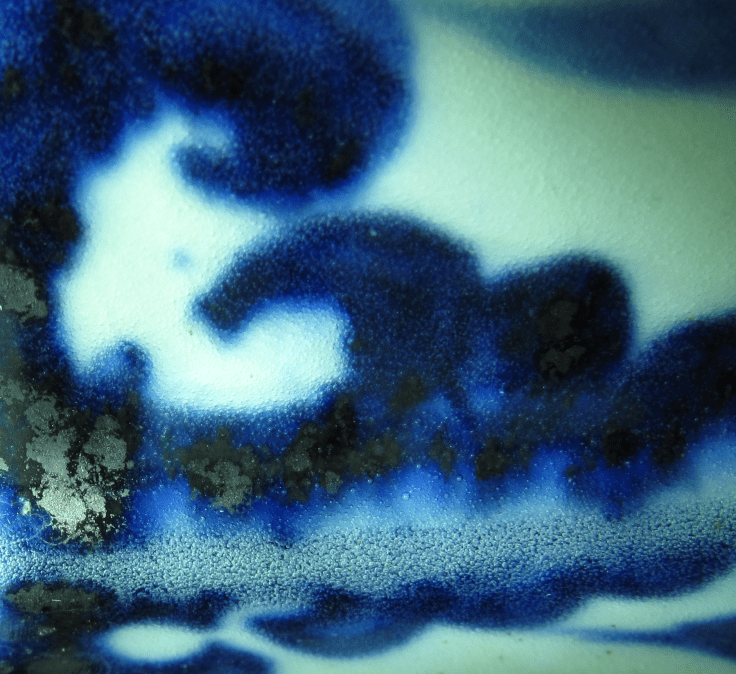
 

IMG_6652.pngFigure 22  


IMG_6668.pngFigure 23  

With all these features matching very well with the features of the Sumali Blue dye, there is no reason to doubt that this Zhihu is not a a genuine Yuan B  & W. Not only is this genuine and real Yuan, but this is a piece that belongs to the very early period when the Sumali Blue dye is first imported to China. The reason? I’ll show you two photos as my argument.
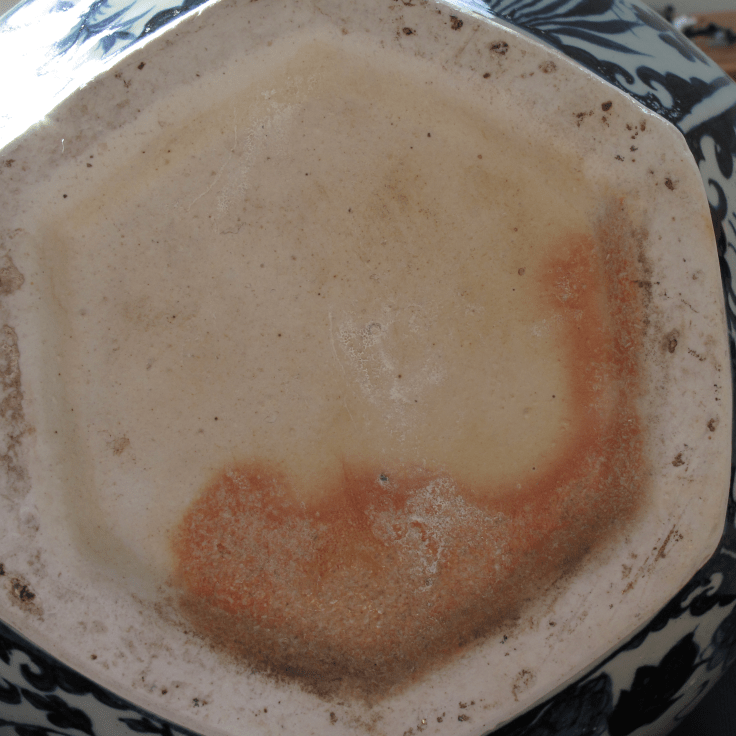
 

IMG_6511.pngFigure 24  


IMG_6696.pngFigure 25   

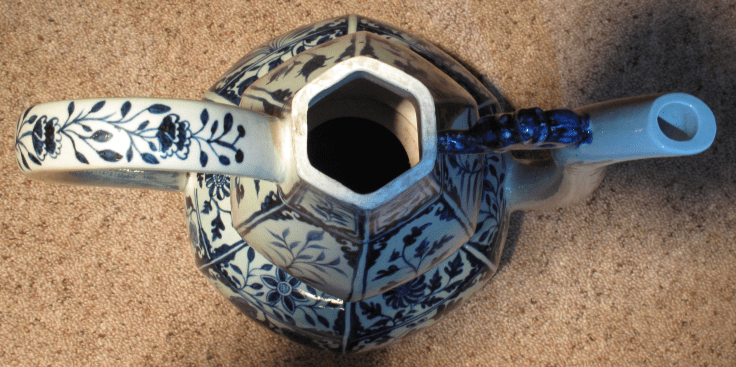
Figure 24 is the bottom of the Zhihu, and Figure 25 shows the mouth of the ewer and the mouth of the spout. You will note that both the bottom and the mouth of the ewer are unglazed, whereas the mouth of the spout is glazed. It only shows that in the beginning of making the first B & Ws, the potters are quite unsure of what needs to be done, and what does not. 

A Blue and White Fluted Phoenix Washer

There are certain facts that collectors of Blue and White of the early Ming periods know very well. They know that Yongle B & Ws do not have marks except for the few cups that ‘press against your palm’, or 壓手杯, as the Chinese used to call them. Aside from these few cups, which are all in the Old Palace Museum in Beijing, any B & W that bears the mark 永樂年製 in underglaze blue is a fake. That is a golden rule. Many experts still believe in this. But many are getting less dubious as more B & Ws that bear the mark surface from many parts of the world. And many of these wares have the most beautiful features of the characteristics of the Sumali Blue dye. There is no question that the dye used by the potters in these wares IS the Sumali Blue dye. It is absolutely impossible to refute these characteristic features. Why are some experts, in the face of these indisputable evidence, still dismiss them as fakes, is something that is totally beyond me. When potters decide to have a mark in the cups, would they not do the same in some other wares? That is only logical. And when experts have not seen wares aside from the cups carrying the mark and yet make a statement declaring such an observation, does that make their declaration logical? That is what I have been wondering for a long time.

The B & Ws in the Xuande period, on the other hand, often have marks on them. But that is not always the case, quite a good proportion of Xuande B & Ws have no marks on them. In such a case, we have to make an effort to tell if the ware belongs to the Yongle or the Xuande period. And to look at the dye pigment in such an instance is often not a good help. There is a reason for this.Only a few years separate the Yongle and the Xuande period. And the dye pigment imported during those two periods are very much the same, probably with some slight differences that we cannot possibly tell. So with an unmarked ware, it is often difficult to tell a Yongle and a Xuande ware.  That is what we often call 永宣不分. Again, this is not always the case. In some wares with very characteristic Yongle features, we can say for sure that the ware is a Yongle.

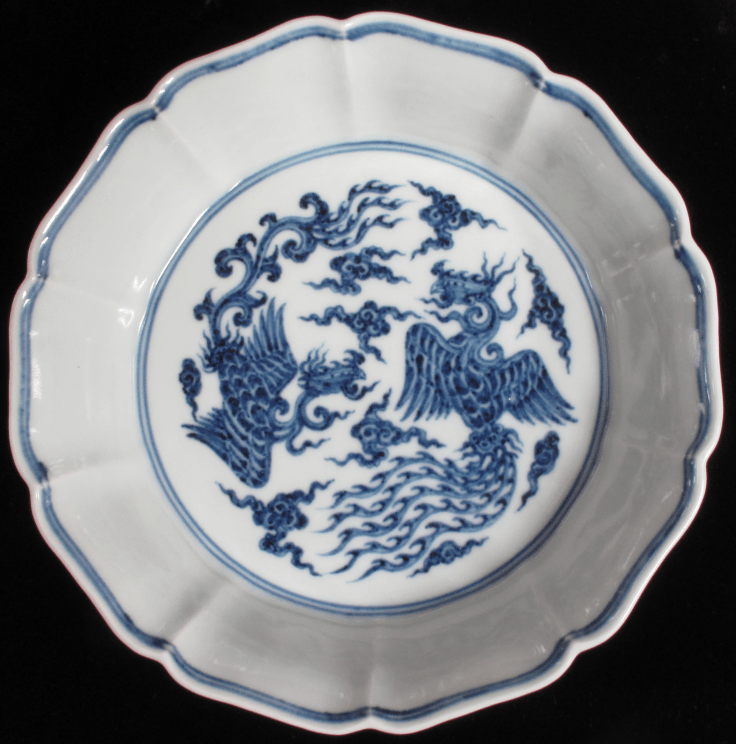
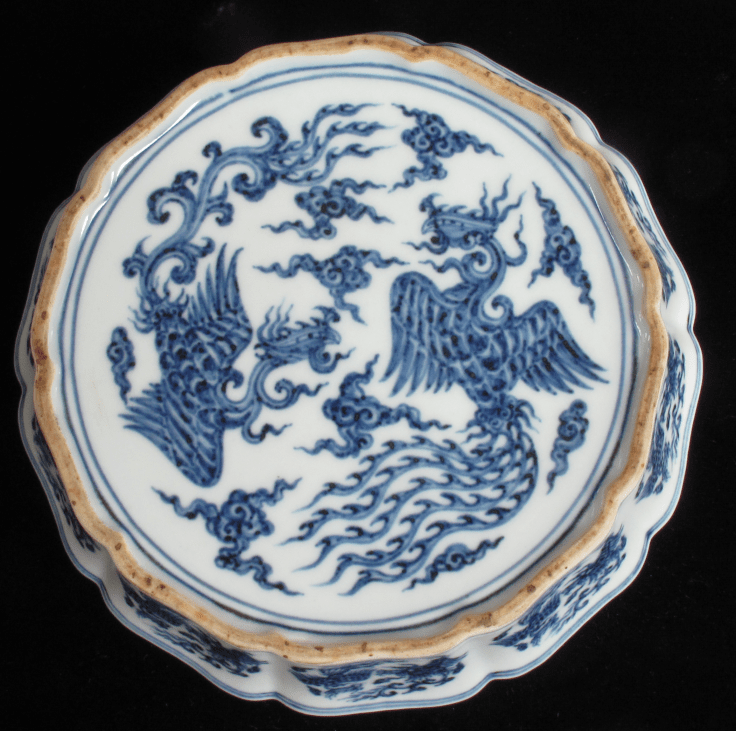
Here is a B & W washer without a mark, and it is difficult to tell if it is a Yongle or a Xuande. It measures 7 inches in diameter and its height is 1 7/8 inches.


IMG_5631Figure 1   


IMG_5632 (1).pngFigure 2  

Before one can say if the ware is a Yongle or a Xuande, it is of the first importance to determine if the blue dye used is of the Sumali Blue dye. Only if we can define the characteristics of the Sumali Blue dye will we able to say that the ware is from the early Ming period, and not a reproduction. Let us try to identify some of the characteristic features of the Sumali Blue dye.


IMG_5720 (1).pngFigure 3  


IMG_5723.pngFigure 4 


Figures 3 & 4 are taken from the same spot, with some variation in the lighting. The plaques are more reflective in Figure 3 than in figure 4. These are plaques without any metallic foils floating on the surface. They just have the muddy layer. You’ll remember that during the late Yuan era, a floating metallic foil above the muddy layer is very common. But this metallic foil is getting less and less obvious in the Yongle B & W, and in most late Xuande B & Ws, the metallic foil is no longer seen. In some cases, even the muddy layer in not very obvious. But the plaques that we see here are typical and consistent with both Yongle and Xuande B & Ws.

I’ll show you more plaques that are similar (Figure 5-10). Look at them carefully. They are all plaques with the muddy layer only. You will also note that all the plaques are quite small, and you can tell when you compare the size of the plaques to the size of the bubbles. One reason is of course the size of the washer and the motif. There are no areas where a lot of blue dye is needed.


IMG_5706.pngFigure 5  


IMG_5712.pngFigure 6   


IMG_5725.pngFigure 7  


IMG_5715 (1).pngFigure 8   


IMG_5649.pngFigure 9  


IMG_5647.pngFigure 10   


But in many parts of this washer, the what we call plaques have no actual plaques; they are but blackish patches among the blue dye, with occasional shadows giving you a hint that it might be a plaque. This is what we call a plaque in its formation. There are not enough particles that form the muddy layer present, and no actual plaque is formed (Figures 11-15). In some late Xuande B & Ws, all the plaques the ware has are these plaques-in-formation. In the whole ware, no actual plaque is seen. If you have a B & W that only has these primitive plaques, you can be sure that it is a late Xuande.


IMG_5678.pngFigure 11  


IMG_5676.pngFigure 12  


IMG_5659.pngFigure 13  


IMG_5651.pngFigure 14


IMG_5659 (1).pngFigure 15  

I’ll just show you another photo of this washer, a primitive plaque with the muddy layer barely seen. But it is unlike any other plaque in this washer, as you can see (Figure 16).


IMG_5689.pngFigure 16   

After examining the plaques, we must look at the dripping and flare. We must realize that this is a small washer, and most of the drawings are in the bottom of the washer and the underside of the base. You have only the phoenixes drawn on the side, and they are small and the potter does not need a lot of blue dye to do the drawing. It is therefore easy to understand that the flare and the dripping would not be obvious. But still, if you look for them, you can definitely see them, particularly when it comes to the decorative lines at the mouth of the washer. Look at Figures 17 and 18.  The dripping effect is clearly shown. There is also the bleaching of the dye in both photos, particularly Figure 17.


IMG_5671.pngFigure 17  


IMG_5694.pngFigure 18   

Figures 19-22 are taken from the flat part of the washer. There is no dripping, but the flare, if you look carefully, can readily be seen. So far, all these features are typical of the Sumali Blue dye.


IMG_5656.pngFigure 19  


IMG_5728.pngFigure 20


IMG_5696.pngFigure 21  


IMG_5645.pngFigure 22    


Many of the photos that I have shown you here, in fact, do allow you to study the bubbles, large and small. And typical of the Sumali Blue dye, the large bubbles are present in areas where the blue coloration is deeper in color. And in many instances, again typical of the dye, some large bubbles are lurking around plaques and primitive plaques. If you enlarge figure 19, you can see the very nice feature of a string of large bubbles at the edge of the dye. In Figure 22, you can see the broad range of blue coloration with certain areas showing a blue coloration not unlike that of sapphire blue. But I’ll show you a few more photos of the bubbles.


IMG_5737.pngFigure 23  


IMG_5739.pngFigure 24 


IMG_5740.pngFigure 25   


IMG_5741.pngFigure 26  


IMG_5742.pngFigure 27   


IMG_5744.pngFigure 28  

These photos, Figures 23-28, show you the large bubbles in this washer. If you want to be exact, these are not really very large bubbles. I would rank them as the smaller size of large bubbles seen in the Sumali Blue dye. But still they are rather lovely bubbles, especially the semi-opaque and pearl-like ones. One point about the number of large bubbles. You’ll note that there are quite a large number of large bubbles in this washer everywhere. Do you like large bubbles in abundance? Do you find them more beautiful? This is an aesthetic question. Personally, I would prefer to have fewer number of large bubbles. Too many of them, to me, makes the ware less beautiful. But this fact does not make me doubt the authenticity of the dye. It is without a doubt, Sumali Blue dye. And the ware an early Ming B & W. Even without a mark, I incline to believe that this washer is a Xuande.

A Xuande Blue and White Candlestick Holder

It is not my intention to go into the history of pottery and ceramics. But all collectors know that in the T’ang Dynasty, potters have an intense interest in making terra-cotta and sancai horses, camels, and figures of human and spirit. In the making of these figures and animals, there is little doubt that it involves a lot of sculpturing. Not only that, the sculpturing has to be done well, at least well enough to make the end product look very much alive. And potters in the T’ang era have not failed us in this. I would say, potters of all ages in China, and in the rest of the world, have not been able to match the skill of the T’ang potters in this aspect. They are by far the best. And it is also interesting to note that, after the T’ang era, for example potters in the Ming dynasty, have very little interest in pursuing what the T’ang potters have  been doing with very keen interest. We do not know the reason for this. Imagine, if we have a B & W dancing figure, or for that matter, a spirit standing on guard, would that look beautiful? It is unfortunate that potters in the following eras have not followed the tradition.

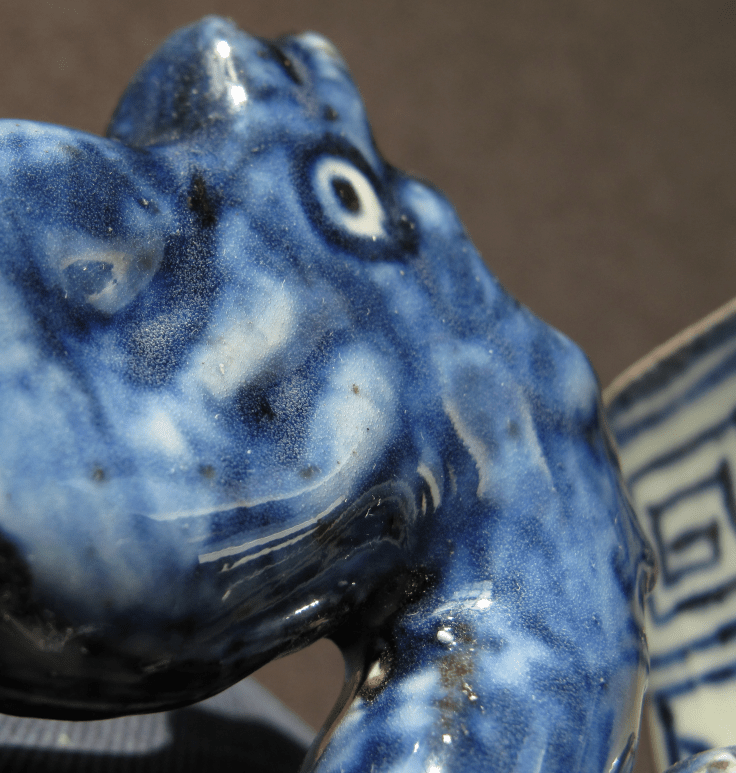
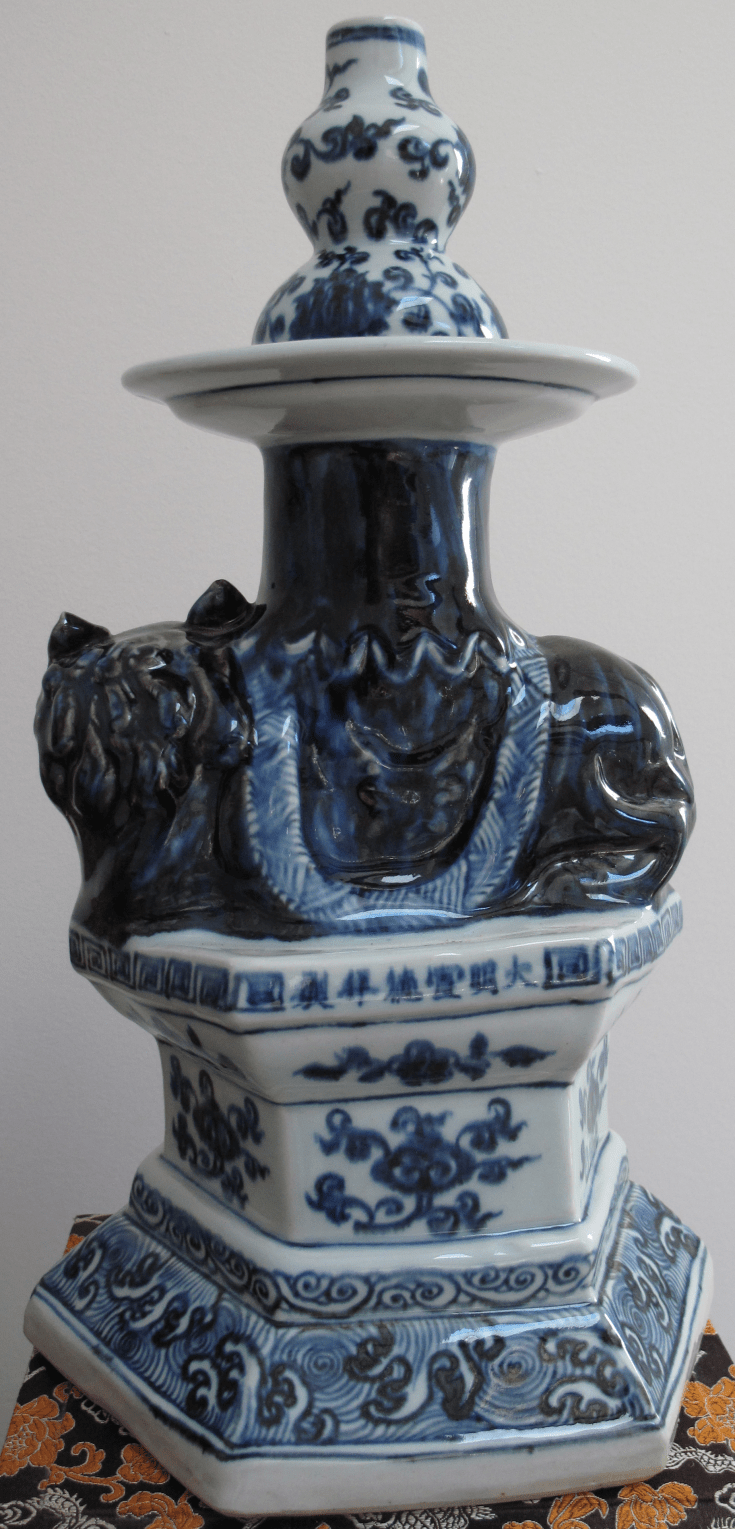
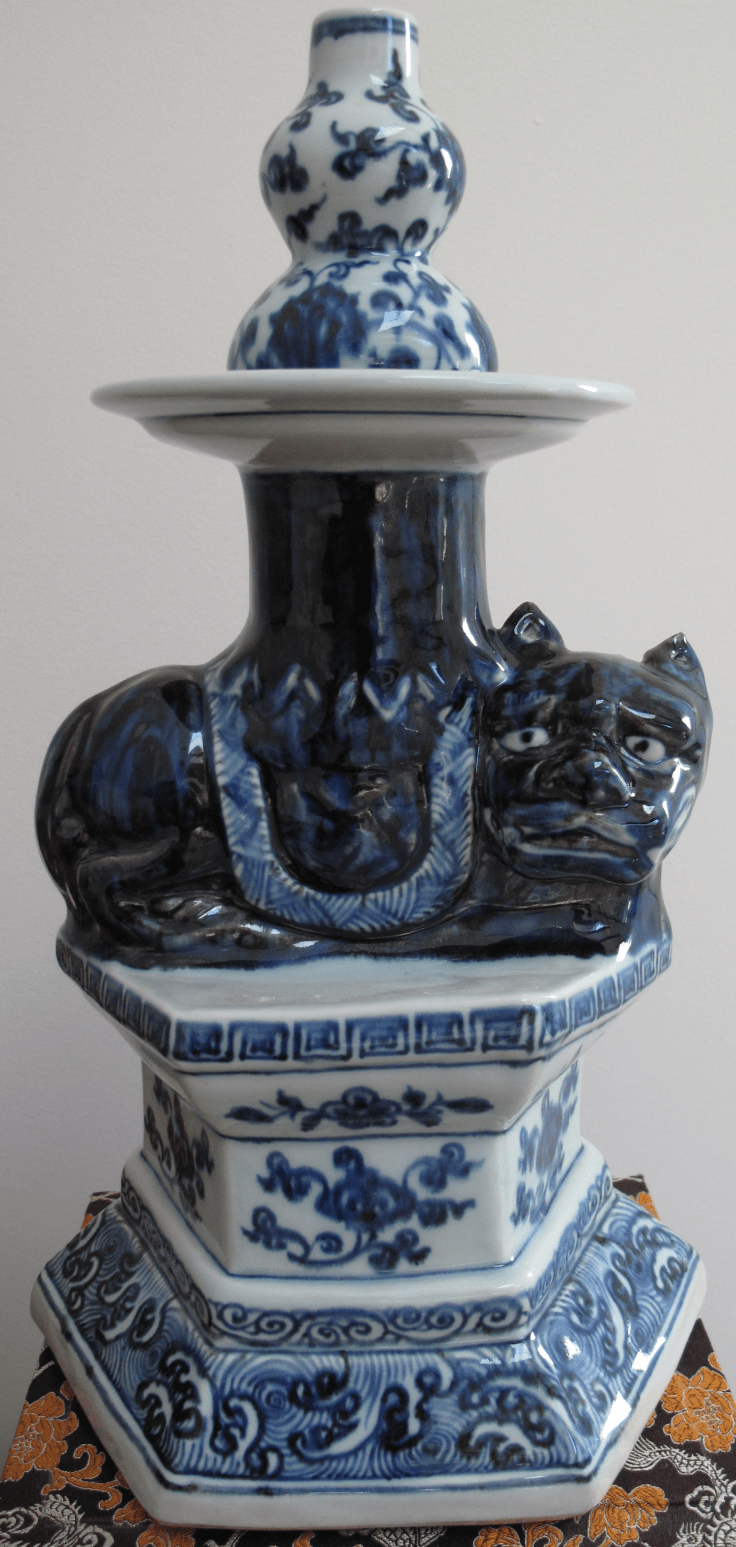
With this very simplified backdrop, I am going to show you a candlestick holder the central theme of which is a crouching lion (Figures 1 & 2). It stands at 13 1/2 inches tall. So, we do see potters sculpturing an animal in the Ming era, though this has to be extremely rare. And in all fairness, the skill and the sculpturing here are perfectly fine.


IMG_6148.pngFigure 1    


IMG_6150.pngFigure 2    

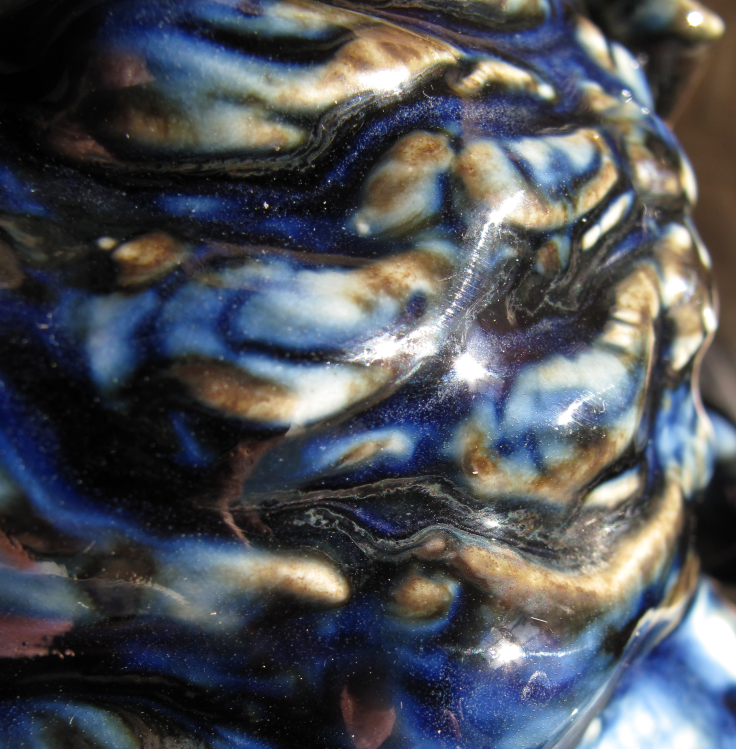
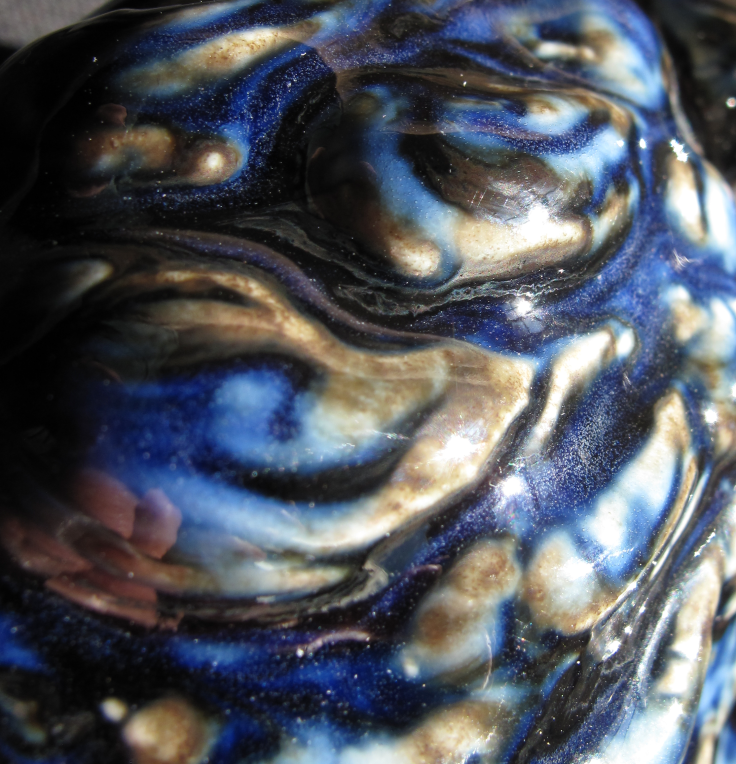
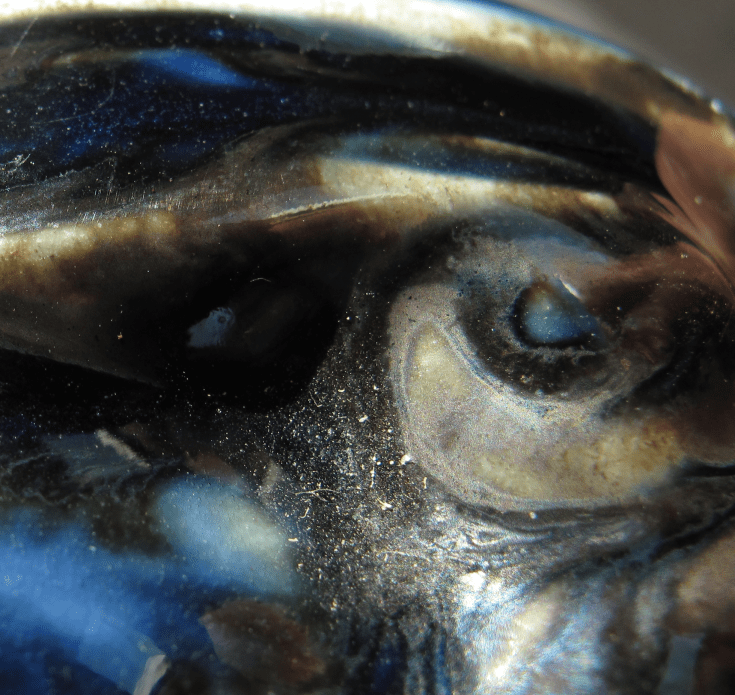
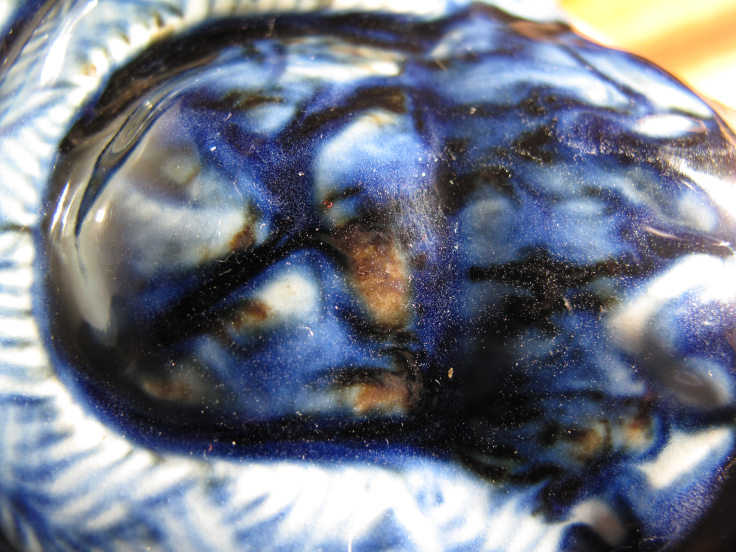
With something that rare, the first thought that we should have in  our mind would be: is this a fake? Now that we are quite familiar with the Sumali Blue dye, we will look at it and see of the dye is consistent with the Sumali Blue dye. Here in the lion, the whole animal is painted blue, so we have plenty of opportunity to look at the specific features of the Sumali Blue dye. We have also the opportunity to look at how the dye will behave in some very exaggerated contours, such as bulging and crevices. I will first show you some photos of the head and the behind where contours are much more magnified.


IMG_6348.pngFigure 3  


IMG_6342.png Figure 4


IMG_6345.pngFigure 5 


IMG_6177.pngFigure 6  


IMG_6283.pngFigure 7  

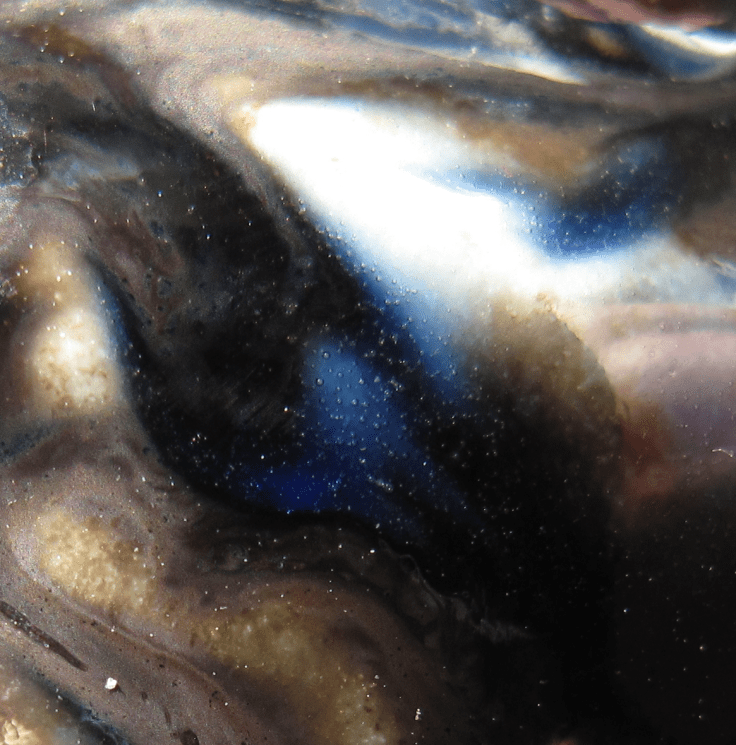
In these photos (Figures 3-7) I am trying to focus of the sharp contour. You will notice that the components of the dye are more clearly defined. Each component falls down the slope at a different speed according to their density, and that would include the different components of the muddy layer. The bubbles-generating blue pigment apparently falls down the slope more quickly and is collected at the base of the slope, at where I call the crevices are. The brownish component, probably the main component of the mud, is lighter in density than the rest, and most of the time, stays at the top of the ridge and slides down slowly. The more reflective part of the mud comes in between in density, and you can clearly see it in Figure 6. Try to enlarge the photos, and you will get an idea how the bubbles are distributed.

Now, let me show you some enlarged photos of these areas.


IMG_6294.pngFigure 8   


IMG_6335.pngFigure 9   


IMG_6233.pngFigure 10   


IMG_6219.pngFigure 11    


IMG_6216.pngFigure 12   


IMG_6213.pngFigure 13  


IMG_6272.pngFigure 14   

In these photos (Figure 8-14), and you will have to look at them very carefully, you can visualize the components of the muddy layer because of the separation of the components by just gravity alone. Look at figure 11 on the left, do you see the brownish component stays at the top of the ridge? This is also very well shown in Figure 12, where the contour of the slope is not as sharp. In Figure 14, you can see the blue dye collected at the bottom of the slope at where the crevice is, and bubbles are building up in large amounts. In Figure 13, look at the bubble distribution at a large and yet more gentle slope. Look at the large and small bubbles are linked up, as if by a string, in many instances. This is also seen in figure 10.

I’ll now show you another two photos showing the bubbles on the slope and down at the crevices (Figures 15-16).


IMG_6186.pngFigure 15   


IMG_6188.pngFigurer 16   

Aside from the lion, the rest of the candlestick holder is very much like a regular Xuande B & W. The plaques, the flare and dripping and the bubbles are all typical or variants of the typical. I’ll show you some photos of these features.


IMG_6206.pngFigure 17  


IMG_6217.pngFigure 18   


IMG_6231.pngFigure 19  


IMG_6247.pngFigure 20  


IMG_6260.pngFigure 21  


IMG_6266.pngFigure 22   


IMG_6270.png

Figure 23   


IMG_6353Figure 24   


IMG_6362.pngFigure 25   


IMG_6364.pngFigure 26 

Look at these photos carefully (Figures 17-26). The appearance of the bubbles, plaques and flares and drippings matches in one way or the other features of other early Ming wares that I have shown you before, and you should have no doubt that the dye of this candlestick holder is of the Sumali Blue dye, and that the ware belongs to the Xuande period.

Before finishing off, I’ll show you the mark of this candlestick holder and a photo showing large bubbles intermingle with the small ones (Figures 27-28), and do pay attention to the lacunae and the pearly white large bubbles, which are very typical of the Sumali Blue dye.


IMG_6202.pngFigure 27


IMG_6316.pngFigure 28  

A Blue & White Xuande Zhadou

Our experience with the Sumali Blue dye tells us that the dye is a lot more complicated than its name may imply. It is quite unlike our modern day dye. Nowadays, when we talk about a certain dye, we already have a picture of the dye in our mind. Not so with the Sumali Blue dye. We know the dye has some very characteristic features, such as the plaques and the bubbles. But then, we can never expect what the bubbles look like, nor the plaques. Some of the bubbles are rather large, some are not nearly as big. Some small bubbles are tightly packed, but some are much less densely crowded together. Some plaques are mature plaques, in the sense they have a metallic foil floating on top of a muddy layer. Some plaques are without the metallic foil, with only the muddy layer at the bottom of the glaze fully exposed to your eyes. Some of the muddy layers are very reflective to sunlight, giving rise to beautiful color when viewed under the sun. Some are not nearly as colorful. 

With all these differences, obviously the nature of the dye is not the same. When we talk about the nature of the dye, we must be more specific. Let us take diamond as an example. We know that not all diamonds are the same. We have yellow diamond, pink diamond, blue diamond and the classic white diamond. And for white diamonds, some are more pure with little inclusions and some are more brilliant than the other. That is to say, though they are all diamonds, their nature is different. Same is true with sapphire. The blue color varies through a wide range—from a light blue to a blue so dark that it is almost black. So, going back to the Somali Blue dye, it is clear that the composition of the dye pigment varies through a big range. The end result, as judged by the bubbles and plaques and the blue coloration, definitely varies. In the many previous B & Ws that I have shown you, you have seen bubbles  present in many forms, so are the plaques. What is a high quality dye, and what dye is of a lower quality is a problem that has no straightforward answers.

Personal preferences aside, I tend to think that very large bubbles in the midst of very small and tightly packed small bubbles in Yongle wares are very beautiful. Plaques that give rise to colorful reflections under the sun are beautiful. Small bubbles that are not too densely packed and yet not too thinly spaced out are the best. I am now going to show you a Xuande B & W that has plaques that are not too reflective to sunlight and the small bubbles are very tightly packed, and see how you would feel about it.

The Xuande B & W is a Zhadou that is 5 inches tall, and 5 1/2 inches wide.


IMG_5852Figure 1


IMG_6096Figure 2   

Let me first show you the plaques (Figures 3-9)


IMG_5868Figure 3   


IMG_5882Figure 4   


IMG_5883Figure 5  


IMG_5951Figure 6  


IMG_5965Figure 7  


IMG_6044

Figure 8   


IMG_5885Figure 9

In these seven photos, except for Figures 6 and 7, which were taken under LED light, they were all taken under direct sunlight. You will note that the plaques do show some reflection, and they are rather nice plaques. But the reflection is far from colorful when you compare these photos to some of the photos that I showed you before. You must wonder why?

I don’t believe anybody can give you an answer. But I can make a guess. The plaques, I have told you before, are from compounds of the dye. And a matured plaque has at least two components—the metallic foil floating on top, and a layer that looks like mud at the bottom, what we call the muddy layer. The metallic layer floating on top is, by all probability, composed mainly of aluminum. What is the composition of the muddy layer? Again, we don’t know. But one thing we can be sure of is that it contains particles, metallic or otherwise, that have a high index of reflection. The content and composition of these highly reflective particles are obviously different in different samples of the Sumali Blue dye because the nature of the dye is just not the same. It is like the case of a dark blue sapphire and a pale blue sapphire. There are a lot of differences, including the reflective index. 

Here in the Zhadou, the plaques, when they are examined under day light, are very much the same as many of the Xuande and Yongle B & Ws. They are just blackish patches in the middle of the blue dye. But, under bright sunlight, the plaques in different wares will not look the same. It all depends on the number of highly reflective particles present in the muddy layer. The plaques with more of these particles will give rise to a colorful reflection than those with a fewer number of such particles. I would say most people would prefer a plaque that reflects with a lot of color. It is just like comparing a brilliant diamond to one that is dull in color. In this aspect, the Sumali Blue dye of this Zhadou, so far as I am concerned, is not of the best quality. But there no doubt that it is a Sumali Blue dye, and the Zhadou is real and of the period.

In these photos, alongside with the plaques, you must have notice the very nice flare and dripping effect. They are no different from any good quality dye. And I’ll just show you a few more photos of these flares and drippings (Figures 10-18). 


IMG_6044 (1)Figure 10   


IMG_6060Figure 11  


IMG_6051Figure 12   


IMG_6015Figure 13  


IMG_6010Figure 14  


IMG_5981Figure 15    


IMG_5965 (1)Figure 16   


IMG_5964Figure 17


IMG_5960Figure 18

Look at the plaques and the flares and drippings in these photos. I would say that they are very typical. Not only typical, but rather beautiful. In choosing these photos, I have tried to include in them the large and the small bubbles. The large bubbles are nice, but not as large as some of the other Xuande B & Ws, not to say the large bubbles in Yongle wares. But still, the pearly white large bubbles, the string of large bubbles and large bubbles lurching around the edge of the deep blue coloration are all there. These features are, as you can remember, characteristic of the Sumali Blue dye.

You will also note that the small bubbles are very densely packed. Normally, very densely packed small bubbles do not look beautiful because many a time, they will give rise to a sense of confusion. The whole appearance looks chaotic. However, if these small bubbles are arranged in the form of tightly packed lacunae, the picture becomes quite different. The bubbles will appear orderly, and the chaotic appearance is no longer apparent. I have taken pains to take some of these photos so that even the small bubbles are quite clearly shown. You will agree with me that these small bubbles are in a rather orderly manner. Let me show you a few more of these. 


IMG_5937Figure 19  


IMG_5936Figure 20  


IMG_5929Figure 21 


IMG_5904Figure 22 


IMG_5933Figure 23  


IMG_5973Figure 24  


IMG_6056Figure 25

Look at the small bubbles in these photos carefully. In everyone of them, the lacunae are very well formed, so that the small bubbles no longer give a sense of chaos when you look at them. If it were not for the lacunae, the small bubbles, and the picture as a whole, will no longer be tolerable, and you would not like the ware at all. Here, it is the small bubbles and the lacunae that save the day. If the dye the potters used in the Zhadou is not the best quality dye, at least it is not the worse.

Before I finish this article off, let me show you the mark. 


IMG_5988Figure 26  

A Xuande Blue and White Drum Stool


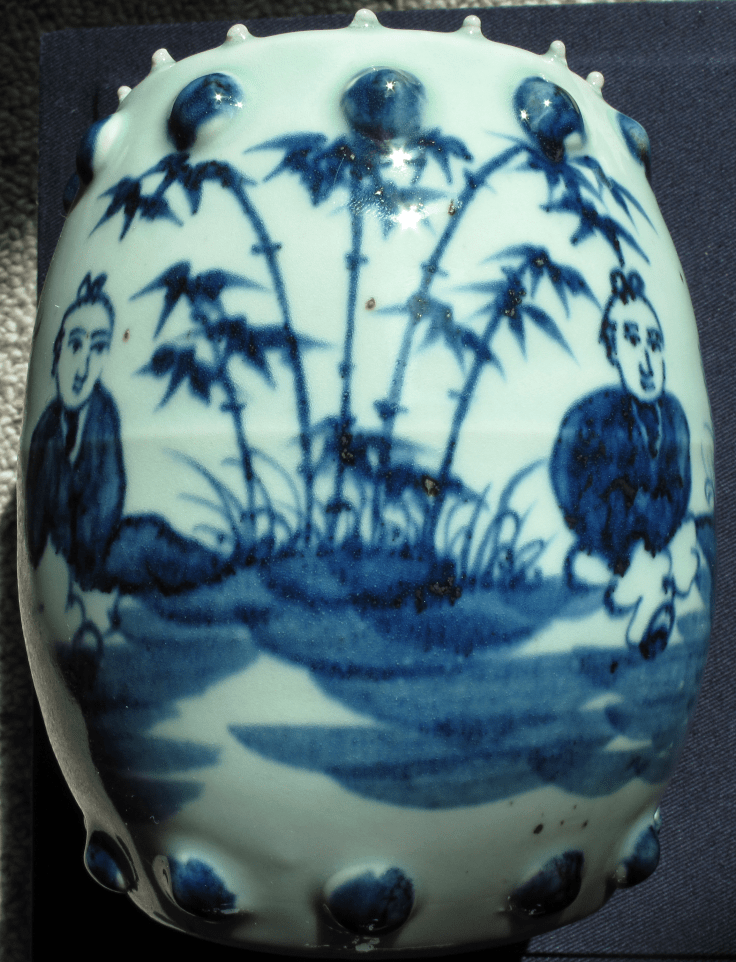
When potters in the early Ming period decide to make a ceramic ware, they have the shape of the ware and the decorative motif to worry about. But I don’t suppose the worry is actually theirs. There are people in the supervisory position to tell them exactly what they should do, and they are but to carry out the instructions. Our experience with Blue and White of Yongle and Xuande tells us that the shape and motif of those wares vary through quite a large range. But it is interesting to note that during the Yongle period, there is no human figures painted in the motif. Even in Xuande period, human figures do not appear very frequently in the motif. We do not know the reason for this. But some connoisseurs have suggested that this has something to do with the dripping and flare of the dye. I believe this is a very valid reason. Imagine a human face that is full of drippings, would the beauty of the figure, and the ware, be marred? 

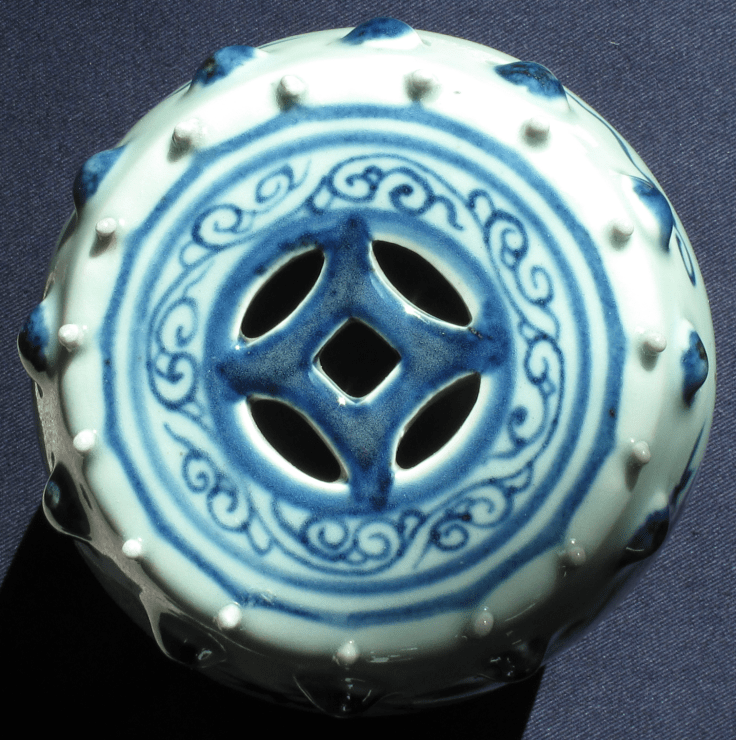
It is of interest to know that the Yuan potters don’t seem to be bothered by this problem. Human figures appear very often in their decorative motif, and things just look fine. I believe they must have a technique by which they can avoid the problem. But like so many trade secrets, they just would not want to disclose those secrets, not even to their pupils. Very soon, the technique vanishes. It is not until the late Xuande period when potters, for whatever reasons, have again master the technique. And many a time, the potters are very comfortable in dealing human figures in their motifs. Now, I’ll show you a Blue and White drum stool as a good example. It measures 5 1/4 inches in height, and 4 3/8 inches wide.


IMG_5756.pngFigure 1  


IMG_5755.pngFigure 2  


IMG_0768.pngFigure 3  


IMG_0820.pngFigure 4  

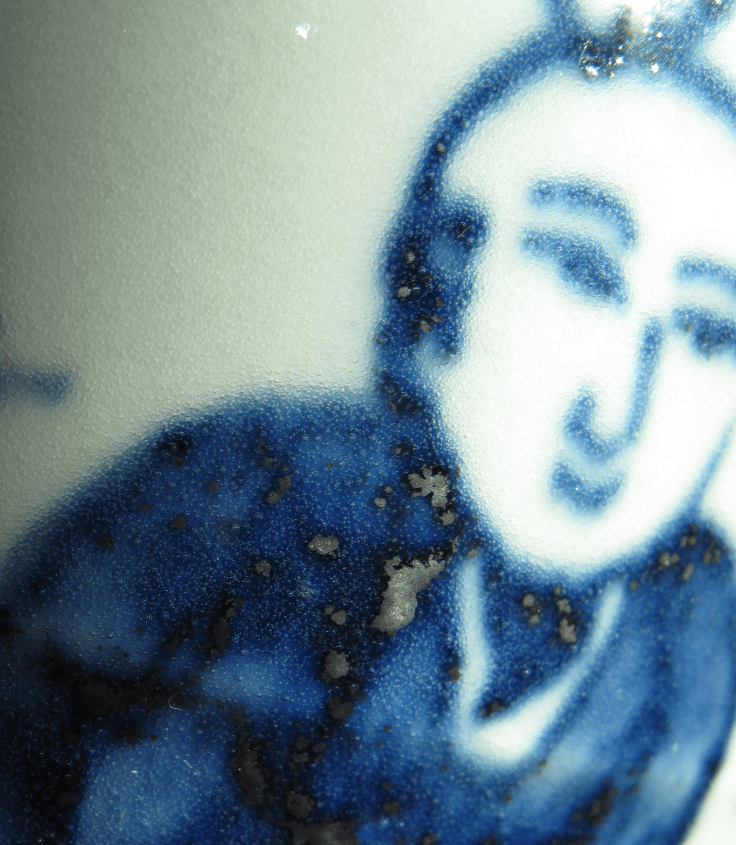
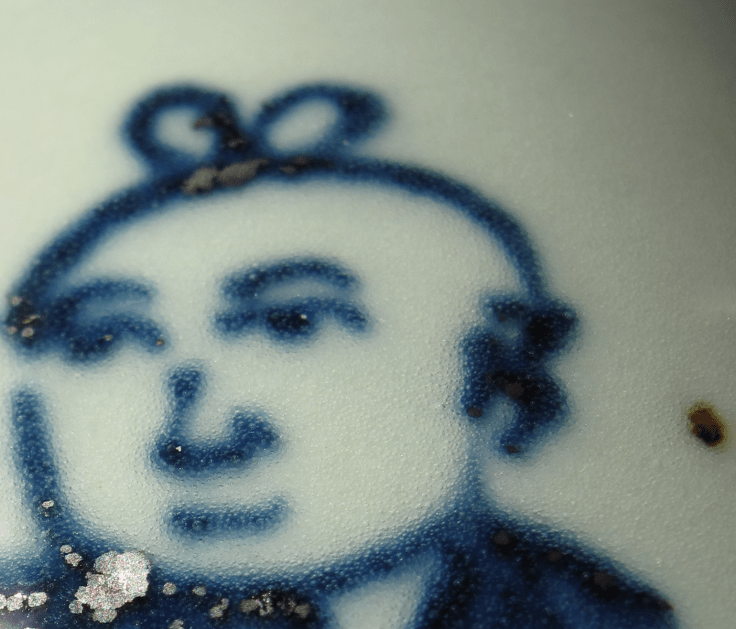
In Figures 3 and 4, you can see that the drippings and flares are largely under control. Still, if you were to look carefully, there are some drippings, but they are in no way giving the overall appearance any impact. I must say that the potters have picked a very good dye to suit the occasion with all the rather large bubbles to enhance the aesthetic effect of the face. If you think that these are beautiful bubbles, I’ll show you more that would definite amaze you  (Figures 5-9).


IMG_0771.pngFigure 5 


IMG_0775.pngFigure 6


IMG_0808.pngFigure 7  


IMG_0816.pngFigure 8 


IMG_0815.pngFigure 9   


Look at the bubbles in these photos. Are they not beautiful? I think, of all the characteristic features of the Somali Blue dye, bubbles and plaques are definitely the two that are most beautiful. Both of these two properties have an almost infinite form of presentation. For bubbles, many forms of presentation are beautiful, and depending on your preference, you may rank one form of presentation higher than the other. But these bubbles, in crystal form, so tightly packed, all bubbling up to the surface, have to be ranked as one of the best presentations.

I think there is another reason for you to find these bubbles beautiful. It is the blue coloration. Look at the blue color, it is not uniform. If the blue color is all the same blue, I am sure it will not be as attractive. Here, some areas are dark, whereas in some other areas, they are a lot lighter. And in some other areas, you’ll find the very beautiful sapphire blue coloration. All these add up to the pleasing effect to the eyes.

But in these bubbles, one thing is lacking—the large bubbles. Only in one or two places can you find a large bubble. But in other areas, as I will shortly show you, they are not the same. This only shows you that the potters know exactly what they are doing. They know that certain blue dyes in their palette are different from the others, and they choose the appropriate ones for the appropriate instance. In Figures 10-16, you can see quite a lot more large bubbles.


IMG_5768.pngFigure 10  


IMG_5760.pngFigure 11   


IMG_5832.pngFigure 12  


IMG_5790.pngFigure 13   


IMG_5776.pngFigure 14  


IMG_5779.pngFigure 15   

In these photos, you can see that many of the large bubbles are semi-opaque, typical of Somali Blue dye, and are in fact very beautiful. The small bubbles also show typical Sumali Blue dye features—a few small bubbles are linked up, as if by a piece of string. And in some of these photos, figure 10 in particular, you can see lacunae formation very well. I will show you a few more photos with these lacunae formation. 


IMG_0797.pngFigure 16 


IMG_0784.pngFigure 17   


IMG_5766.pngFigure 18  


IMG_0824.pngFigure 19  


In these photos, aside from the lacunae formation, which you can see more clearly if you try to blow up the photos a little, you can also see the drippings. Note that in figure 19, some of the small plaques actually drift away from the main plaque—again, a  feature indicating that the blue dye pigment is of high quality. Figures 20-22 are photos showing you the same feature.


IMG_5791.pngFigure 20   


IMG_5828.pngFigure 21


IMG_5812.pngFigure 22   

With all these features that I have shown you, there is no doubt that this drum stool is a Xuande. But you must not forget to see the plaques in many of these photos. Look at them carefully. These plaques are all without the metallic foil floating on top. In other words, the plaques only have the muddy layer. As you may remember, the muddy layer has a rich content of minerals and compounds that are reflective to sunlight, and they are much more colorful under the sun than those plaques with an aluminum foil floating atop. Again, these plaques are the most typical of the Sumali Blue dye, and seeing them, it is just another piece of evidence that the ware belongs to the Xuande period.

Blog at WordPress.com.

Up ↑