I have told you in my article—A Yongle Blue and White Dragon Moon Flask—in some detail about plaques in wares that are painted with the Sumali Blue dye. Now I am going to show you another Yongle Blue and White that also has a lot of plaques. But the plaques here have appearances that are quite different from the Moon Flask. To be sure, plaques in both of these two wares are beautiful. But it also proves my point that plaques have many faces, and we need to study them, and know them well, before we can be comfortable with ourselves when we deal with Blue and Whites of those eras.
It is a tankard that I am going to show you. It is rather small, measuring only 13.3 cm in height. It is not very rare, but I would not say that it is commonly seen either (Figure 1 and 2).
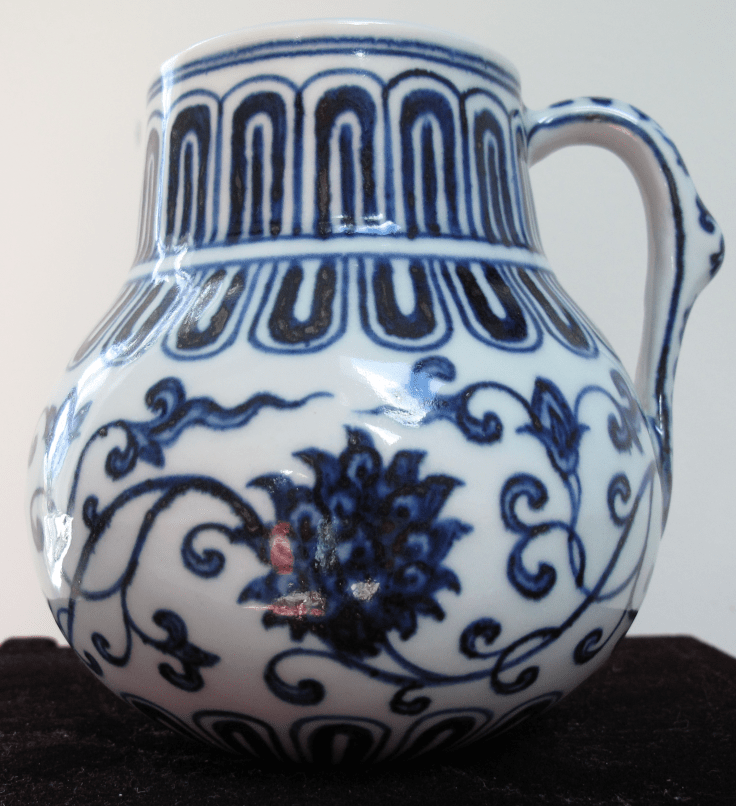 Figure 1
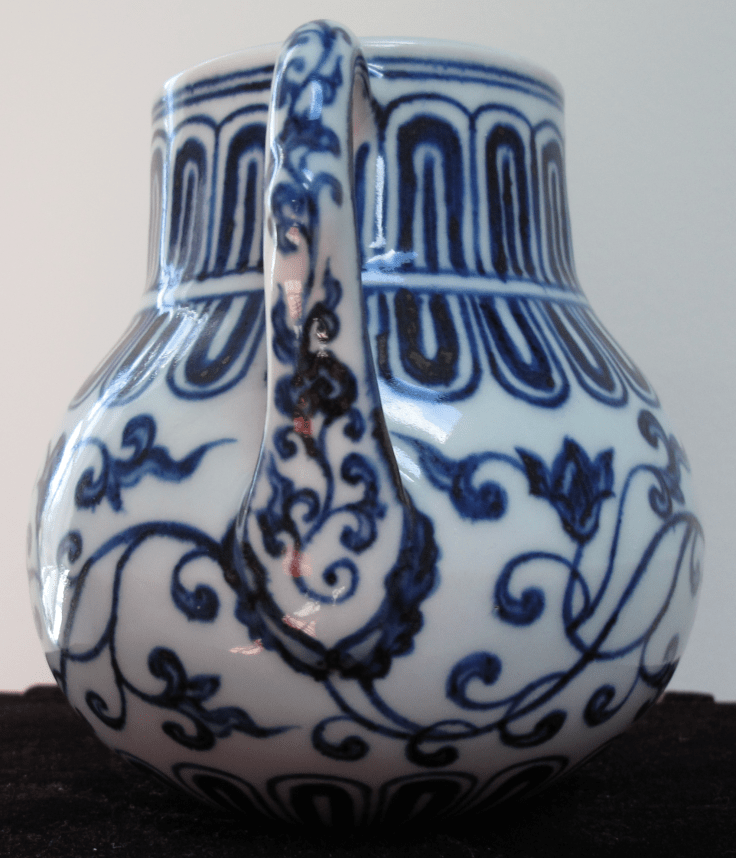 Figure 2
Now, looking at this tankard, how do you know that it is genuine and of the Yongle period? If you were to take it to an expert, will he tell you about the ware as I am going to tell you?
To me, this tankard has a very nice blue color, the sapphire blue. It is among the best blue colors a Blue and White can have. You can see the plaques too, but if you are not an experienced collector, these plaques can easily be overlooked. They are just dull blackish staining inside the dark blue areas, nothing remarkable. Look at Figures 3-6.
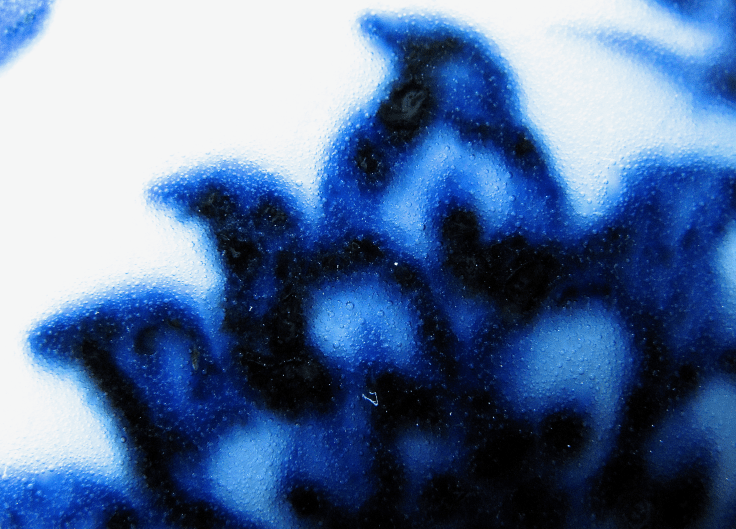 Figure 3
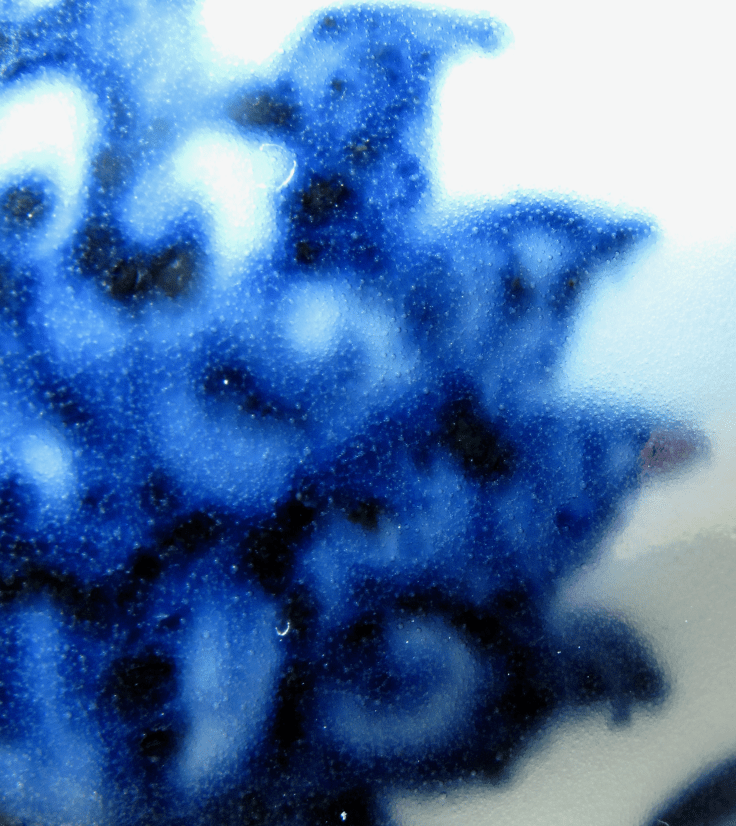 Figure 4
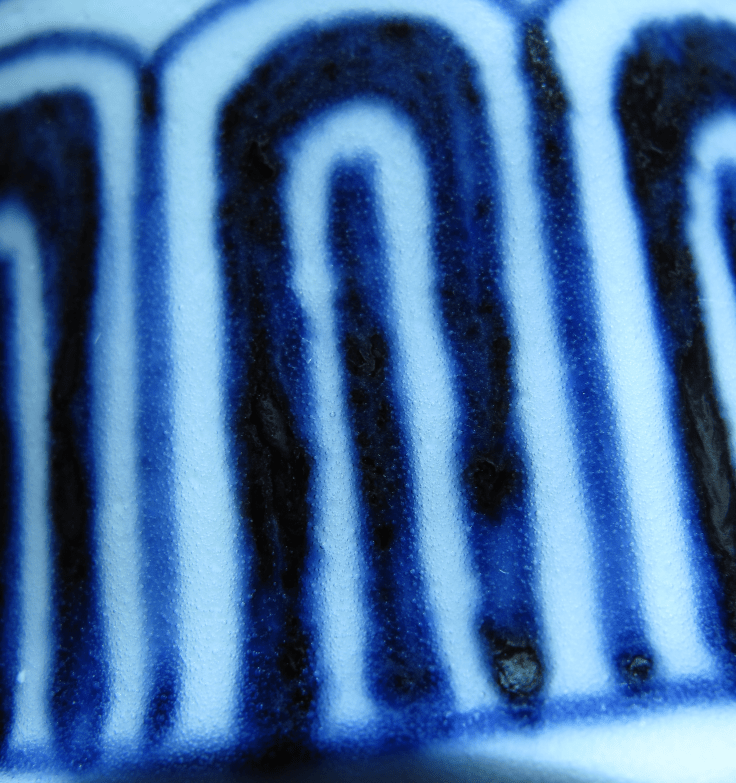 Figure 5
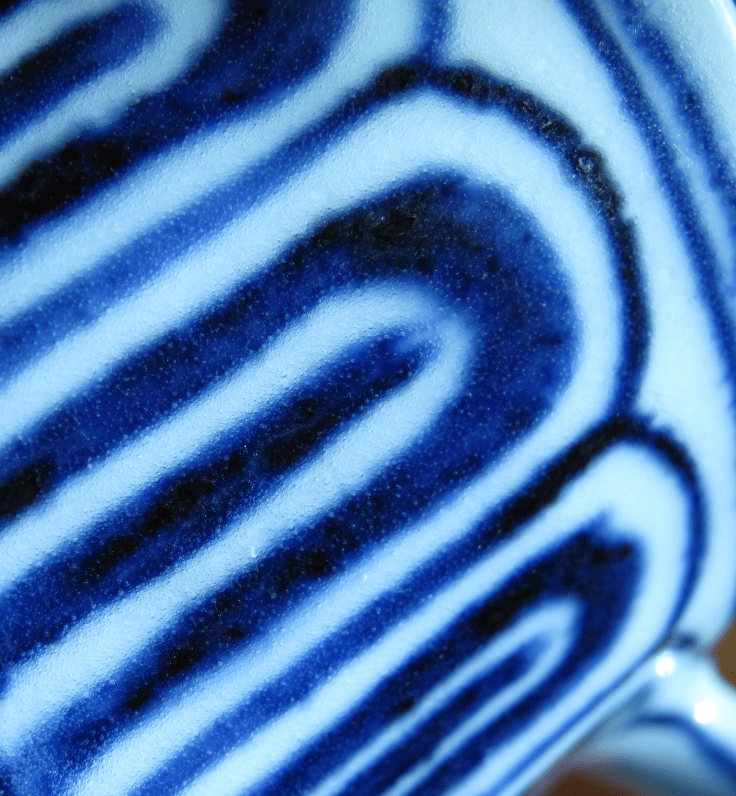 Figure 6
These photos (Figure 3-6) were taken under daylight. Pay attention to the blue color. This is the typical sapphire blue—a blue sapphire gem under the sun. The plaques are everywhere. Some of these are well formed plaques, others are not, as you will see later on. But here they only appear as blackish patches in the deep blue color.
However, these inconspicuous black coloration, under sunlight, will have a totally different appearance. The appearance also depends on the strength of the sunlight and the angle with which it strikes the plaques, as you can see in figure 7-12.
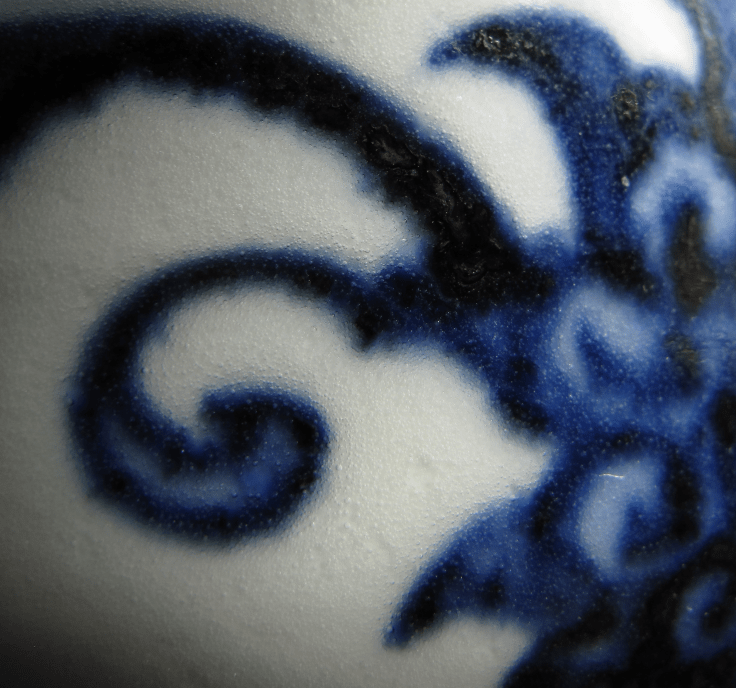 Figure 7
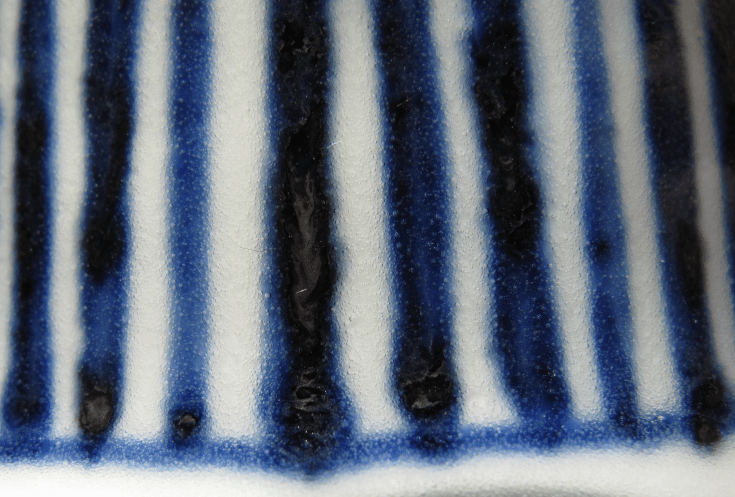 Figure 8
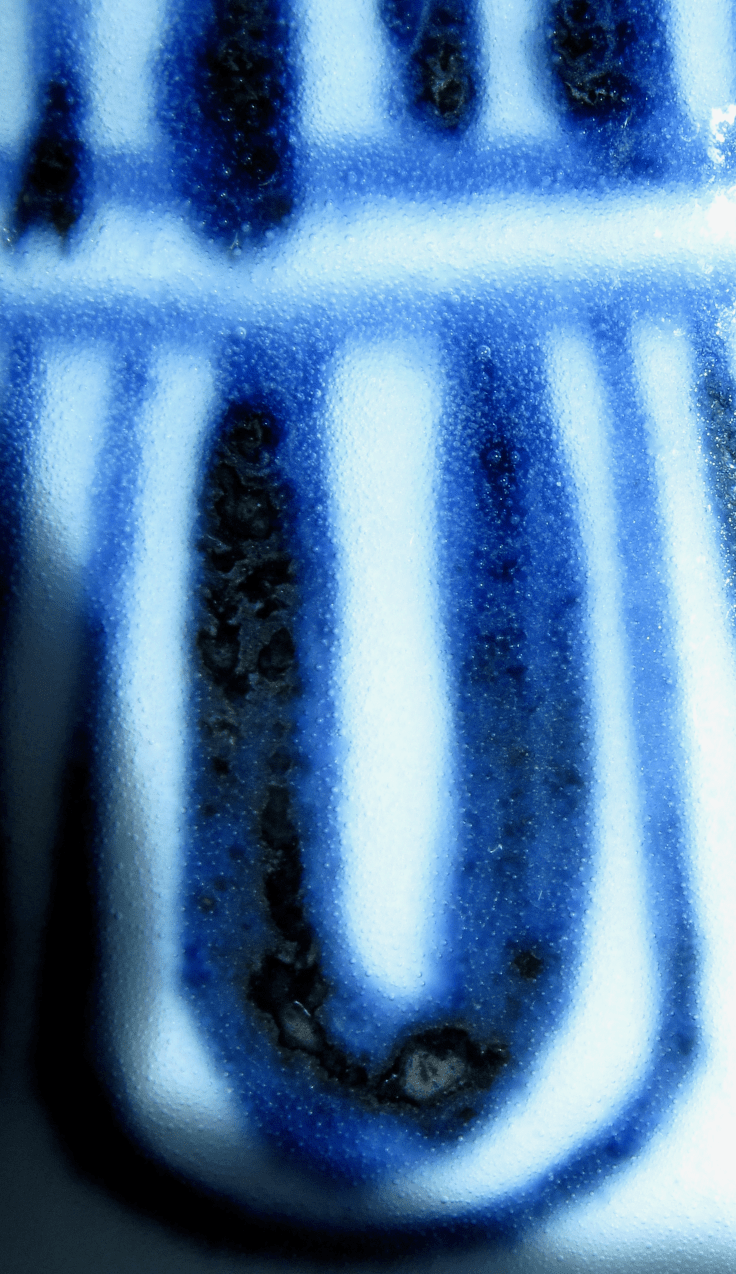 Figure 9
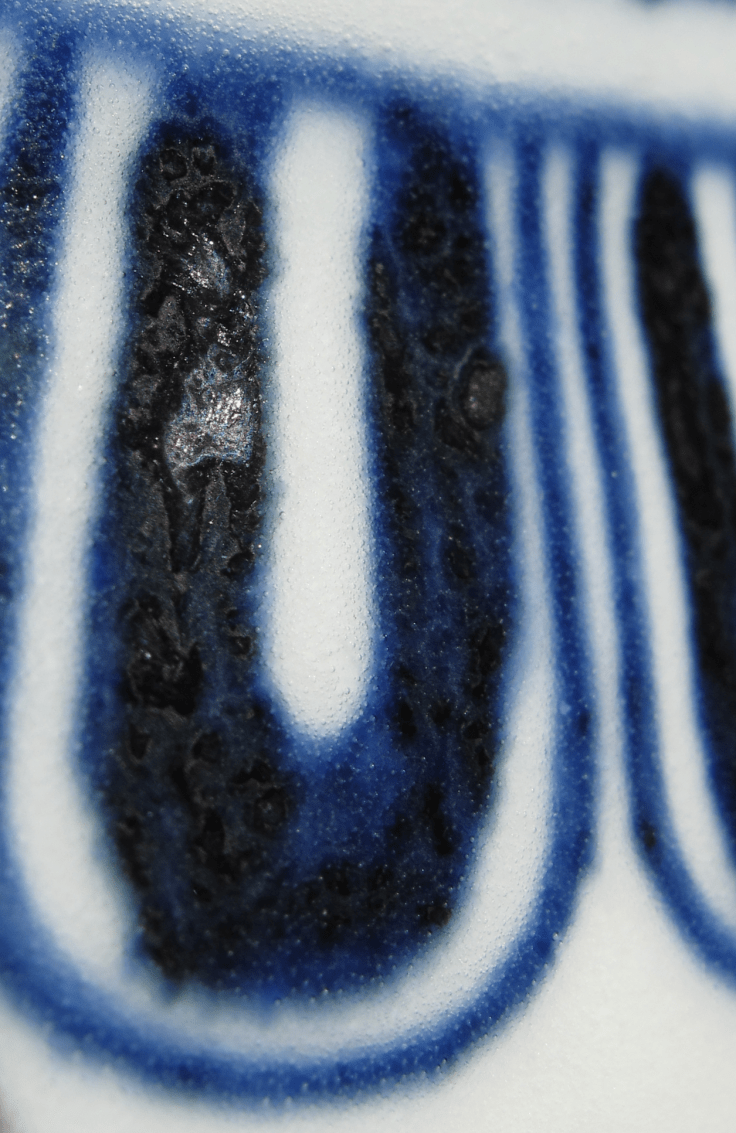 Figure 10
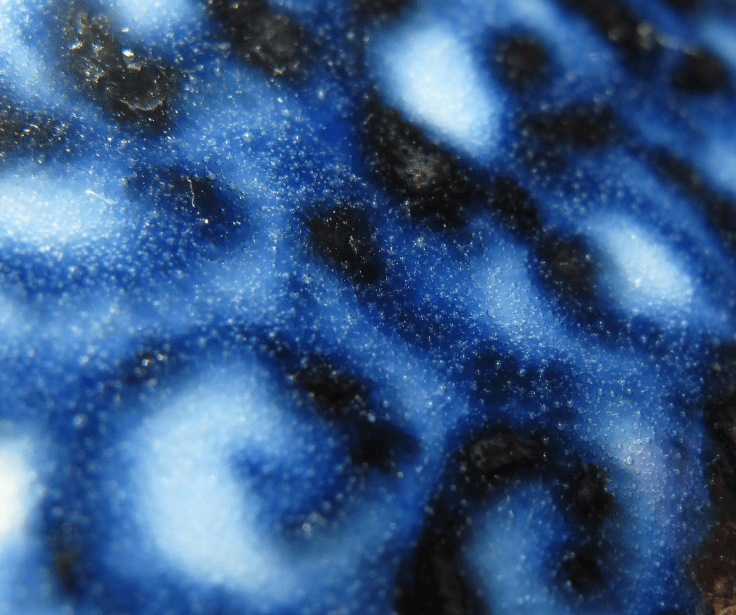 Figure 11
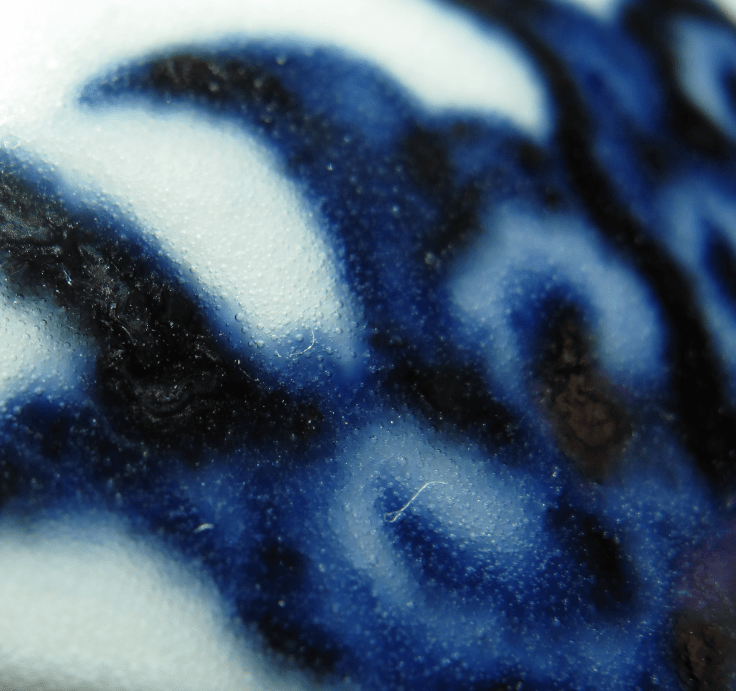 Figure 12
In Figure 7-12, the plaques are more clearly seen, when there is more reflection from the sunlight. Even those parts that do not have reflections are more clearly shown. But you need to look at them carefully. They are not all the same.
Now, I am going to show you the well formed plaques under direct sunlight, you will like their appearances (Figure 13-20). You have to examine them carefully. Note the irregular shape, note the very varied color, and note that many plaques have holes in their midst. And outside the plaques, it is always blackish, and further away, you can see the blue coloration. And look at Figures 19 and 20 again. Between the plaques are strands that seem to be filled with minute beautiful glittering dots. We can only surmise that they are reflections from the very minute particle in the Sumali Blue dye.
There must be some minute particles that remain insoluble and in suspension and have drifted out in between the plaques, filling the narrow spaces between two plaques and giving rise to reflection under the sun that presents in this manner. This is not something very common, but is an endorsement that the dye is Sumali Blue dye, and is always a lovely sight.
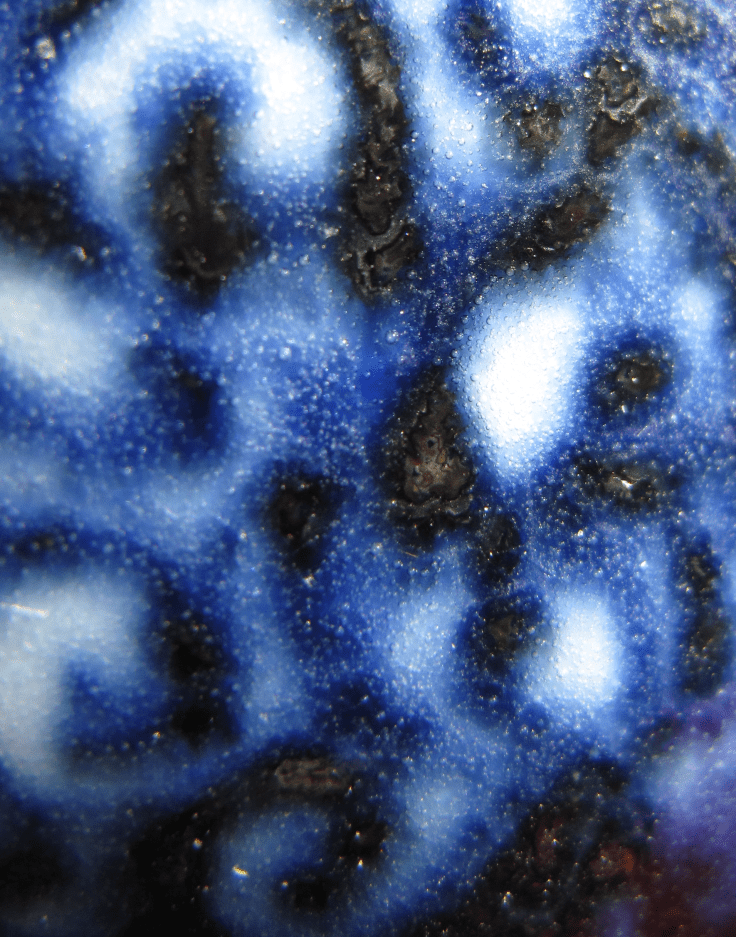 Figure 13
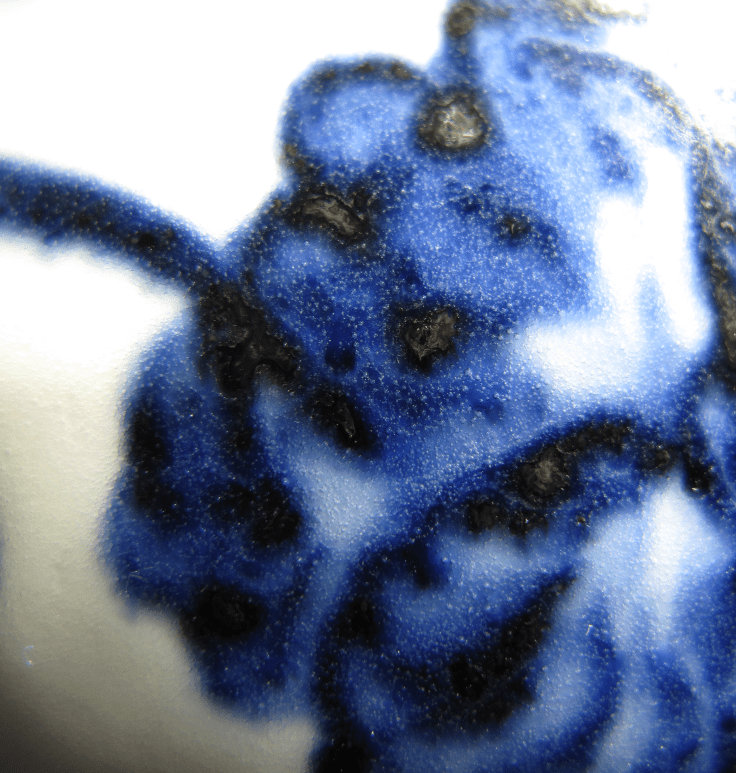 Figure 14
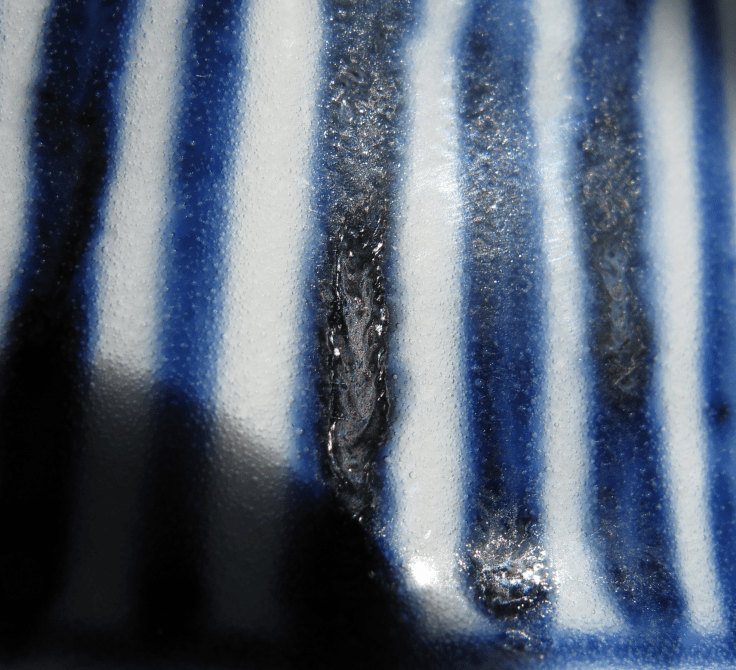 Figure 15
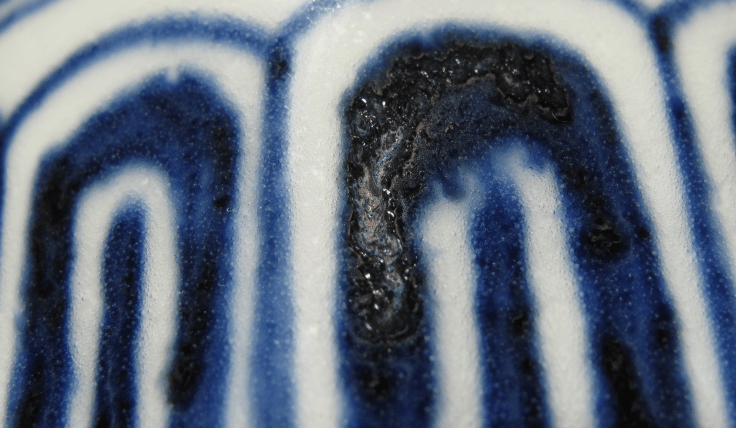 Figure 16
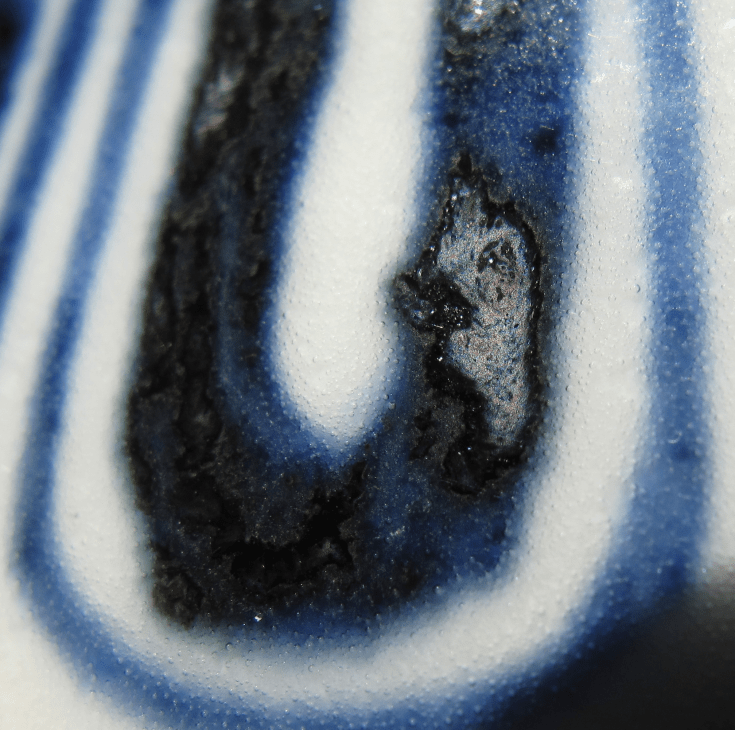 Figure 17
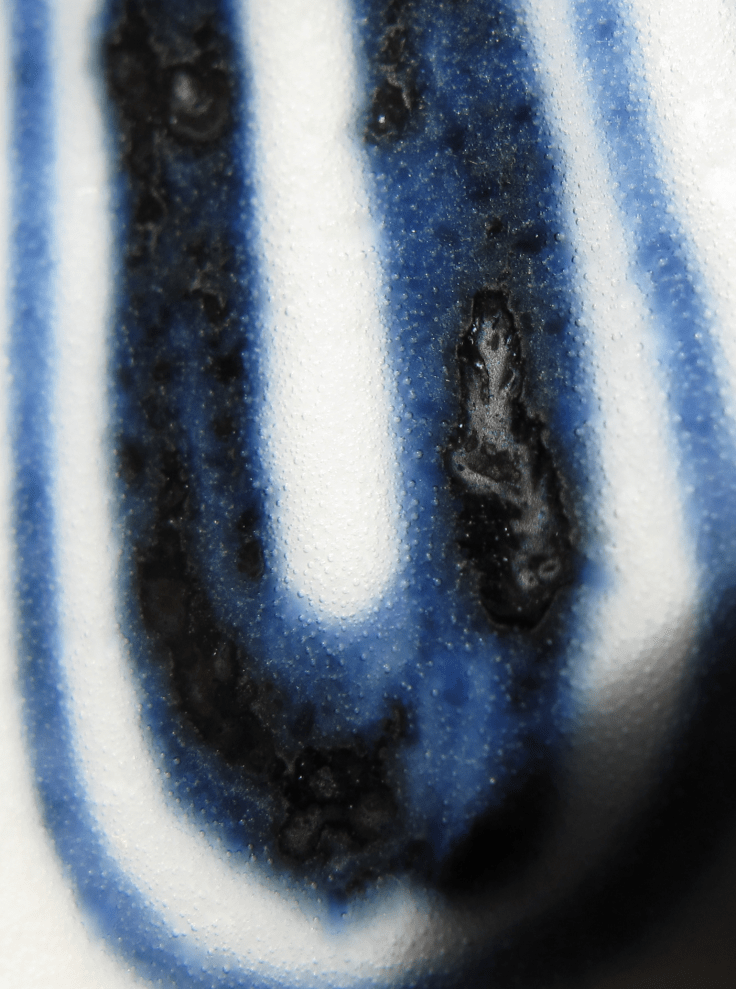 Figure 18
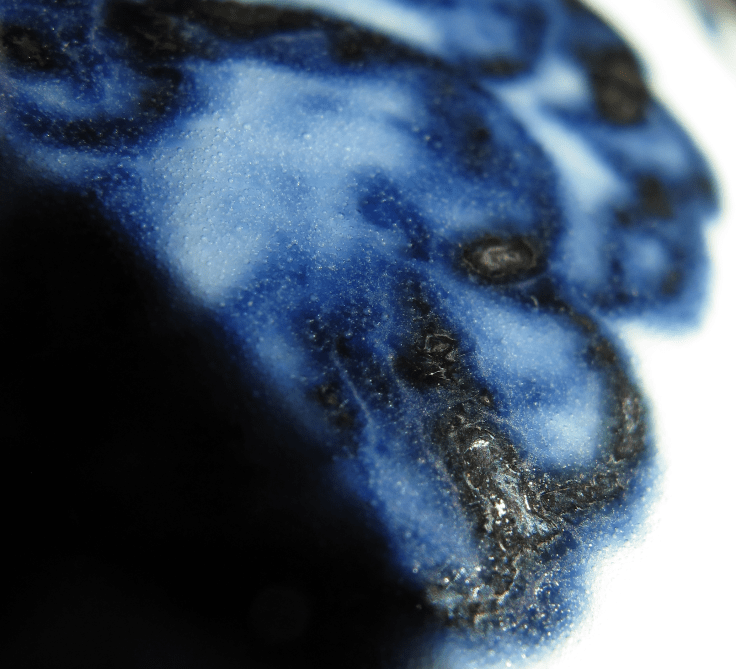 Figure 19
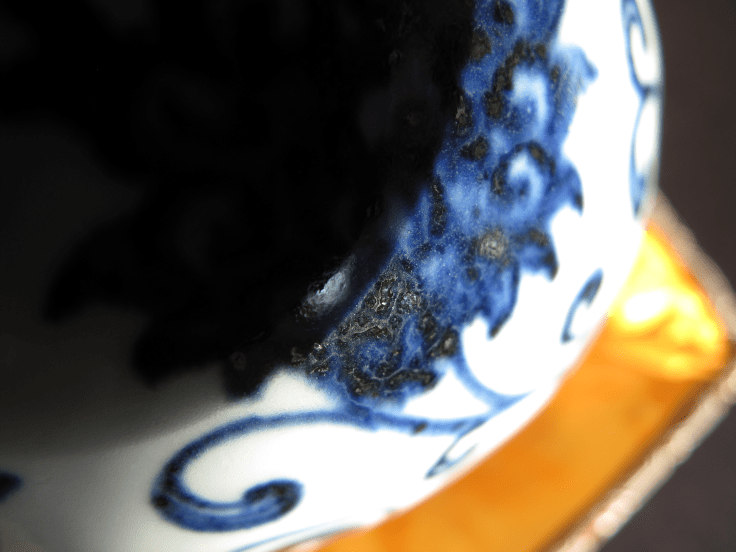 Figure 20
Looking at these plaques under different light condition, you cannot help but marvel at the beauty of them. But, if you can hold this tankard in your hands and look at it with a magnifying glass, you will be even more impressed. You can see the plaques in their three dimensional state, you can see the minor details, and the more vivid colors. You will also note that the depressions over the plaques in this tankard is not as obvious as in other Blue and Whites. They are much more gentle except in isolated areas where the plaques have more metallic reflection. There, the depression is similar to most of the other wares.
You may not know, but the beauty of the plaque and the shallow and gentle depression over it are related. This has a lot to do with the dye pigment here. As I have told you, the Sumali Blue dye varies much in its quality over the five decades of so during which the dye was imported—in term of its color, its purity, its composition, its granulation size and so on.
Here in this tankard, it has very nice blue color, and, as you will see, the metallic element is not rich, and the granules, or should I say, the minute crystals, are very fine. When a plaques is about to form, because of these variations, it does not mature into a full-fledged plaque in most instances. There is simply not enough metallic element to coagulate together to form such a mature plaque with an aluminum-foil-like tiny sheet on the top, which would give a depression in the cooling process. Instead, most of the metal element is still randomly deposited in the mud-like layer below with some loosely aggregated together here and there. These small aggregates are in various stages of ascending to the surface with some floating right at the top. That is why, under sun light, they show reflections that represents the haphazard distribution of the metallic element. This three dimensional look, mainly due to the various stages of the plaques in the process of formation, is clearly visible because no fully form aluminum-foil like plaque is obstructing the view. Stretch your imagination a little and you’ll understand why plaques are different. And that is why, the reflection is not as strong as in the case of a mature plaque with a shiny metallic sheet above. This subtle reflection is in fact even more charming to look at. The beautiful strands of very tiny shining dots in between plaques shown in figure 18 and 19 happen to be formed by some of the tiny metallic particles drifting away from the main plaque.
Before I leave the subject of plaque in this tankard, let me just show you another photo (Figure 21).
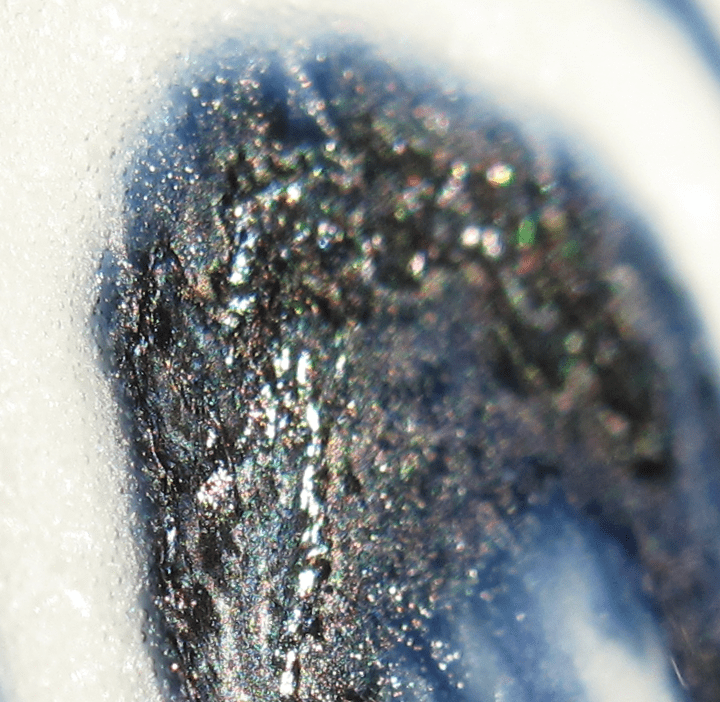 Figure 21
I deliberately show you this blurred photo because only in a blurry state can I make a tiny dot into a small circle. Look at the many different colors at the top—green, red. pink, yellow, violet and the rest. It only shows that the fine powder in the form of tiny crystals originates from something that has very beautiful colors. What can it be is everybody’s guess? But I do believe such colored particles are not reproducible by forgers, and this appearance in the photo is another endorsement that the dye is Sumali Blue dye, and the tankard is genuine and of the early Ming period.
Here, I want to say something about what I have told you. I have made many observations, supplemented by photos, and I also have theories for the observations. I have approached all these in a scientific manner, and like a scientist, I have always questioned myself if I am right in all these, especially the theories. I think such initial theories are important in serious studies, particularly scientific studies. That is how understanding of a subject begins. Look at the theory of the flat earth and that the earth was the center of the universe centuries ago, now the whole concept of the earth and its relationship to the universe is much changed. Look at the causes of cancer in medicine, they too have changed a lot over the years. But the original theories play an important part in stimulating the study and in the advancement of all these scientific studies. As to the observation, I try to do it as accurately as possible, but I am sure there is a lot of room for improvement, particularly when there is further advancement of the photo equipments. However, I remain confident that these photos, even at this stage, are enough to allow you to say that the dye is Sumali Blue dye, which is a clear indication that the ware is made in the Yuan and early Ming periods.
Now let us go back to the other aspects of the Somali Blue dye. In many of the photos here, aside from the plaques, you can also see the flare and dripping effect. Note that these flares and drippings are rather typical, and they are not too much exaggerated. I would like to draw your attention to Figure 7 where there are a lot of these. The important thing to note is that, when the photo is enlarged, the margins where the drippings merged with the white glaze tend to show a tinge of very faint blackish green. To me, this is an indication that the dye pigment is of good quality. You should remember this.
The bubbles in this tankard is different from the previous few wares that I have shown you. It only confirms what I have said, that there is a lot of variation in bubble presentation in different wares. Here in Figure 22, note the large bubbles, they are mostly in the dark blue areas. Note that in many places, they almost form a line along the margin of such blue areas. The small bubbles are not as abundant and as small as in some other B & Ws, but this is a variation that is well within the norm. Look at all the photos again, and choose those areas where there are a lot of small bubbles, you can easily see the lacunae formation. In Figure 22, because the small bubbles are not abundant, lacunae formation is not obvious. Instead, there is a phenomenon you should keep in mind. In many places, two or there or four bubbles seem link together, most of the time with two large bubbles at both ends. In the middle are often one to two very small bubbles. These short chain bubbles are placed randomly, but they do not give an impression that all the bubbles are in disarray. I would say this particular phenomenon is rather beautiful to look at, and wares with this type of pattern are often nice wares.
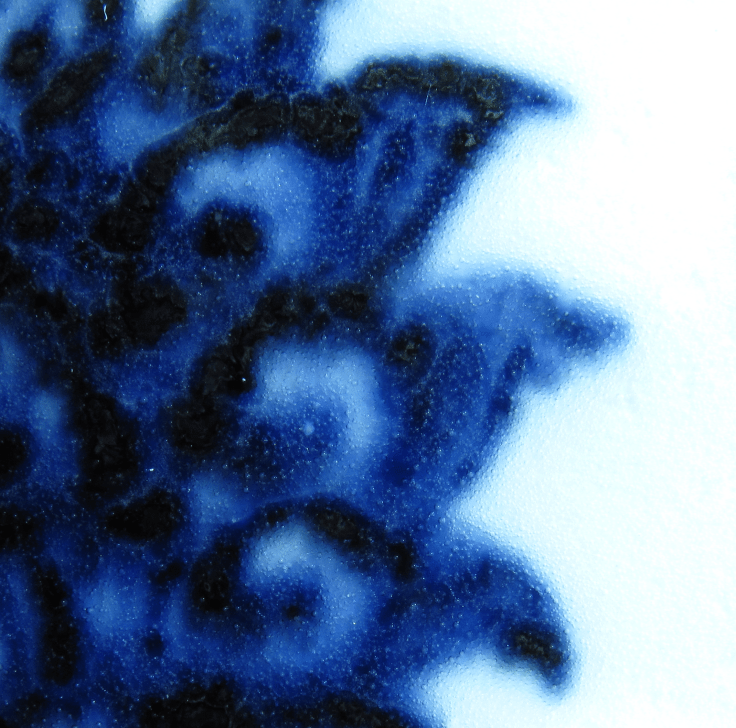 Figure 22
I’ll show you another two photos (Figure 23-24). The description of the bubbles for Figure 22 can basically be applied in these two photos. In fact, most of the photos that I showed you for plaques have bubbles similar to the description for Figure 22. Study these photos carefully and try to remember them. Compare these photos to those of the other B & Ws that I have shown you, and note their similarities and differences, and you’ll realize the variations, though quite significant, have some basic principles to follow, and you cannot miss them when you see them.
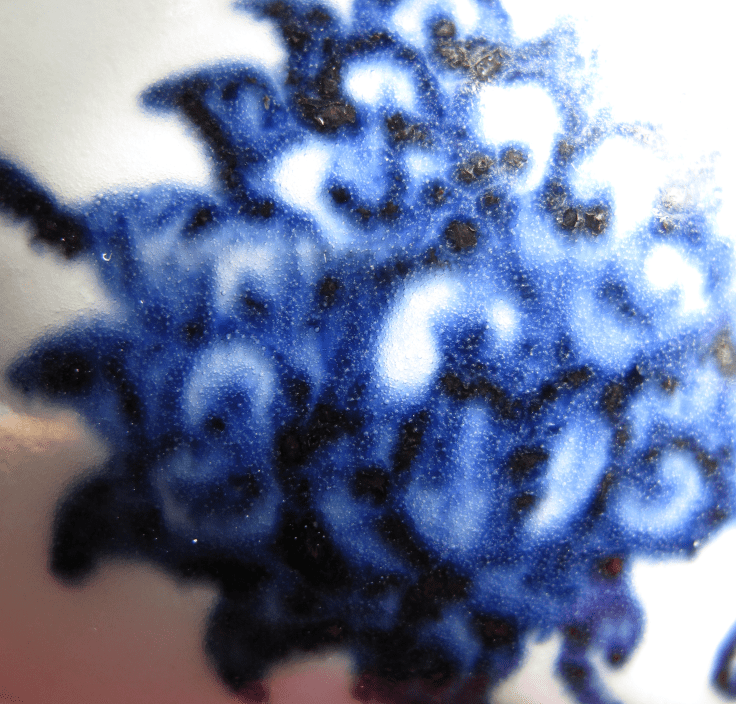 Figure 23
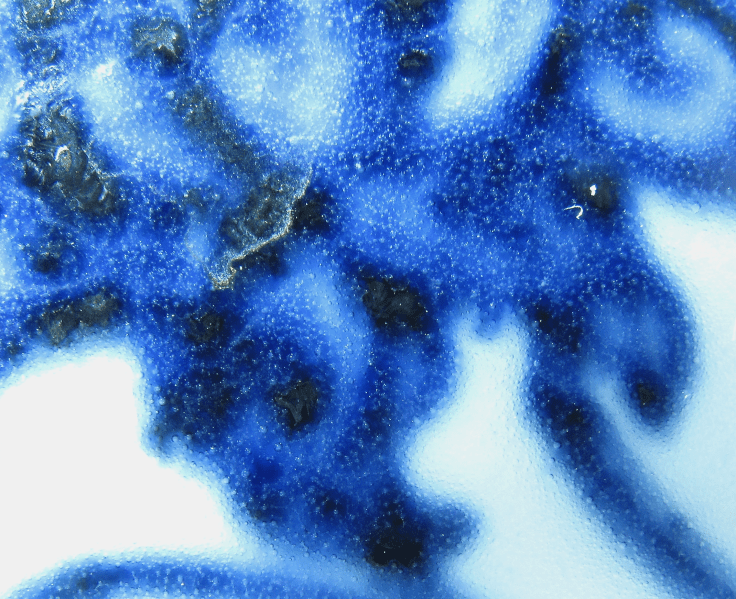 Figure 24
Before I end this article, I’ll show you another photo (Figure 25). On the left is the base of the handle of this tankard. At where the handle joins the body, there is a ridge. Over the ridge are blackish streaks flowing down from the handle to the body. This is quite common. I would suppose the reason for this again lies with the dye pigment. It is probable that the blackish component of the dye has two components, one with lower specific gravity and the other with higher specific gravity comparing to the blue component, as you’ll see later on in some other B & Ws where the black pigment moves faster than the other components of the dye. Here, the black component’s specific gravity is lower than the other components, as a result, it flows down the ridge at a slower rate. We must realize that all these dye pigment components lie in the medium of the viscous glaze, and they are all moving in the same direction. The rate of movement of the dye components is always relative to the viscous glaze. That is why, when the rest of the dye pigments components have already flowed down below the ridge, the black component is still at around the ridge, giving such an appearance. From all these observations, we can infer that the composition of the dye is very complicated, and is very different from the replacement dyes in later period, not to say the modern dye that we use today.
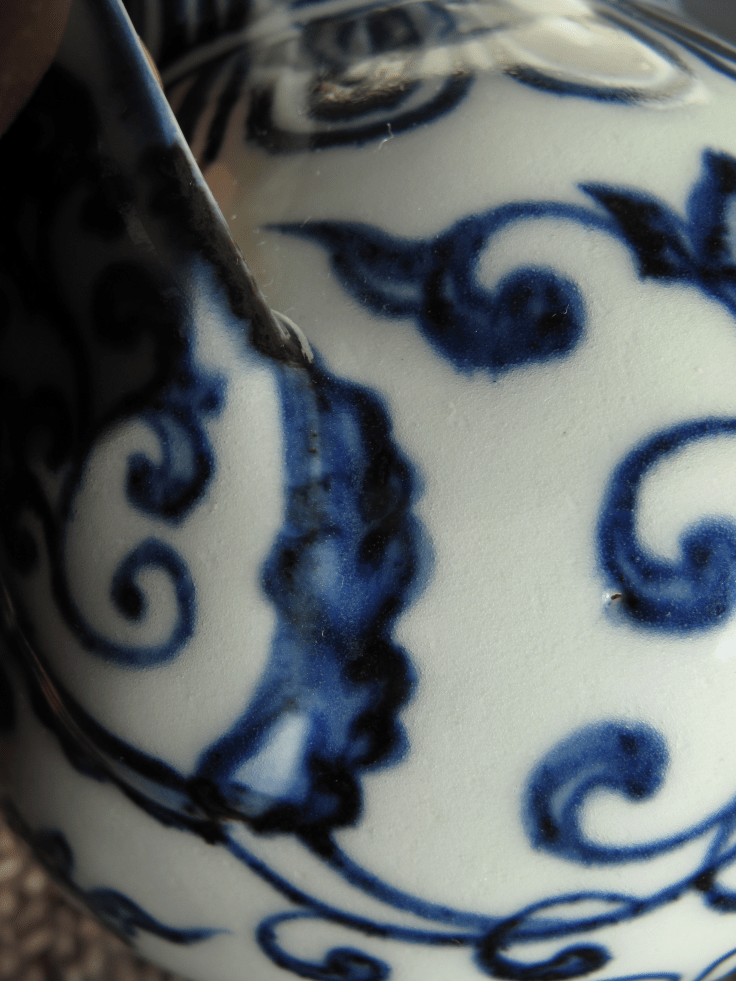 Figure 25
 yongleandxuande.com