
In January 2018, I wrote an article on a Yuan Blue and White Charger with a Lohan molded in relief at the center in the flat part of the charger. Like most Yuan B & Ws, it is a charger with plenty of plaques on the Lohan. I am going to show you this charger again, taking advantage of the morning sun to shoot some photos showing-casing the reflections of the plaques, and what is more, the beautiful glaze that this charger has. .
Now, ceramics and glaze are inseparable. It is like the body and the soul. Yes, glaze is the soul of ceramics. Nothing can be more important than the glaze. To me, the value of a ceramic ware rests largely on the glaze. When a ceramic ware is beautiful, it is the glaze that contributes most to its beauty. Imagine a well potted ware with very nice shape and attractive motif and beautiful color, but with a glaze that is either very dull, or emitting glaring reflections, would the ware be valued greatly? No, I don’t think so.
You may wonder why I have never talked on this most important subject? I have a good reason, and it is a simple one. When we say a ware has a beautiful glaze, what exactly does it mean? In fact, it means very little. It all depends on your experience. Here, experience overrides everything simply because there is no definition as to what is a good glaze. It is quite unlike the Sumali Blue dye. There, I can show you the color, the plaques, the bubbles and the drippings and flares. With glaze, there is really little to show. One needs to look at many, many wares and accumulates the experience before one can sense what is good and what is not good. That is all that I can tell you. As you will understand, this practice will undoubtedly involve a lot of subjective feeling. And subjective feeling is often very biased, so much so that the conclusion can be very different from person to person. Until the day when someone can come up with a definition for a glaze in a measurable term, this problem will remain.
Meanwhile, I would like to tell you what I think is a good glaze. Of course, it is all adjectives that are up to the interpretation of the reader, and at the end of the day, it might mean very little. It is a nice and soft luster, with a mellow glow. When you look at it, it is very pleasing to the eyes. It should never be very bright, nor should it be glaring. The Chinese use the term 寶光 to describe a beautiful luster, a luster that is similar to the reflection emitting from the most treasured jewels. As for the very glaring glaze, they use the term 賊光 to describe it, for whatever reason.
There is another point that I want to make about glaze. Most people will say that newly made ceramic wares have bright and glaring glaze. But with time, the brightness and glare would fade away, and the glaze would become more mellow. I think this is a myth. A good ceramic ware with a good glaze is born that way. Time does not change the glaze at all. Nor will a glaring glaze turn to a mellow glaze over a long period. Glaze does not change. Its beauty is all related to the constituents of the glaze. To be sure, the composition of a glaze is always a top secret. Potters keep the formulae to themselves. The general composition is of course well known, but ingredient that would make the glaze beautiful is another matter, and there probably are many such ingredients involved in minute quantities. That is why, the various famous kilns in China starting more than a thousand years ago have glaze that is quite different one from the other. The one thing that is in common is that they are all marvelous and appealing. It only shows that potters of different kilns have their own secret formulae. And forgers of today have no way to crack their secrets.
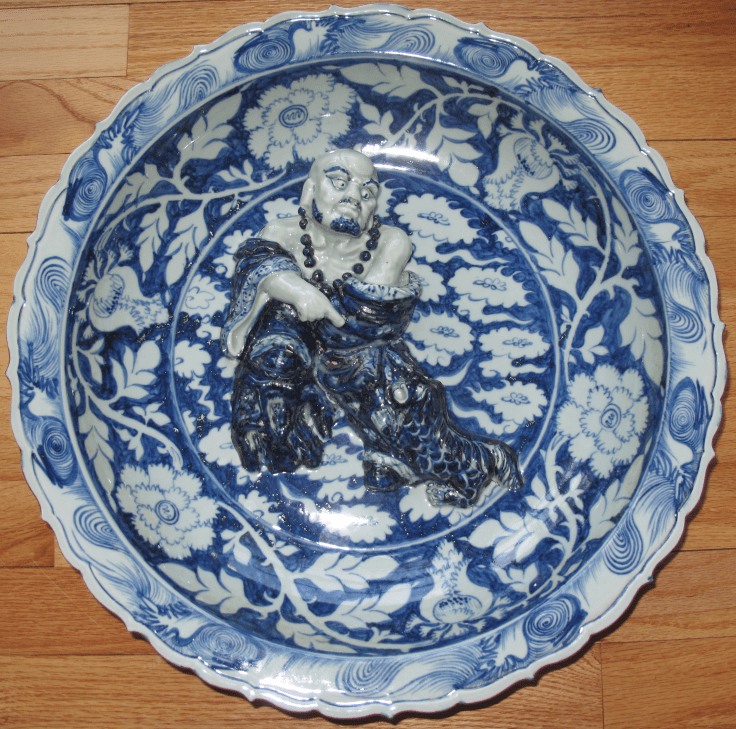 Figure 1
When you read this article, you should also read the article I wrote in January 2018. There, I showed you the beautiful sapphire blue coloration of the dye, together with the mottling, and the small and large bubbles. And in the Lohan, I showed you the plaques and other features that would leave no doubt as to the authenticity of the charger. Here, I take advantage of the morning sun, and would show you the colorful reflections of the plaques, and what is more important, the glaze of this charger. The glaze is well seen here because of the molding and folding of the sculpture of the Lohan. These would allow the glaze to accumulate in such a manner that it is much thicker than in a ware where there is no foldings.
Now let me first show you the reflections of the plaques under the sun. You will note that the reflection is not as colorful as when the plaque is on a flat surface when the plaque is necessarily flat. One needs to know that the reflection has a lot to do with the angle that the sunlight strikes on the plaque surface. It is only at the correct angle that the reflection will be particular reflective. A little alteration in the angle, and the reflection will not be as colorful. So, when most of these plaques are mainly on a contoured convex surface of the Lohan, the sunlight can hardly strike all the surface at the correct angle at any one time, making the brightness of the reflection less. Another thing that you need to do is to enlarge the photos somewhat, and the colorful reflection will be better seen (Figures 2-13).
 Figure 2
 Figure 3
 Figure 4
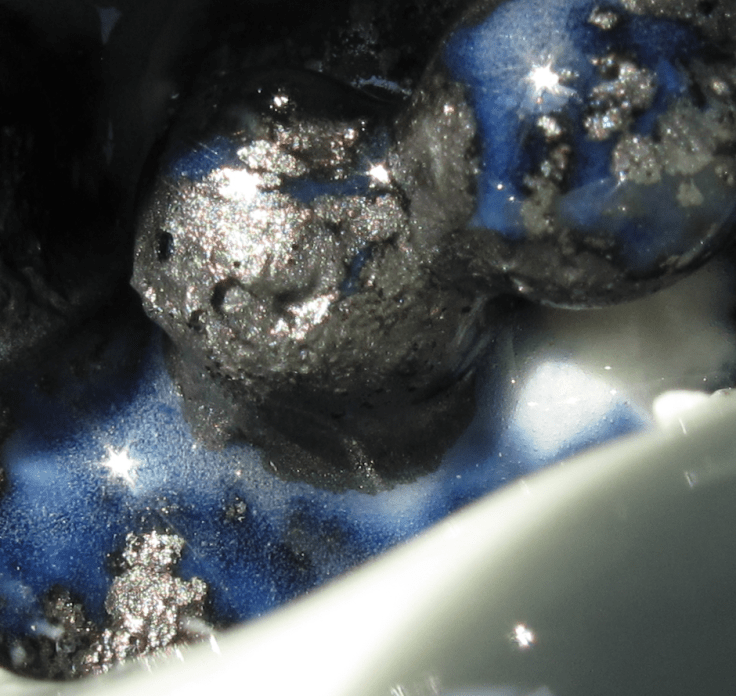 Figure 5
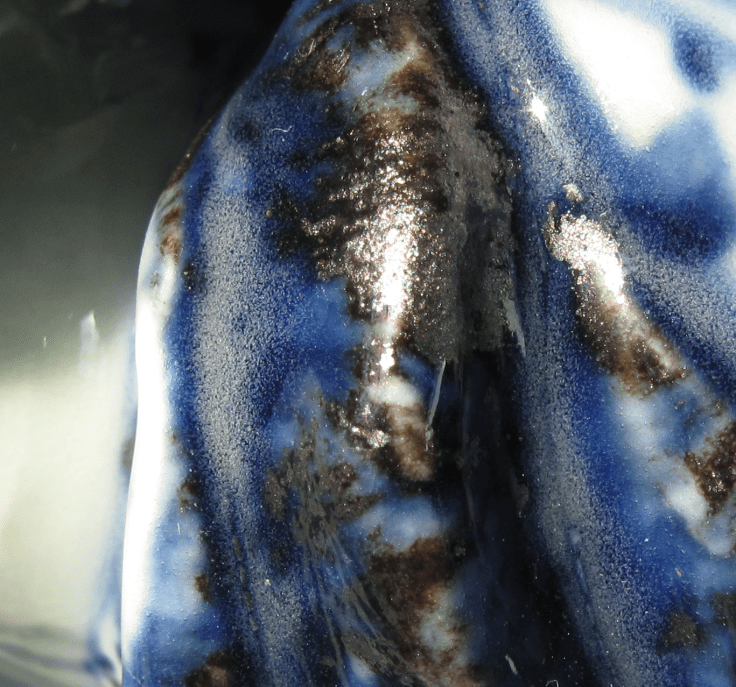 Figure 6
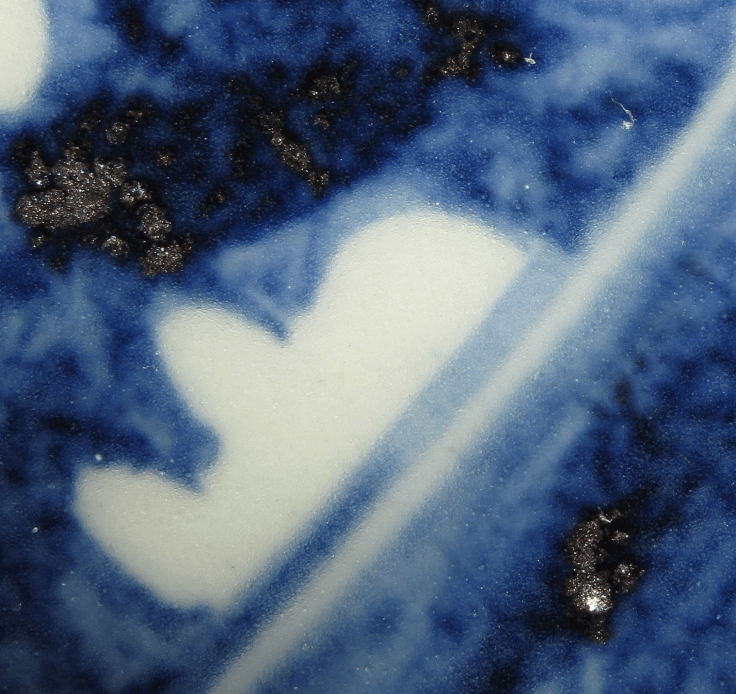 Figure 7
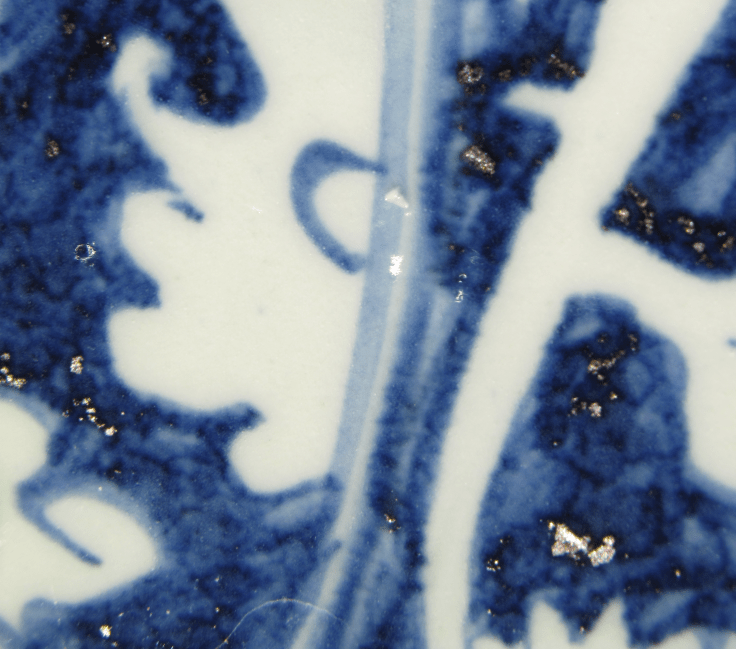 Figure 8
 Figure 9
 Figure 10
 Figure 11
 Figure 12
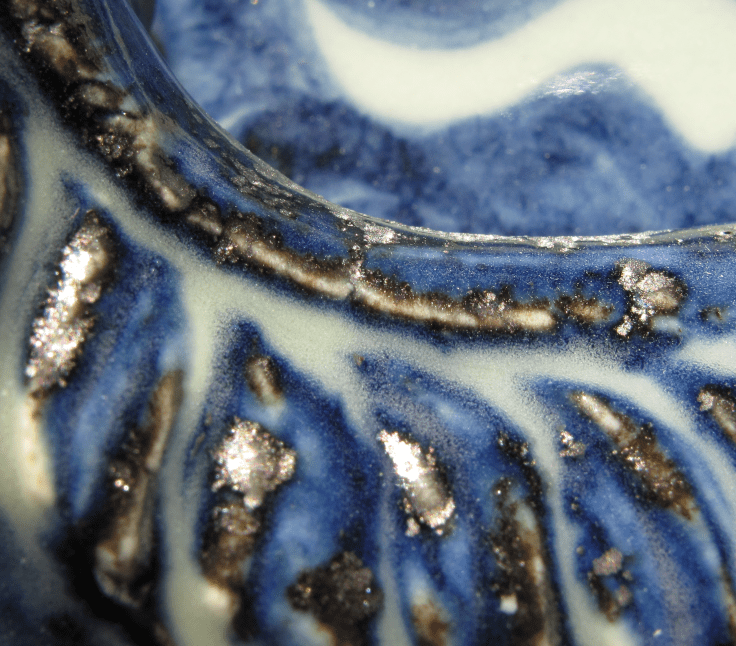 Figure 13
If you are going to compare these photos with those that I posted in January 2018, you will notice that the reflections are a lot more colorful, thanks to the morning sun. You will also note the small bubbles are all very densely packed, and you can discern the lacunae very clearly. At where there is a groove, the small bubbles are more than tightly packed. The whole area is overwhelmed with bubbles. Still, instead of giving you a feeling of confusion, it is rather nice to look at. Figure 12 and figure 13 are taken from the same spot, with Figure 13 a bit out of focus at certain areas. There, the tiny pinpoint colored spots become a small round circle, enabling you to see the various colors more clearly.
Now, I am going to show you the very beautiful glaze of this ware. Look at the photos carefully, and try to remember what the glaze is like (Figures 14-29).
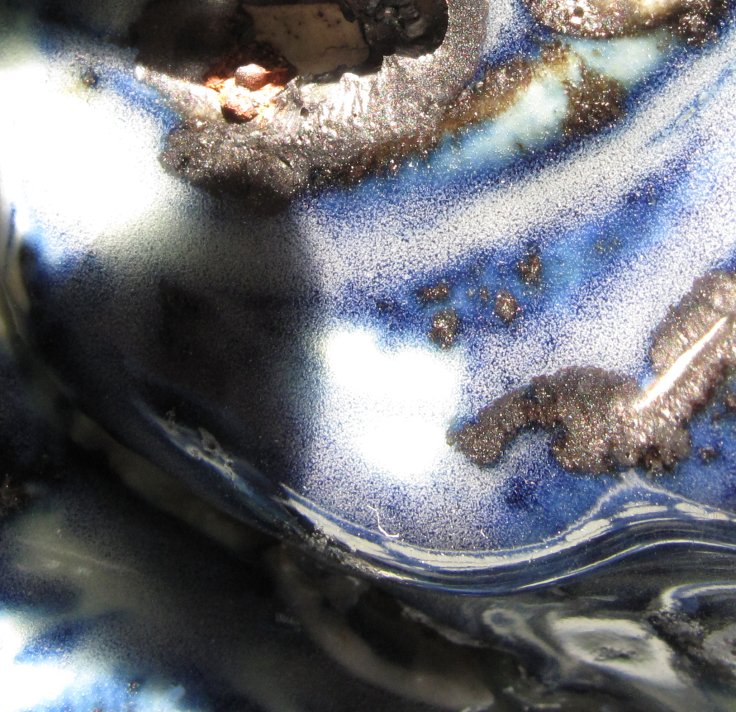 Figure 14
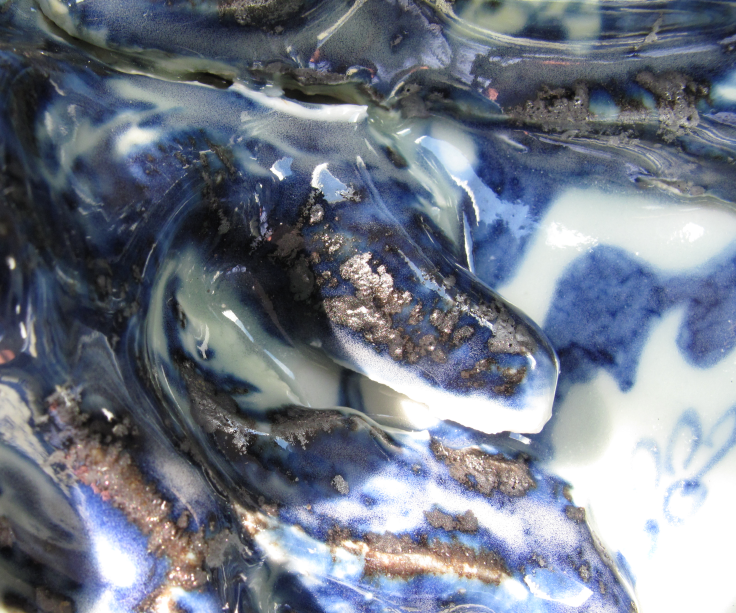 Figure 15
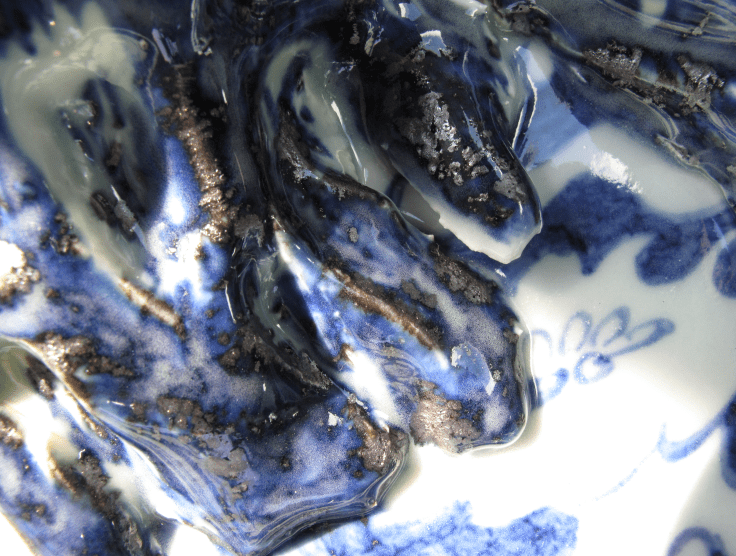 Figure 16
 Figure 17
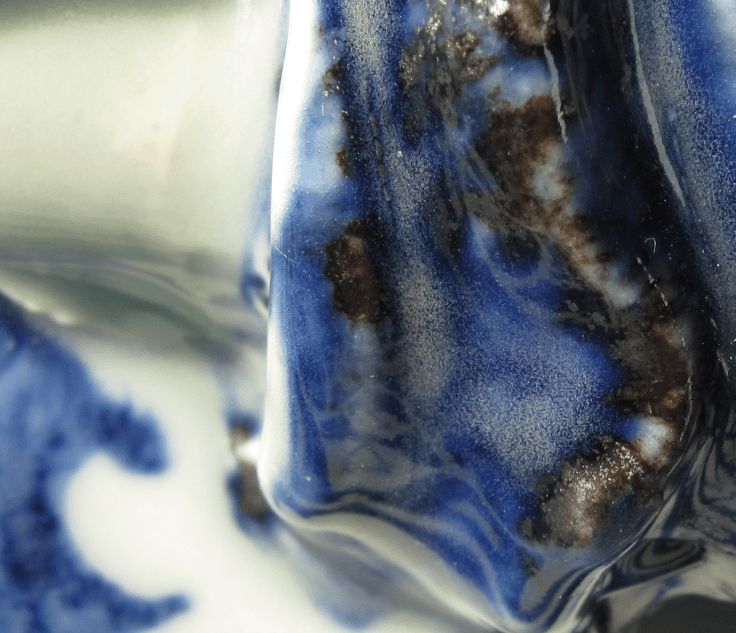 Figure 18
 Figure 19
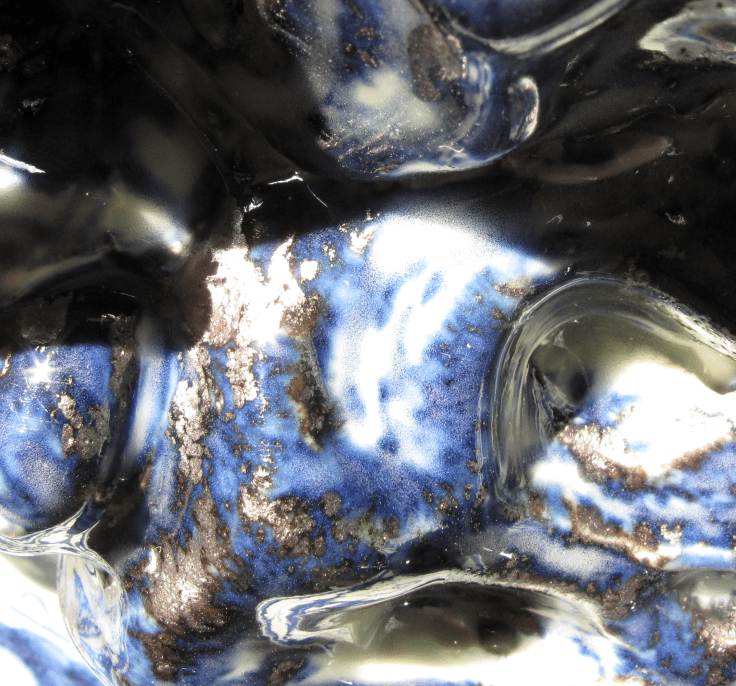 Figure 20
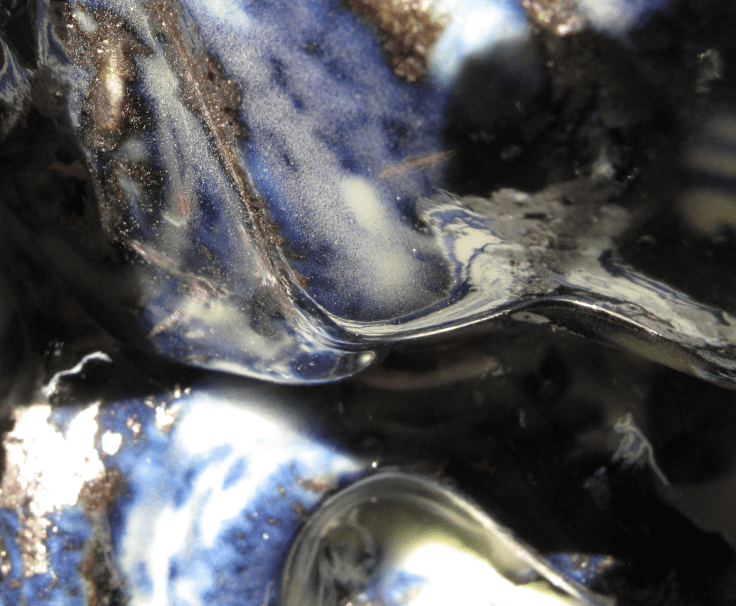 Figure 21
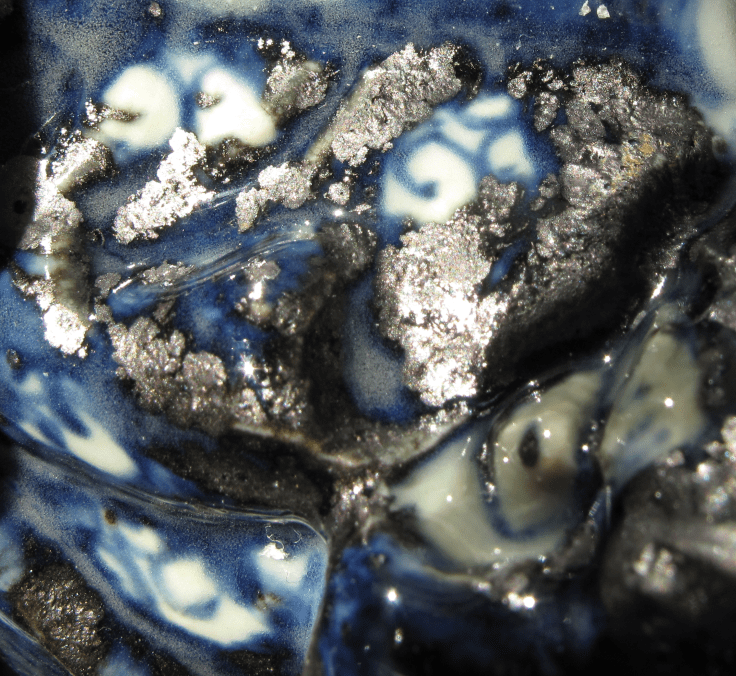 Figure 22
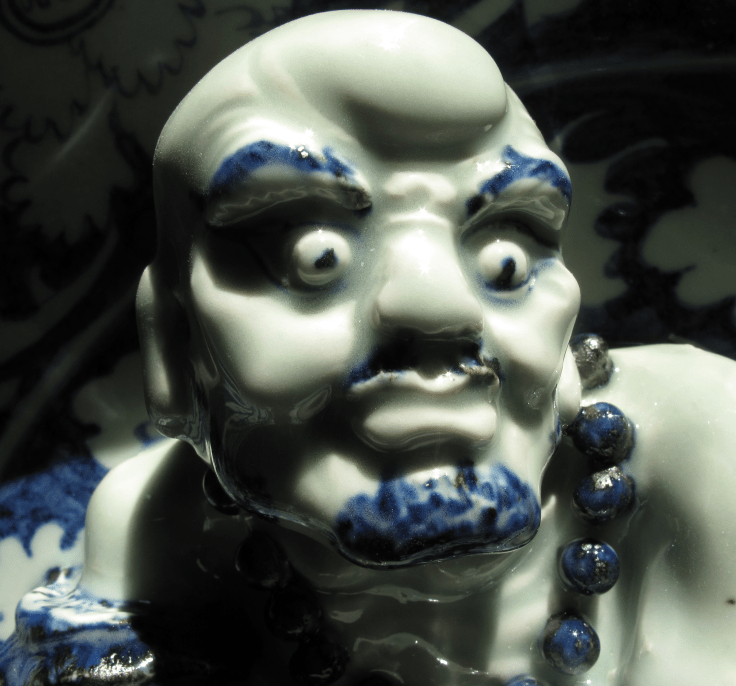 Figure 23
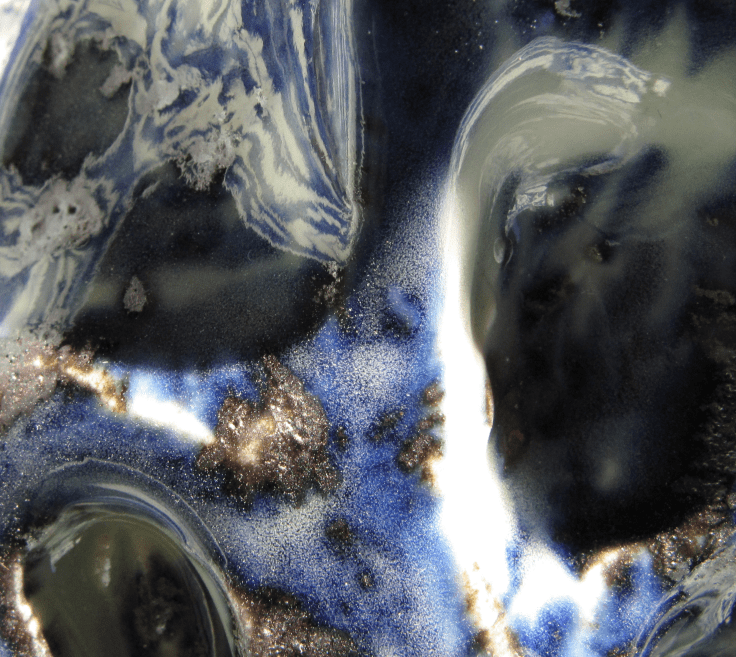 Figure 24
 Figure 25
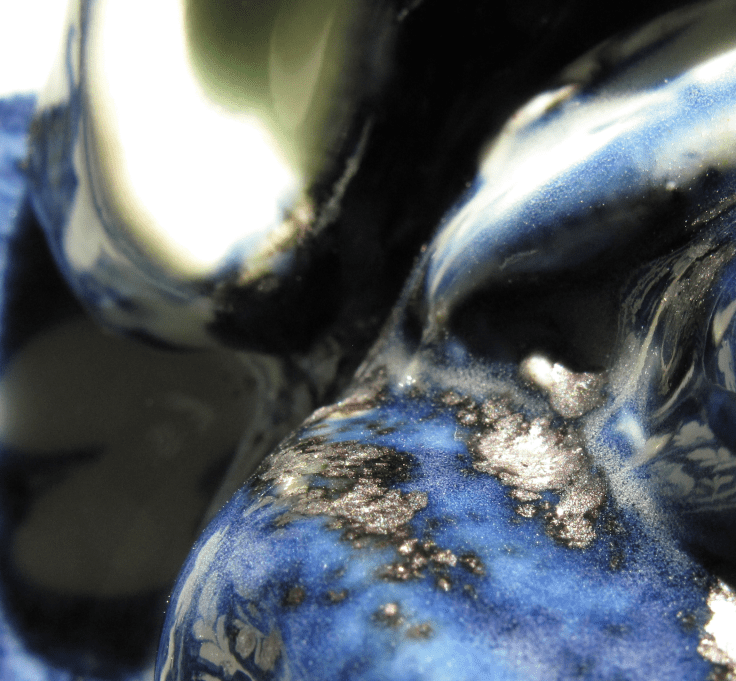 Figure 26
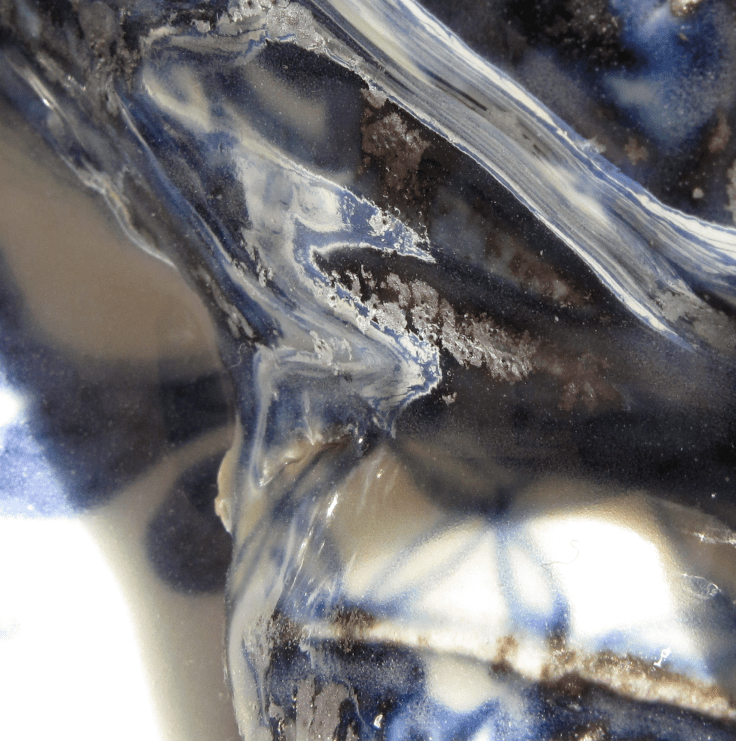 Figure 27
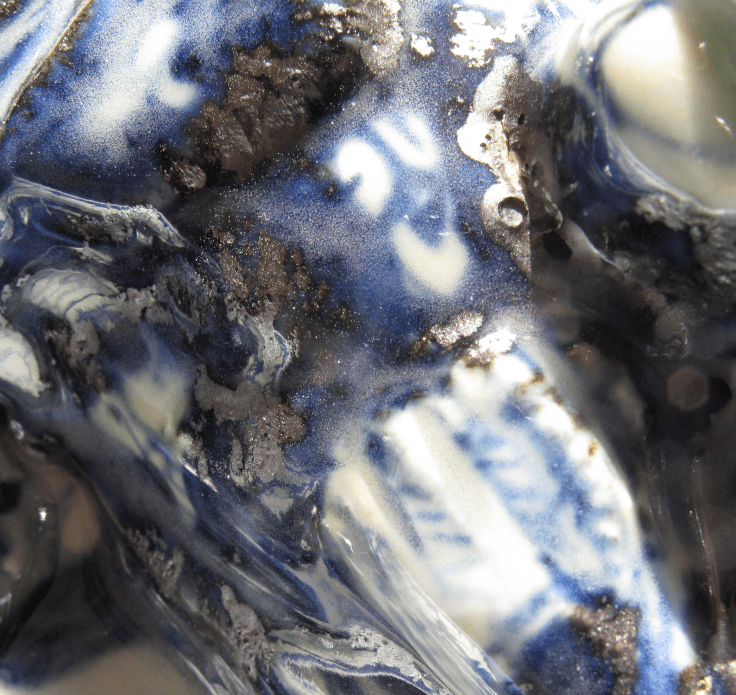 Figure 28
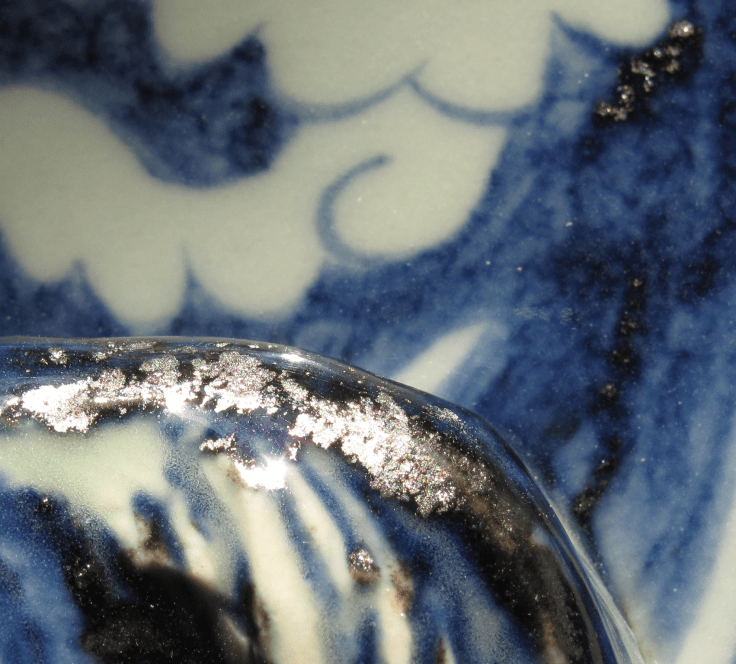 Figure 29
As I have told you, the beauty of the glaze of a ceramic ware is very subtle. You cannot define it. It is mostly a subjective feeling, yet a feeling that is shared by connoisseurs and experts. You can only tell with experience after you have seen many many pieces of ceramic wares. Here in this Yuan charger, I think the glaze is not only thick, but very beautiful. And I can tell you that many of my collector friends share the same thought. They all like it.
It is interesting to note that after Xuande, beautiful glaze in a ceramic ware is seldom seen. But why? Technology is always getting better, why not the glaze? I suppose it has a lot to do with the ingredients. Potters do not want to tell their secret formulae, particularly the essential constituents. But to me, that is only part of the answer. The real answer might be that the ingredients are extremely expensive and rare, and potters at a later period simply cannot afford the exorbitant price. And after a while, the names of these ingredients are simply forgotten. Nowadays, even our very capable forgers are not able to figure out the formulae and reproduce a glaze that is half as good.
 yongleandxuande.com
Leave a comment