
There are certain facts that collectors of Blue and White of the early Ming periods know very well. They know that Yongle B & Ws do not have marks except for the few cups that ‘press against your palm’, or 壓手杯, as the Chinese used to call them. Aside from these few cups, which are all in the Old Palace Museum in Beijing, any B & W that bears the mark 永樂年製 in underglaze blue is a fake. That is a golden rule. Many experts still believe in this. But many are getting less dubious as more B & Ws that bear the mark surface from many parts of the world. And many of these wares have the most beautiful features of the characteristics of the Sumali Blue dye. There is no question that the dye used by the potters in these wares IS the Sumali Blue dye. It is absolutely impossible to refute these characteristic features. Why are some experts, in the face of these indisputable evidence, still dismiss them as fakes, is something that is totally beyond me. When potters decide to have a mark in the cups, would they not do the same in some other wares? That is only logical. And when experts have not seen wares aside from the cups carrying the mark and yet make a statement declaring such an observation, does that make their declaration logical? That is what I have been wondering for a long time.
The B & Ws in the Xuande period, on the other hand, often have marks on them. But that is not always the case, quite a good proportion of Xuande B & Ws have no marks on them. In such a case, we have to make an effort to tell if the ware belongs to the Yongle or the Xuande period. And to look at the dye pigment in such an instance is often not a good help. There is a reason for this.Only a few years separate the Yongle and the Xuande period. And the dye pigment imported during those two periods are very much the same, probably with some slight differences that we cannot possibly tell. So with an unmarked ware, it is often difficult to tell a Yongle and a Xuande ware. That is what we often call 永宣不分. Again, this is not always the case. In some wares with very characteristic Yongle features, we can say for sure that the ware is a Yongle.
Here is a B & W washer without a mark, and it is difficult to tell if it is a Yongle or a Xuande. It measures 7 inches in diameter and its height is 1 7/8 inches.
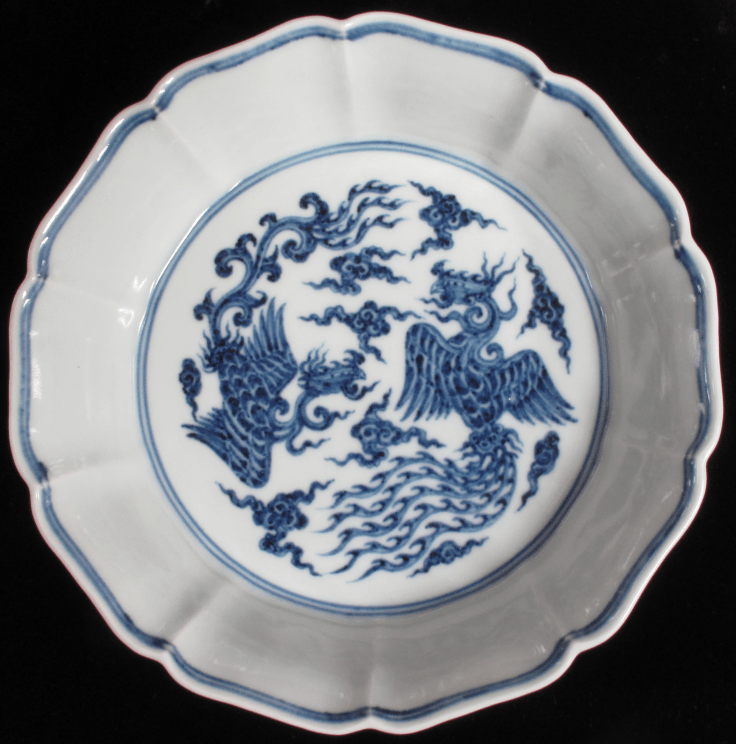 Figure 1
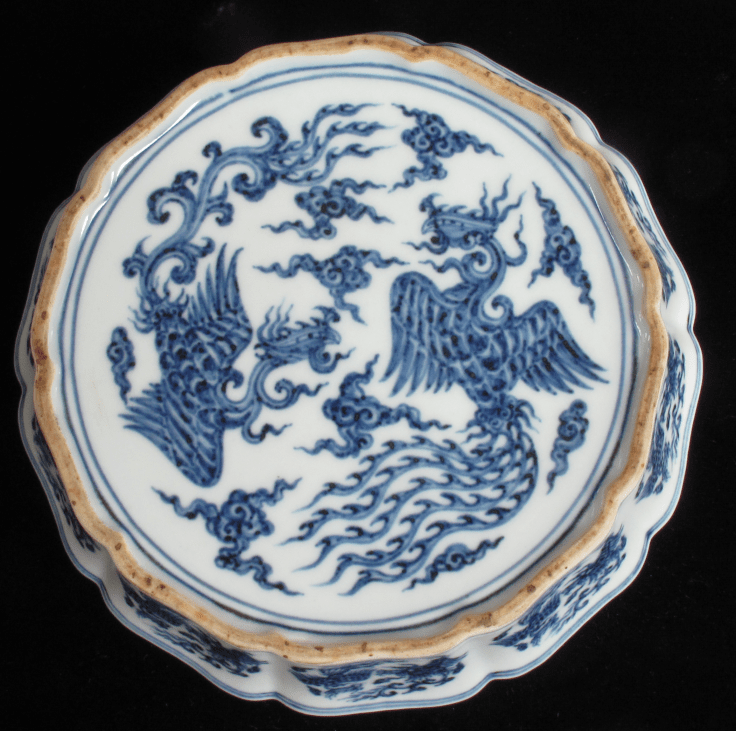 Figure 2
Before one can say if the ware is a Yongle or a Xuande, it is of the first importance to determine if the blue dye used is of the Sumali Blue dye. Only if we can define the characteristics of the Sumali Blue dye will we able to say that the ware is from the early Ming period, and not a reproduction. Let us try to identify some of the characteristic features of the Sumali Blue dye.
 Figure 3
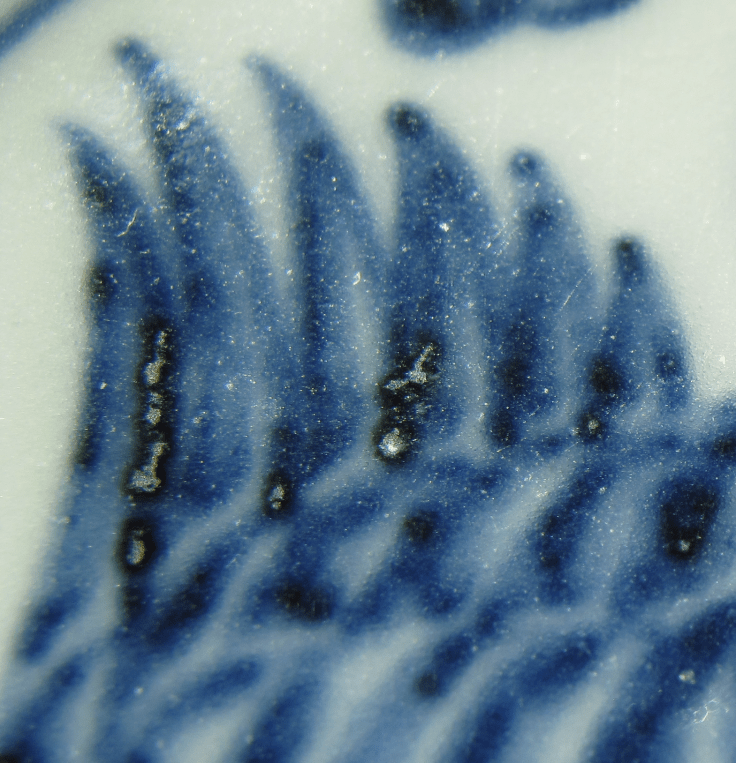 Figure 4
Figures 3 & 4 are taken from the same spot, with some variation in the lighting. The plaques are more reflective in Figure 3 than in figure 4. These are plaques without any metallic foils floating on the surface. They just have the muddy layer. You’ll remember that during the late Yuan era, a floating metallic foil above the muddy layer is very common. But this metallic foil is getting less and less obvious in the Yongle B & W, and in most late Xuande B & Ws, the metallic foil is no longer seen. In some cases, even the muddy layer in not very obvious. But the plaques that we see here are typical and consistent with both Yongle and Xuande B & Ws.
I’ll show you more plaques that are similar (Figure 5-10). Look at them carefully. They are all plaques with the muddy layer only. You will also note that all the plaques are quite small, and you can tell when you compare the size of the plaques to the size of the bubbles. One reason is of course the size of the washer and the motif. There are no areas where a lot of blue dye is needed.
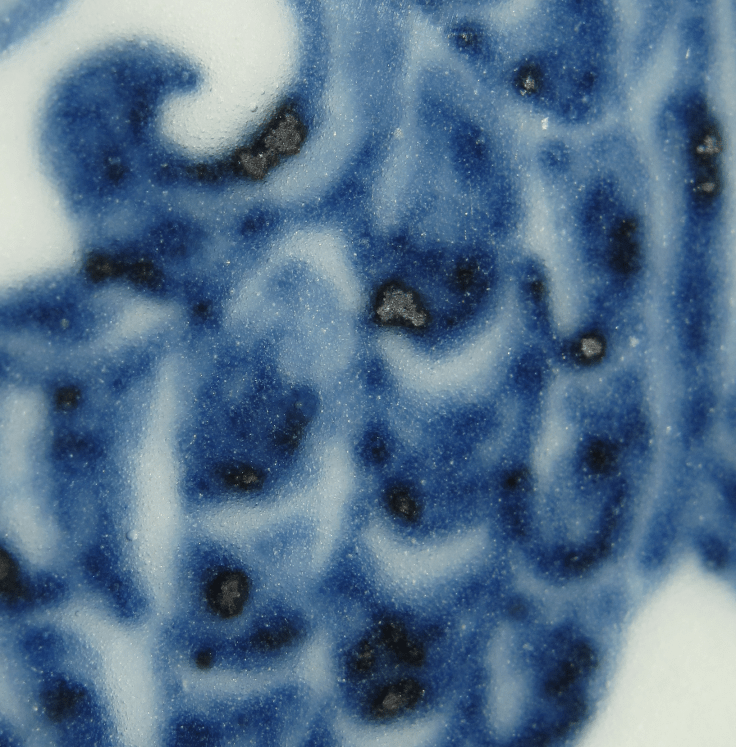 Figure 5
 Figure 6
 Figure 7
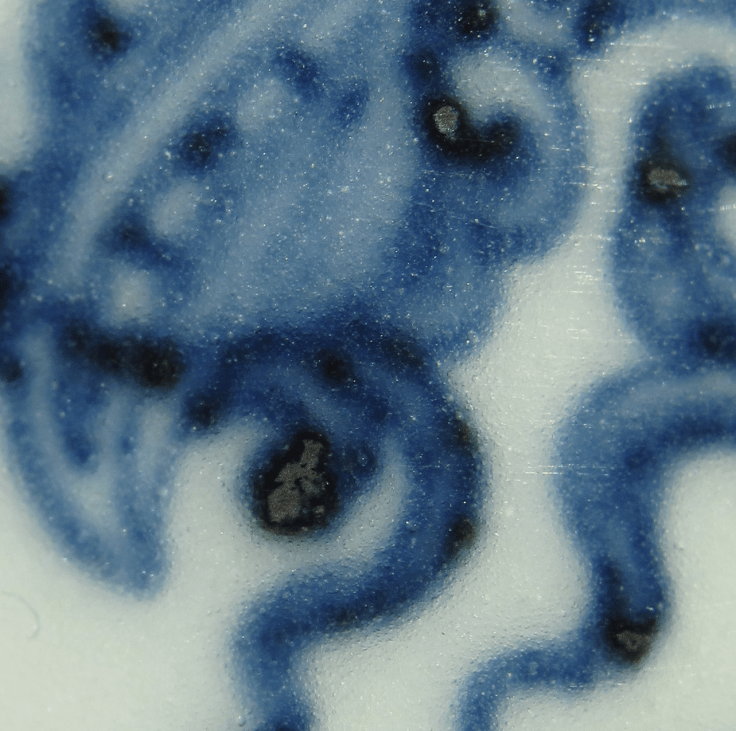 Figure 8
 Figure 9
 Figure 10
But in many parts of this washer, the what we call plaques have no actual plaques; they are but blackish patches among the blue dye, with occasional shadows giving you a hint that it might be a plaque. This is what we call a plaque in its formation. There are not enough particles that form the muddy layer present, and no actual plaque is formed (Figures 11-15). In some late Xuande B & Ws, all the plaques the ware has are these plaques-in-formation. In the whole ware, no actual plaque is seen. If you have a B & W that only has these primitive plaques, you can be sure that it is a late Xuande.
 Figure 11
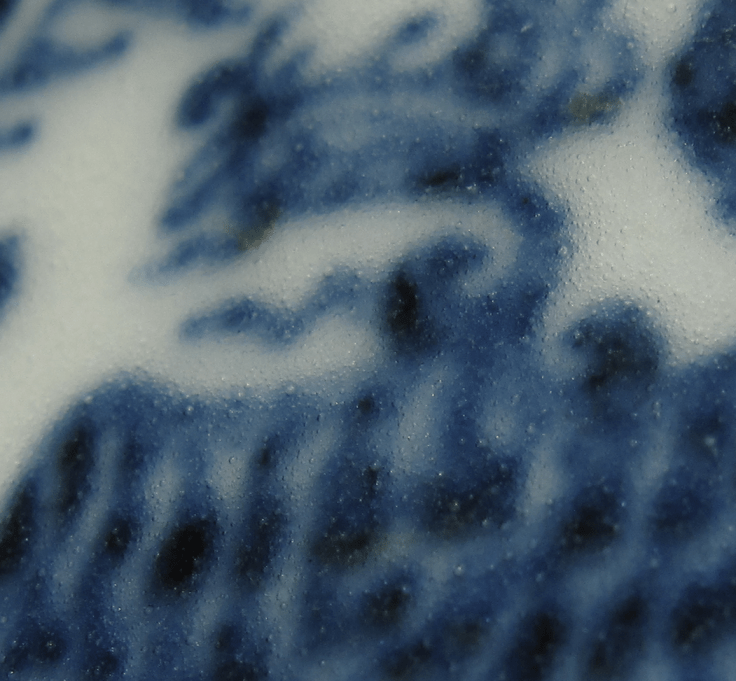 Figure 12
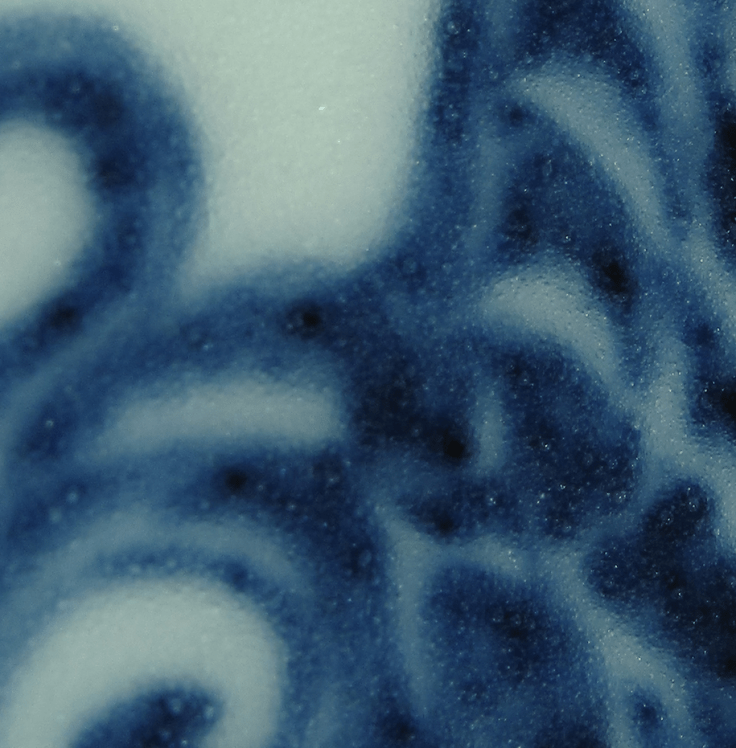 Figure 13
 Figure 14
 Figure 15
I’ll just show you another photo of this washer, a primitive plaque with the muddy layer barely seen. But it is unlike any other plaque in this washer, as you can see (Figure 16).
 Figure 16
After examining the plaques, we must look at the dripping and flare. We must realize that this is a small washer, and most of the drawings are in the bottom of the washer and the underside of the base. You have only the phoenixes drawn on the side, and they are small and the potter does not need a lot of blue dye to do the drawing. It is therefore easy to understand that the flare and the dripping would not be obvious. But still, if you look for them, you can definitely see them, particularly when it comes to the decorative lines at the mouth of the washer. Look at Figures 17 and 18. The dripping effect is clearly shown. There is also the bleaching of the dye in both photos, particularly Figure 17.
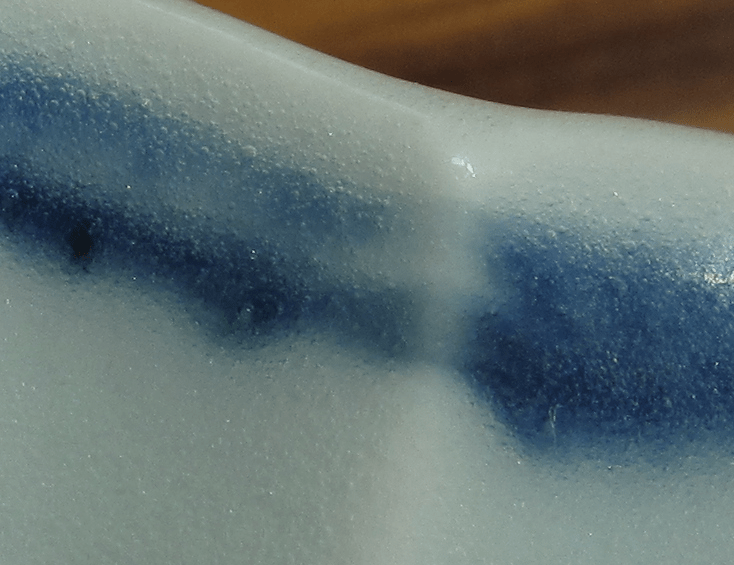 Figure 17
 Figure 18
Figures 19-22 are taken from the flat part of the washer. There is no dripping, but the flare, if you look carefully, can readily be seen. So far, all these features are typical of the Sumali Blue dye.
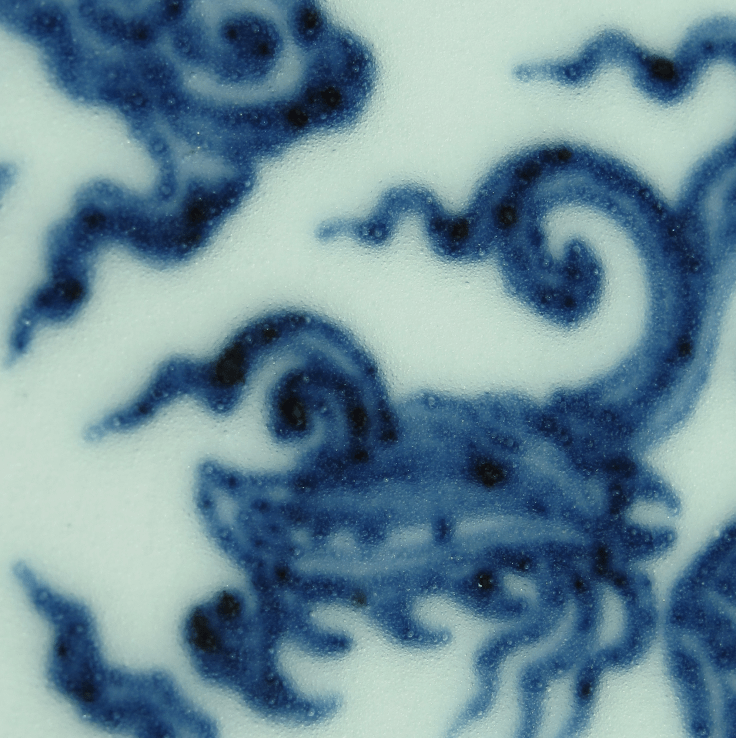 Figure 19
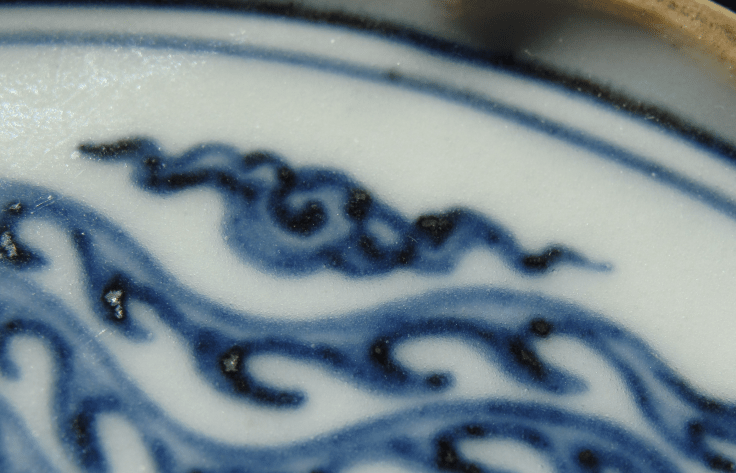 Figure 20
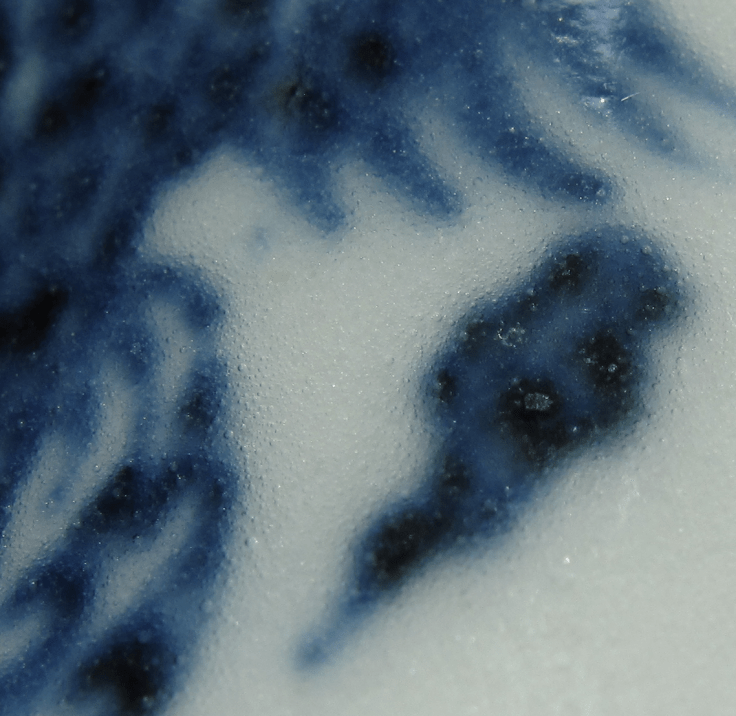 Figure 21
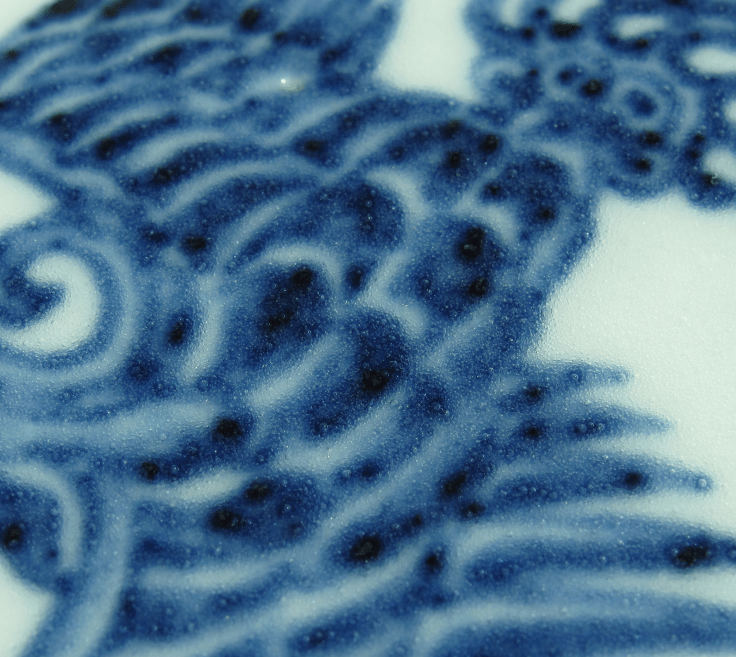 Figure 22
Many of the photos that I have shown you here, in fact, do allow you to study the bubbles, large and small. And typical of the Sumali Blue dye, the large bubbles are present in areas where the blue coloration is deeper in color. And in many instances, again typical of the dye, some large bubbles are lurking around plaques and primitive plaques. If you enlarge figure 19, you can see the very nice feature of a string of large bubbles at the edge of the dye. In Figure 22, you can see the broad range of blue coloration with certain areas showing a blue coloration not unlike that of sapphire blue. But I’ll show you a few more photos of the bubbles.
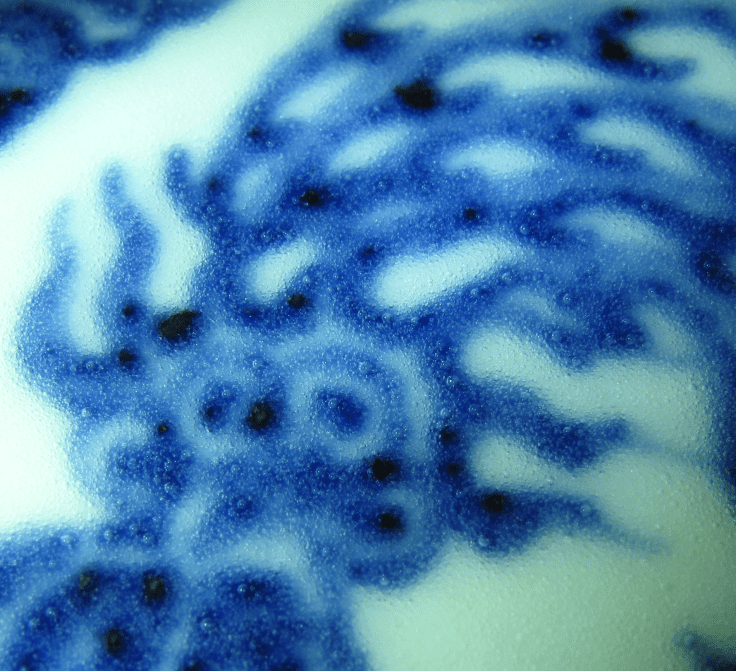 Figure 23
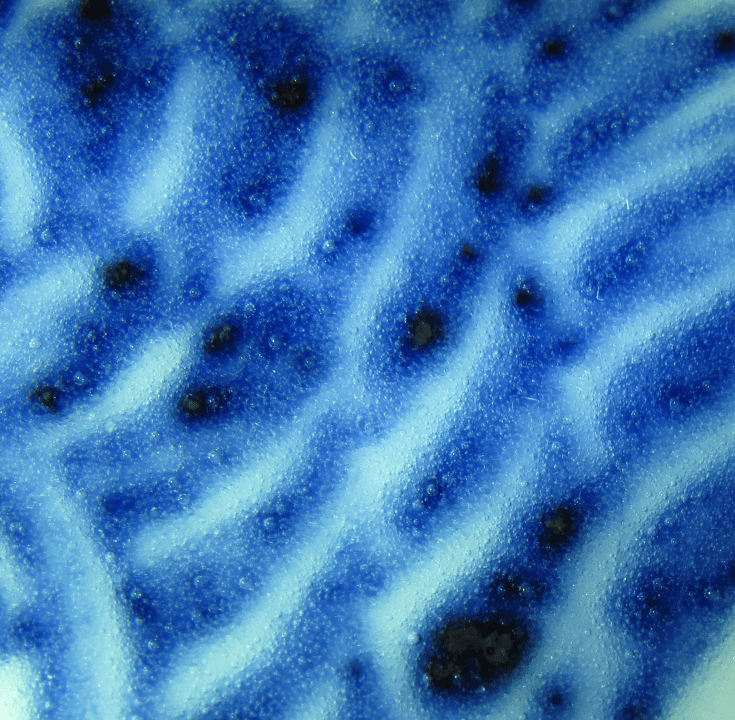 Figure 24
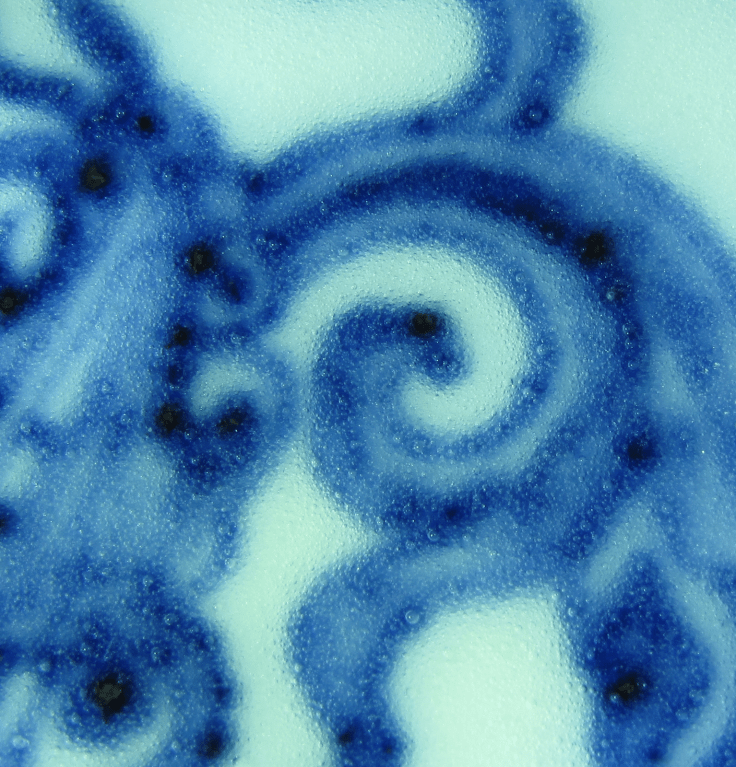 Figure 25
 Figure 26
 Figure 27
 Figure 28
These photos, Figures 23-28, show you the large bubbles in this washer. If you want to be exact, these are not really very large bubbles. I would rank them as the smaller size of large bubbles seen in the Sumali Blue dye. But still they are rather lovely bubbles, especially the semi-opaque and pearl-like ones. One point about the number of large bubbles. You’ll note that there are quite a large number of large bubbles in this washer everywhere. Do you like large bubbles in abundance? Do you find them more beautiful? This is an aesthetic question. Personally, I would prefer to have fewer number of large bubbles. Too many of them, to me, makes the ware less beautiful. But this fact does not make me doubt the authenticity of the dye. It is without a doubt, Sumali Blue dye. And the ware an early Ming B & W. Even without a mark, I incline to believe that this washer is a Xuande.
 yongleandxuande.com
Leave a comment