
Our experience with the Sumali Blue dye tells us that the dye is a lot more complicated than its name may imply. It is quite unlike our modern day dye. Nowadays, when we talk about a certain dye, we already have a picture of the dye in our mind. Not so with the Sumali Blue dye. We know the dye has some very characteristic features, such as the plaques and the bubbles. But then, we can never expect what the bubbles look like, nor the plaques. Some of the bubbles are rather large, some are not nearly as big. Some small bubbles are tightly packed, but some are much less densely crowded together. Some plaques are mature plaques, in the sense they have a metallic foil floating on top of a muddy layer. Some plaques are without the metallic foil, with only the muddy layer at the bottom of the glaze fully exposed to your eyes. Some of the muddy layers are very reflective to sunlight, giving rise to beautiful color when viewed under the sun. Some are not nearly as colorful.
With all these differences, obviously the nature of the dye is not the same. When we talk about the nature of the dye, we must be more specific. Let us take diamond as an example. We know that not all diamonds are the same. We have yellow diamond, pink diamond, blue diamond and the classic white diamond. And for white diamonds, some are more pure with little inclusions and some are more brilliant than the other. That is to say, though they are all diamonds, their nature is different. Same is true with sapphire. The blue color varies through a wide range—from a light blue to a blue so dark that it is almost black. So, going back to the Somali Blue dye, it is clear that the composition of the dye pigment varies through a big range. The end result, as judged by the bubbles and plaques and the blue coloration, definitely varies. In the many previous B & Ws that I have shown you, you have seen bubbles present in many forms, so are the plaques. What is a high quality dye, and what dye is of a lower quality is a problem that has no straightforward answers.
Personal preferences aside, I tend to think that very large bubbles in the midst of very small and tightly packed small bubbles in Yongle wares are very beautiful. Plaques that give rise to colorful reflections under the sun are beautiful. Small bubbles that are not too densely packed and yet not too thinly spaced out are the best. I am now going to show you a Xuande B & W that has plaques that are not too reflective to sunlight and the small bubbles are very tightly packed, and see how you would feel about it.
The Xuande B & W is a Zhadou that is 5 inches tall, and 5 1/2 inches wide.
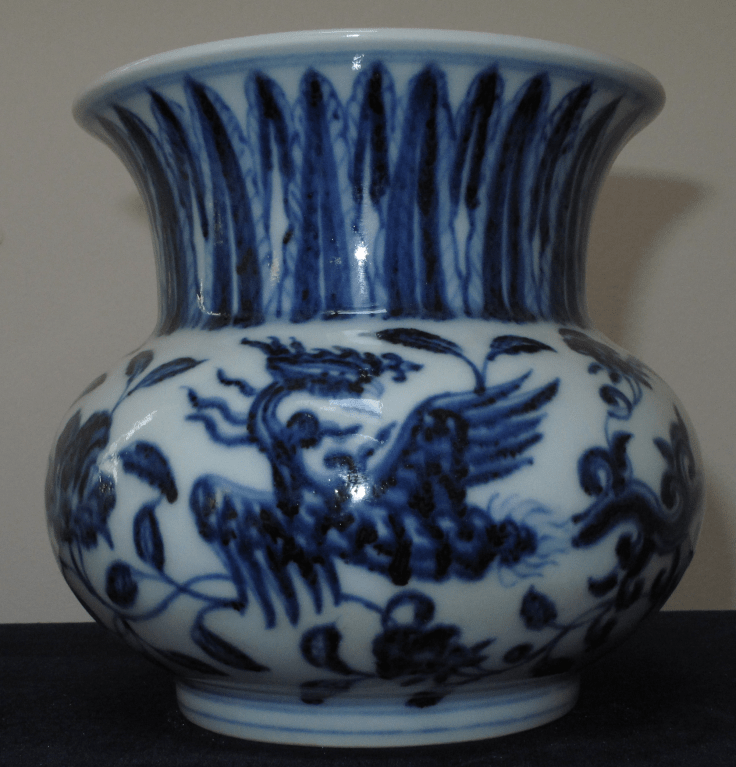 Figure 1
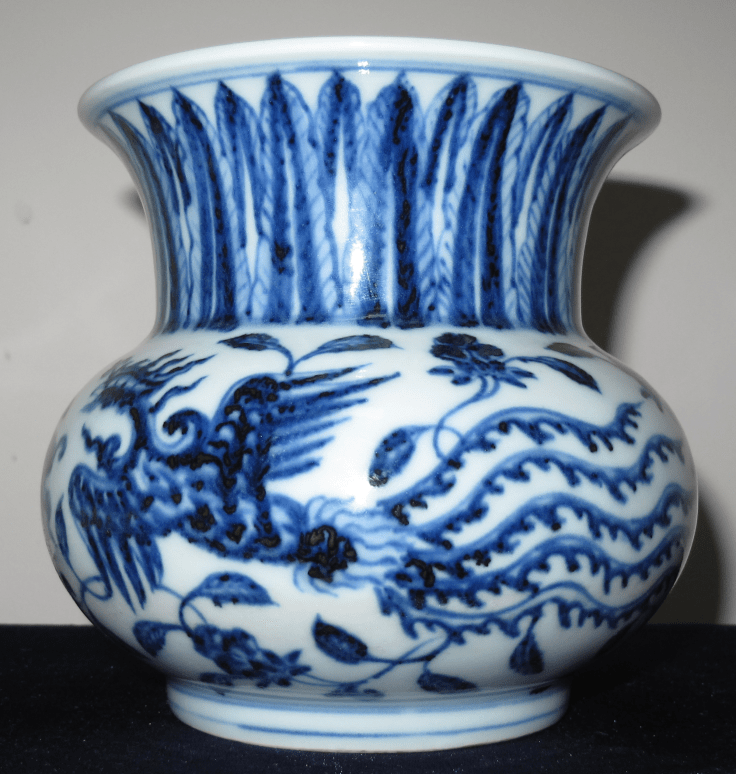 Figure 2
Let me first show you the plaques (Figures 3-9)
 Figure 3
 Figure 4
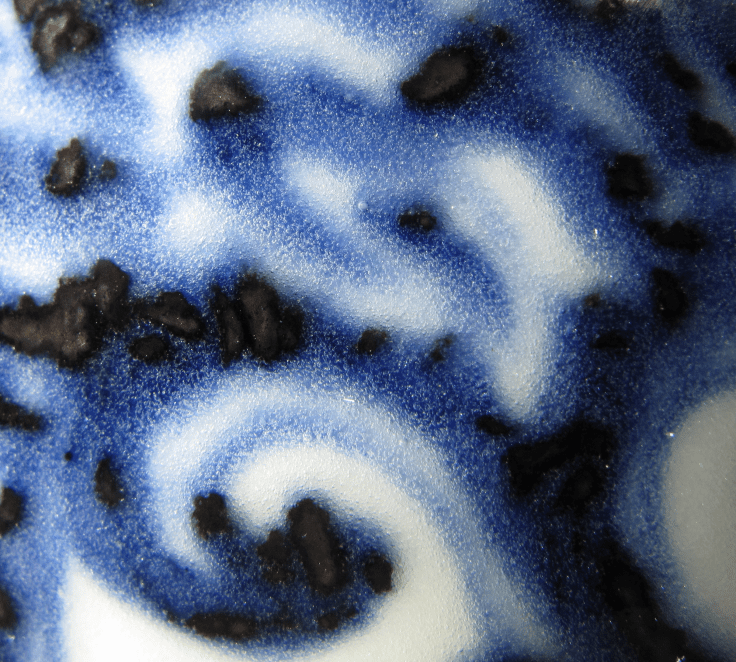 Figure 5
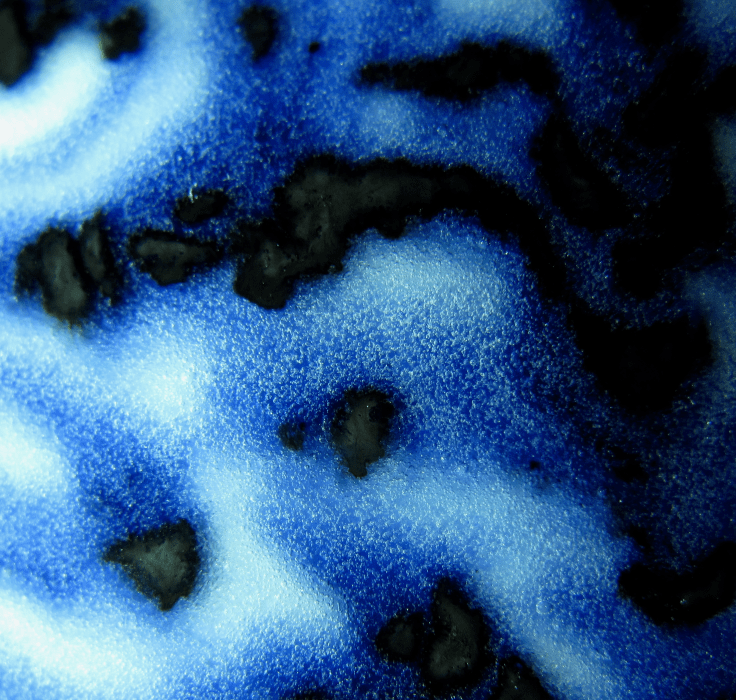 Figure 6
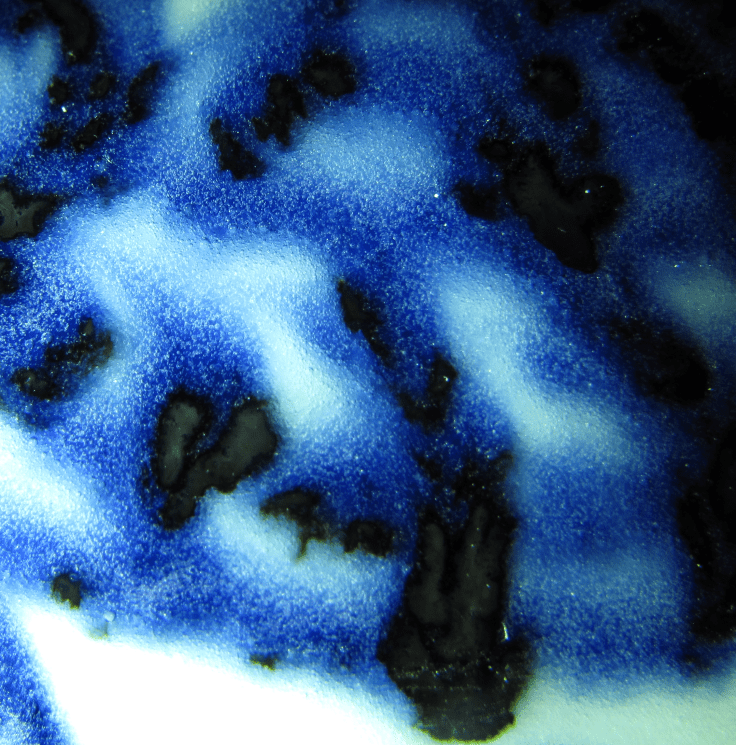 Figure 7
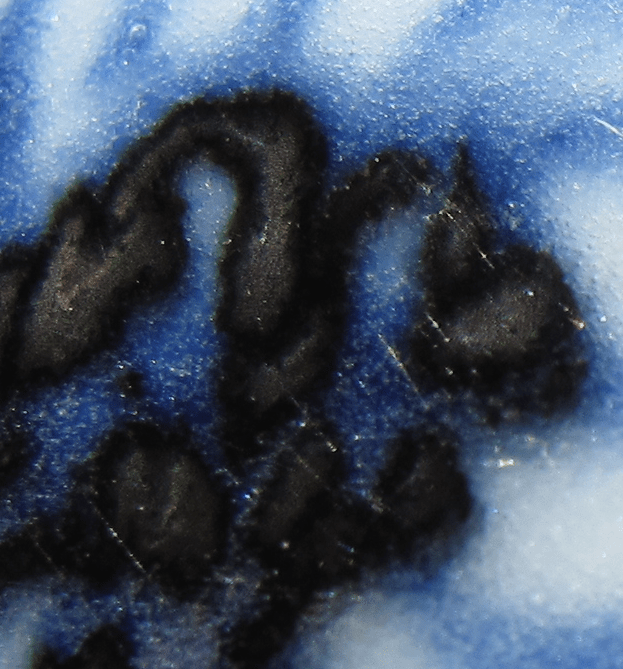
Figure 8
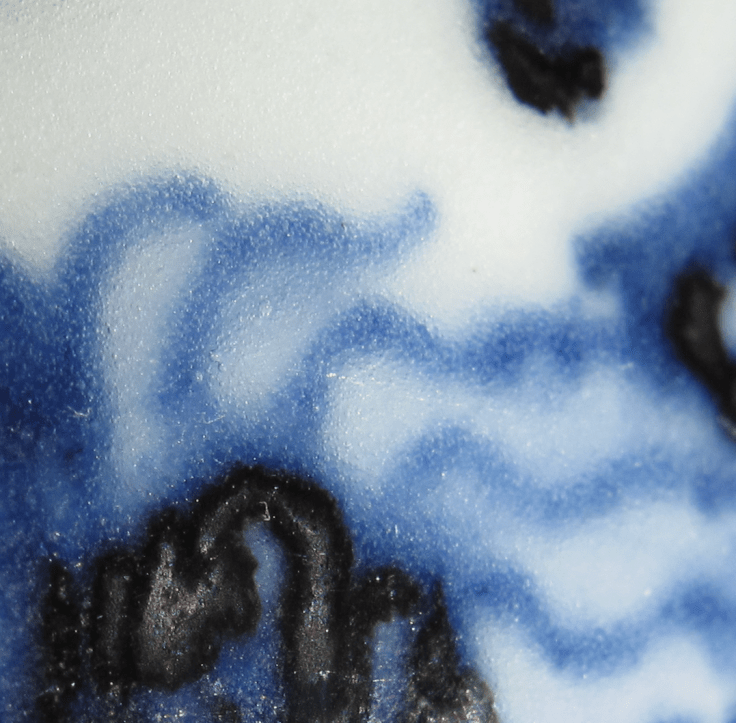 Figure 9
In these seven photos, except for Figures 6 and 7, which were taken under LED light, they were all taken under direct sunlight. You will note that the plaques do show some reflection, and they are rather nice plaques. But the reflection is far from colorful when you compare these photos to some of the photos that I showed you before. You must wonder why?
I don’t believe anybody can give you an answer. But I can make a guess. The plaques, I have told you before, are from compounds of the dye. And a matured plaque has at least two components—the metallic foil floating on top, and a layer that looks like mud at the bottom, what we call the muddy layer. The metallic layer floating on top is, by all probability, composed mainly of aluminum. What is the composition of the muddy layer? Again, we don’t know. But one thing we can be sure of is that it contains particles, metallic or otherwise, that have a high index of reflection. The content and composition of these highly reflective particles are obviously different in different samples of the Sumali Blue dye because the nature of the dye is just not the same. It is like the case of a dark blue sapphire and a pale blue sapphire. There are a lot of differences, including the reflective index.
Here in the Zhadou, the plaques, when they are examined under day light, are very much the same as many of the Xuande and Yongle B & Ws. They are just blackish patches in the middle of the blue dye. But, under bright sunlight, the plaques in different wares will not look the same. It all depends on the number of highly reflective particles present in the muddy layer. The plaques with more of these particles will give rise to a colorful reflection than those with a fewer number of such particles. I would say most people would prefer a plaque that reflects with a lot of color. It is just like comparing a brilliant diamond to one that is dull in color. In this aspect, the Sumali Blue dye of this Zhadou, so far as I am concerned, is not of the best quality. But there no doubt that it is a Sumali Blue dye, and the Zhadou is real and of the period.
In these photos, alongside with the plaques, you must have notice the very nice flare and dripping effect. They are no different from any good quality dye. And I’ll just show you a few more photos of these flares and drippings (Figures 10-18).
 Figure 10
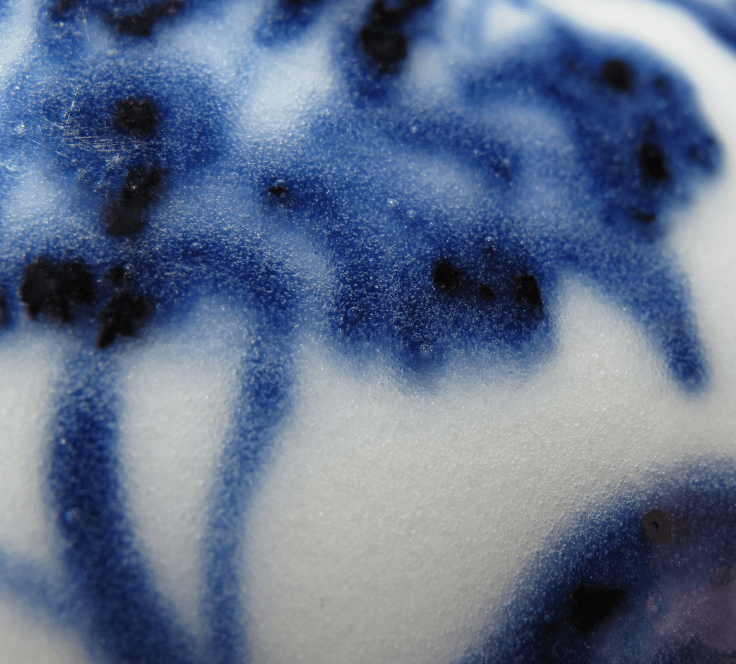 Figure 11
 Figure 12
 Figure 13
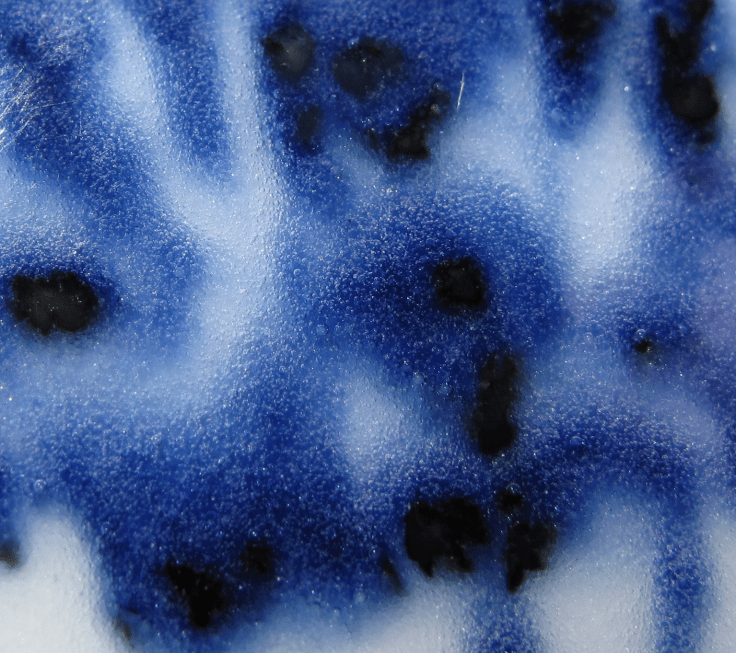 Figure 14
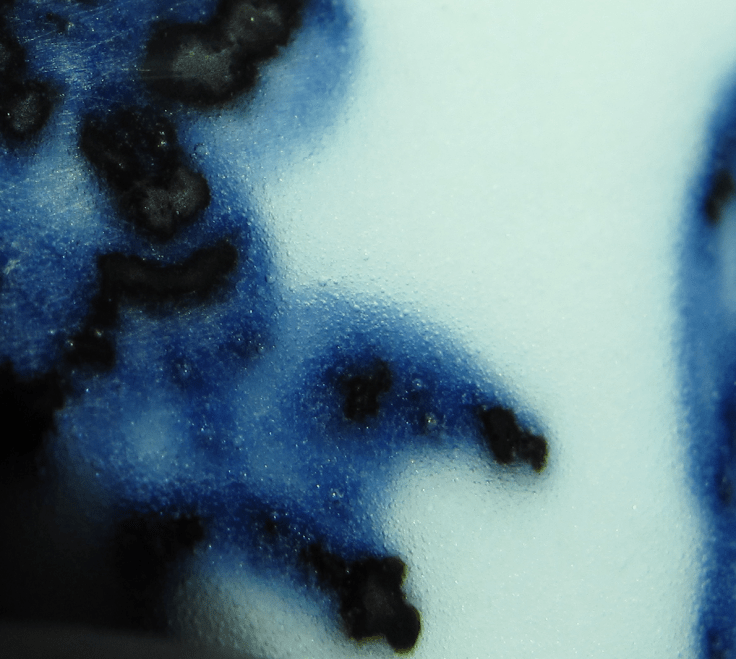 Figure 15
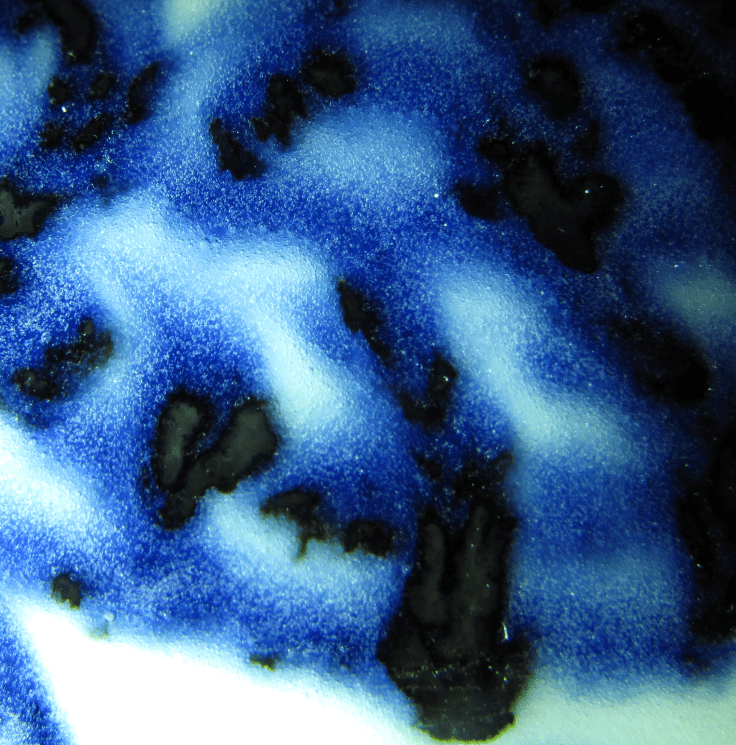 Figure 16
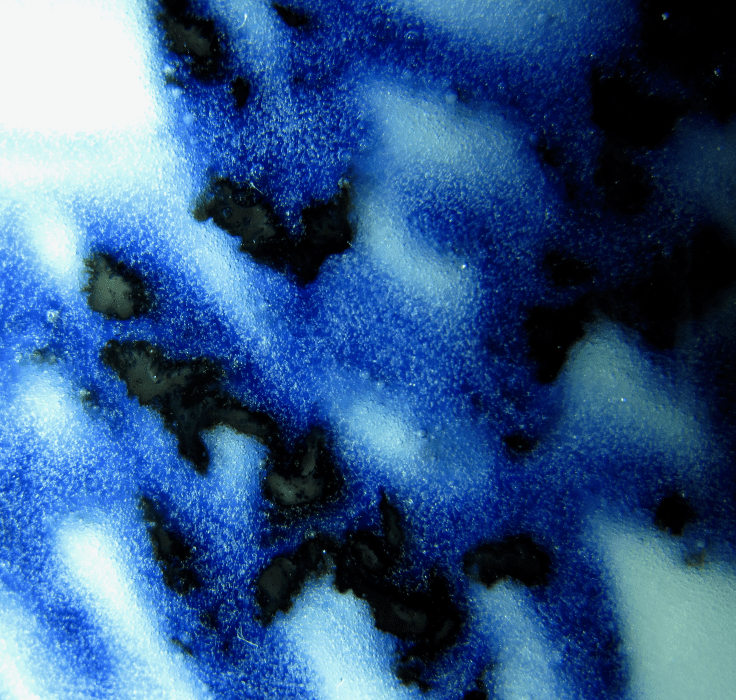 Figure 17
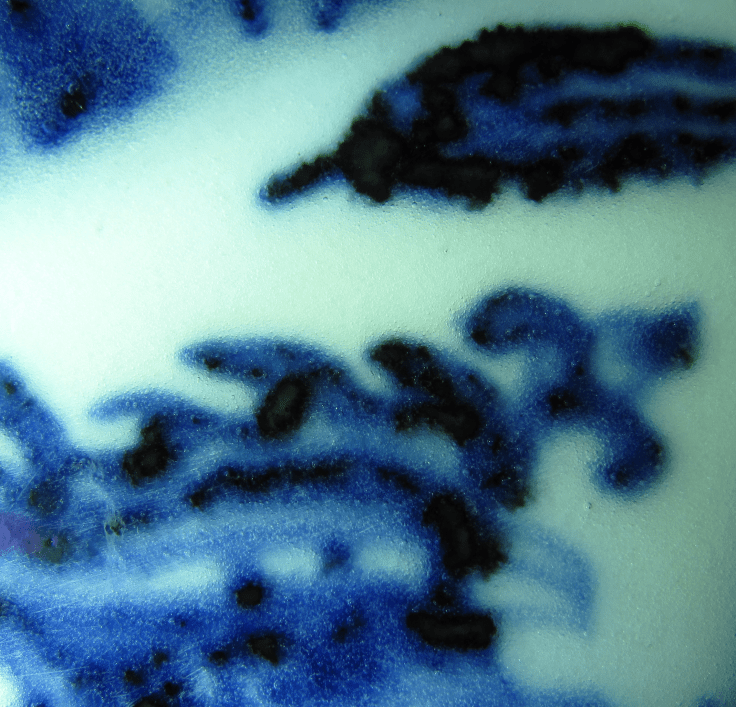 Figure 18
Look at the plaques and the flares and drippings in these photos. I would say that they are very typical. Not only typical, but rather beautiful. In choosing these photos, I have tried to include in them the large and the small bubbles. The large bubbles are nice, but not as large as some of the other Xuande B & Ws, not to say the large bubbles in Yongle wares. But still, the pearly white large bubbles, the string of large bubbles and large bubbles lurching around the edge of the deep blue coloration are all there. These features are, as you can remember, characteristic of the Sumali Blue dye.
You will also note that the small bubbles are very densely packed. Normally, very densely packed small bubbles do not look beautiful because many a time, they will give rise to a sense of confusion. The whole appearance looks chaotic. However, if these small bubbles are arranged in the form of tightly packed lacunae, the picture becomes quite different. The bubbles will appear orderly, and the chaotic appearance is no longer apparent. I have taken pains to take some of these photos so that even the small bubbles are quite clearly shown. You will agree with me that these small bubbles are in a rather orderly manner. Let me show you a few more of these.
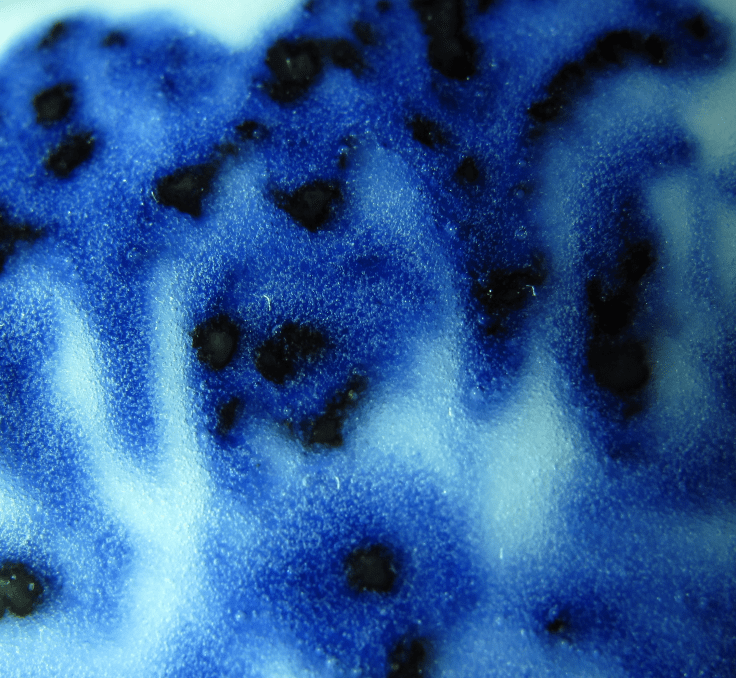 Figure 19
 Figure 20
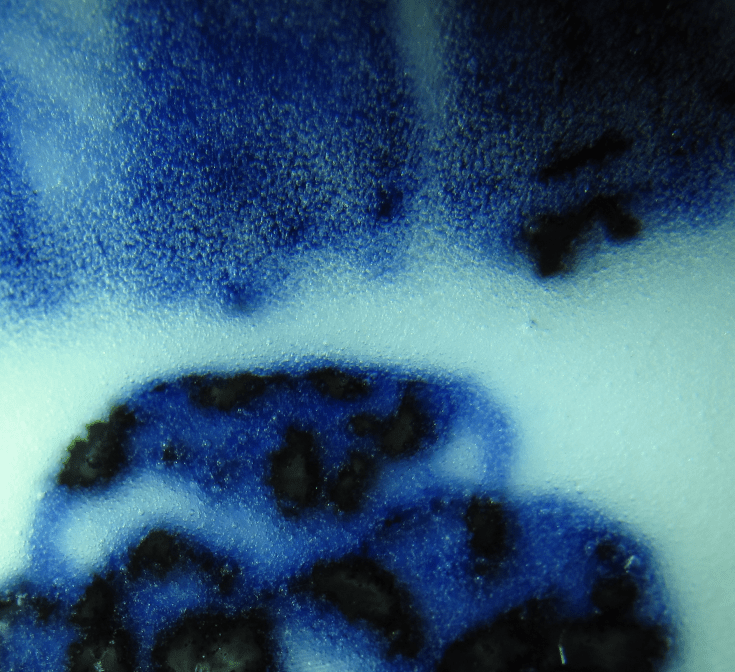 Figure 21
 Figure 22
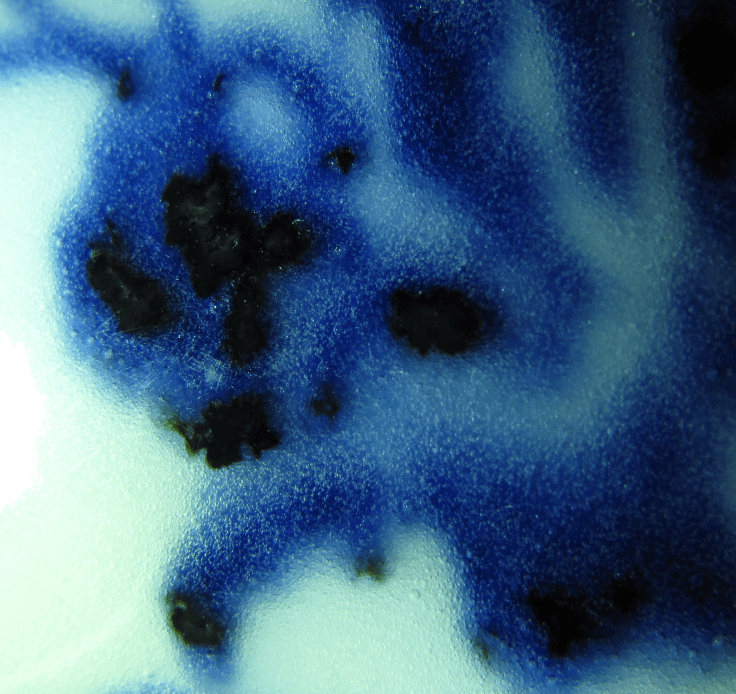 Figure 23
 Figure 24
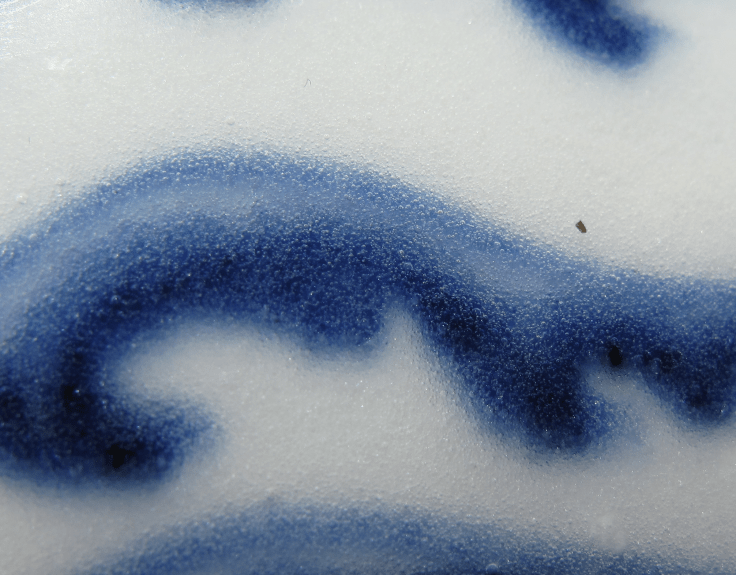 Figure 25
Look at the small bubbles in these photos carefully. In everyone of them, the lacunae are very well formed, so that the small bubbles no longer give a sense of chaos when you look at them. If it were not for the lacunae, the small bubbles, and the picture as a whole, will no longer be tolerable, and you would not like the ware at all. Here, it is the small bubbles and the lacunae that save the day. If the dye the potters used in the Zhadou is not the best quality dye, at least it is not the worse.
Before I finish this article off, let me show you the mark.
 Figure 26
 yongleandxuande.com
Leave a comment