
When potters in the early Ming period decide to make a ceramic ware, they have the shape of the ware and the decorative motif to worry about. But I don’t suppose the worry is actually theirs. There are people in the supervisory position to tell them exactly what they should do, and they are but to carry out the instructions. Our experience with Blue and White of Yongle and Xuande tells us that the shape and motif of those wares vary through quite a large range. But it is interesting to note that during the Yongle period, there is no human figures painted in the motif. Even in Xuande period, human figures do not appear very frequently in the motif. We do not know the reason for this. But some connoisseurs have suggested that this has something to do with the dripping and flare of the dye. I believe this is a very valid reason. Imagine a human face that is full of drippings, would the beauty of the figure, and the ware, be marred?
It is of interest to know that the Yuan potters don’t seem to be bothered by this problem. Human figures appear very often in their decorative motif, and things just look fine. I believe they must have a technique by which they can avoid the problem. But like so many trade secrets, they just would not want to disclose those secrets, not even to their pupils. Very soon, the technique vanishes. It is not until the late Xuande period when potters, for whatever reasons, have again master the technique. And many a time, the potters are very comfortable in dealing human figures in their motifs. Now, I’ll show you a Blue and White drum stool as a good example. It measures 5 1/4 inches in height, and 4 3/8 inches wide.
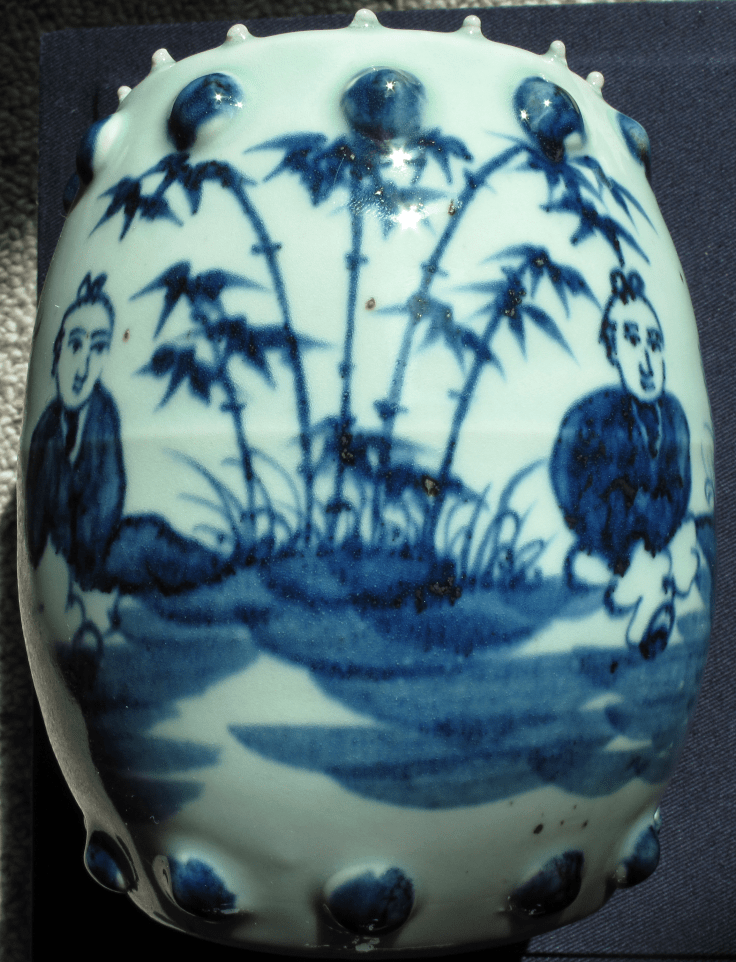 Figure 1
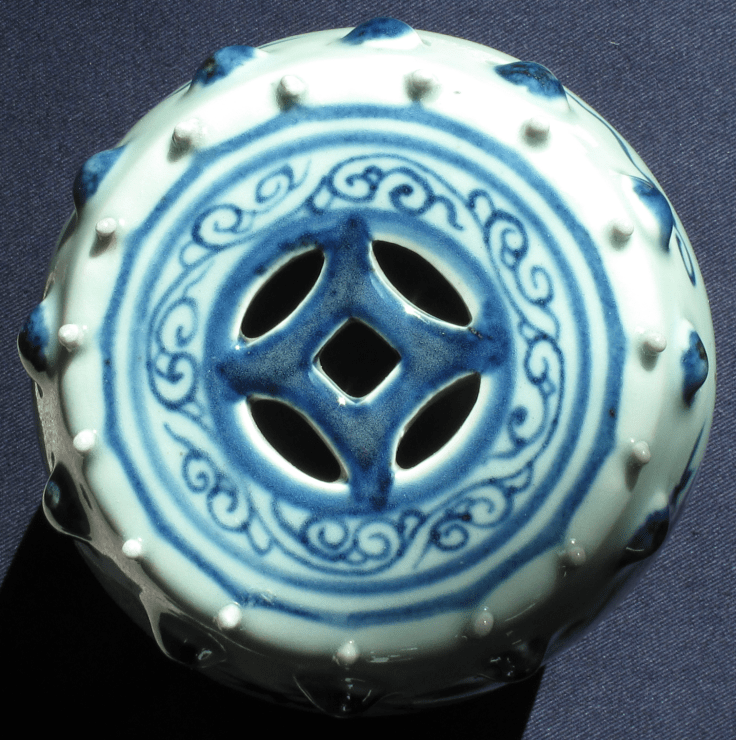 Figure 2
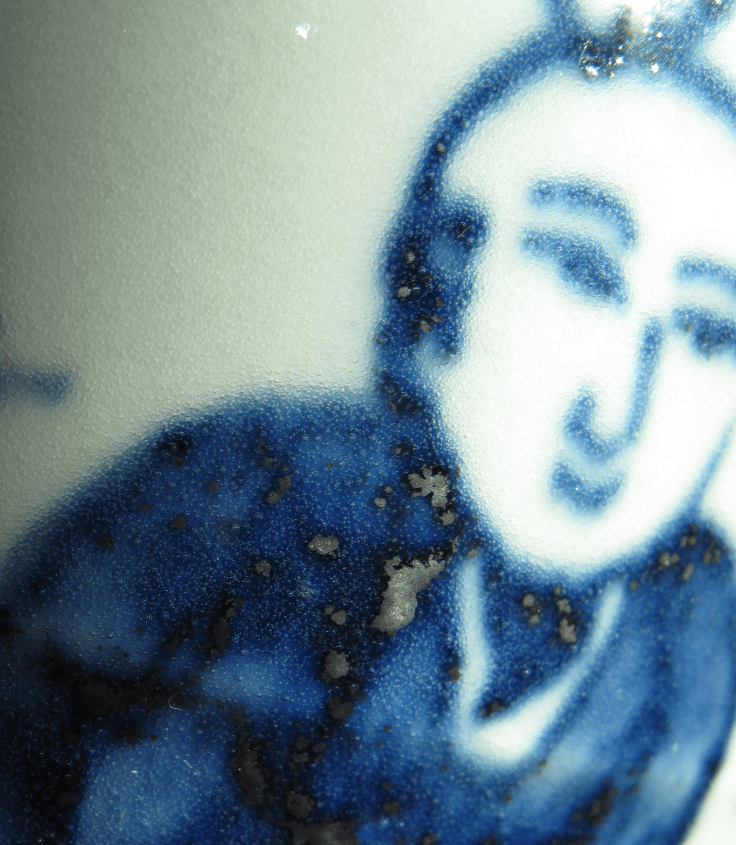 Figure 3
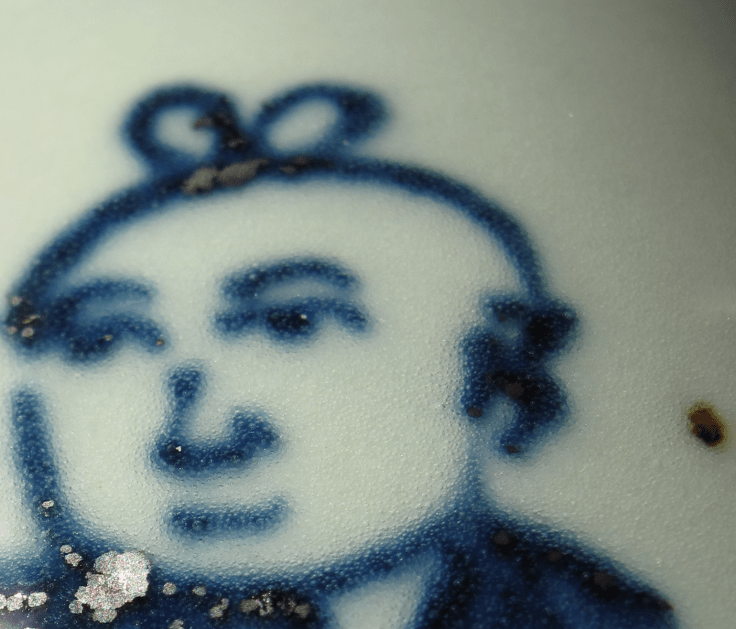 Figure 4
In Figures 3 and 4, you can see that the drippings and flares are largely under control. Still, if you were to look carefully, there are some drippings, but they are in no way giving the overall appearance any impact. I must say that the potters have picked a very good dye to suit the occasion with all the rather large bubbles to enhance the aesthetic effect of the face. If you think that these are beautiful bubbles, I’ll show you more that would definite amaze you (Figures 5-9).
 Figure 5
 Figure 6
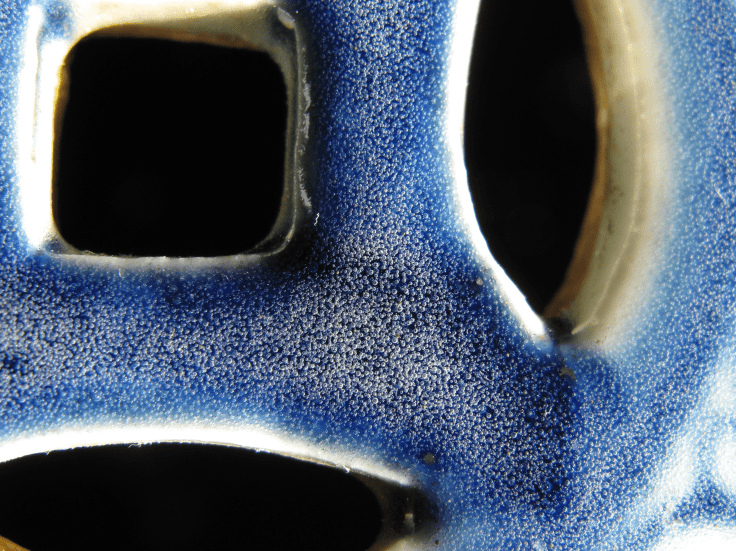 Figure 7
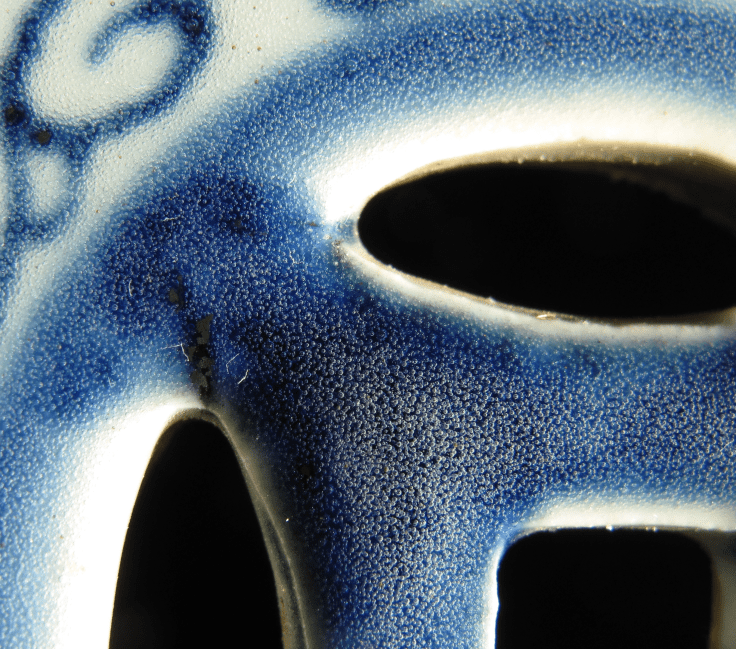 Figure 8
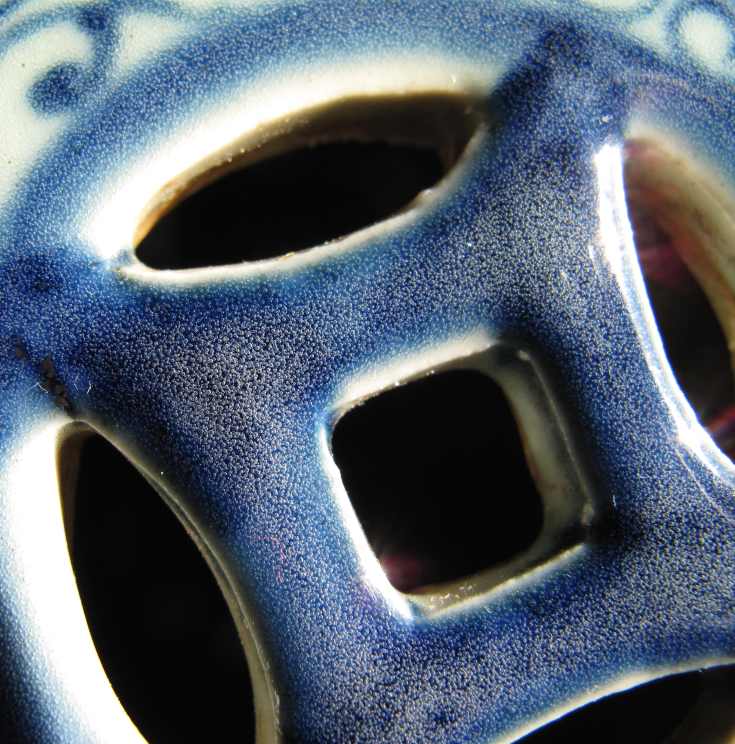 Figure 9
Look at the bubbles in these photos. Are they not beautiful? I think, of all the characteristic features of the Somali Blue dye, bubbles and plaques are definitely the two that are most beautiful. Both of these two properties have an almost infinite form of presentation. For bubbles, many forms of presentation are beautiful, and depending on your preference, you may rank one form of presentation higher than the other. But these bubbles, in crystal form, so tightly packed, all bubbling up to the surface, have to be ranked as one of the best presentations.
I think there is another reason for you to find these bubbles beautiful. It is the blue coloration. Look at the blue color, it is not uniform. If the blue color is all the same blue, I am sure it will not be as attractive. Here, some areas are dark, whereas in some other areas, they are a lot lighter. And in some other areas, you’ll find the very beautiful sapphire blue coloration. All these add up to the pleasing effect to the eyes.
But in these bubbles, one thing is lacking—the large bubbles. Only in one or two places can you find a large bubble. But in other areas, as I will shortly show you, they are not the same. This only shows you that the potters know exactly what they are doing. They know that certain blue dyes in their palette are different from the others, and they choose the appropriate ones for the appropriate instance. In Figures 10-16, you can see quite a lot more large bubbles.
 Figure 10
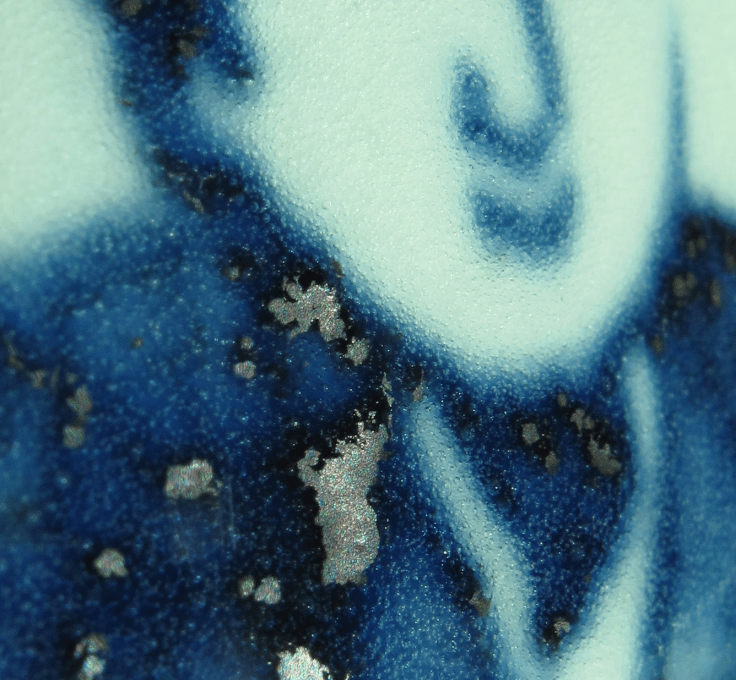 Figure 11
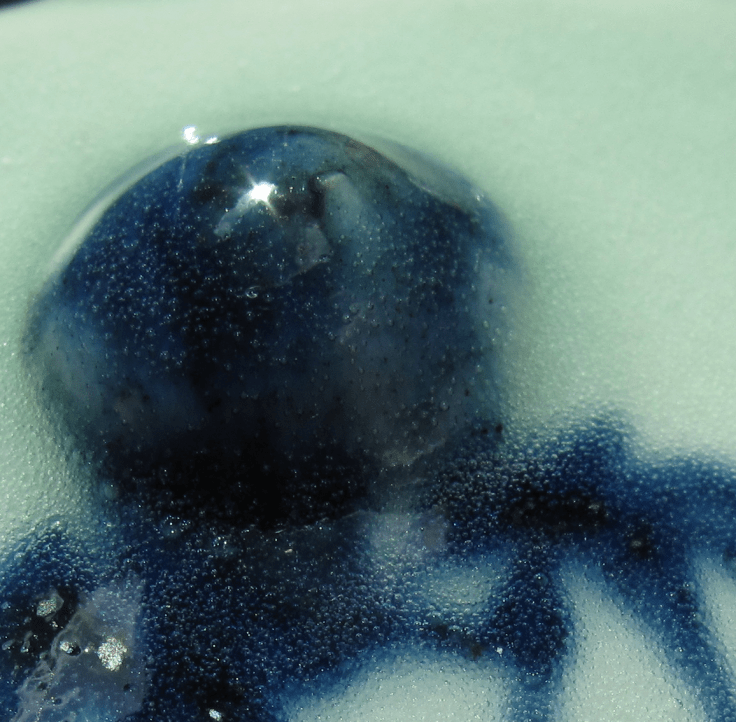 Figure 12
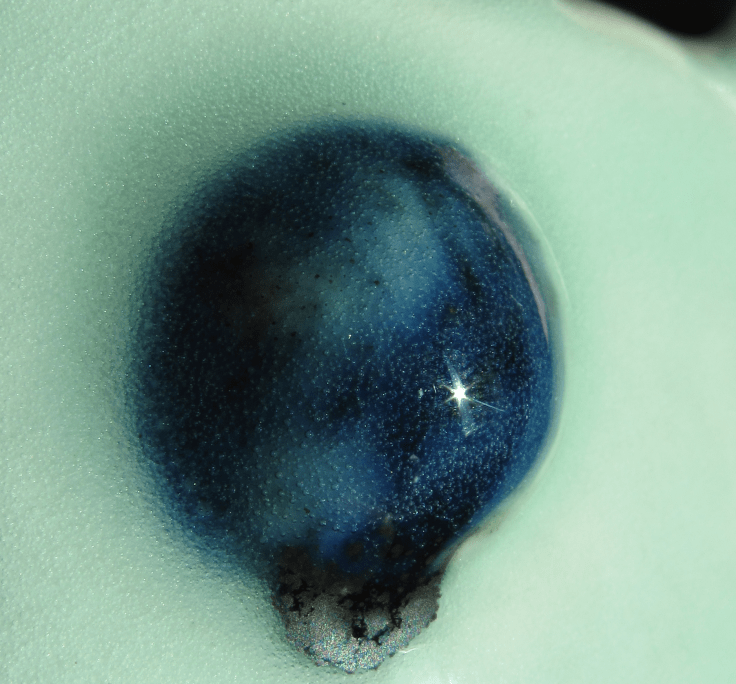 Figure 13
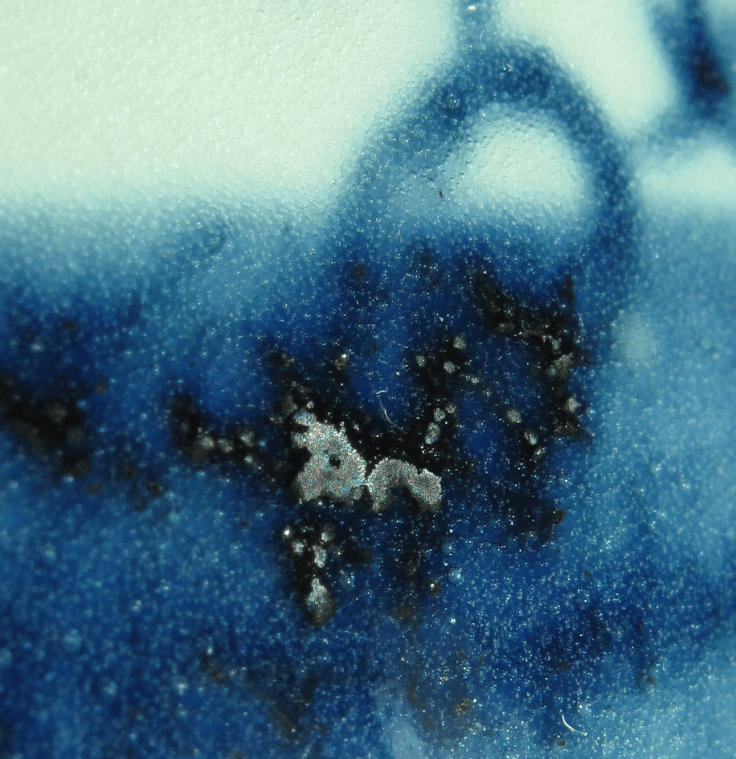 Figure 14
 Figure 15
In these photos, you can see that many of the large bubbles are semi-opaque, typical of Somali Blue dye, and are in fact very beautiful. The small bubbles also show typical Sumali Blue dye features—a few small bubbles are linked up, as if by a piece of string. And in some of these photos, figure 10 in particular, you can see lacunae formation very well. I will show you a few more photos with these lacunae formation.
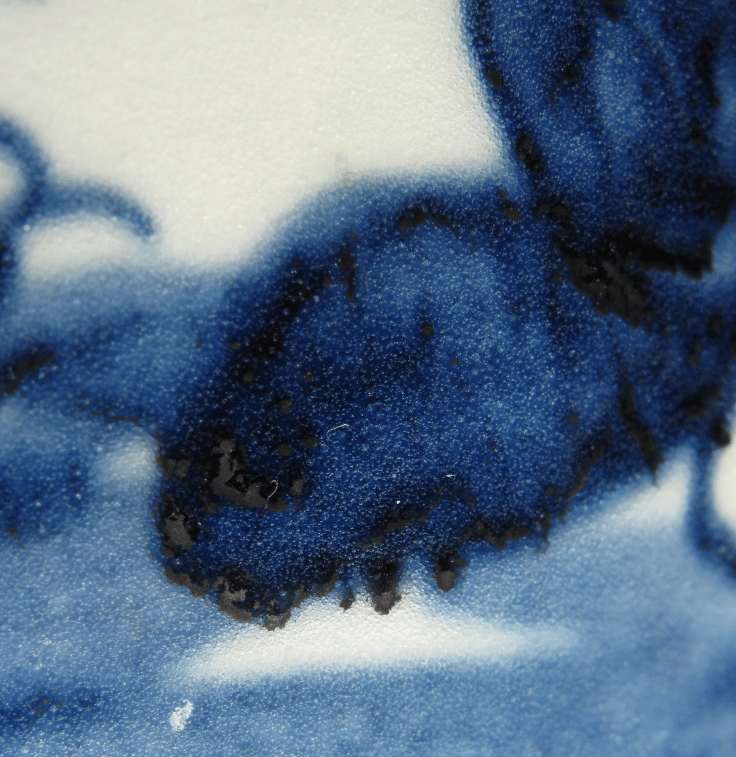 Figure 16
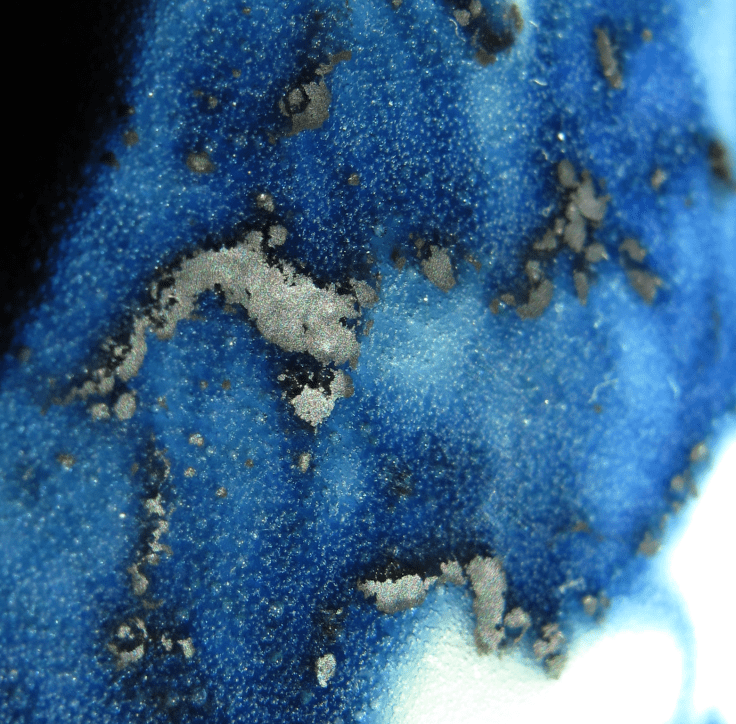 Figure 17
 Figure 18
 Figure 19
In these photos, aside from the lacunae formation, which you can see more clearly if you try to blow up the photos a little, you can also see the drippings. Note that in figure 19, some of the small plaques actually drift away from the main plaque—again, a feature indicating that the blue dye pigment is of high quality. Figures 20-22 are photos showing you the same feature.
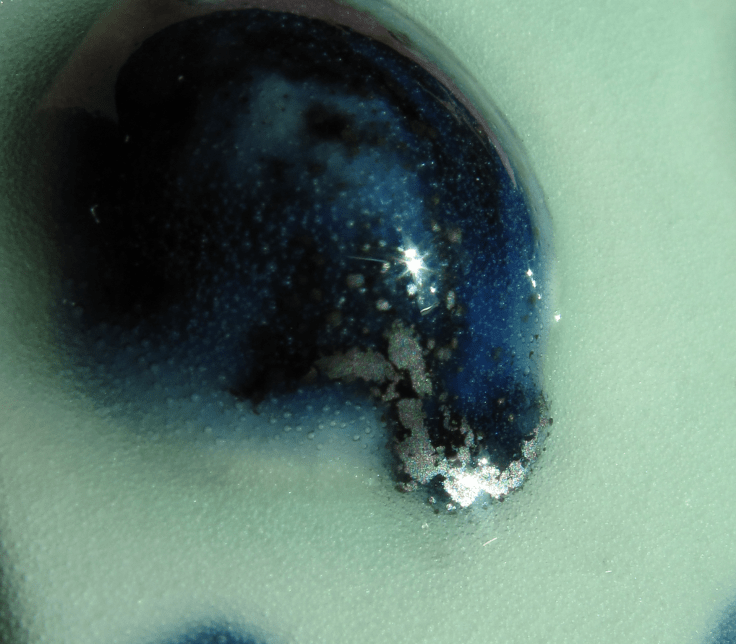 Figure 20
 Figure 21
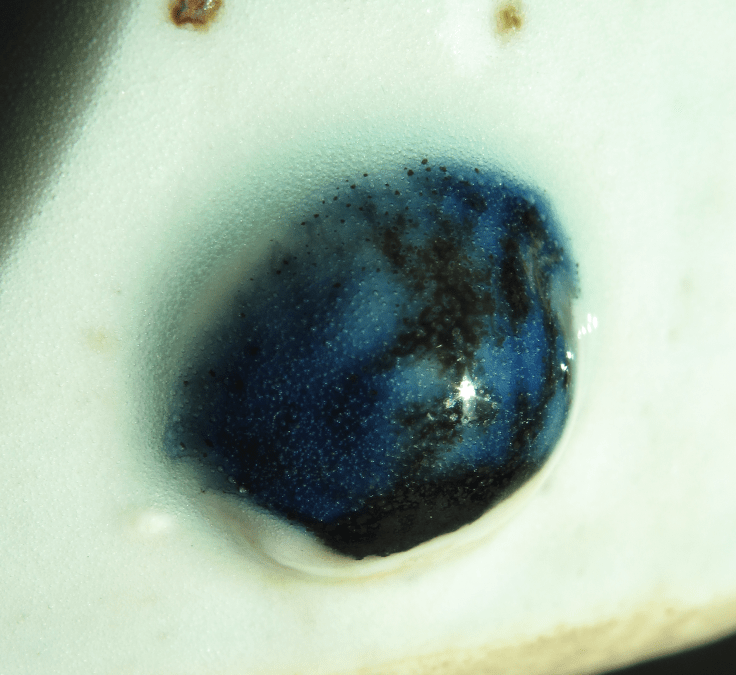 Figure 22
With all these features that I have shown you, there is no doubt that this drum stool is a Xuande. But you must not forget to see the plaques in many of these photos. Look at them carefully. These plaques are all without the metallic foil floating on top. In other words, the plaques only have the muddy layer. As you may remember, the muddy layer has a rich content of minerals and compounds that are reflective to sunlight, and they are much more colorful under the sun than those plaques with an aluminum foil floating atop. Again, these plaques are the most typical of the Sumali Blue dye, and seeing them, it is just another piece of evidence that the ware belongs to the Xuande period.
 yongleandxuande.com
Leave a comment