
In the process of collecting early Ming and Yuan Blue and Whites, very often we’ll come across wares that have uncommon shape. What do we do? If you were to evaluate the ware in the traditional manner where shape and design and a few other things play an important role, you would instantly raise your alarm—this can be a fake. But if you were to use the Sumali Blue dye pigment characteristics as the standard for evaluation, you would stay calm. Just look at the dye’s characteristics, and you can draw your conclusions there.
This time, I am going to show you a Xuande Blue and White fluted bowl. It stands at 8 1/8 in diameter, and 3 3/8 inches tall. Fluted bowls in the early Ming period are not very common, though I would not say that they are rare. But this fluted bowl is different and is quite rare. Normally, with a fluted bowl, the groove on the outside and the ridge on the inside of the bowl are vertically down, from the mouth of the bowl to the bottom of it, or to the foot on the outside. Here, in this bowl, it is oblique. The groove on the outside and the ridge inside are slanting downwards at an angle at almost 45 degrees. In fact the groove and ridge also appear at the lower part of the bowl above the foot rim, and they are encircling each of the 16 decorative floral pattern. I would say this is quite a job for the potter who made this bowl.
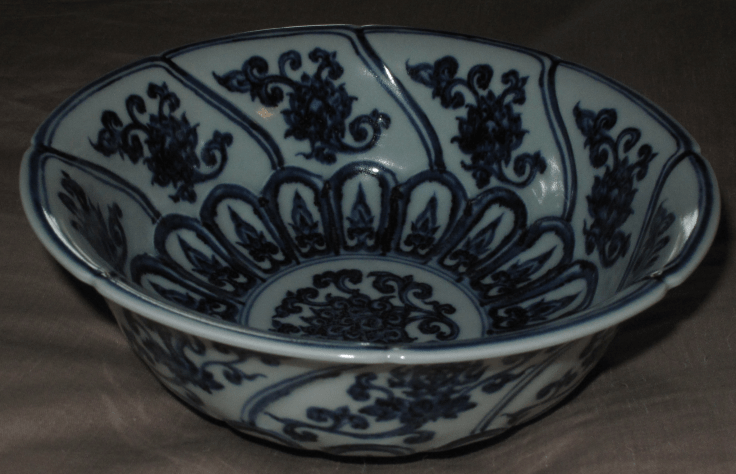 Figure 1
 Figure 2
 Figure 3
The bowl is divided into eight panels by these grooves. In these eight panels, the eight auspicious symbols are drawn and each one is sitting on a lotus flower. Decoration in blue and white wares in early Ming period is quite common, and I’ll take this opportunity to show you these eight symbols.
 Figure 4 花 Flower
 Figure 5 蓋 Canopy
 Figure 6 傘 Parasol
 Figure 7 螺 Conch
 Figure 8 輪 Wheel
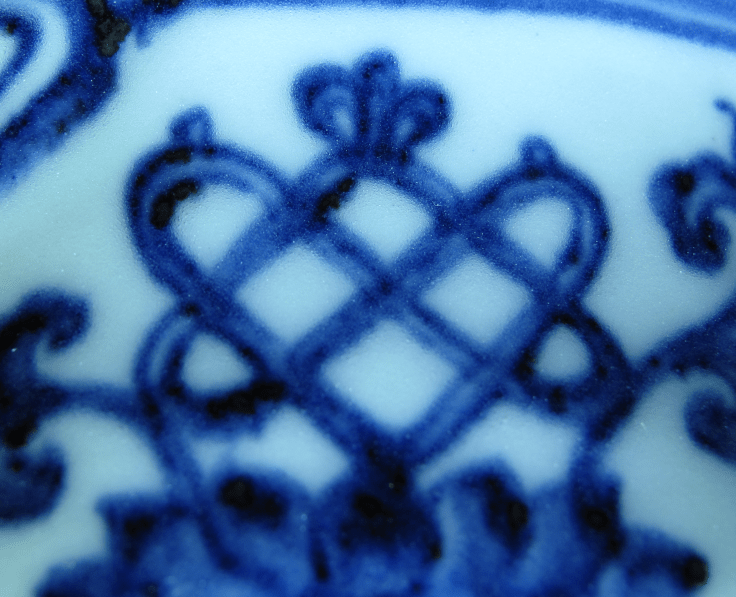 Figure 9 結 Knot
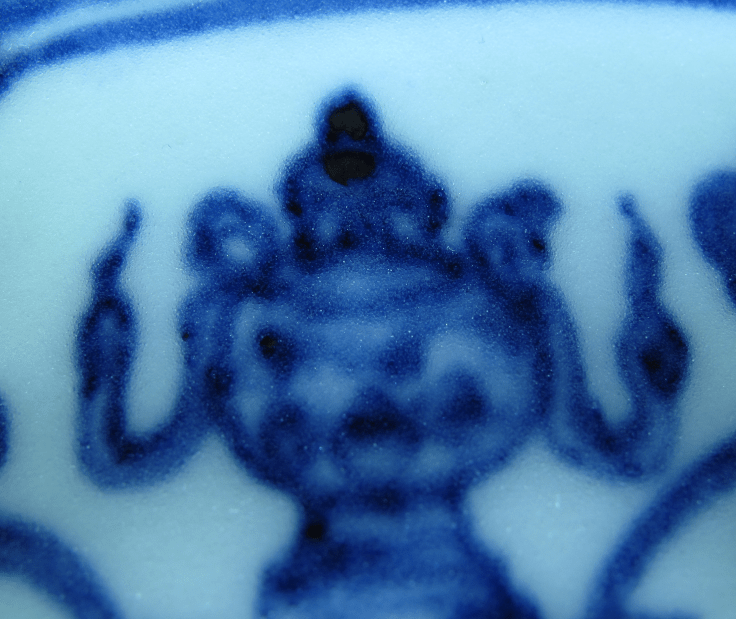 Figure 10 罐 Vase
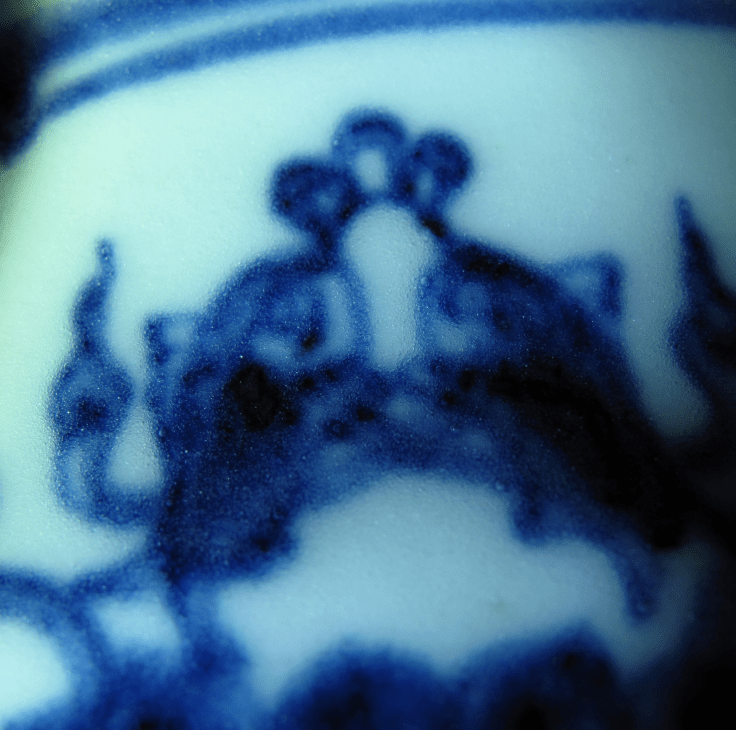 Figure 11 魚 Fish
I have said it many times before that in evaluating an early Ming ware, one should not depend on the shape of the ware, the workmanship, and the motif. Skillful forges can overcome all these and make something so similar that no one can tell the differences. The only thing that they cannot imitate is the Sumali Blue dye and its characteristics. The only reason I am showing you the eight symbols is for the sake of interest, and for interest alone. The only sure way to tell a genuine B & W of the early Ming period is by looking at the characteristics of the dye pigment.
From these photos, some of the large bubbles and some plaques are already apparent. But I’ll enlarge these characteristics so that they can be clearly seen.
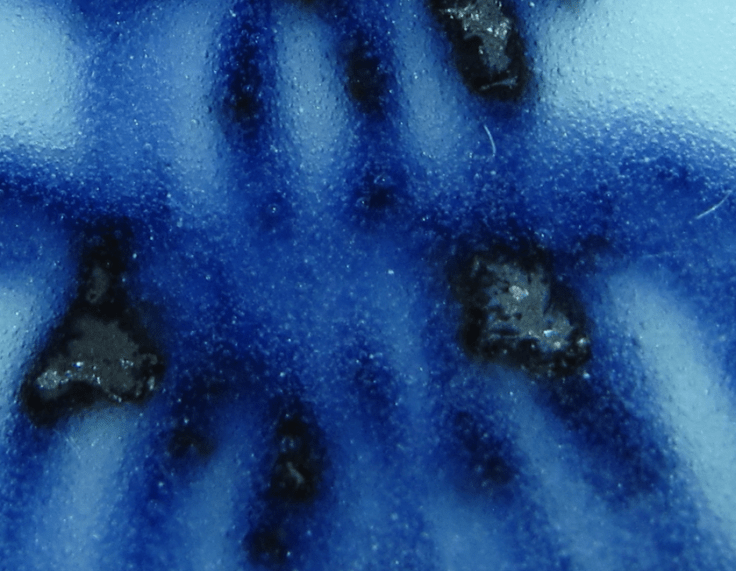 Figure 12
 Figure 13
Look at these two photos. Figure 12 is taken under LED light, and Figure 13 under sunlight. Do you see the differences? The most obvious are the plaques. In figure 12, the reflections are not bright, nor are they colorful. And there are but a few areas with reflections. The rest of the plaque is dull. In fact, the reflective part is the area where there is a metallic foil floating on top, the dull area represents the muddy bottom with no metallic foil overhanging it. This kind of plaque with only a small area covered by the metallic foil is common, and in this bowl, almost all plaques are like this one. Look at the Figure 13, taken under sunlight, even the muddy layer gives a colorful reflection. This is because included in the muddy layer, there are many metallic particles intermingle with the mud-like material, and the metallic particles, like most metals, give colorful reflections.
Look at the bubbles, particularly the large one, and notice the different appearances. Which do you prefer? In fact, people of experience all say that ceramic wares, if possible, should be examined under sunlight. You have a different feel about everything you look at.
I’ll show you photos of another plaque, taken under LED light, weak sunlight, and sunlight (Figures 14-16).
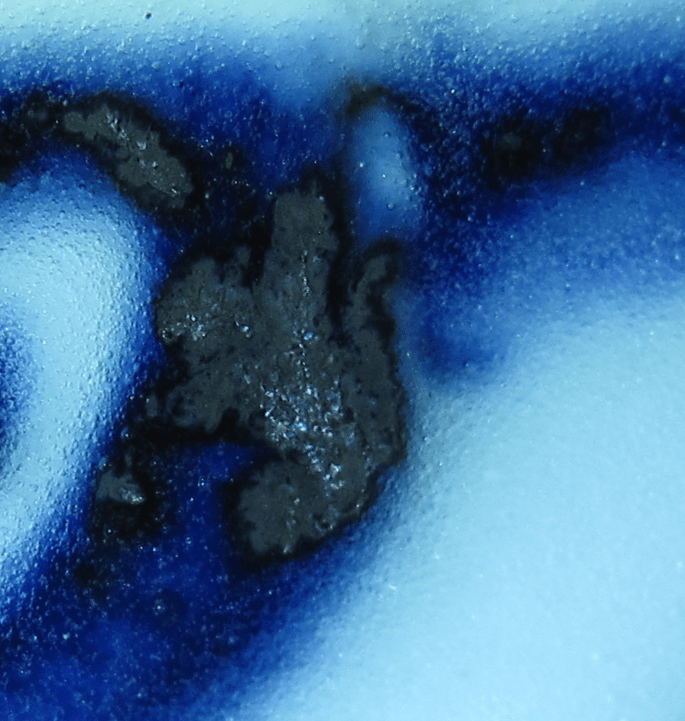 Figure 14
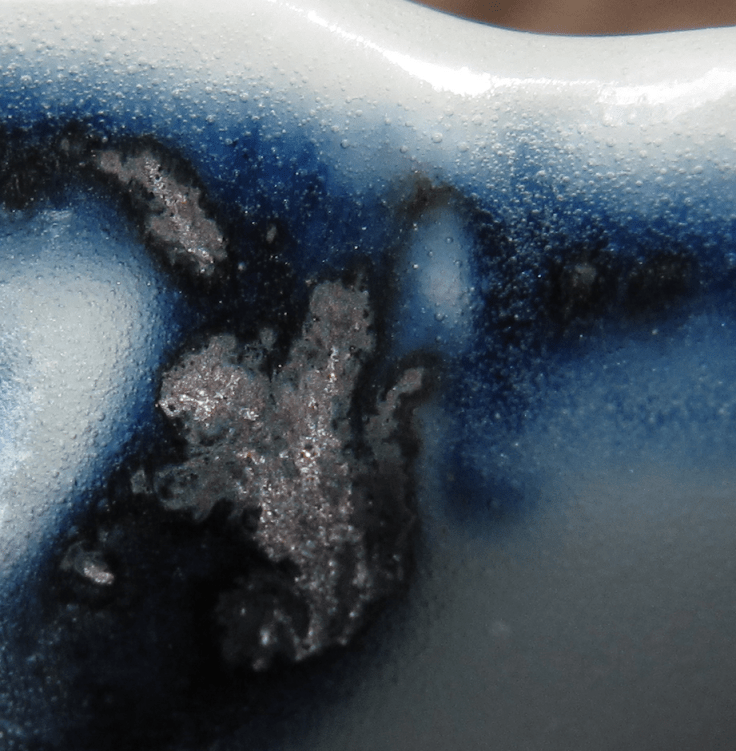 Figure 15
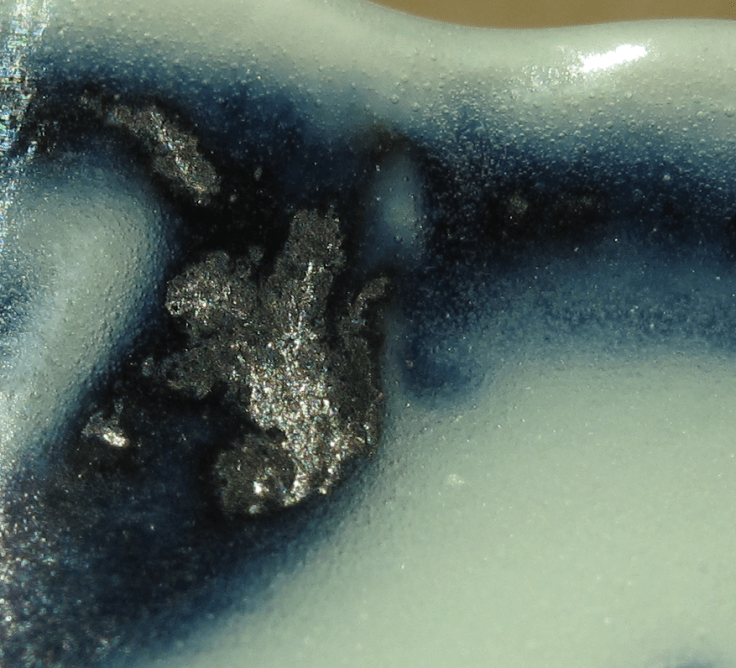 Figure 16
Look at these photos carefully and note the differences. Figure 14 is taken under LED light, Figure 15 weak sunlight and Figure 16 direct sunlight. Note the metallic sheet, the muddy layer and how the different lights affect them. The bubbles appear to be better shown in the LED photo, but that is because the sunlight is not the strongest when the photo was taken.
I’ll now should you a few more photos of plaques in this bowl (Figures 17-25). The plaques, as you can see, are rather typical of Xuande.
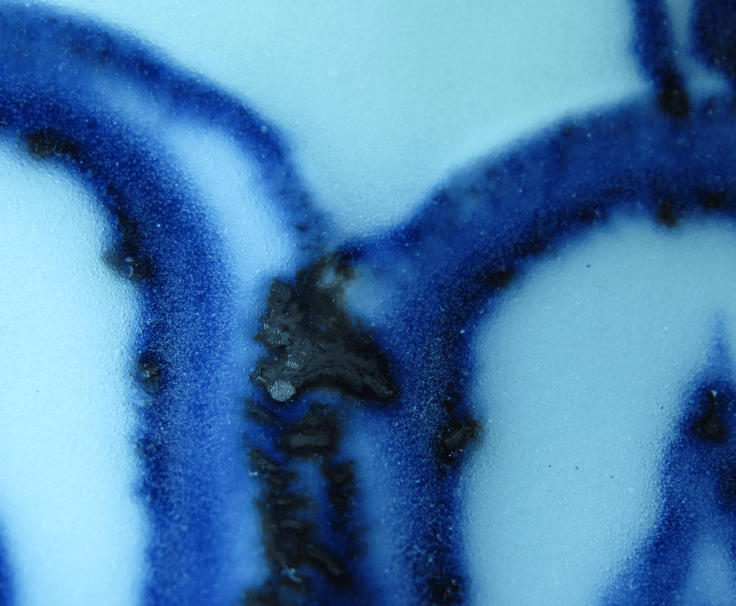 Figure 17
 Figure 18
 Figure 19
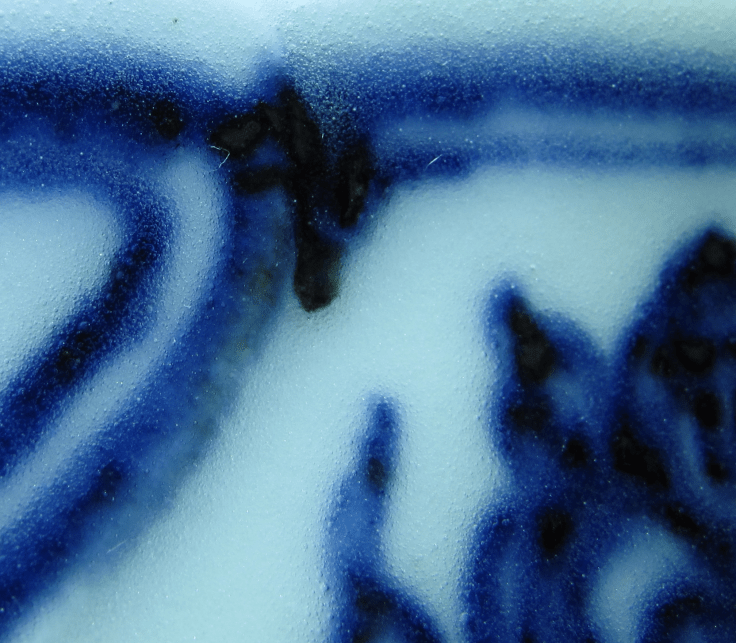 Figure 20
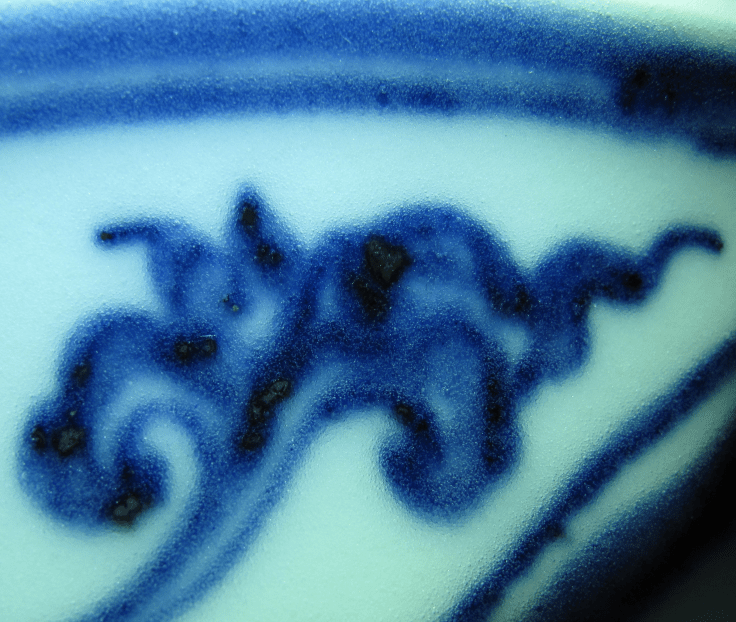 Figure 21
 Figure 22
 Figure 23
 Figure 24
 Figure 25
While looking at the plaques, pay attention to the flare and dripping effect. In quite a few of these photos, the dripping appear to be odd—it is dripping on both sides. But if you remember that there are raised ridges in these areas, the dripping on both sides is self-explanatory. You must also notice that at the end of the dripping, many a time, you can see that there is a tinge of greenish grey. I have told you before this greenish tinge is an indication that the dye is of good quality.
In some of these photos, particularly Figure 18, you can see the large bubbles very well. They are rather large, and sometimes pearly and opaque, another indication that the dye is good.
Let me further enlarge two more photos for you and you can appreciate the beauty of the large bubbles in this bowl.
 Figure 26
Look at the string of large bubbles on the left hand side. Isn’t it beautiful?
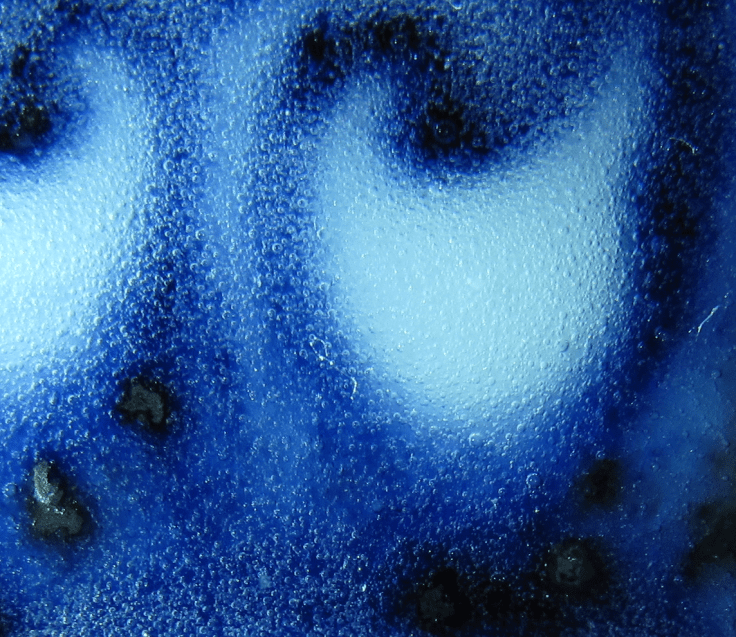 Figure 27
And look at the large bubble at the top near the center. It is sitting on a small pool of sapphire blue dye—a classic presentation of a beautiful bubble. The small bubbles nearby are very clear, and all bubbling up to the surface. This again is typical of a good Sumali Blue dye, and is most often seen in areas where the glaze is copious, for example, where the bowl proper joins with the foot rim (Figures 28-29).
 Figure 28
 Figure 29
As I have said, you do not need to look at the shape, the motif to authenticate a genuine Yongle or Xuande Blue and White. Just look at the characteristics of the dye—the plaques and the bubbles and very often, the blue coloration, and they speak for themselves that the ware is a genuine Xuande, and in this case, when the bowl bears the Xuande mark, of the period.
 yongleandxuande.com
Leave a comment