
I have told you the Sumali Blue dye has two important characteristics. They are the bubbles and plaques. In all the previous articles, I have tried to show you the variations of these two characteristics that you can have with the dye with a lot of photos. It is crucial that you are familiar with these various forms of presentation, for the process of evaluating a genuine and real early Ming Blue and White ceramics rests very much on these specific features of the Sumali Blue dye. But one thing you can be certain: no matter how many photos I show you, there are bound to be other forms of presentations. The thing to remember is that variations in presentations should not trouble you so long as you know the basics about the bubbles and the plaques. Bubbles are never uniform in size. There are size variations. Plaques are a little tricky, that is why I try to show you as many variation as I can. Once you are familiar with these, you can easily tell the fake plaques on fake wares. Here in this article, I want to show you a rather rare ware with quite unusual bubbles and plaques. It is a lantern-shaped Zun vase, with Xuande mark. Whether it is of the period, we’ll try to look at the characteristics of the dye pigment.
 Figure 1
This vase stands last 13 1/8 inches tall. The shape, as you can see, is rather unusual for a Xuande Blue and White. While the motif of different fruit on a ware is common, the presentation of these fruits in four panels is very uncommon in early Ming B & Ws. If an expert is to base his judgement on the shape and style of the motif, I would not be surprised that the vase be dismissed summarily. Talking about the style of painting, it is only the paneling of presentation that is not common, the painting part is as typical of a Xuande as a Xuande can be, though I don’t normally stress on the painting style when evaluating a ware of the Xuande period.
Since the vase is so uncommon, I’ll show you all the four panels, plus a photo taking from the top.
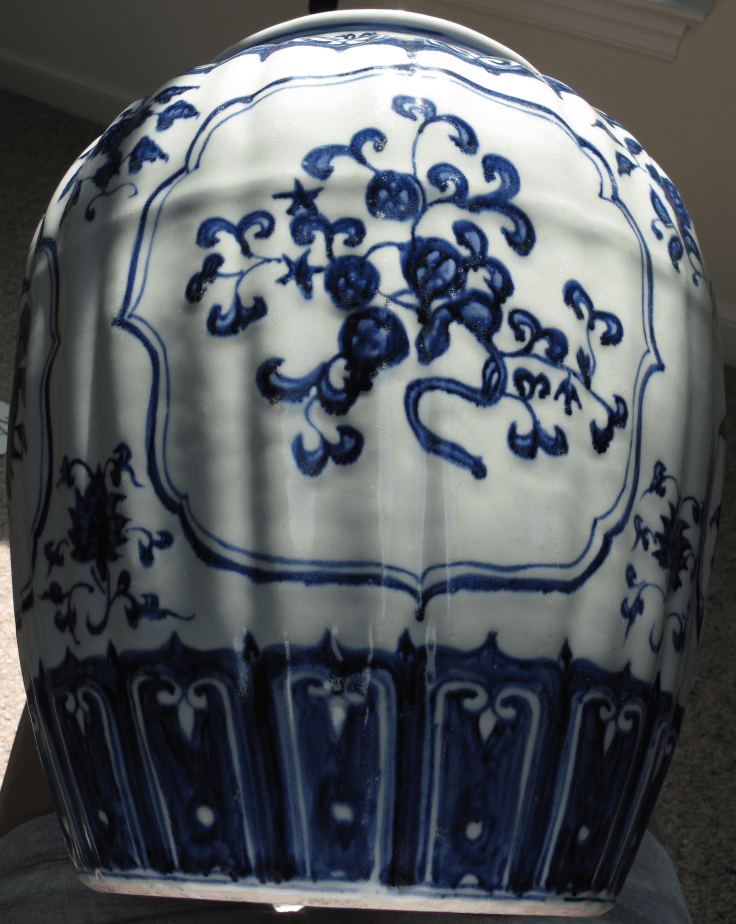 Figure 2
 Figure 3
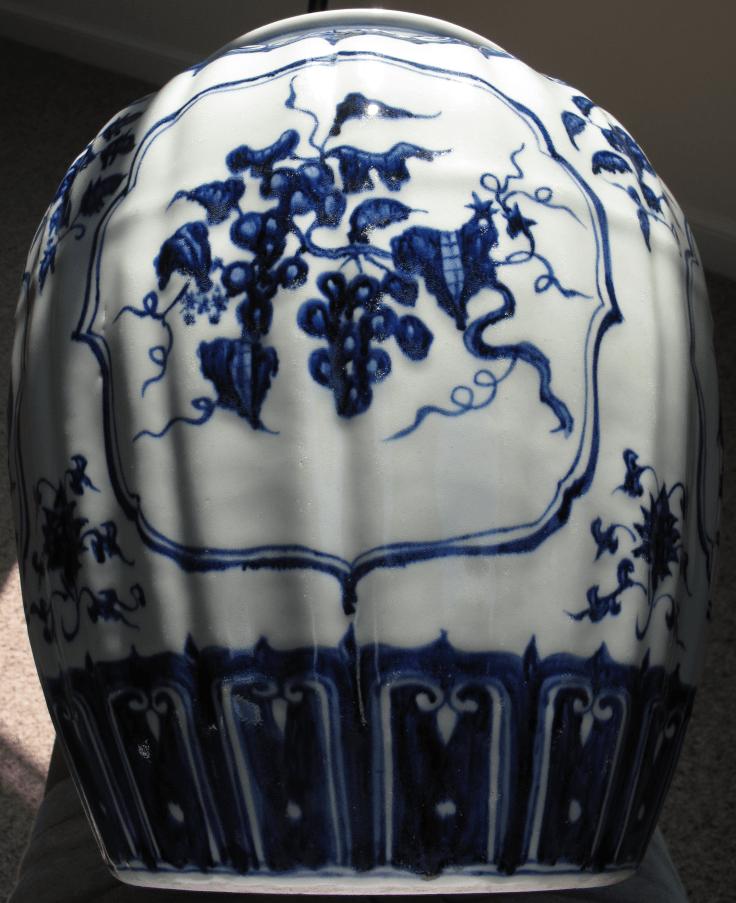 Figure 4
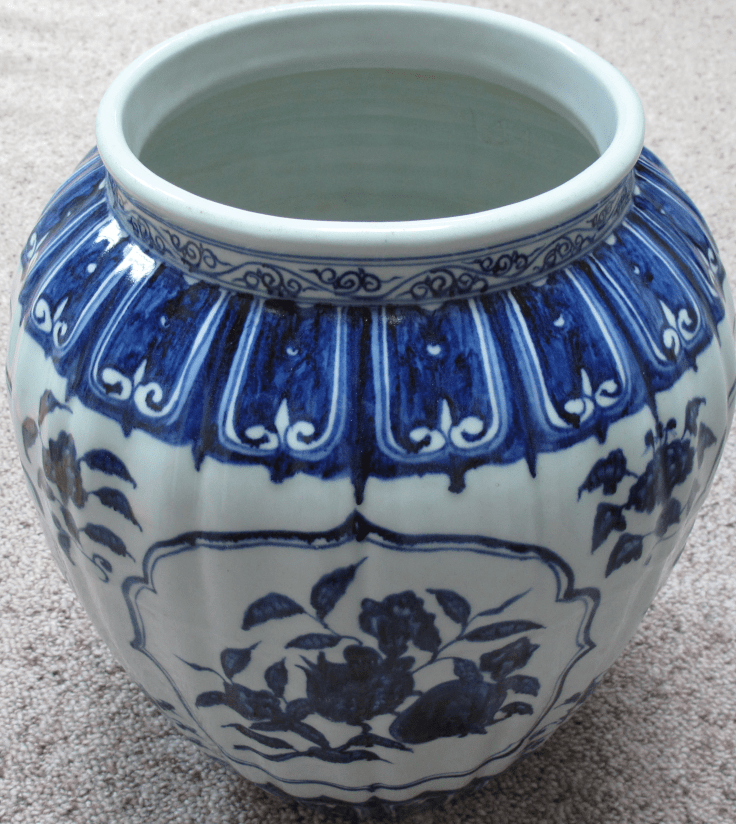 Figure 5
I’ll first show you the plaques. Plaques in this vase is almost completely absent with the naked eye, despite the fact that there are many very dark blue areas spreading across the vase, areas where you commonly find plaques. However, with the help of a magnifying glass, here and there, you do see some plaques. Most of them are very fine, like thin hairs, though in certain areas, they are very faint small plaques.
 Figure 6
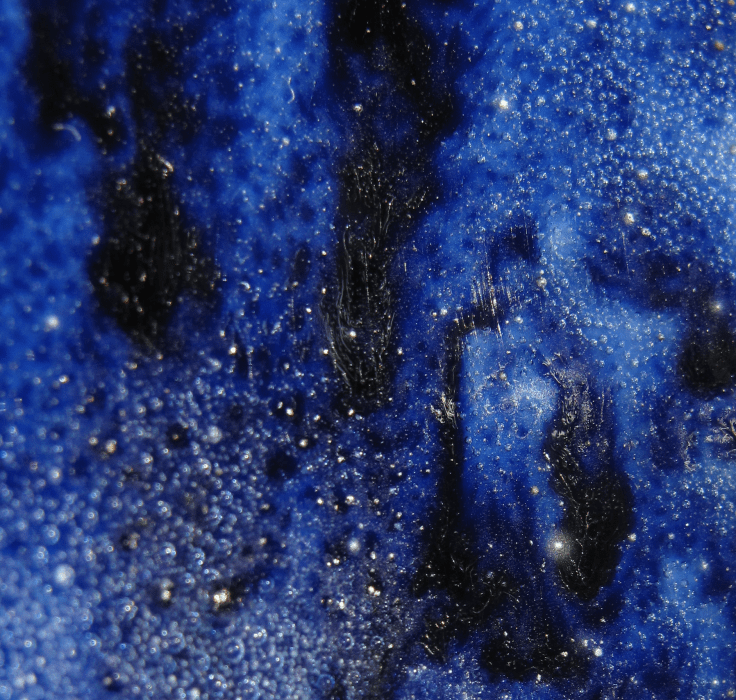 Figure 7
 Figure 8
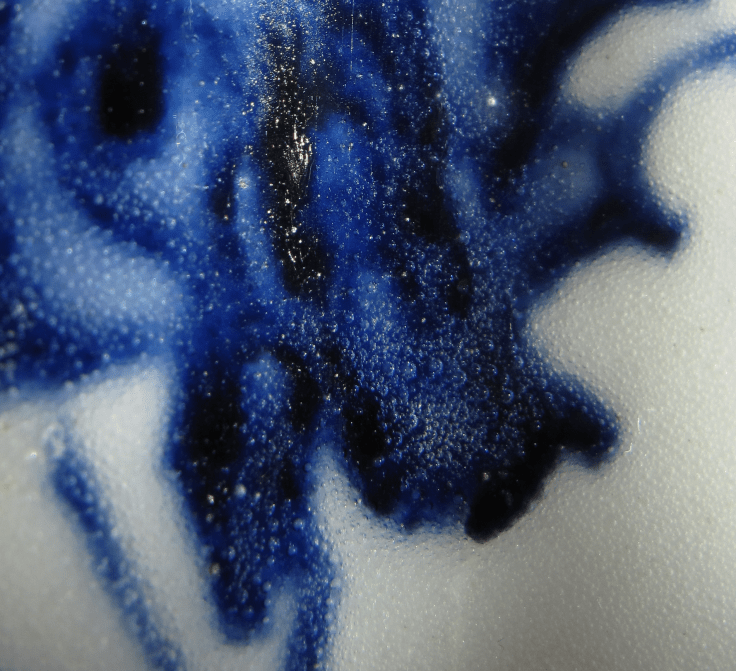 Figure 9
Do you see the very thin plaques (Figures 6-9)? I would say they are thinner than hair. Such thin plaques are very uncommon. And here, they sometimes intermingle with very small plaques. In one or two areas in this vase, you do see some small and vague plaques (Figures 10-11). The plaques here are quite different from those that I have shown you previously.
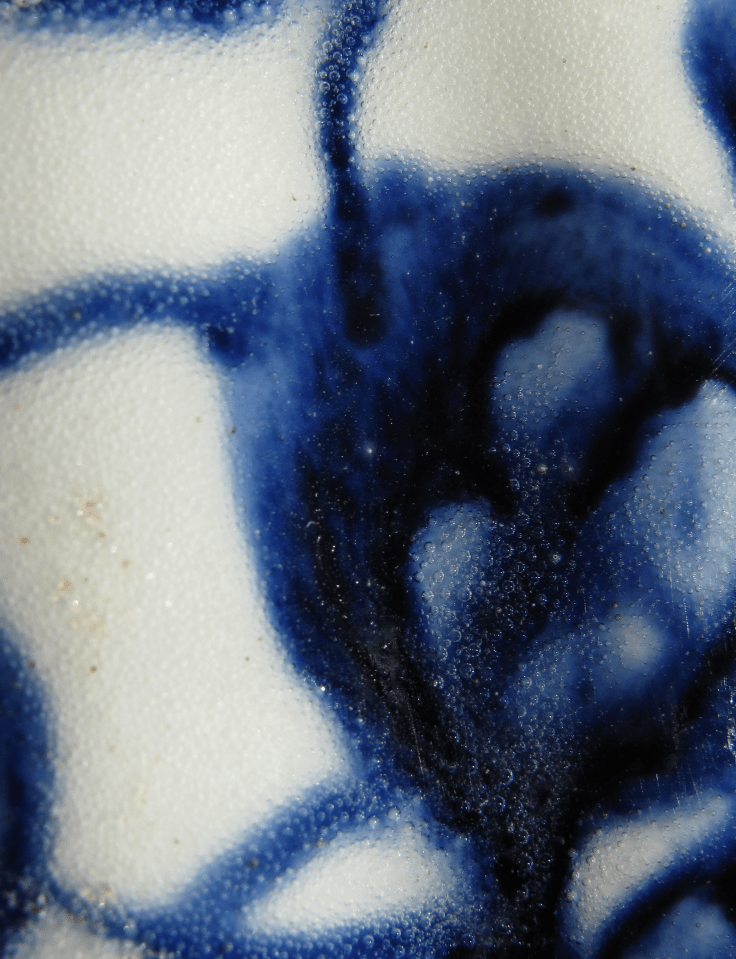 Figure 10
 Figure 11
Now, in these photos, you must have noticed the bubbles are also very different from those that I have shown you before. You have bubbles from very small size to the rather large ones. If you were to grade the size from 1 to 10, you probably have all ten sizes. This is not common. Also there are a lot of pearly white bubbles. On many occasions, two or more bubbles are linked up, as if by a string. And the distribution of the bubbles is also unique. Let me show you more photos of the bubbles (Figures 12-19).
 Figure 12
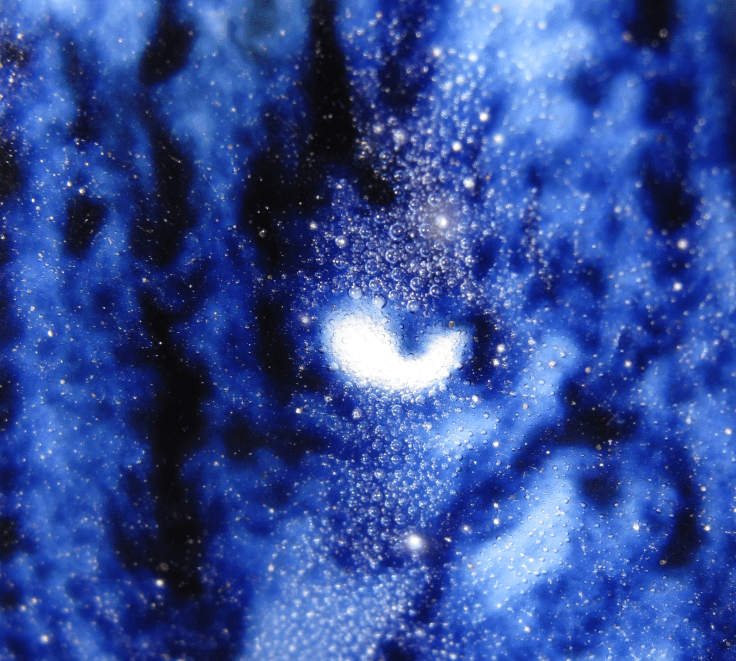 Figure 13
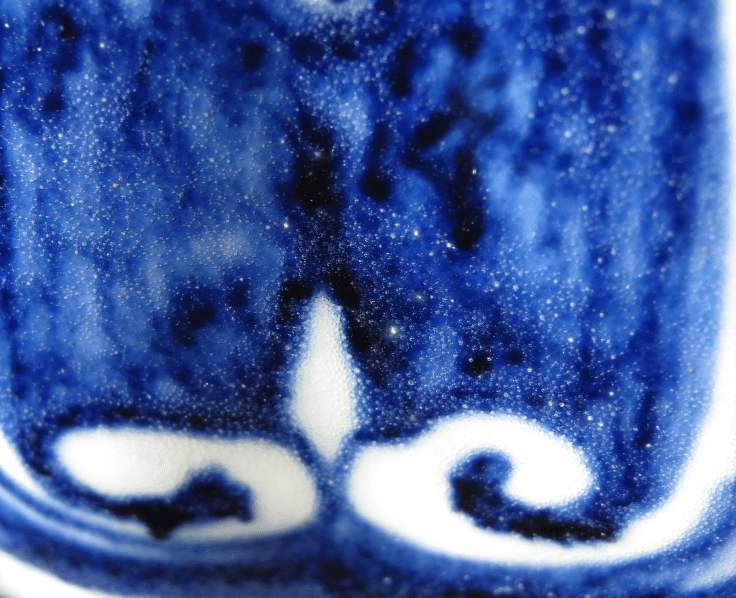 Figure 14
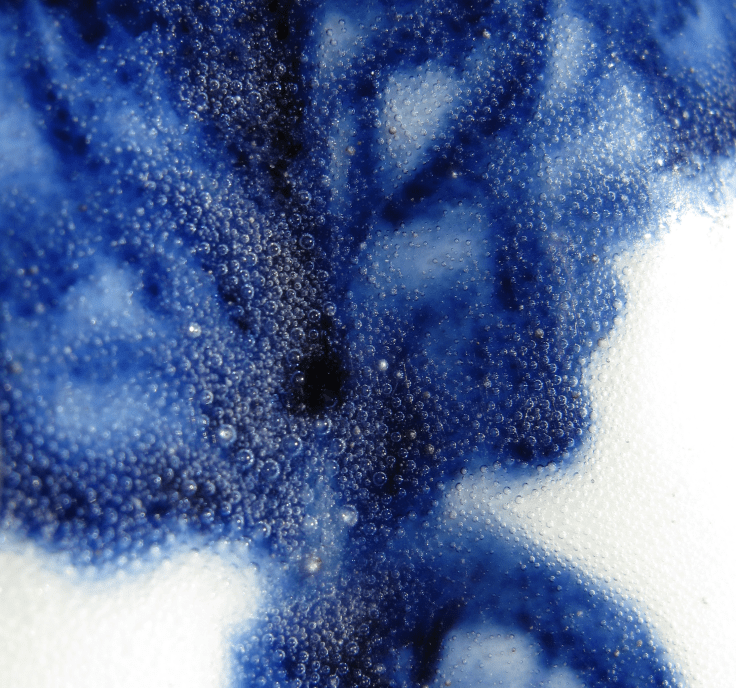 Figure 15
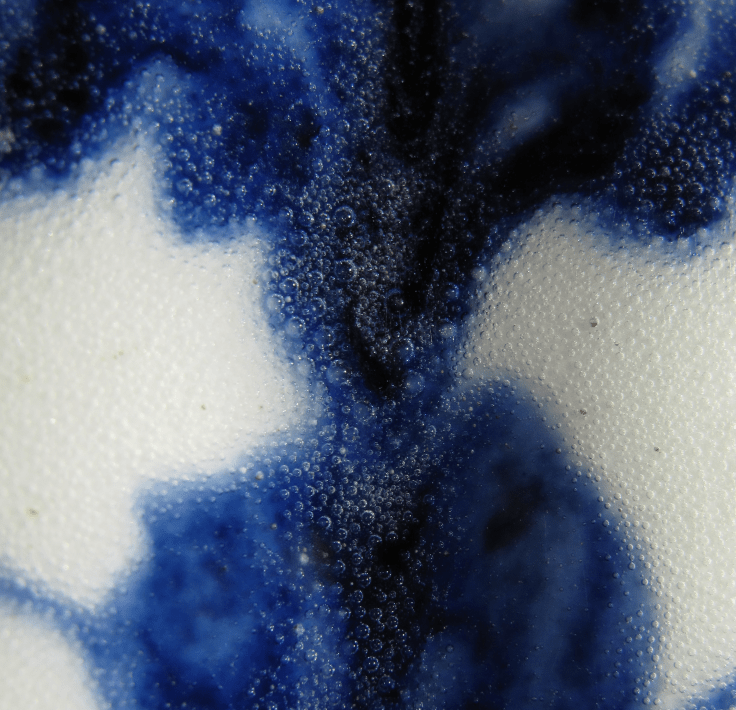 Figure 16
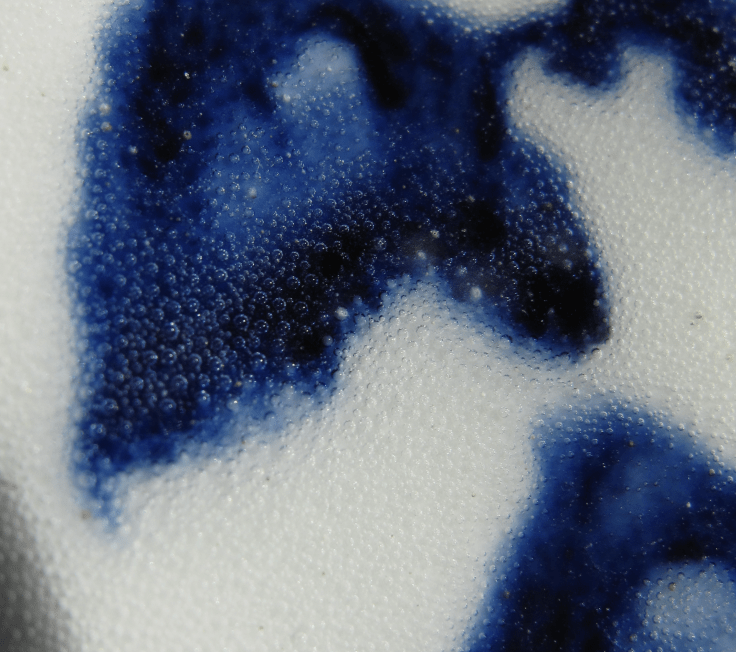 Figure 17
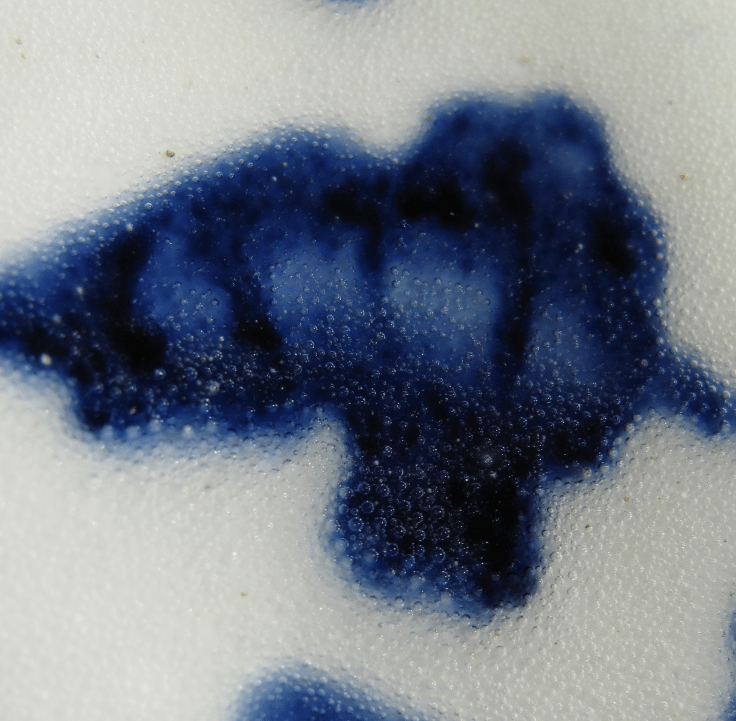 Figure 18
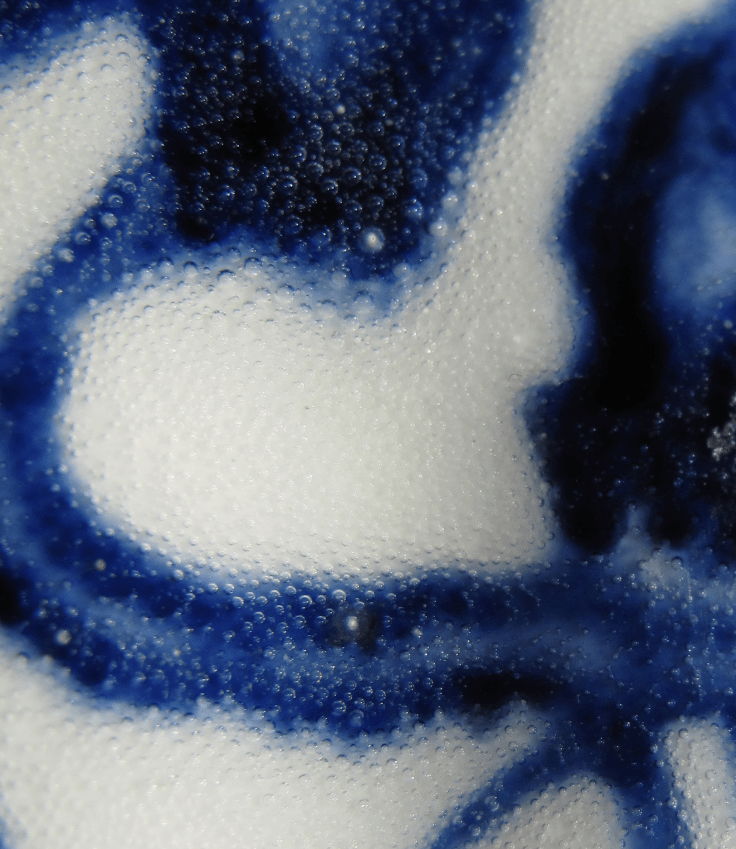 Figure 19
Look at these photos carefully. Isn’t it amazing that in some areas, the bubbles are so tightly packed, whereas in others, there are so few of them. And look at the strings of large, white, and pearly bubbles. there are so many of them. Are they not pretty? Even though lacunae formation is not seen in the larger bubbles, but in some areas where the small bubbles are not too sparse, you do see them, and very well too, as in figure 14. Have you seen bubbles present in this many in your B & Ws?
In all these phots, you would also notice the drippings, some are very dense, and some are not. I’ll show you more.
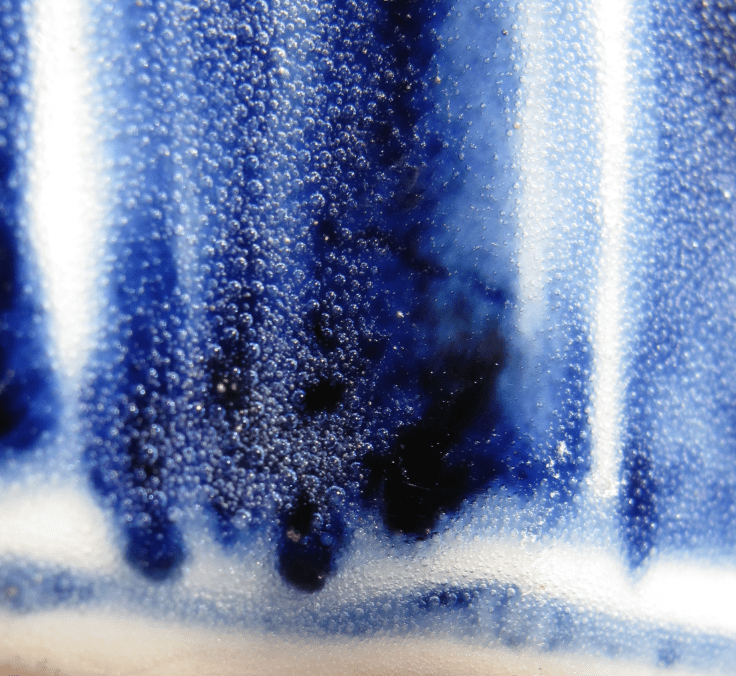 Figure 20
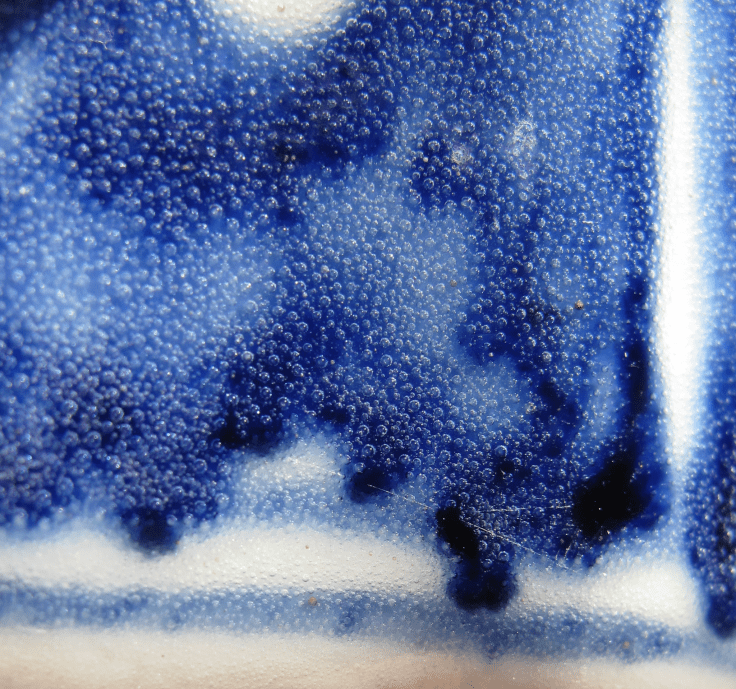 Figure 21
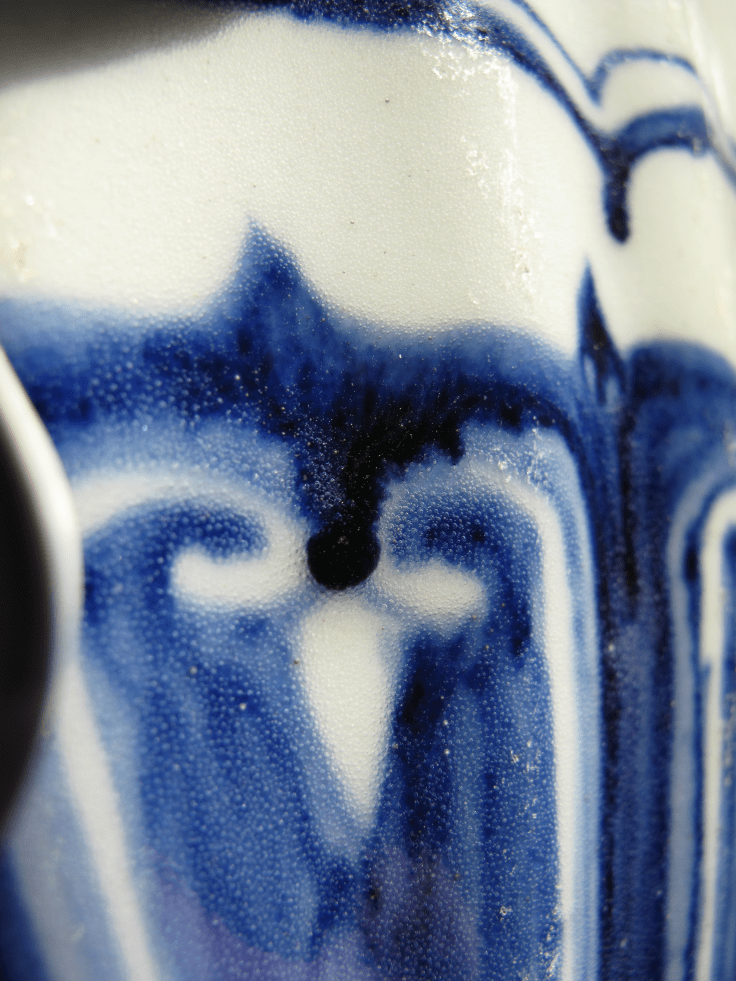 Figure 22
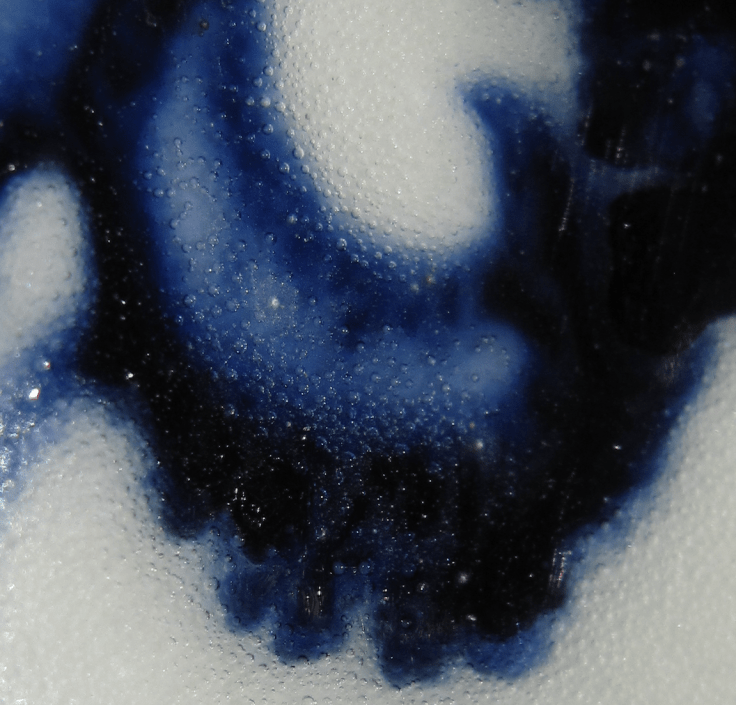 Figure 23
The drippings in figures 20-23 are very typical, though many a time, they are thick and dark.
There is yet another feature that is very obvious here in this vase. Let me show you a few photos first.
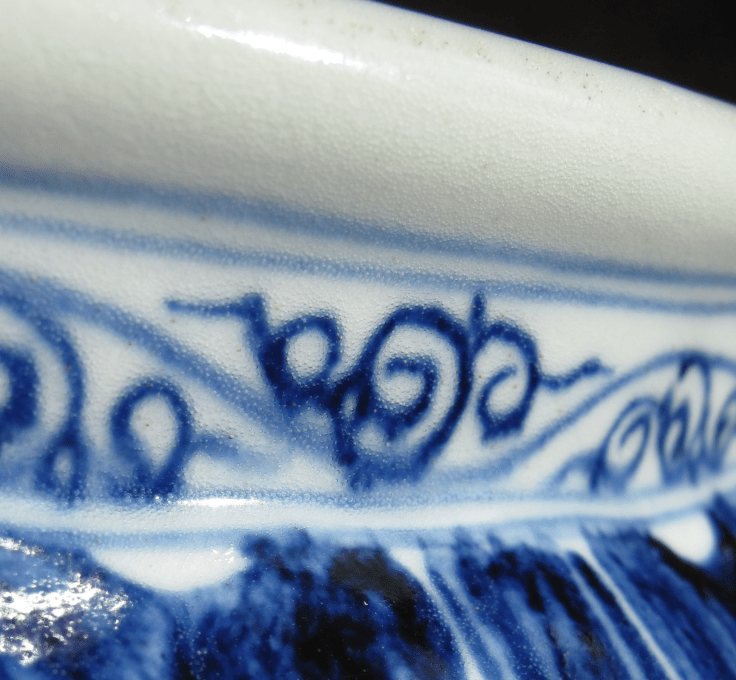 Figure 24
 Figure 25
 Figure 26
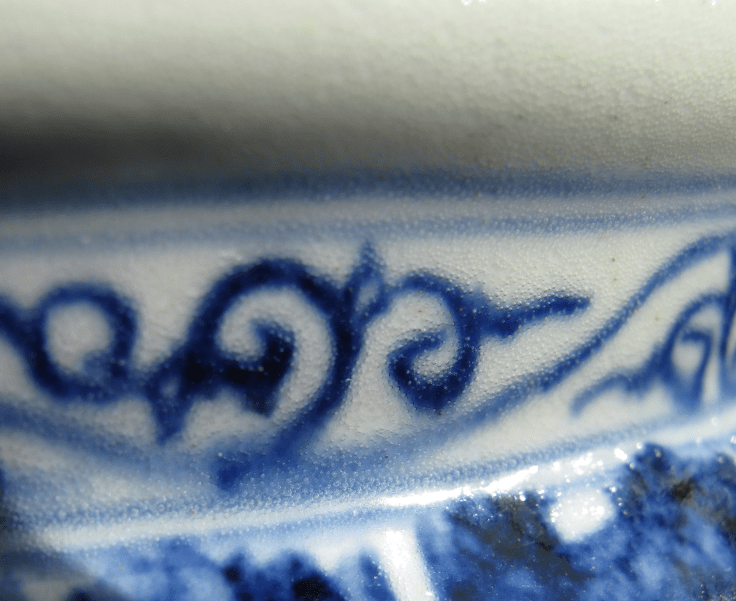 Figure 27
Now, in these photos (Figures 24-27), notice some parts of the lines of the floral scroll is being white washed, and the lines become lighter in color and flared out. It appearance is exactly what the term suggests—white washed. We do not know the cause of it, but it is certainly not the property of the dye. The occurrence is always at the top of the ware, in this case, the vase. For this, people have suggested that it might be due to too much glaze that is applied to the top, resulting in too much of the glaze flowing down, and washing away part of the dye pigment. And we can see that this phenomenon is also seen in the mark (Figures 28-29).
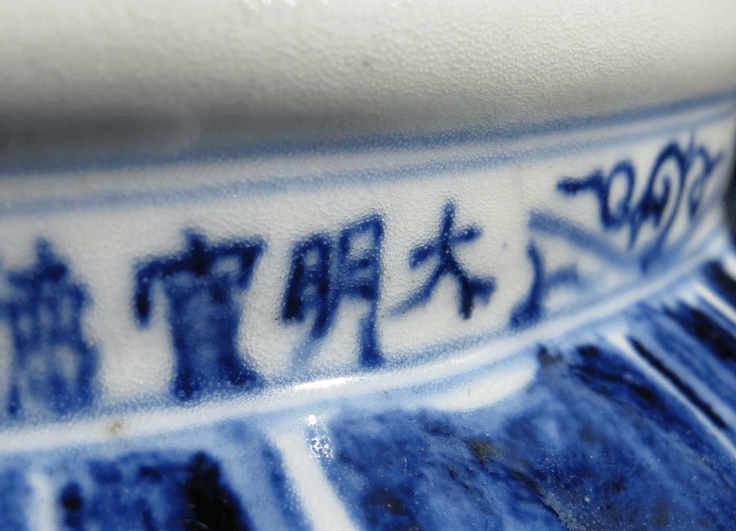 Figure 28
 Figure 29
With the presence of all these features, no matter how uncommon the shape and drawing style are, do we have any doubt that this vase is of the Xuande period?
 yongleandxuande.com
Leave a comment