
Plaque is not only an integral part of the Sumali Blue dye, it is also a most important feature. Except in some late Xuande B & Ws, where the plaques are reduced to very tiny specks, most of the time, they are very prominent. We have seen the very extensive plaques in many of the Yuan B & Ws. In Yongle and Xuande periods, the plaques are often less abundant, but still, they are very obvious.
I have told you that a plaque has essentially two components—a light reflecting metallic layer floating on the surface of the glaze on top of the plaque. It is so shiny that people used to call it tin foils. But I do have a suspicion that it is not tin. We must know that aside from tin, there is another element, aluminum, that also has a shiny reflection. Aluminum has a specific gravity of 2.7, whereas the specific gravity of tin is around 7.2-7.5. For the metallic foil to float on glaze, it is much easier with aluminum than with tin.
Underneath this aluminum foil is what I call the muddy layer that rests right on top of the ceramic bisque. The space between the aluminum foil and the muddy layer is all filled by the viscous glaze. This space is not always clear. Many a time, you can see particles that eventually form the aluminum foil rising from the muddy layer and get frozen abruptly in that space when the cooling process begins. It is as though a small part of the metallic sheet is caught there. A very interesting phenomenon.
The muddy layer is also interesting if you are to look at it carefully. Unfortunately, it is not something that you can always see well. Why? When there is an aluminum foil floating right on top of the muddy layer, particularly when the foil is large, naturally, most of the muddy layer will be blocked from your view. The most that you can see will be the periphery of it. When the foil gets smaller, more of the muddy layer can be seen. In many Yongle and Xuande B & Ws, the metallic foil is completely absent. In such a case, we can make a very good study of the muddy layer. Now, I have shown you photos of the muddy layer in many previous articles, and under direct sunlight, they are colorful and beautiful. They are colorful because of the content of the mud that is very rich in mineral particles that are highly reflective of sunlight. They are called muddy layer because they often resemble a patch of dried mud when you see them in daylight using a magnifying glass, so that, in a way, they have a thickness. This is the commonest presentation.
However, there are instances where the muddy layer is so thin that there is hardly any mud at all. This has a lot to do with the nature of the dye, I believe. These thin muddy layers, if you were to see them in daylight, not directly under the sun, are just deep bluish, or blackish patches intermingled with the surrounding blue coloration. But they do have colorful reflections under the sun, though not as much as the mud. I suppose they have the same components as the mud, but the amount is much less, so that even under direct sunlight, their reflective power is much less than that of the mud. Here, I am going to show you a B & W Xuande vase that has this kind of very thin muddy layer. It measures 10 1/4 inches in height.
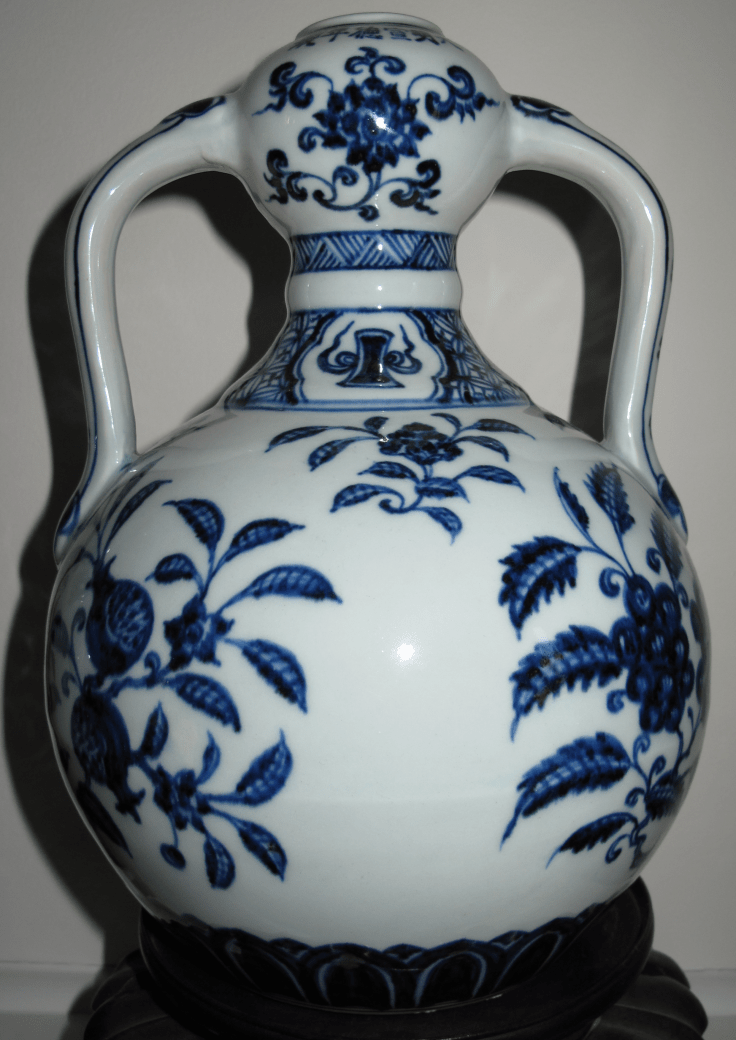 Figure 1
Let me just show you a few photos first (Figure 2-5).
 Figure 2
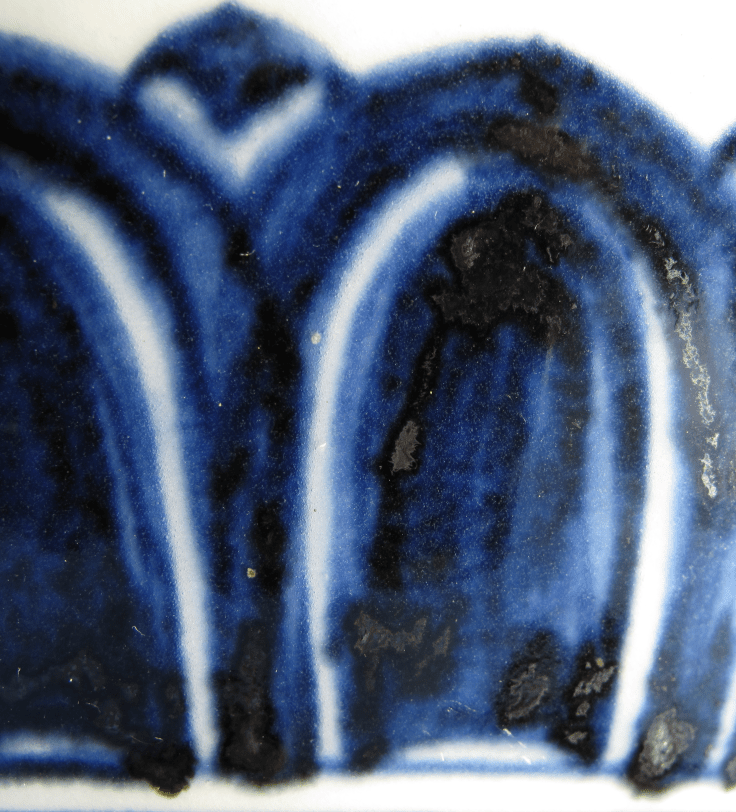 Figure 3
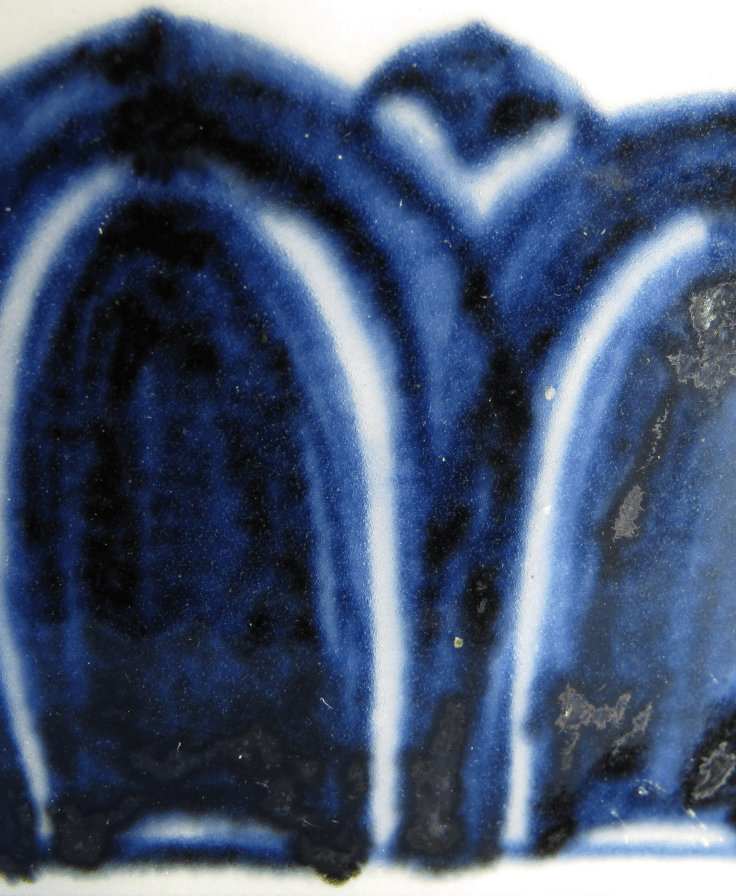 Figure 4
 Figure 5
These photos show the laplet pattern that is typical of a early Ming B & W at the bottom of a vase. They are taken under direct sunlight. You will note that these four photos are taken at around the same spot, with the vase turning a bit to the right from Figure 2 to Figure 5.
The first thing you note here is that the plaques are not as reflective as many of the plaques that I previously showed you. On the left side of the photos, the reflection is well shown, though not exactly colorful. As you move to the right, particularly on the upper portion of the photos, sometimes the plaques are reduced to blackish patches without any signs that they are formed plaques. The only reason for this is that the scarcity of the reflective particles present in the very thin muddy layer.
Now let me show you the reflectiveness of these plaques in the laplets under the best of conditions.
 Figure 6
 Figure 7
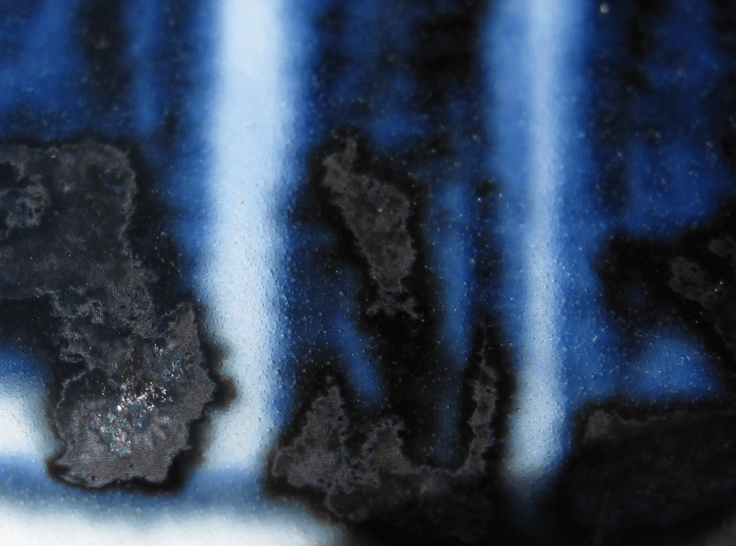 Figure 8
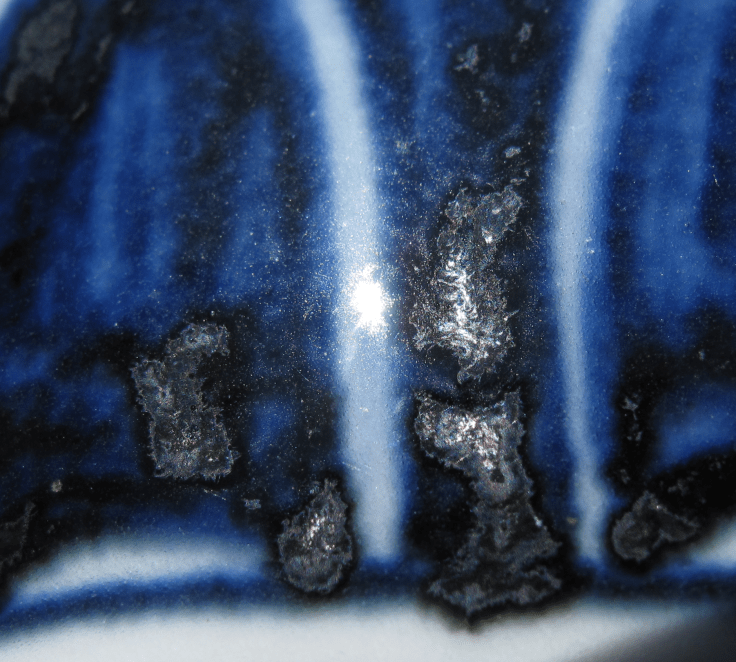 Figure 9
 Figure 10
Note the reflections in these photos. They are much less colorful than some of the other Xuande, Yongle and Yuan B & Ws. Still, they are colorful and beautiful. But for you to get a good grasp of their differences, you must go back to some of my other articles and compare. Only then can you know the variations between these plaques, and by logic, the dye pigments.
I have told you that potters/painters back in those times used to use different blue dye pigments for different purposes. This is an attempt to save money, for the Sumali Blue dye pigments are very expensive. We have no idea exactly how expensive the dye pigments are, and a lot depends on the grade and quality of the dye, but the best dyes must be terribly expensive, and the best wares are only for the court and high officials of the kingdom. Here, in this vase, we know that the pattern of laplets at the bottom is not the main theme, would the painters use a very good dye for that purpose?
To answer this question, we can just look at the blue dye of the main theme—the different kinds of fruits in the body (Figures 11-16).
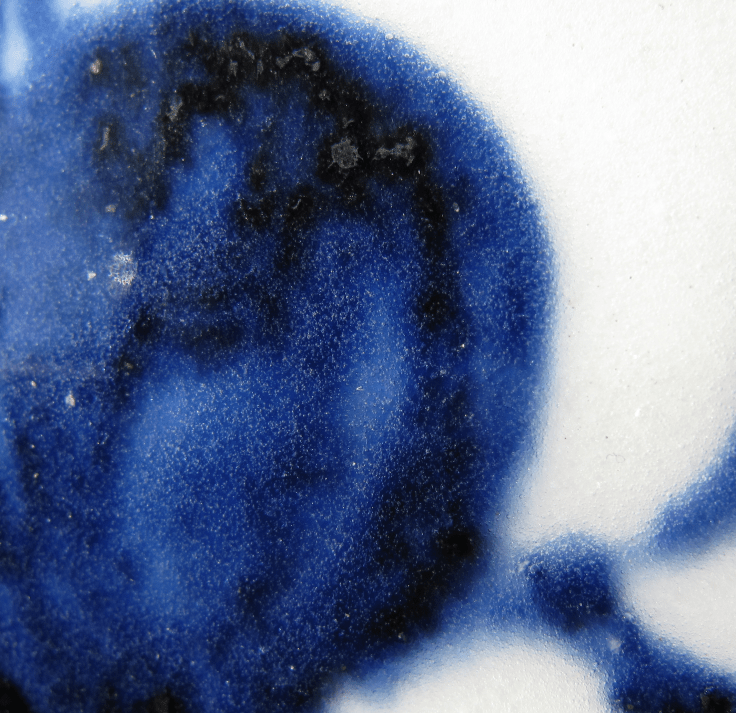 Figure 11
 Figure 12
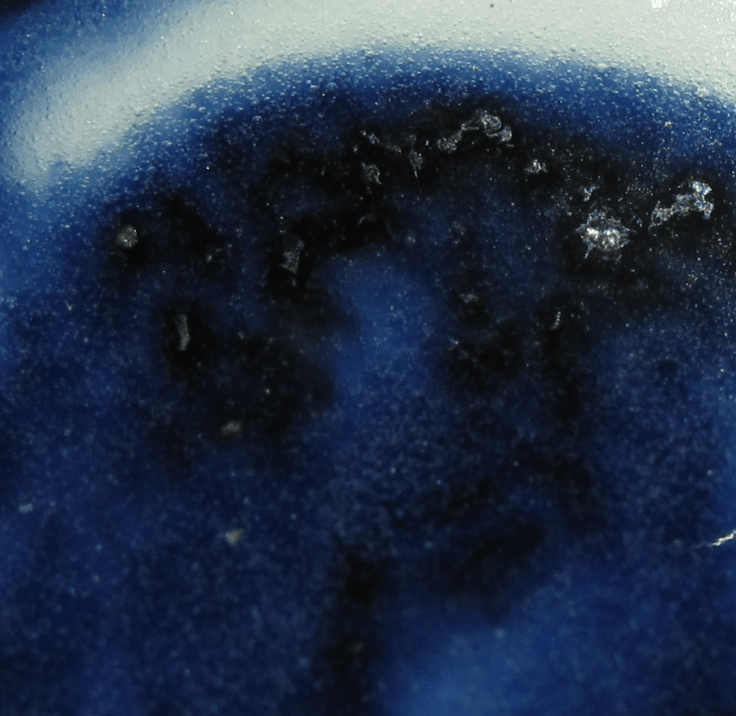 Figure 13
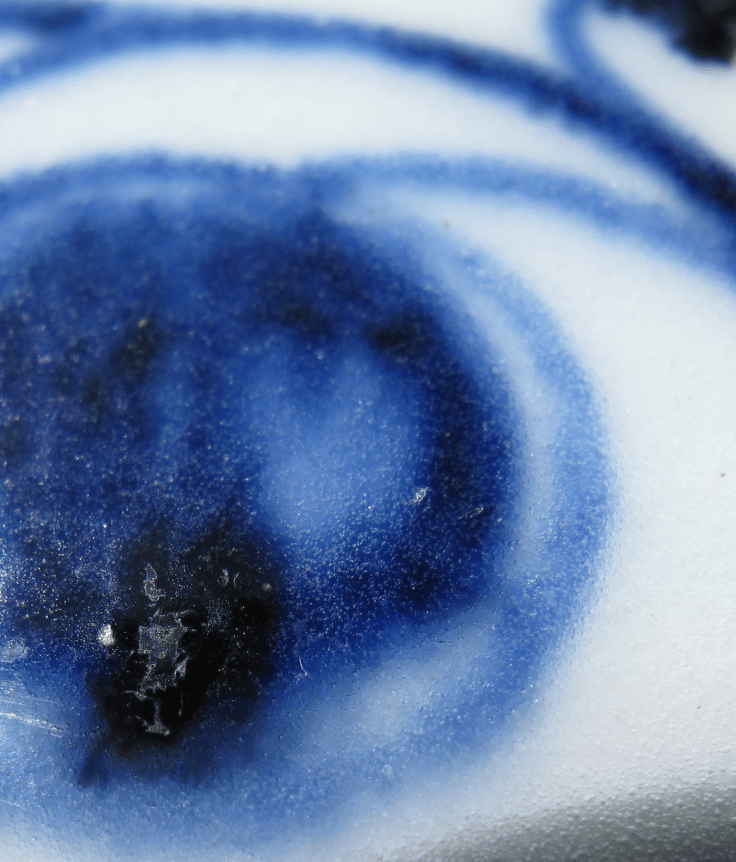 Figure 14
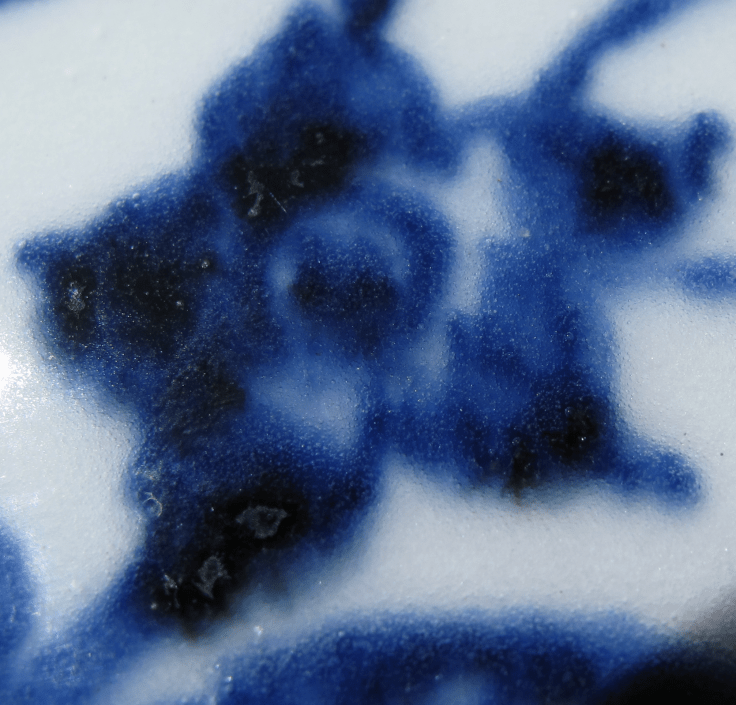 Figure 15
 Figure 16
You will immediately notice the differences between the blue dye here and that of the laplets at the bottom of the vase. The blue color itself is different. Here, you do see the sapphire blue here and there. I have talked to you about sapphire blue quite a few times, and that is indicative of dye of the finest quality. The plaques are not very extensive, as contrast to those in the laplets. But the reflections are much more colorful and have finer features. You will agree that these are nicer looking plaques. Not only that, the bubbles are very different. Here, the large bubbles are not many, but the small bubbles are rather densely packed, and many a time, have lacunae formation that are really impressive. I would say even the flare are different from those at the base of the vase. Are you not convinced that the potters used different blue dye pigments for these two areas?
We must look at these photos carefully, and blow them up if necessary. Note that the large bubbles, while not many are present at a glance, there are many others that are lurking in the dark blue areas. And the small bubbles and lacunae formation are so beautiful that I must show you more photos of these features (Figures 17-21), which are some sort of a hall mark that the dye is of very fine quality.
 Figure 17
 Figure 18
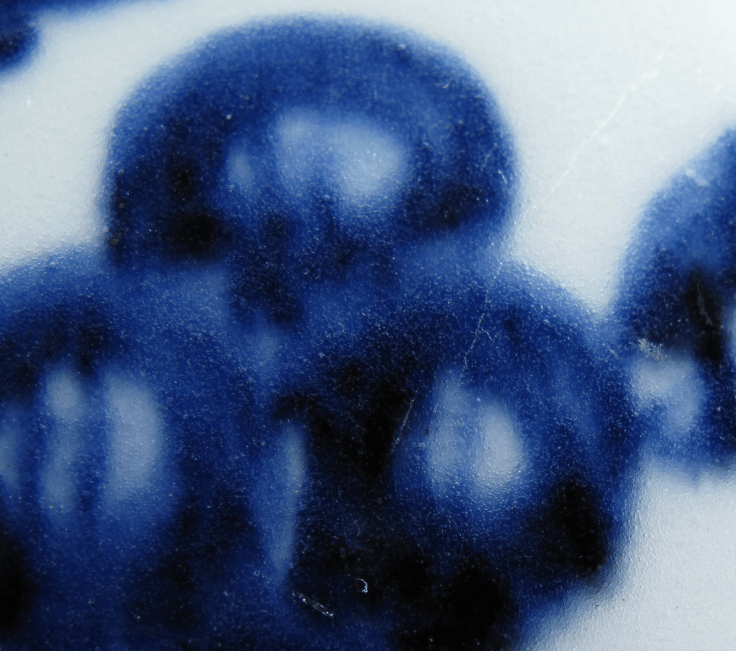 Figure 19
 Figure 20
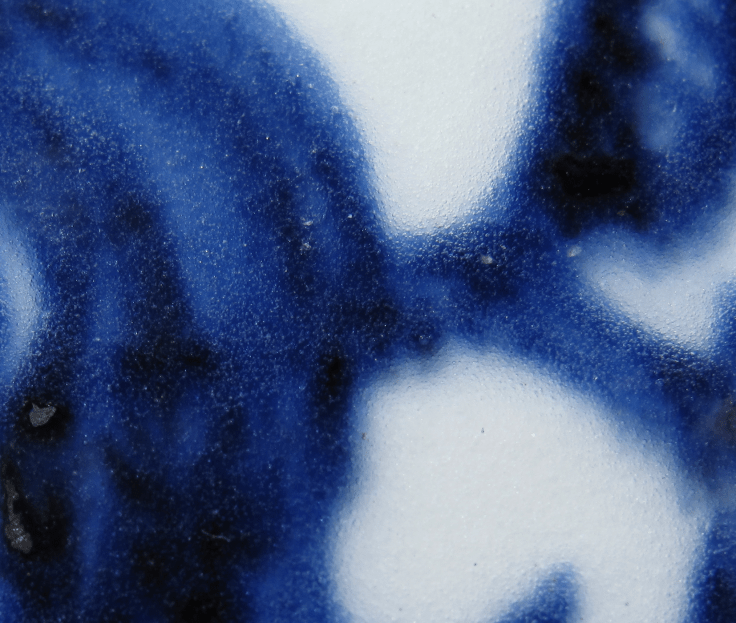 Figure 21
While looking at these large and small bubbles and lacunae formation, you must have noticed that even the flare and dripping have certain differences with those at the base laplets. Here, they are subtle, and faded into the whiteness beyond almost seamlessly. It is a pleasing sight to look at. Let me just show you a few more photos of these flares and drippings.
 Figure 22
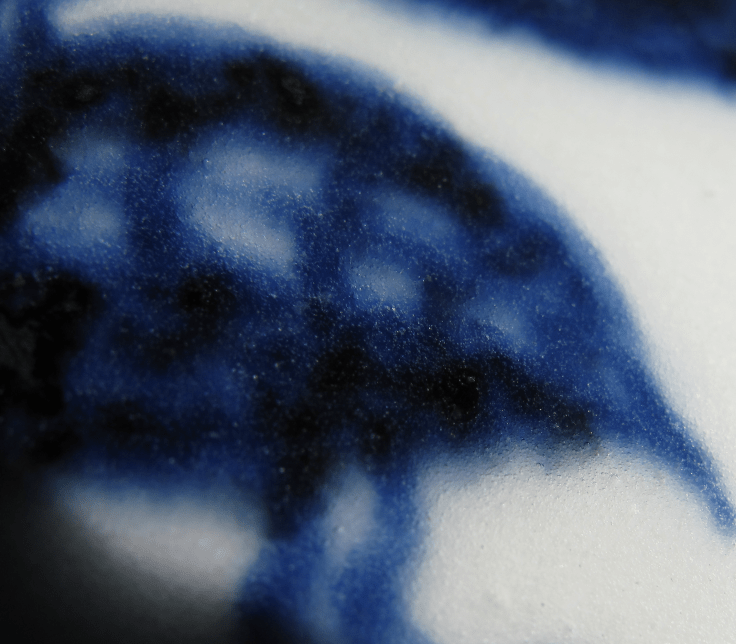 Figure 23
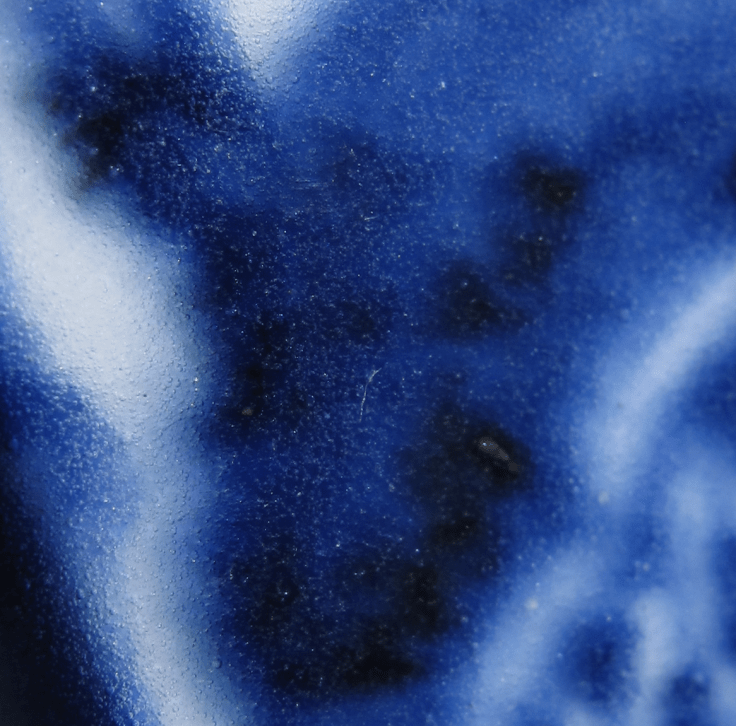 Figure 24
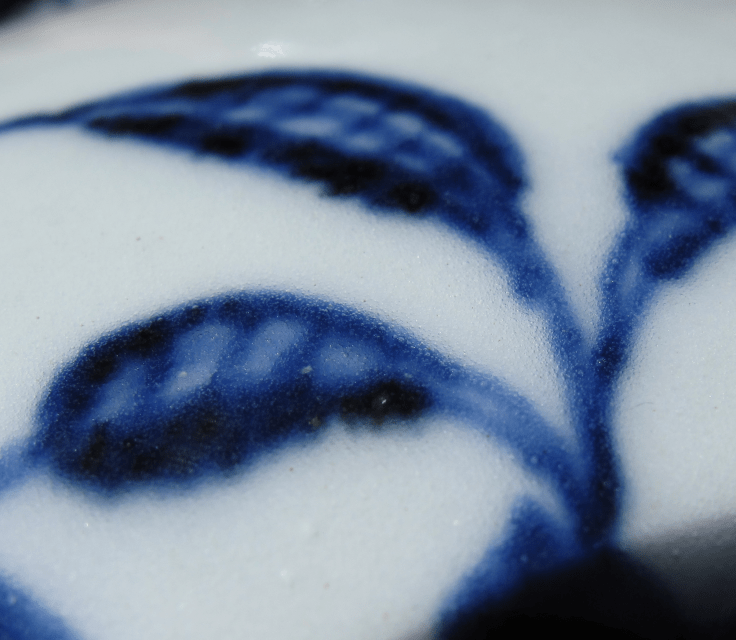 Figure 25
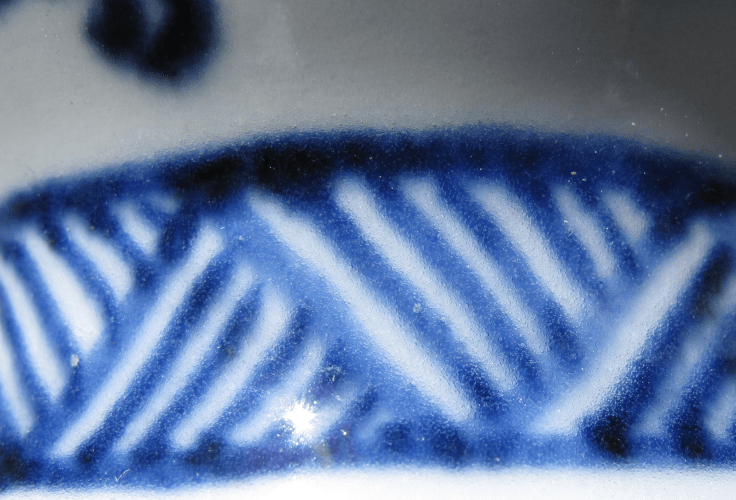 Figure 26
Are these flares and drippings charming? But I think, in going through these photos, you should, in each photo, pay attention to the plaques, large and small bubbles and the lacunae. You would begin to appreciate the beauty of the Sumali Blue dye.
 yongleandxuande.com
Leave a comment