
I have shown you the plaques of the Sumali Blue dye in my previous articles. They vary a lot, and I can tell you that the variation is almost limitless. But with these variations, they do have some pattern to follow. With the Yuan Blue and Whites, they often have large shiny aluminum-like plaques, and the underlying muddy layer is often concealed. With Yongle and Xuande, the metallic-like layer is often not large enough to cover up the underlying muddy layer. And in some of the wares, the large muddy layer is the only remains of a plaque—a muddy layer without any metallic sheet on top. The muddy layer also varies. In some, it is clearly seen. Whereas in other cases, the muddy layer is but some blackish patch among the dark blue color, so that it is very inconspicuous. In what I suppose to be the late Xuande period B & W, these muddy layer can be very small, like a tiny dot. But you can detect it when you see it glitter at a certain angle under the sun.Without direct sunlight, these spots become a dimple. They are not difficult to detect. I’ll now show you a ware with these features. It is a blue and white stem bowl (Figure 1). It stands at 9 inches tall.
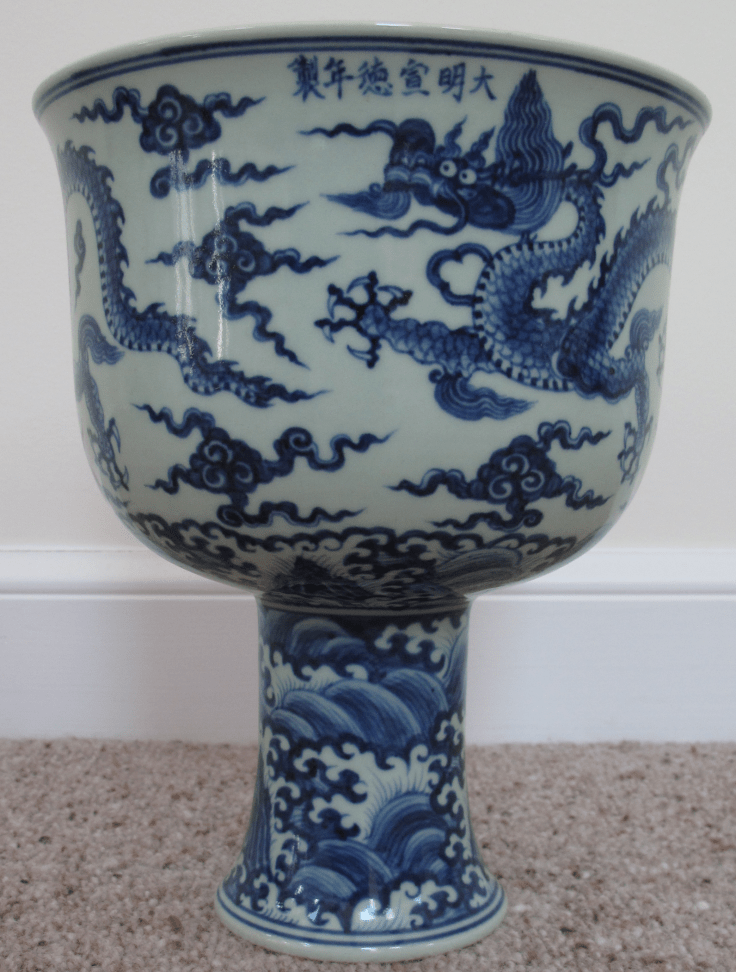 Figure 1
Let me first show you a few photos with these rather small plaques (Figures 2-8). Figure 8 is from the bottom of the inside of the bowl.
 Figure 2
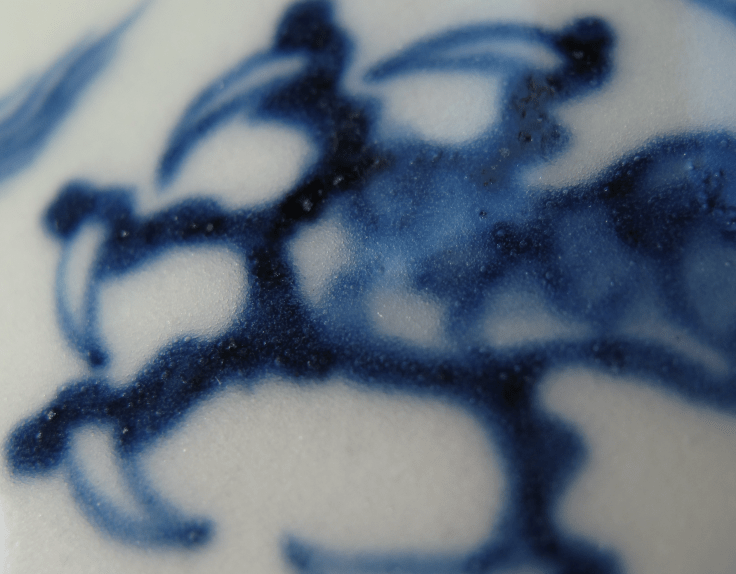 Figure 3
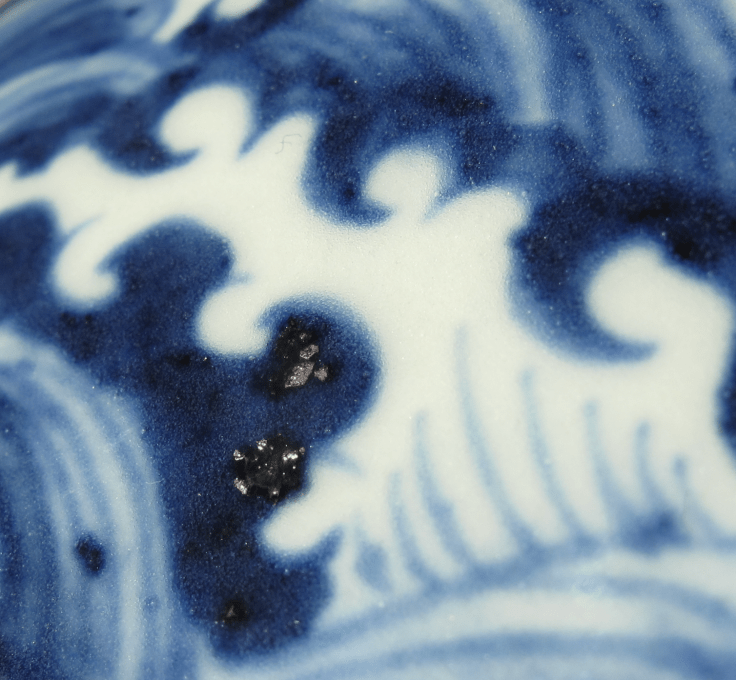 Figure 4
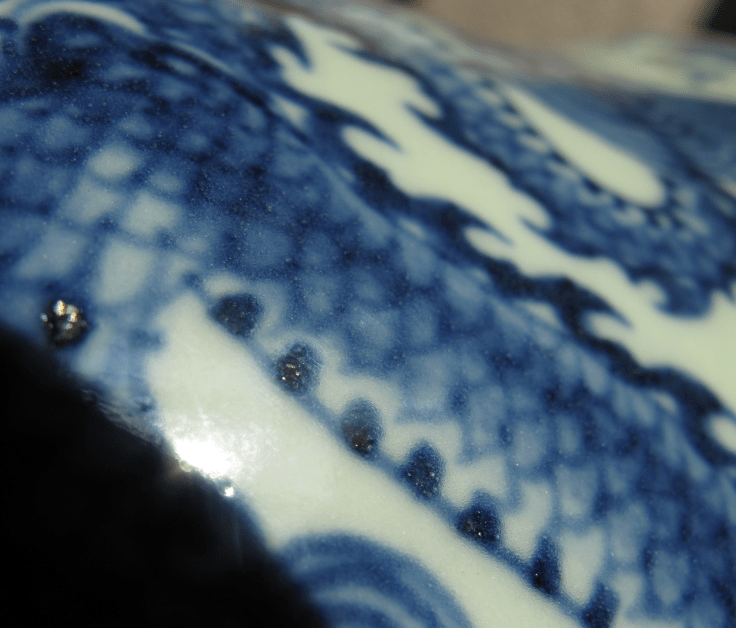 Figure 5
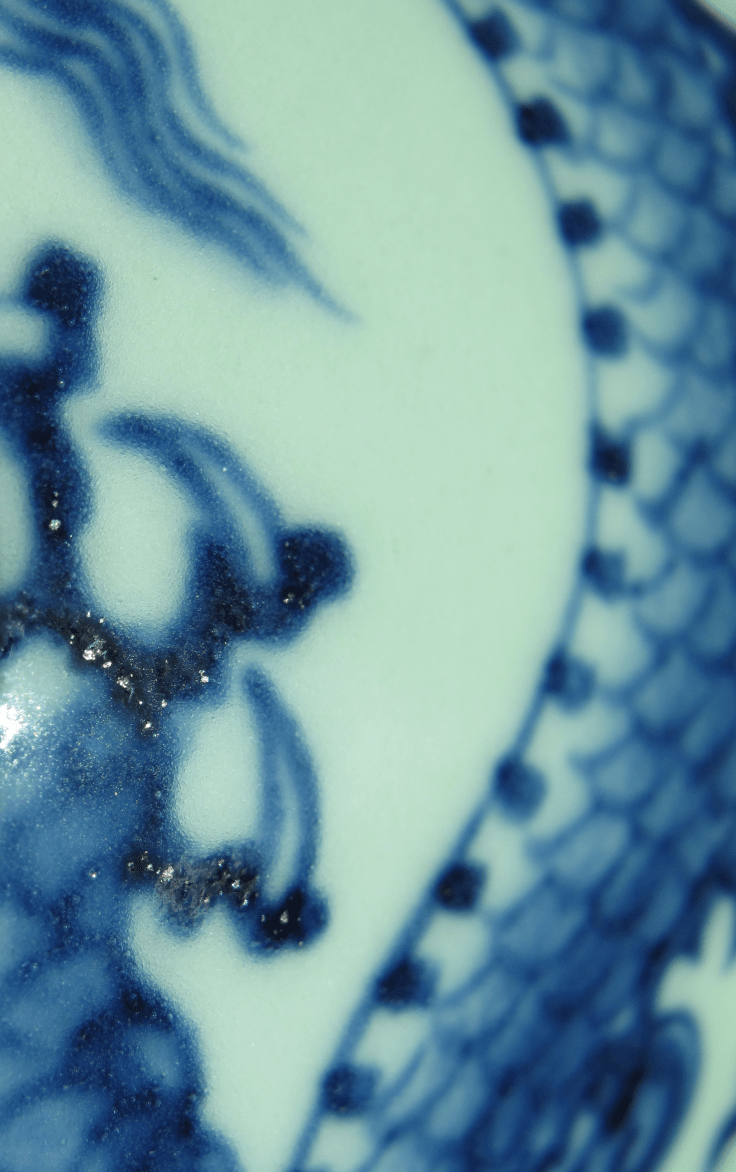 Figure 6
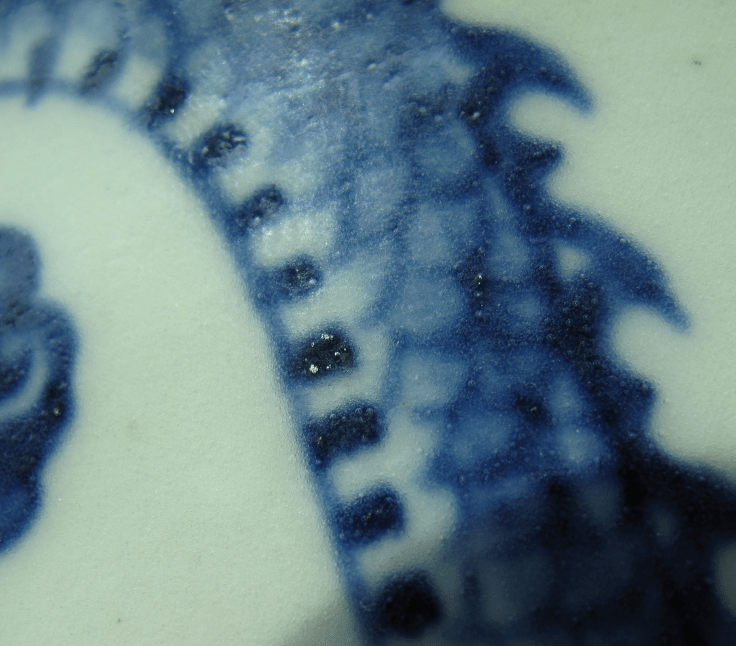 Figure 7
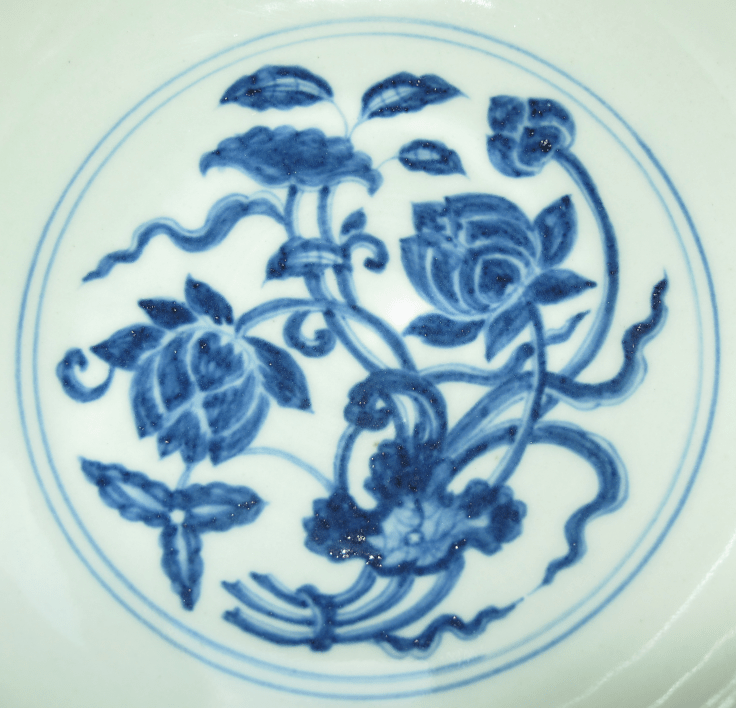 Figure 8
Look at these plaques, which are in fact the muddy layer without the shiny metallic sheet on top, are they not quite different from those that I have shown you in my previous articles? In this stem bowl, most of the plaques are similar to these, very small. But there are a few instances where the plaques are slightly larger, as shown in the photos below (Figures 9-11).
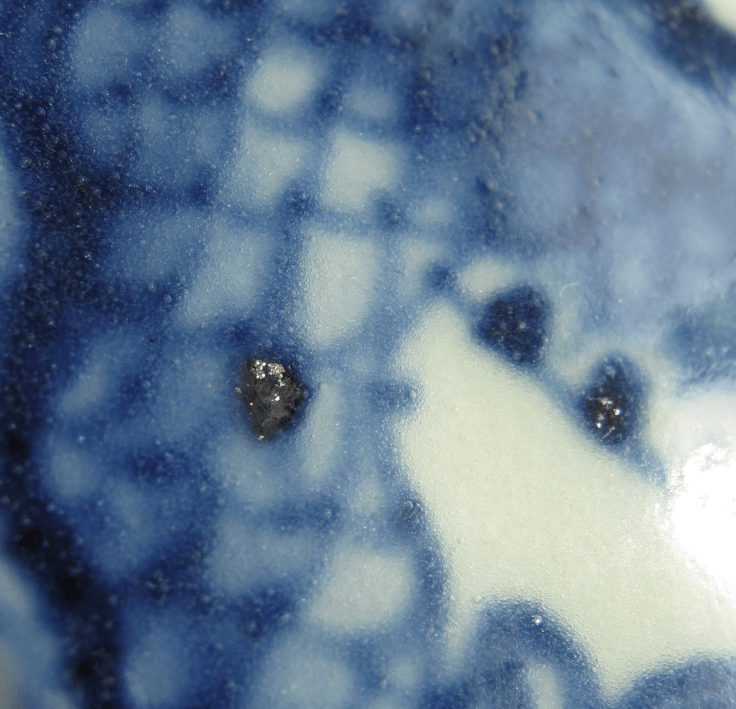 Figure 9
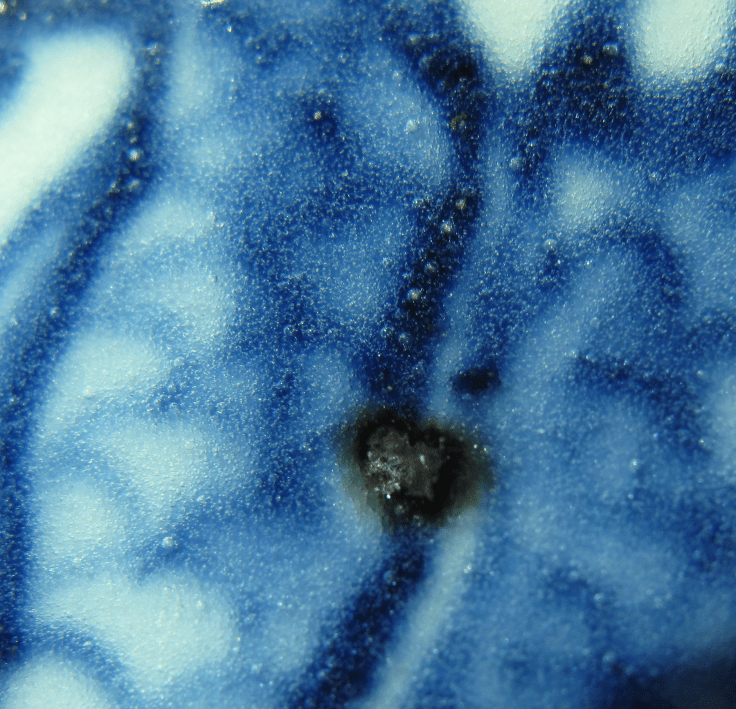 Figure 10
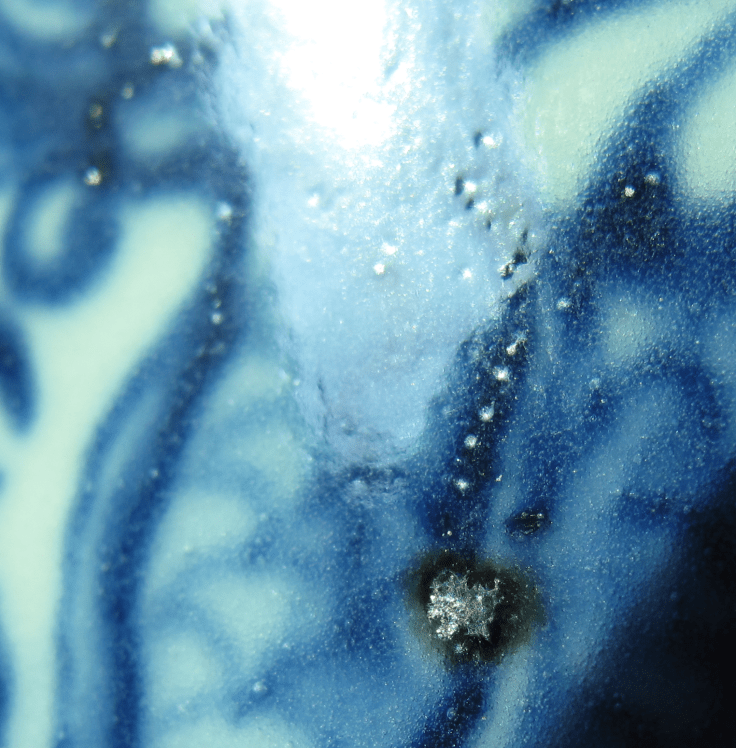 Figure 11
As you can see, the plaques here are bigger, but still they are small. Figure 10 and Figure 11 are taken from the same spot. But you can see the flair emitting some green coloration. I have told you quite a number of times before that when the blue dye pigment emits some green coloration around a plaque, most of the time, it indicates that the dye is of very good quality. In Figure 11, in the out of focus part, you can actually see some dimples—dimples that I refer to in the opening paragraph. You can also see the same kind of dimples in Figure 9.
Here in another photo to show you the dimples.
 Figure 12
Look at Figure 12 again. You can see the large and small bubbles very well. The large bubbles are rather abundant, but not too abundant. I have come to the conclusion after looking at many blue and whites of these three periods, that too many large bubbles may not be very desirable. Here in this stem bowl, I think the number of large bubbles is close to what I call the upper limit of desirable large bubbles in a ware. You don’t really want too many of these. But the large bubbles here are very beautiful.
The small bubbles are not very tightly packed, but still, they are quite dense, allowing very nice lacunae formation. Figure 10 is a good example, but I’ll show you more (Figures 13-23).
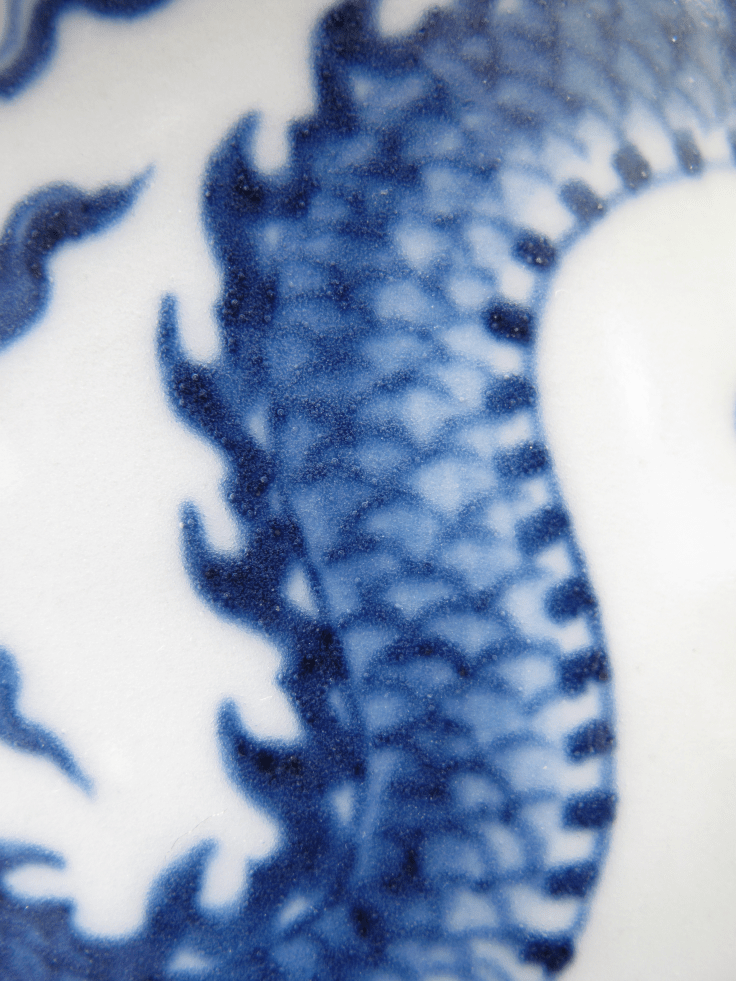 Figure 13
 Figure 14
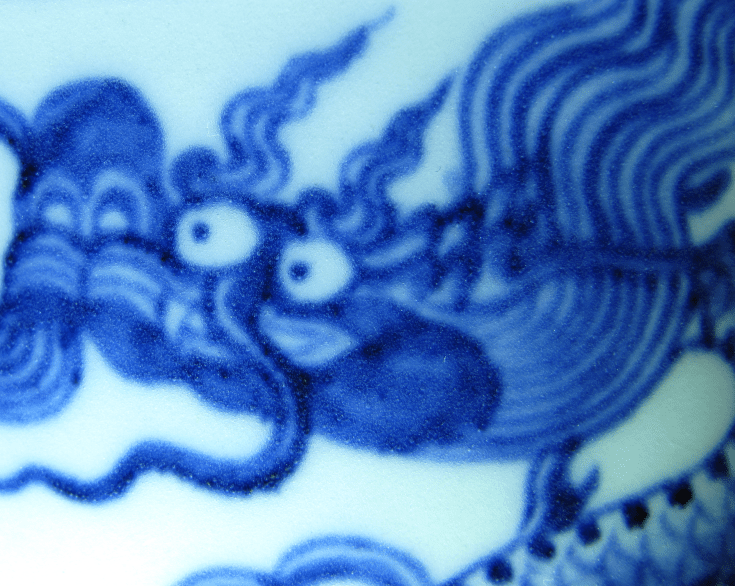 Figure 15
 Figure 16
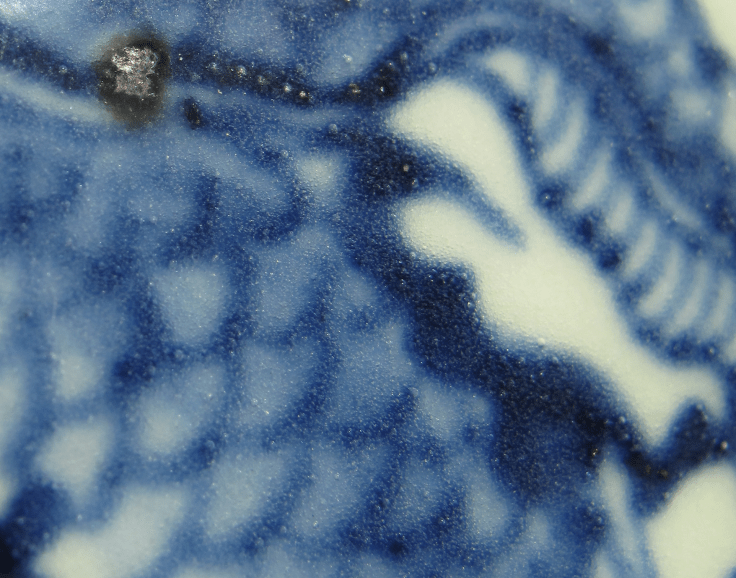 Figure 17
 Figure 18
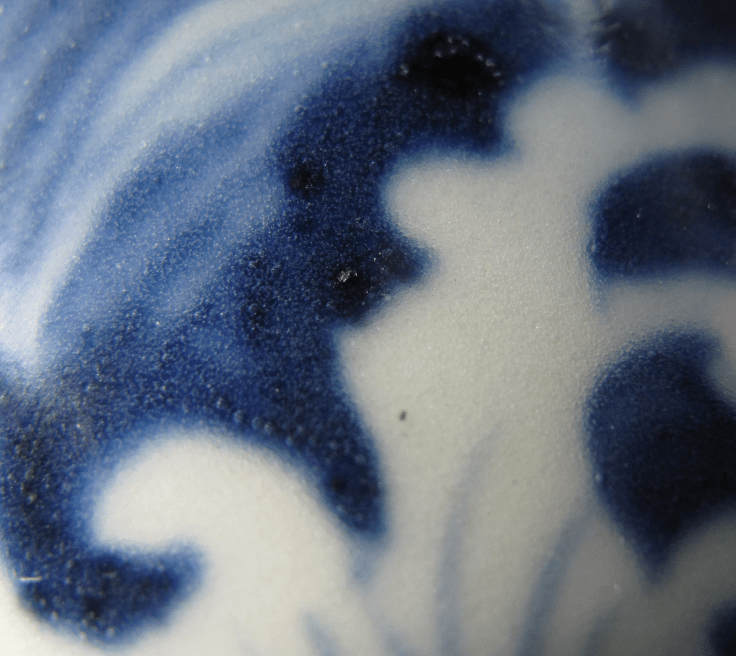 Figure 19
 Figure 20
 Figure 21
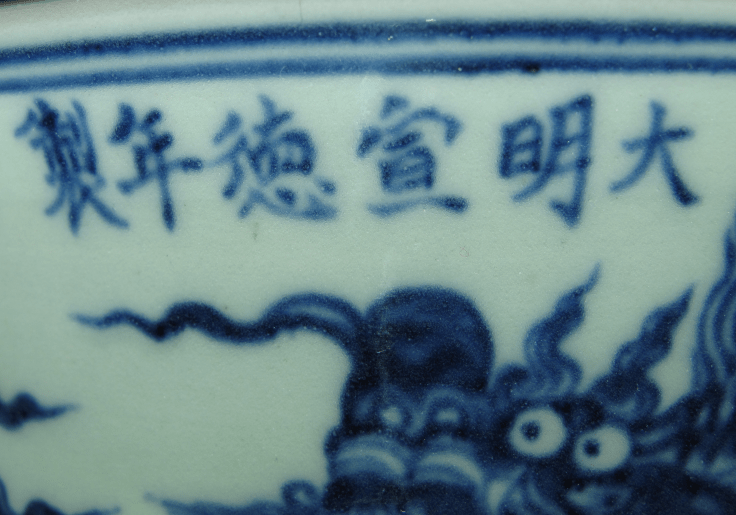 Figure 22
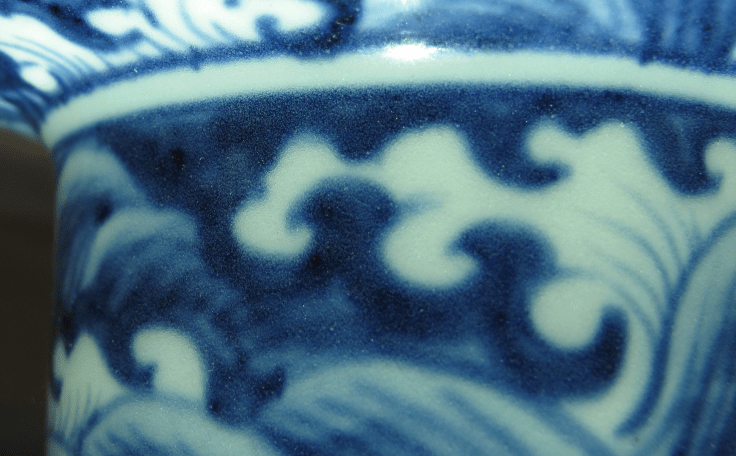 Figure 23
You will note that in these photos, the large bubbles appear in exactly the way I have been describing to you. They all lie within some dark blue coloration. The small bubbles form very nice lacunae. And you must look at the dripping and flair. You must remember that this is a stembowl, so the drawings are all on a vertical plane. I am sure you will not miss the drippings. But they are not very enhanced, as in some other wares. It only shows that the quality of the dye varies from batch to batch of the import, and in many instances, from ware to ware.
 yongleandxuande.com
Leave a comment