
Collectors often ask themselves: What is a beautiful ceramic ware? What is a beautiful Blue and White? How do you tell? There is no answer to this. It is often said: Beauty is in the eye of the beholder. So, what is beautiful to you may not be beautiful to another collector. However, I do believe that there are certain criteria that we should consider when we look at a ware from an aesthetic point of view. If we are to look at a Xuande Blue and White, what kind of criteria should we take? I think the ware should be well potted, the motif should be appealing, and it should not be too commonly seen. When you have a ware that you see everywhere, how can you treasure it? That is why collectors put so much emphasis on the uniqueness of a ware.
Aside from this what I call very broad-stroke description of a beautiful B & W, I think a sophisticate collector would look at finer details of a ware. Is the glaze good? A good glaze is very important, and it takes some experience to appreciate it. The ideal glaze to me is one that will emit some very mellow glow. Some people would stress that the ware should not be shiny. But I would say that a nice ware should be shiny, except that the shine should not give an impression that the ware is new. It is like a fine gem. So, it is shiny, but not anything that makes the ware look new. This is subtle and I don’t believe anyone can give you a more detailed explanation. Experience here rules.
But there are some other fine details that do not need a lot of experience to appreciate, namely, the color, the plaques, the drippings and flare, and the bubbles. It is these features, on closer look with a magnifying glass, can distinguish a fine B & W from an ordinary one. Now, let me show you a B & W pilgrim flask, Xuande marked and you can see for yourself if the flask is beautiful.
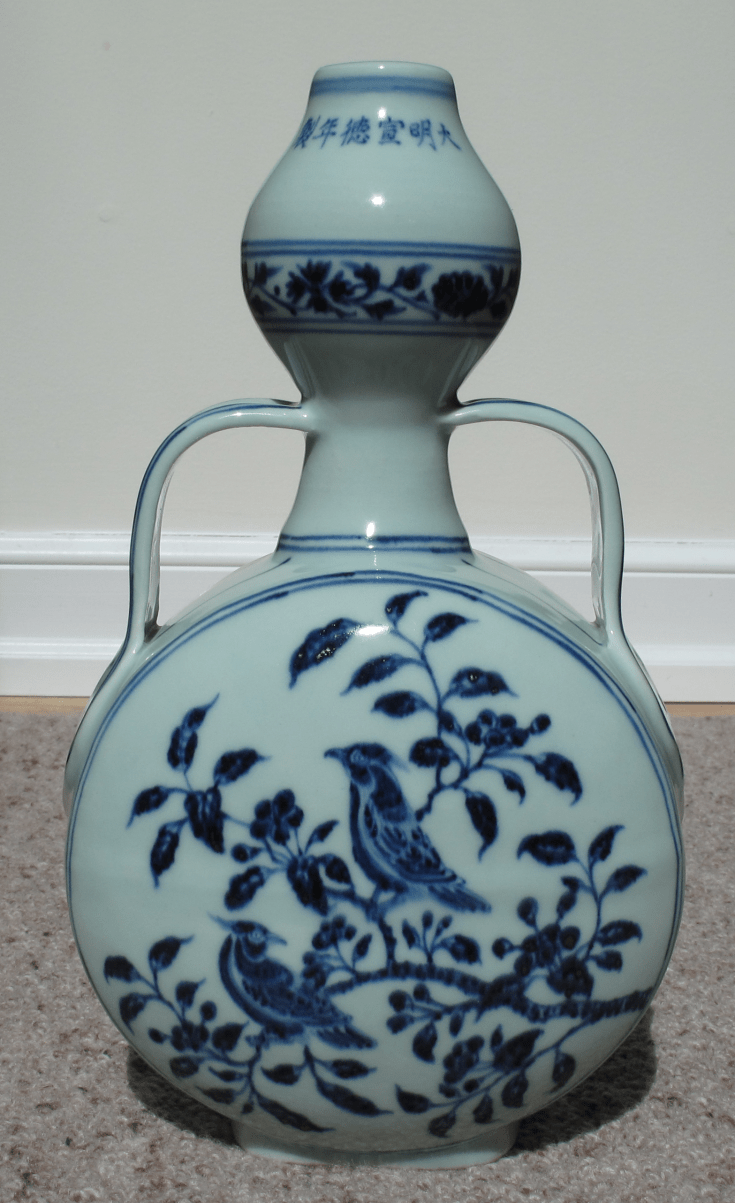 Figure 1
The pilgrim flask, or moon flask, measures 11 inches tall. As you can see, the motif is rather rare in a flask, though in plates and chargers, you can see similar themes more often. The potting, the painting of the motif are all up to standard. Even at a distance, you can see some plaques reflecting sunlight, and some drippings.
With a closer look (Figure 2), more of the reflecting plaques are seen, and quite a number of plaques that are but blackish patches are also apparent. Note also the dripping—they are just right, not too much exaggerated.
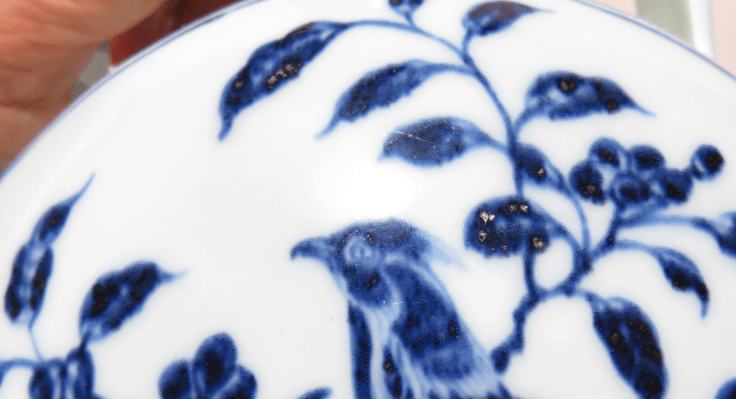 Figure 2
I’ll show you some even closer shots (Figures 3-6).
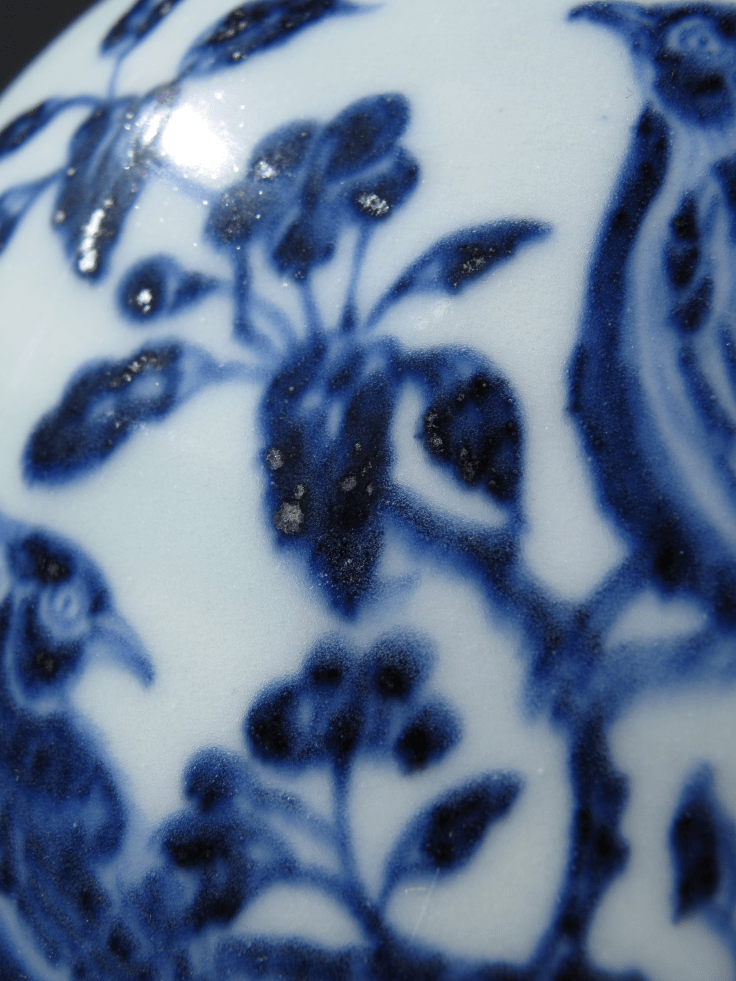 Figure 3
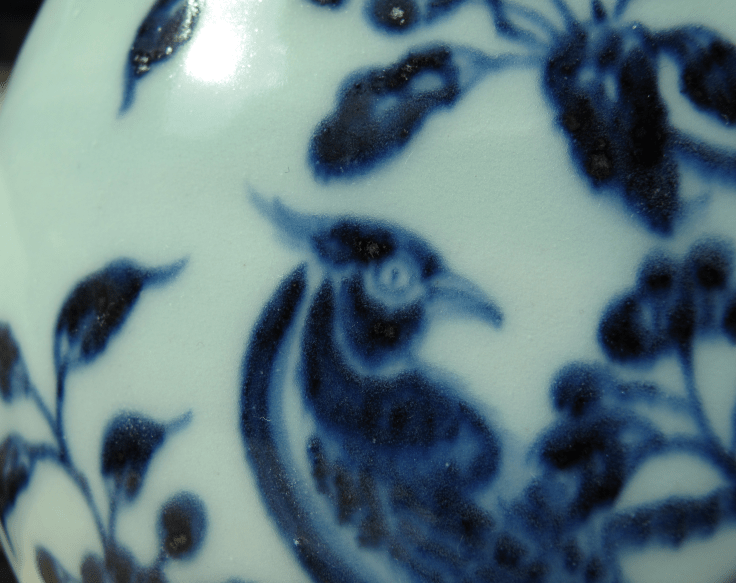 Figure 4
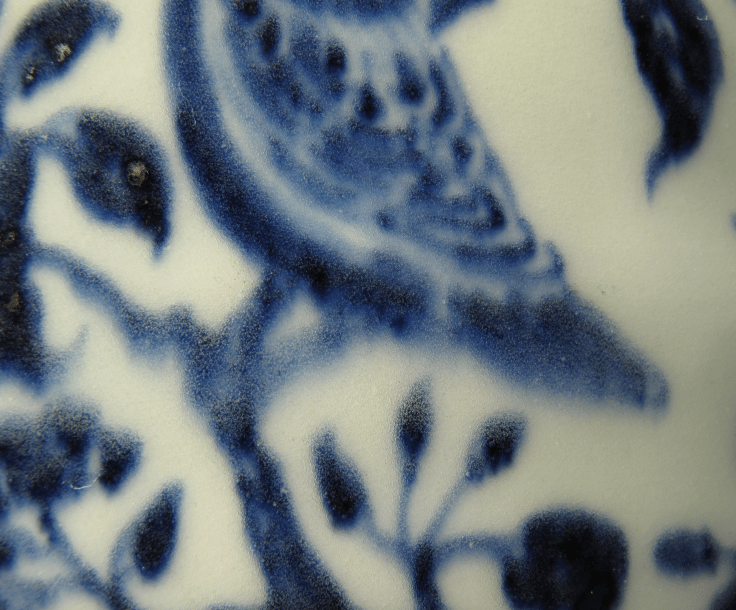 Figure 5
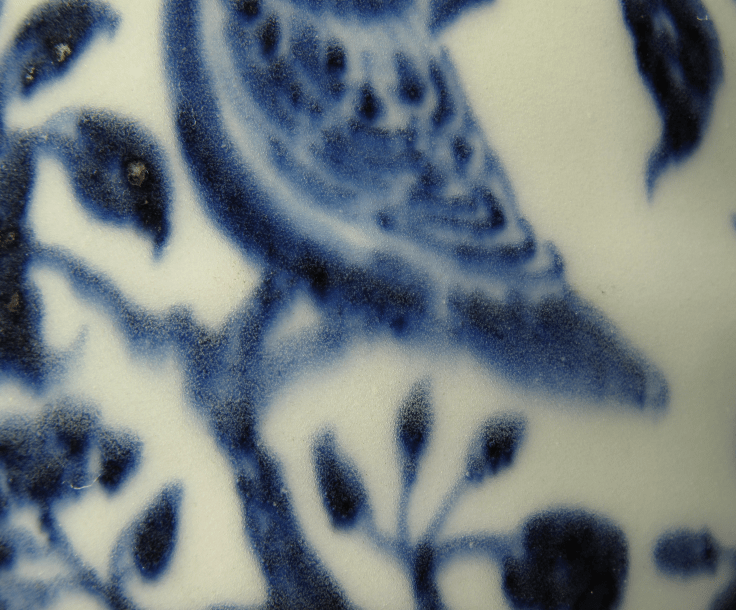 Figure 6
Look at the plaques in these photos. When the sunlight hits the plaques at the right angle, there will be reflections from these plaques. You can see that the reflections from these plaques vary in brightness—from highly reflective to just a dull reflection. But most of the plaques do not even show up, they are just a dark shade inside some deep blue coloration. Note also the dripping effect in these photos. In each of these four photos, you can see some form of dripping. Pay attention to their presentations, and I can tell you that what you see here is very typical. You do not see any excessive dripping, which, you can understand, mars the beauty of a ware, and might lead to doubt as to the authenticity of it.
Experienced collectors will know that, the plaques will have a different appearance under the sun (Figures 7-12).
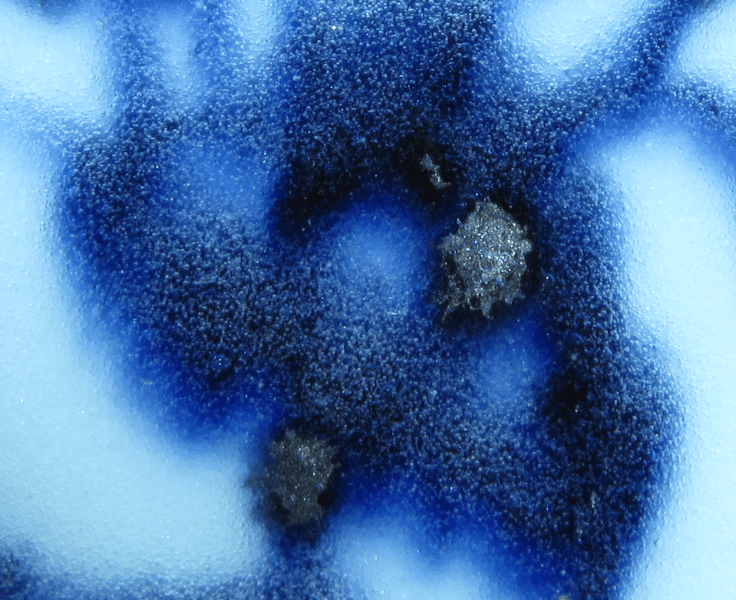 Figure 7
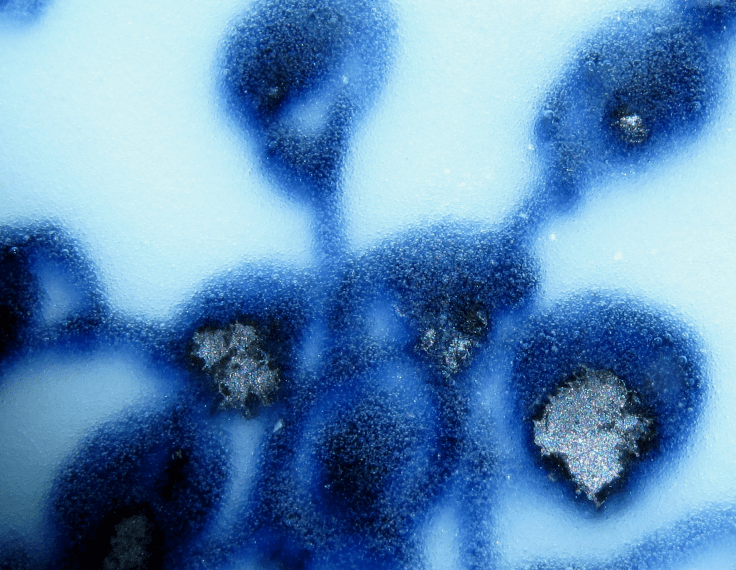 Figure 8
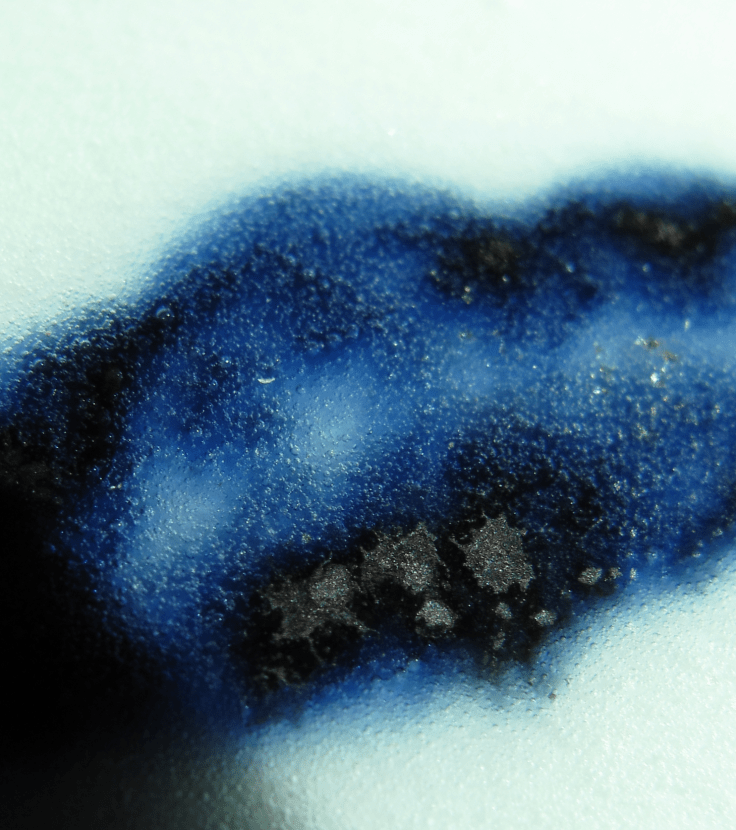 Figure 9
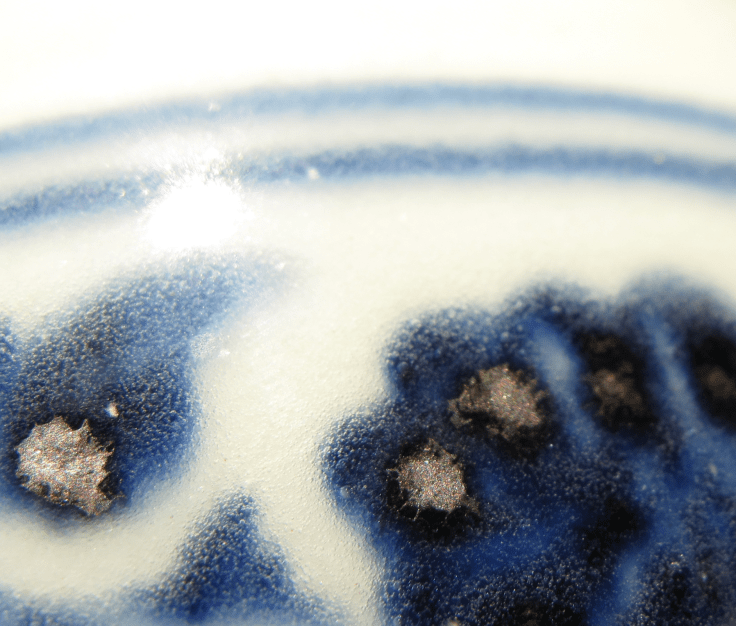 Figure 10
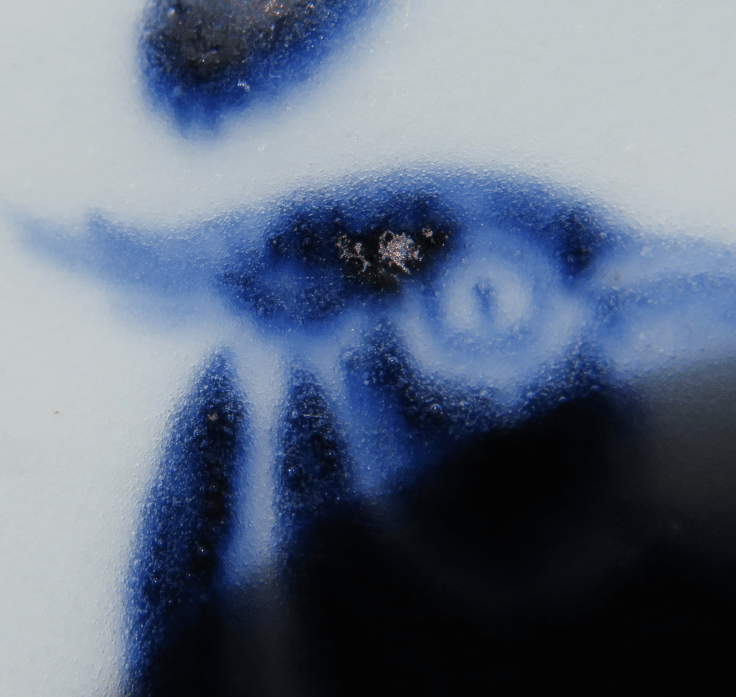 Figure 11
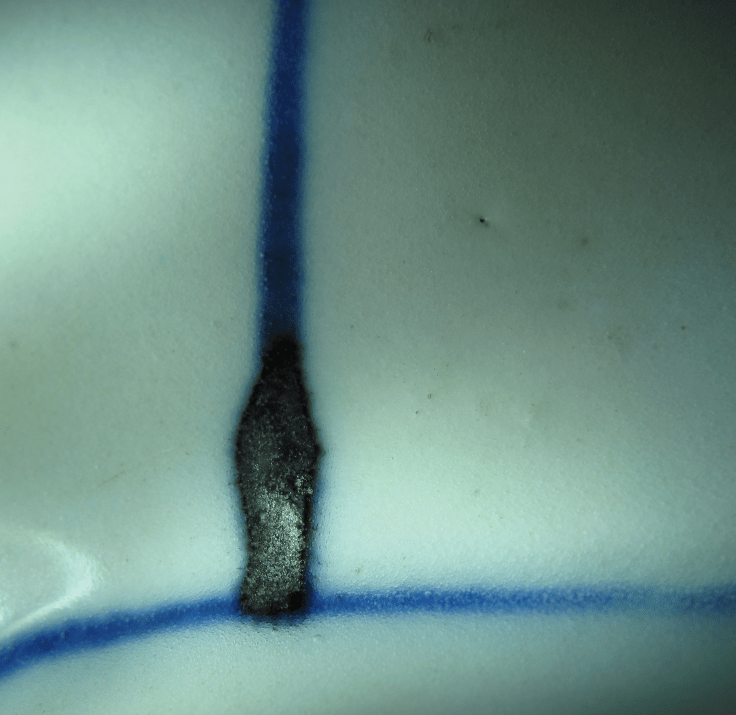 Figure 12
I am sure you can appreciate the beauty of the plaques here, the shape, the multi-color reflections. It is also amazing that under sunlight, when plaques are just millimeters away from each other, some show colorful reflections while the others have no reflection at all. Note also the classic feature of a plaque here. Each plaque is sitting in a pool of blackish coloration, which in turn is surrounded by some deep blue color with some lighter blue just beyond. In these same photos, you can see the drippings better. In Figure 9 you can actually see a small speck that breaks away from the main dripping. The blackish dripping is in fact part of the plaque, and the breakaway represents something in the blackish material that is heavier than the rest, and drips down at a faster rate. I have told you before that such a feature occurs in dyes that are of very good quality.
In these photos, you can also see the bubbles, which, together with the plaques, are the main themes of the Sumali Blue dye. Look at figure 9 again. Look at the beautiful large bubble at the top margin and a few at the lower margin on the right side. The small bubbles are in lacunae formation. But I’ll show you one very unique feature in this vase—the strings of large bubbles that can be found in quite a number of places (Figures 13-20).
 Figure 13
 Figure 14
 Figure 15
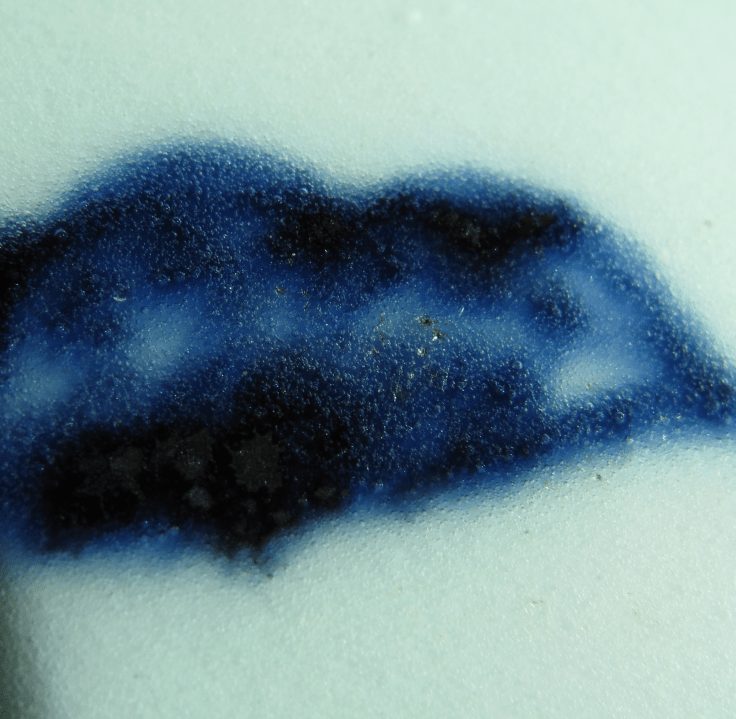 Figure 16
 Figure 17
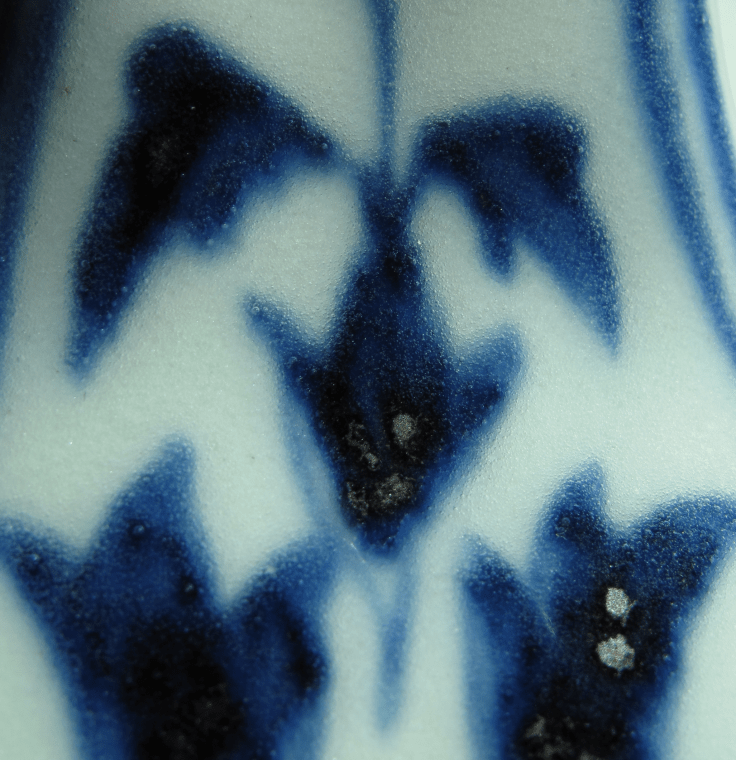 Figure 18
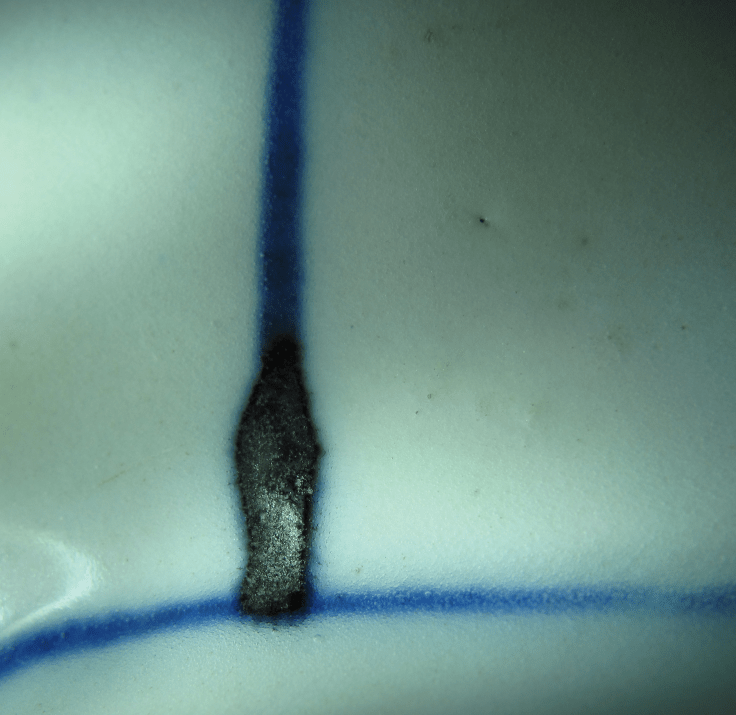 Figure 19
 Figure 20
String of large bubbles is rather uncommon and it mostly occurs in dyes of very high quality. It is more common in Yongle B & W. In any single ware, if it does have this phenomenon, it is seldom for you to find more than 2 or 3 strings. Here, in Figure 13, it is a classic with so many bubbles in one string. In the other photos, the strings are very obvious. It only shows the dye used here is of extremely high quality.
To say that the dye is of high quality, we can also look at the blue coloration and the lacunae (Figures 21-25).
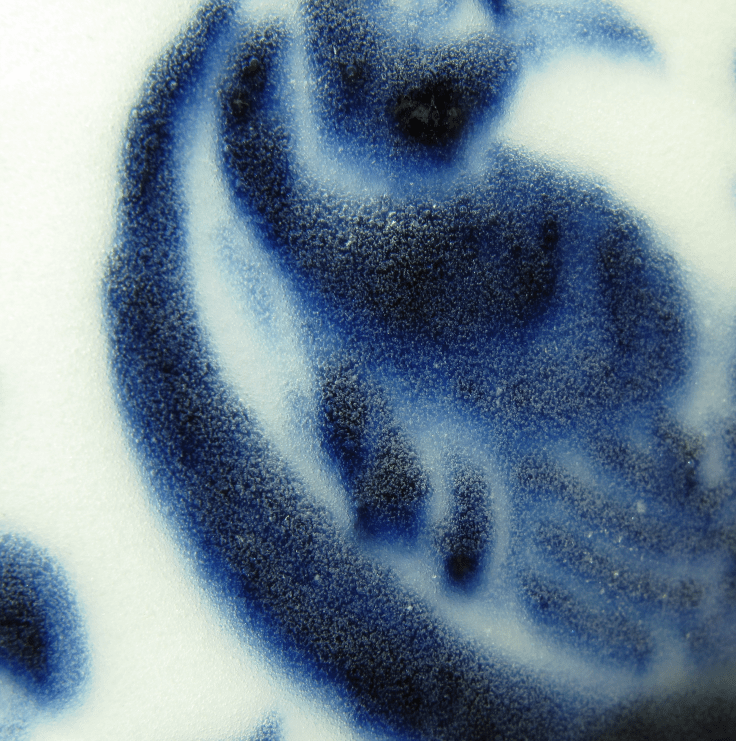 Figure 21
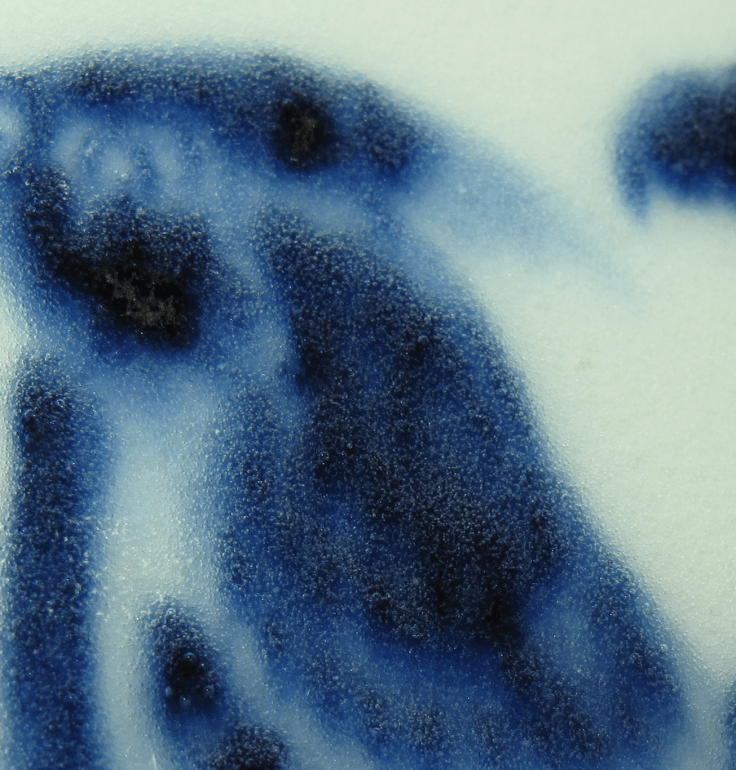 Figure 22
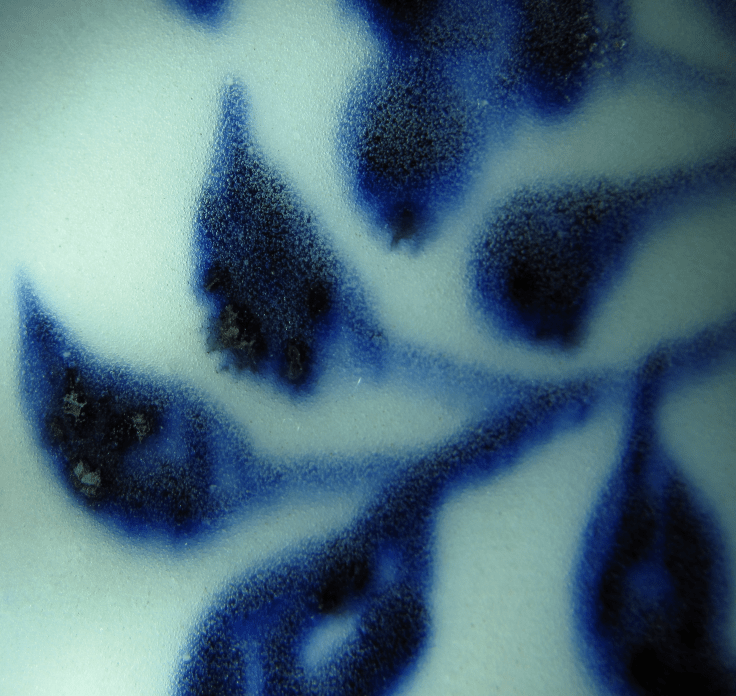 Figure 23
 Figure 24
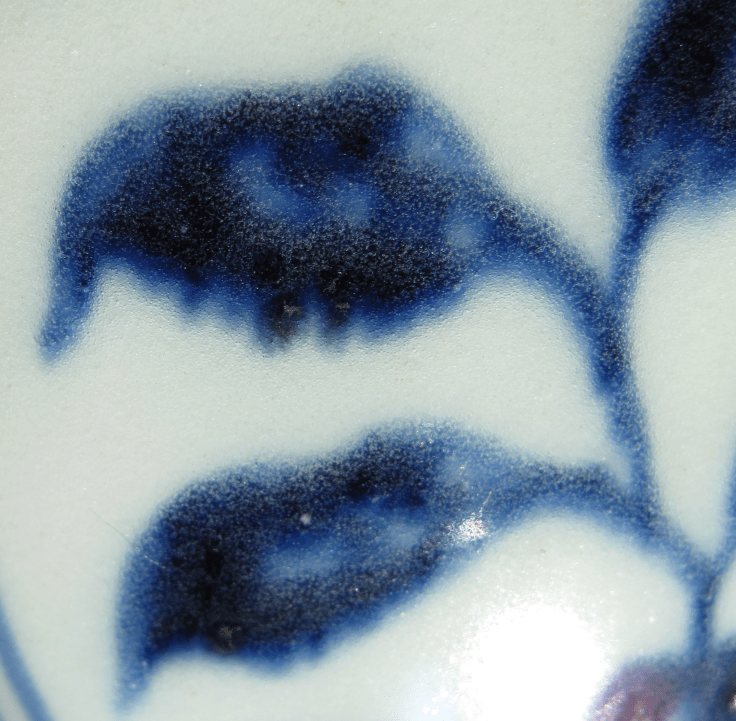 Figure 25
Look at the beautiful lacunae in these photos. They are so crowded together, yet, there is not a feeling that the bubbles and lacunae are in disarray or disorganized. At where the lacunae are most crowded, the background is an almost blackish deep blue color. Further out towards the margin, the very deep blue color becomes a sapphire blue before it fades into a very light blue. The sapphire blue, to me, is just remarkable. Look at Figure 21 again, the changing of the blue coloration–from blackish blue to a light blue, in so many places is as good as it can get in any B & W.
These features, at times subtle, are what sophisticated collectors are looking for in a beautiful B & W. They distinguish themselves with these finer details from the ordinary. I hope you can look at all these photos carefully and remember every characteristic well.
 yongleandxuande.com
Leave a comment