
In my last article, A Blue & White flower bowl, Xuande mark, I talked about plaques, and primitive plaques in particular. And I have said, plaques are important features in the Sumali Blue dye. They are not only important, but they form a fascinating subject to study. Understanding the nature of these plaques would allow a collector to determine if a Blue and White belonged to the Yuan and early Ming period, and with ease. Here, I am going to show you a Xuande vase with the intention to introduce you more on the subject of the muddy layer of a plaque.
Muddy layer is the bottom layer of a full blown plaque. The top layer is the small aluminum foil like sheet floating on top of the glaze layer. This is the simplest description of a matured plaque. Beyond this, there are many many variations of a plaque. For example, with a Yuan B & W that has many plaques, we can see the shining aluminum foil easily, at every angle in daylight. For wares with not so extensive plaques, say those in the Yongle era, you do not see the plaques in daylight, but tilting it at a certain angle, you’ll see dimple at where the plaque is. So that in such wares, at a correct angle, there are dimples everywhere. In Xuande B & Ws, most of the time the shining foil is not there, and only the muddy layer is present, what do you see? You’ll see patches of darkish blue, almost black, within slightly larger rather deep blue patches surrounding them. When the metallic content is high, on tilting the ware, you can see a very slight reflection from those muddy patches. When the metallic content is low, there will be no more reflections except some vague shadows within those deep blue patches. These are some very general description of the plaques.
Now, let me show you the garlic mouth vase that measures 13 1/8 inches tall (Figure 1). I’ll show you the plaques with only the muddy layer, there being no shining aluminum foil on top.
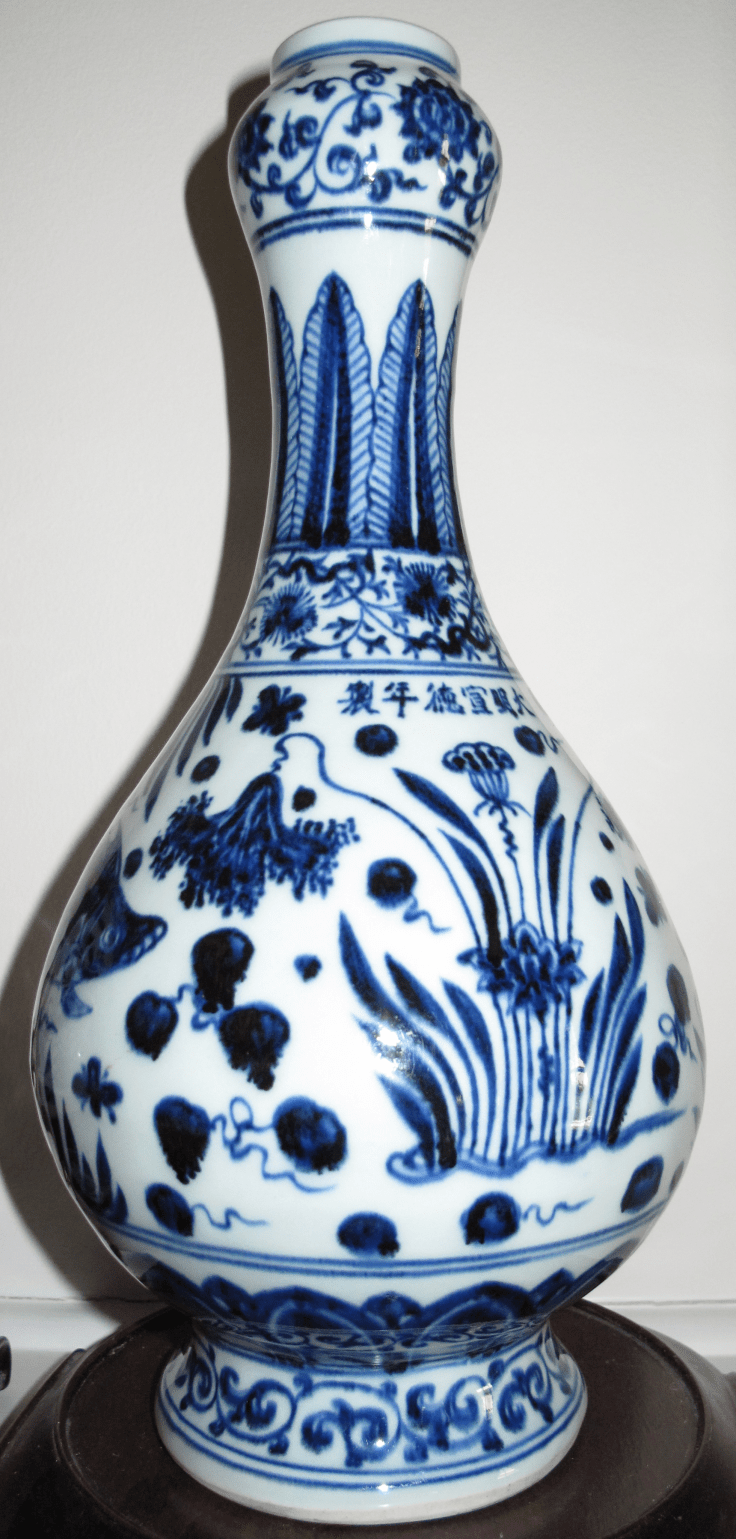 Figure 1
As I have said, when there is a plaque without the aluminum foil on top, it means only one thing, the part of the dye pigment that produces the plaque has not enough aluminum content. If the content is very rich, the aluminum foil will be large, as in many of the Yuan Blue and Whites. As the metal content of the dye pigment decreases, the metallic foil gets smaller. That is what happens in the Yongle B & Ws. In the Xuande era, many of the plaques are without the metallic foil on top. All that you can see is the muddy layer. This does not mean that there is no aluminum in the muddy layer. No, inside the mud, there is still quite a lot of the metal. But most of the aluminum particles are adherent to the muddy material, and cannot rise up to the surface. So, when the sunlight is striking the muddy layer in the correct angle, the shiny reflection is still very obvious. But when the angle is not right, even under the sun, you can only see the mud, but not the metal.
What is more, when the ceramic ware is still inside the kiln under high temperature, the glaze might be near its boiling point, so that, like water about to boil, the bottom part of the glaze would rise up, forming small, local currents. It is small and localized because the thickness of the glaze layer is rather small, unlike a kettle of water. Furthermore, the viscosity of the glaze does not allow it to boil like water. The whole glaze layer is in effect in dynamic motion, only that everywhere, the current is very slow moving and localized because of the thinness and viscosity of the glaze, and the force rather small. But this dynamic motion forms a small force that would have an effect on the blue dye pigment that includes the mud like material that lies right at the bottom, causing it to drift and shift with the currents. The shifting of the material in the mud, because of the affinity of metal particle to metal particle, allows the mud and the metal to deposit, not in a random manner, but rather in patterns that are constantly changing. I believe this concept of localized small, or should I say, micro-currents within the glaze layer is an important part to understand why bubbles and plaques should behave in a manner as they appear under our magnifying glass.
Now, let me show you how the plaques in this garlic mouth vase look like.
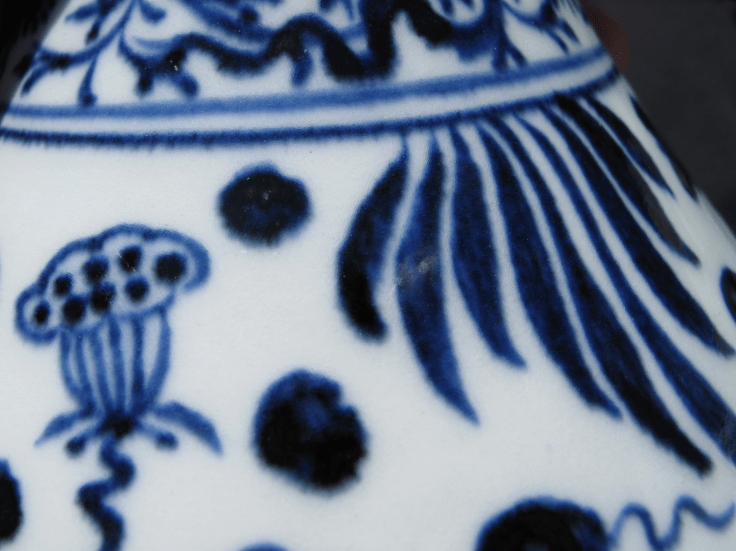 Figure 2
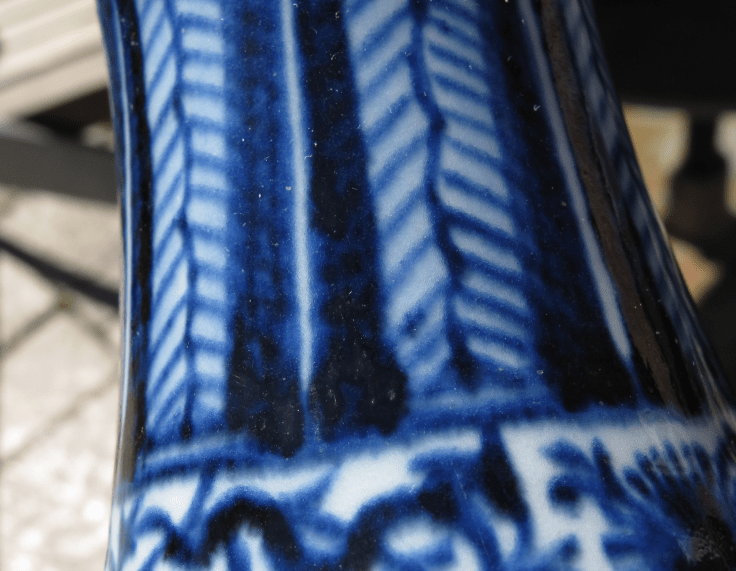 Figure 3
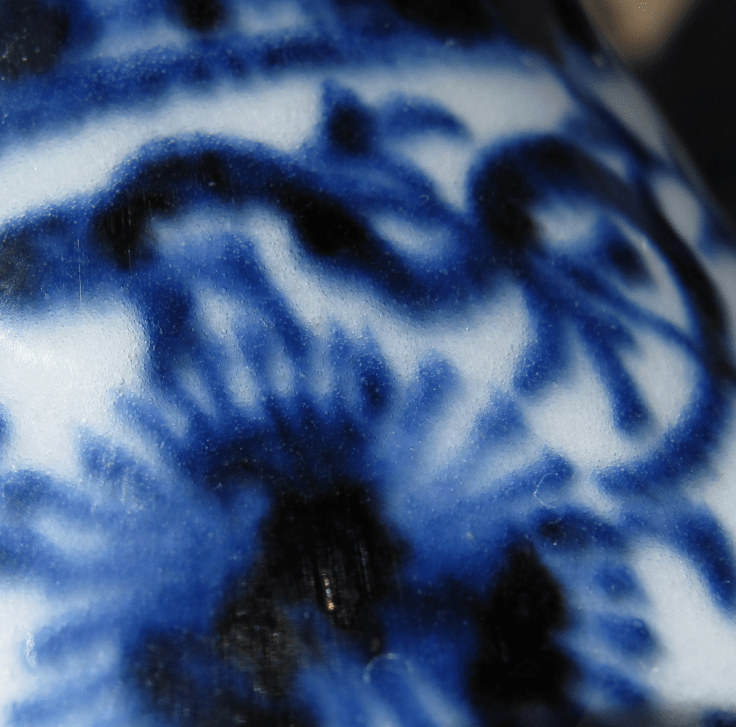 Figure 4
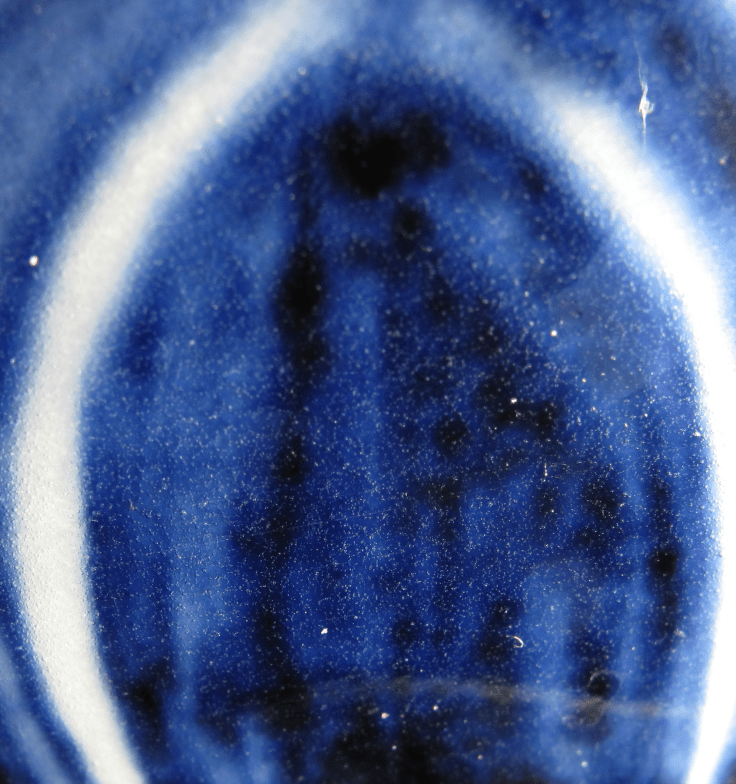 Figure 5
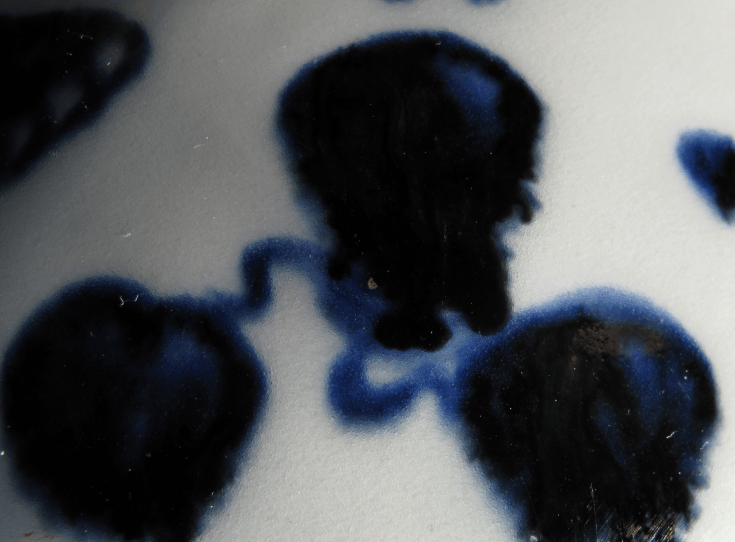 Figure 6
Figure 7
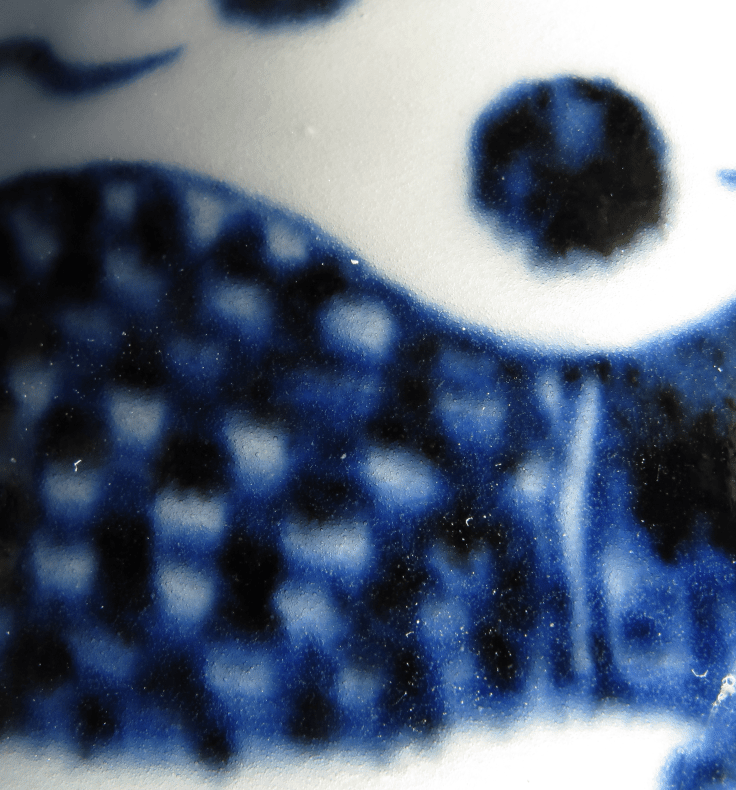 Figure 8
Figures 2-8 are all taken under daylight. In all these photos, you can see dark, almost black patches being surrounded by some deep blue coloration. The margin of this blue coloration can be minimal, or sometimes quite wide. But if you are not experienced, you have no idea that these are plaques. There is no signs of any metallic content anywhere. What is obvious, though, is the flares and drippings that associate with the plaques. Study these photos carefully, and you can get an impression what plaques can look like.
But if you were to take the vase under the sun, and tilt it in various angles, this is what you would see.
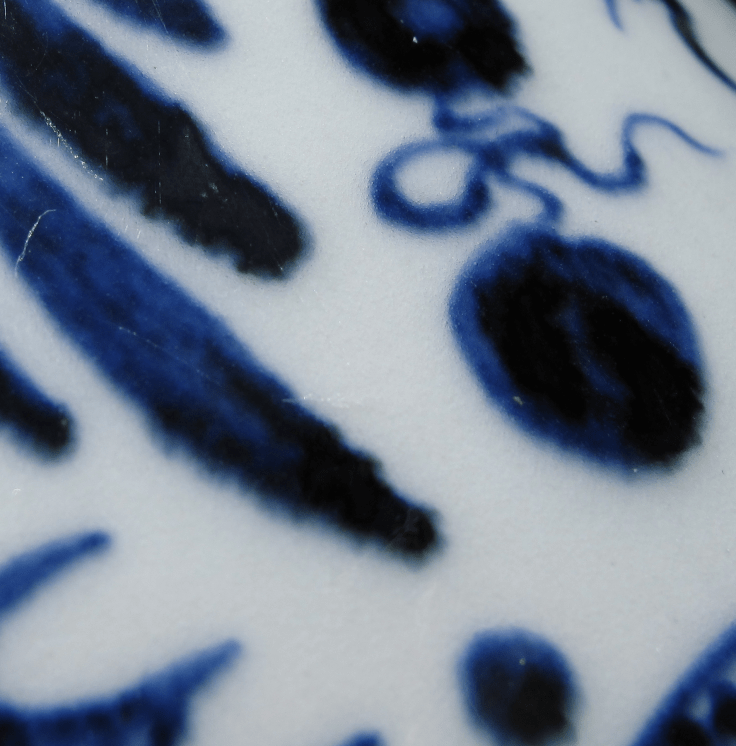 Figure 9
 Figure 10
In Figure 9, you can hardly see any reflections. But tilt the vase at a certain angle, you can see some very beautiful reflections that is from the muddy layer. The metal is still adherent to the muddy material, but with the micro-currents that is moving around in the glaze layer, the deposit of the muddy material and metal keeps changing, until the cooling process begins, when every movement will suddenly come to a stop, resulting in this particular appearance.
 Figure 11
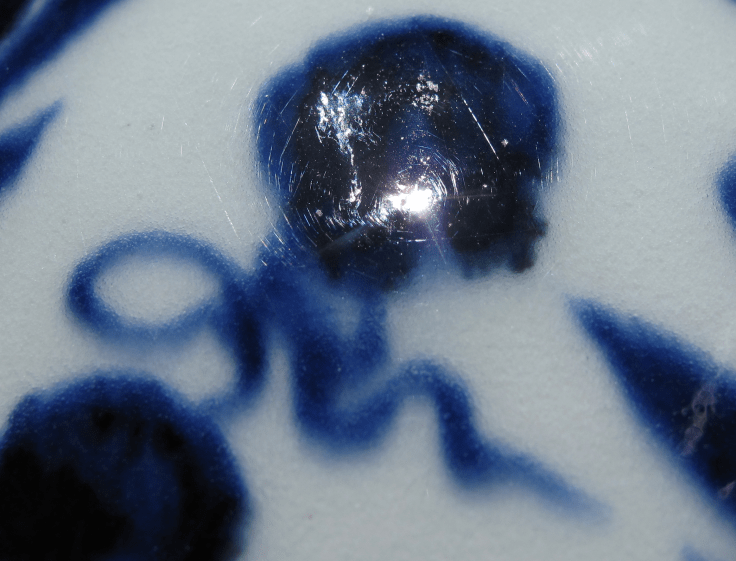 Figure 12
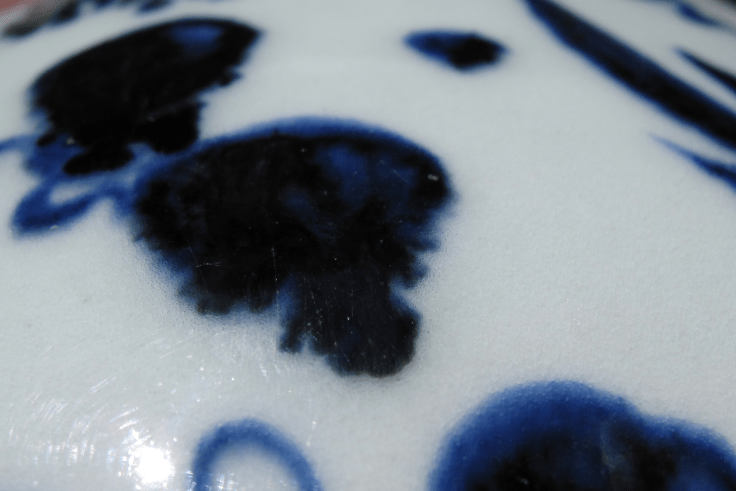 Figure 13
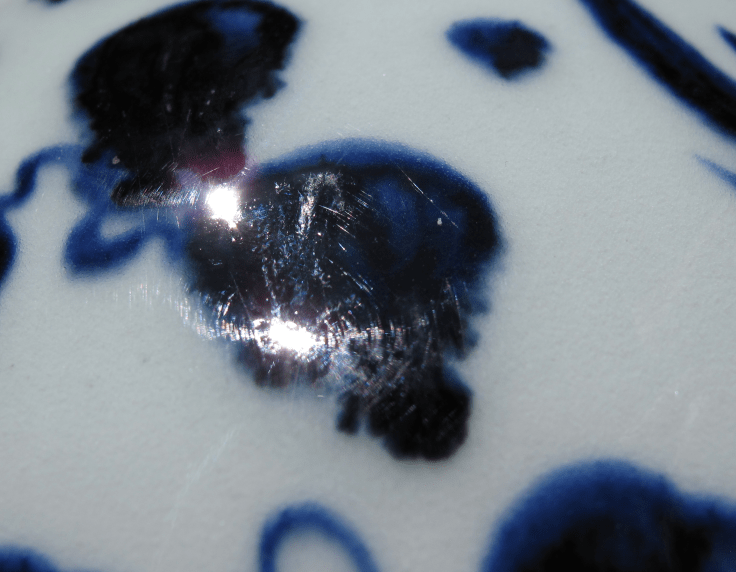 Figure 14
Now, Figure 11 and 12, and Figures 13-14, they all show the same thing as in figures 9-10. At one angle, no plaques can be seen. At other angle, the beautiful reflection is all apparent.In fact, in any of these plaques in this vase, the same effect could be achieved under the sun. It only shows that the muddy layer is not all mud, but with a rather rich content of aluminum, and they all show their beautiful reflections when the angle is right.
I am now going to show you some of the flares and drippings in this vase (Figures 15-19. In fact, the flares and drippings in this vase are beautiful. They are obvious, but they are not exaggerated. With too much exaggeration, sometimes you might want to take a good look at all the other characteristics to see if they are all compatible with the Sumali Blue dye.
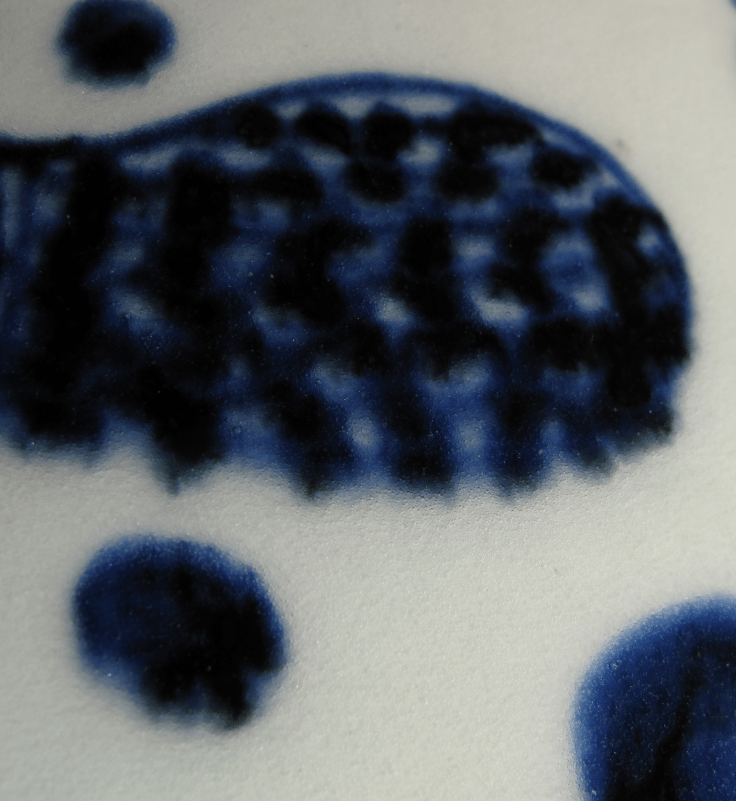 Figure 15
 Figure 16
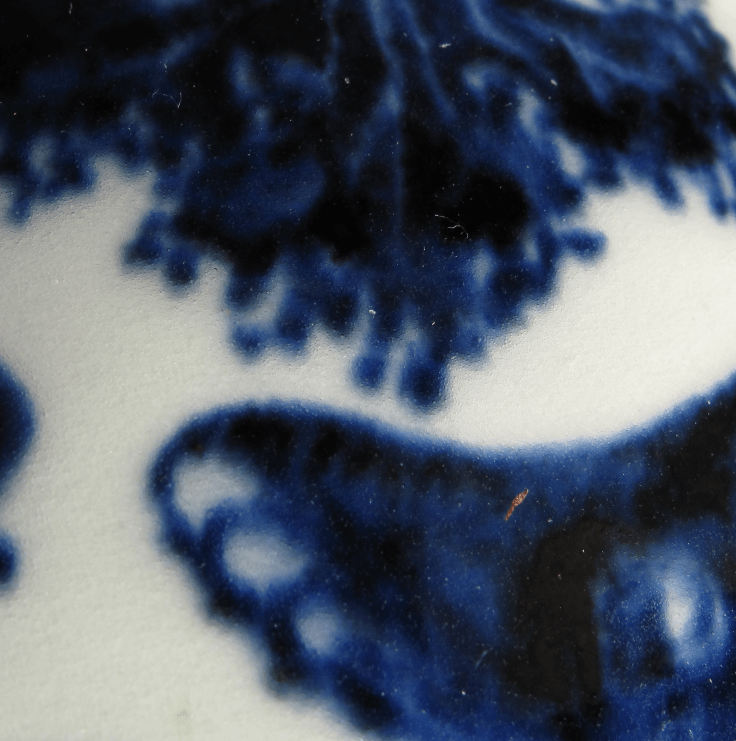 Figure 17
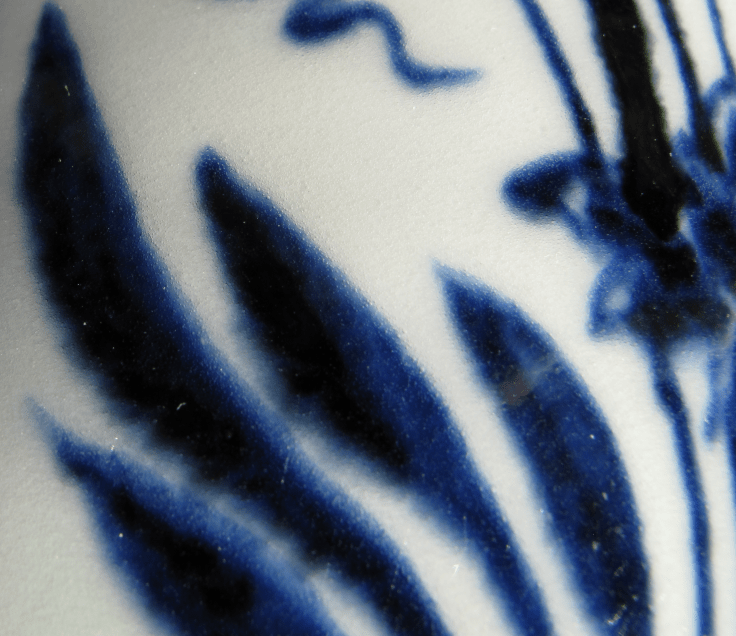 Figure 18
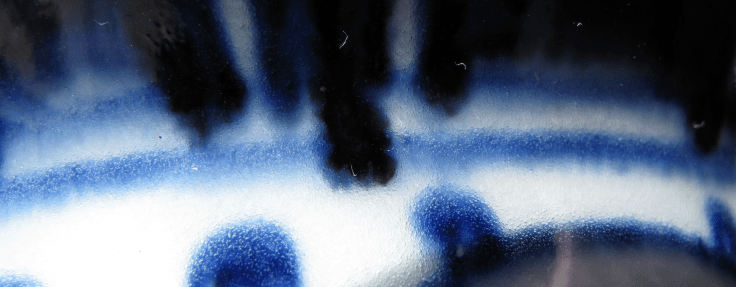 Figure 19
These flares, when you enlarge the photos, you will see that at the margin of the flare, as it is fading into the white glaze, shows a tinge of greenish coloration. This, I have been telling you, is a sign that the quality of the dye is very good.
The bubbles in the vase is somewhat different from the Yuan and Yongle B & Ws. There is no very large bubbles. But still you can easily tell the large bubbles from the small ones. The bubbles are not very crowded, and lacuna formation, under these circumstances, are only seen when the bubbles are relatively dense. These bubbles also show a feature that is commonly seen in Sumali Blue dyes. The bubbles tend to form a chain that seems to be strung together by a string. These are rather short chains, just up to five to six bubbles in one chain. But they are quite pretty to look at.
Look at Figures 20-23 carefully, and note the features that I have just mentioned—the bubbles are not too crowded, the large and small bubbles, the lacunae and the short chains of bubbles. And don’t forget to look at many large bubbles that are lurking in the darker part of the muddy layer. these are all features of the Sumali Blue dye, their presence in a B & W is an indication that the ware genuinely belong to the early Ming period.
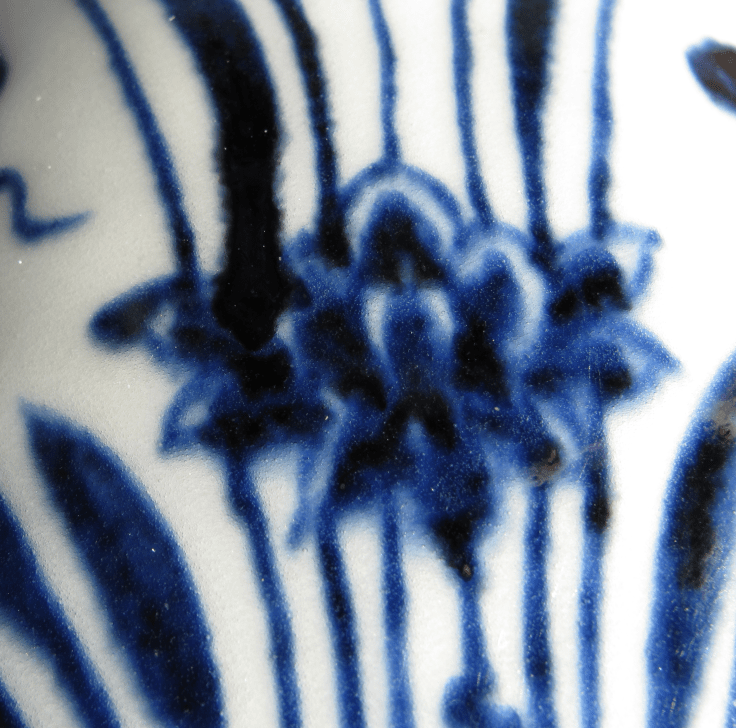 Figure 20
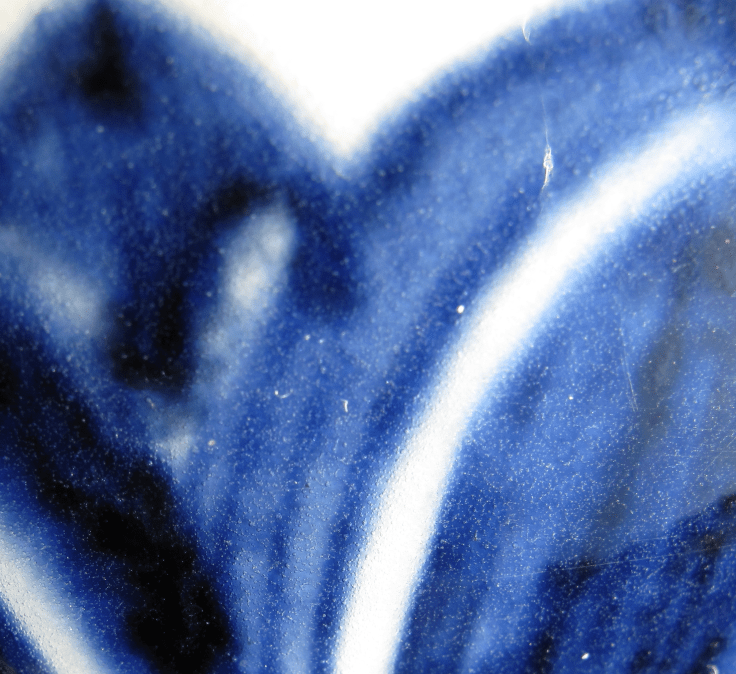 Figure 21
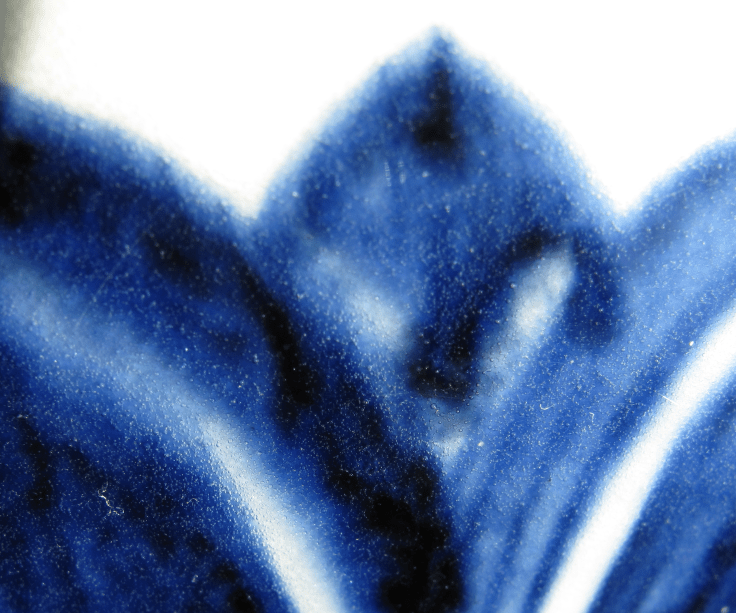 Figure 22
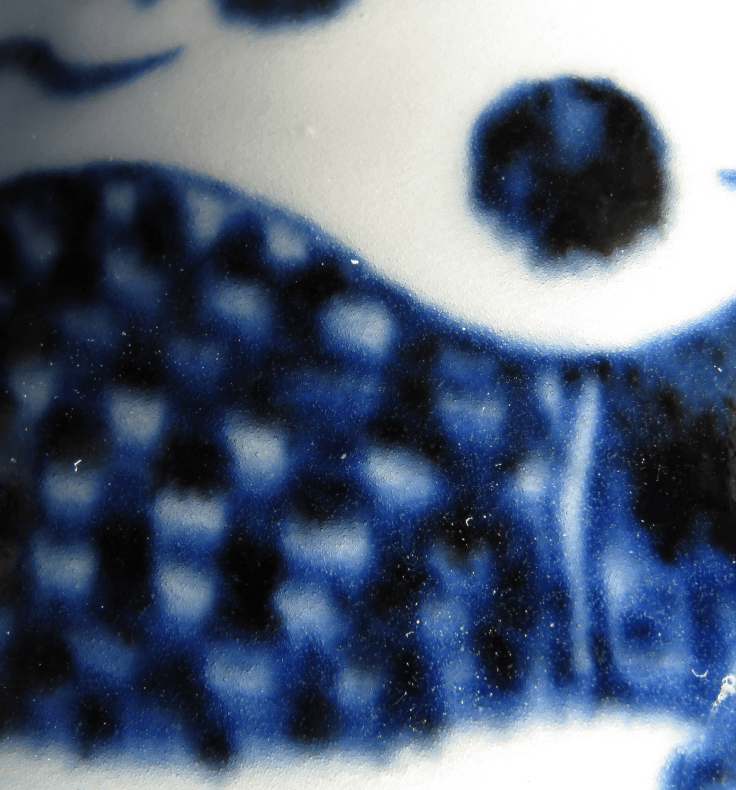 Figure 23
 yongleandxuande.com
Leave a comment