
In the article on a Yuan Charger with a Lohan in relief, I have told you that the potters, in painting the charger, they had used at least two different kinds of Sumali Blue dye. It seems that that was a very common practice, in an attempt to cut down the cost. It has long been known that the Sumali Blue dyes were very expensive, though we will never be able to find out how pricey those dye pigments were. Simple logic will tell us that even in those days, the exporters must have many different grades of dye pigment to offer. Some are much more expensive than the others. The potters, knowing exactly the price of each pigment, would choose the right kind of pigment for their purpose, and minimize the cost for maximum effect. In this large bowl (Figure 1 and 2) that I am going to show you, the potters must have used three different grades of the Sumali Blue dye, as I’ll show you.
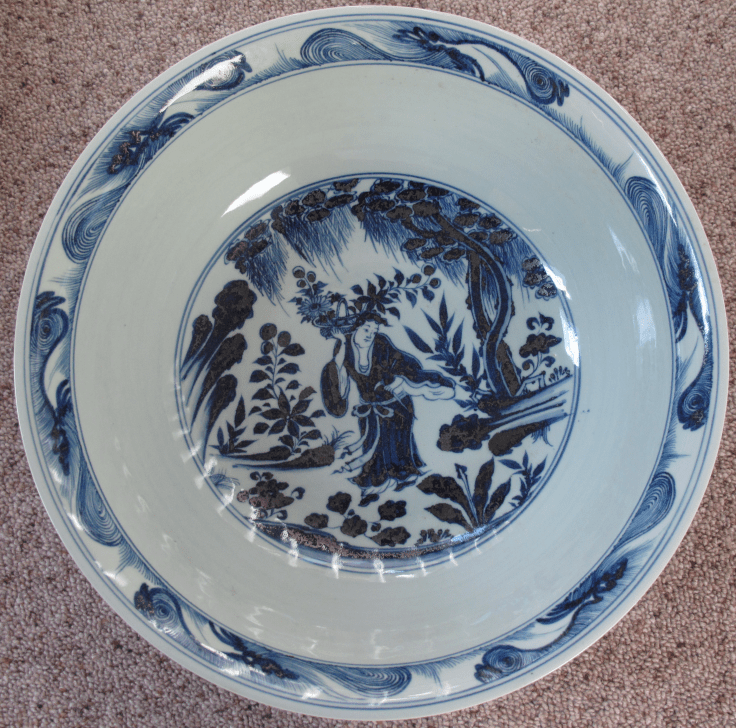 Figure 1
The bowl measures 16 3/16 inches in diameter, and is 6 inches tall.
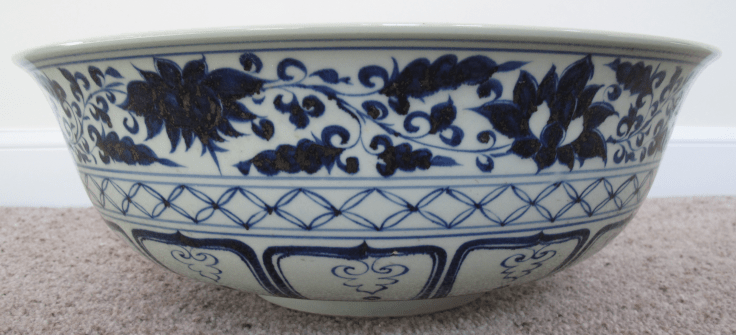 Figure 2
As you can see, plaques in this bowl are everywhere. The abundance of plaques is a prominent feature of B & W of the Yuan dynasty, particularly when the color of the blue dye is very dark. As a general rule, when the blue color gets less dark, the plaques will be less abundant, and probably thinner too. I have told you that the shape of a plaque is ever changing, and it is a waste of time trying to describe it. Rather, by looking more of these photos, and enlarging them when the occasion warrants it, you learn more about plaques than any other method you can think of, except, of course, by looking at the real thing. Still, there are a few characteristics of these plaques that you may want to remember—they will serve you in good stead. These plaques are quite thick with coarse granules. On closer examination, many minute particles of different colors are embedded in the granules. Our modern day high resolution cameras are still not able to capture these minutes particles. But, if we were to examine these plaques with a 10x magnifying glass under the sun, you will be shocked to find that these plaques can be THAT beautiful with a lot of particles reflecting many different colors. Sometimes, at the verge of the thick plaque, there are small breakaway plaques that lie close to the main plaque, as in cases of flare and drippings. There. you will notice how thin these small plaques are when compared to the main plaque.
Now, let me show you some photos of these plaques.
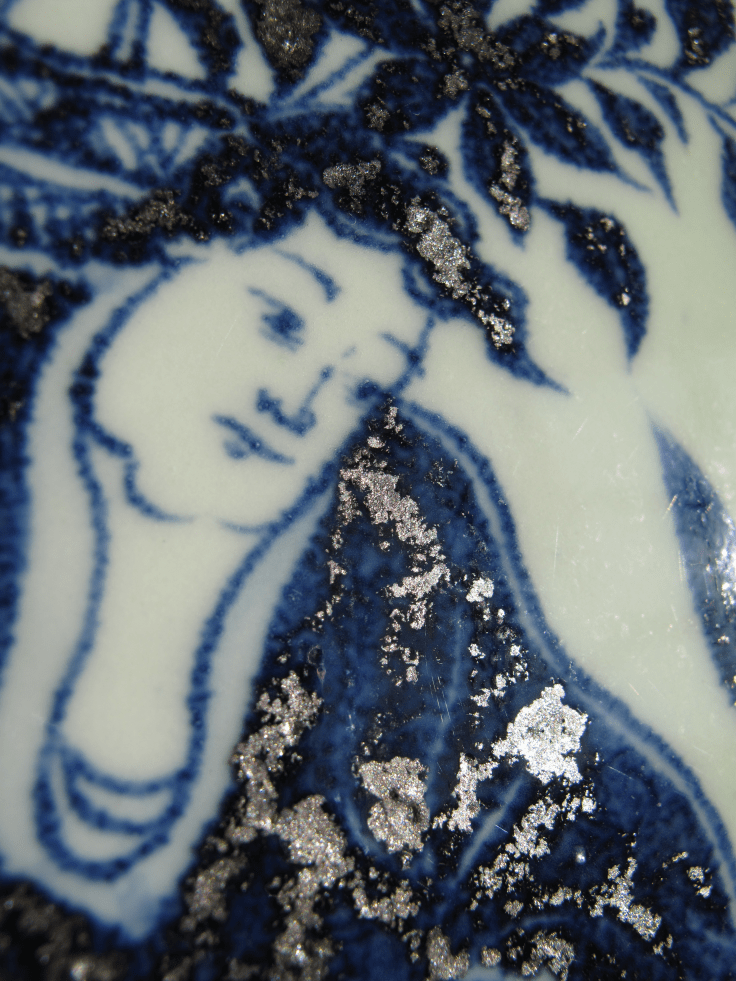 Figure 3
 Figure 4
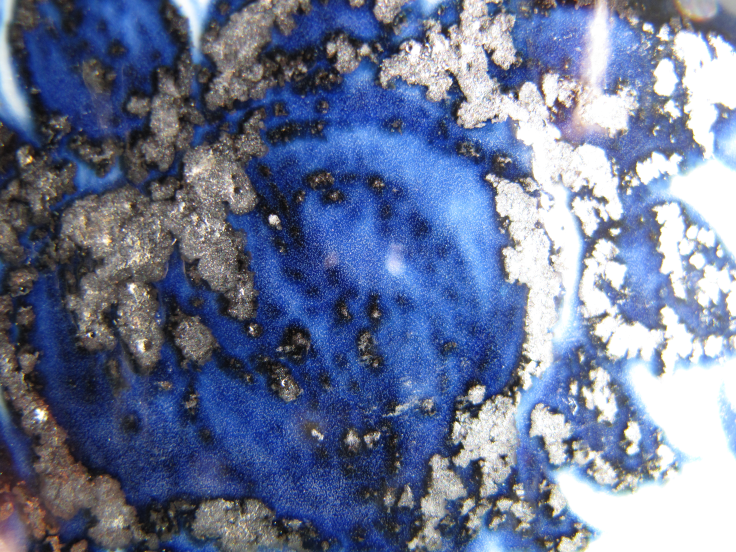 Figure 5
 Figure 6
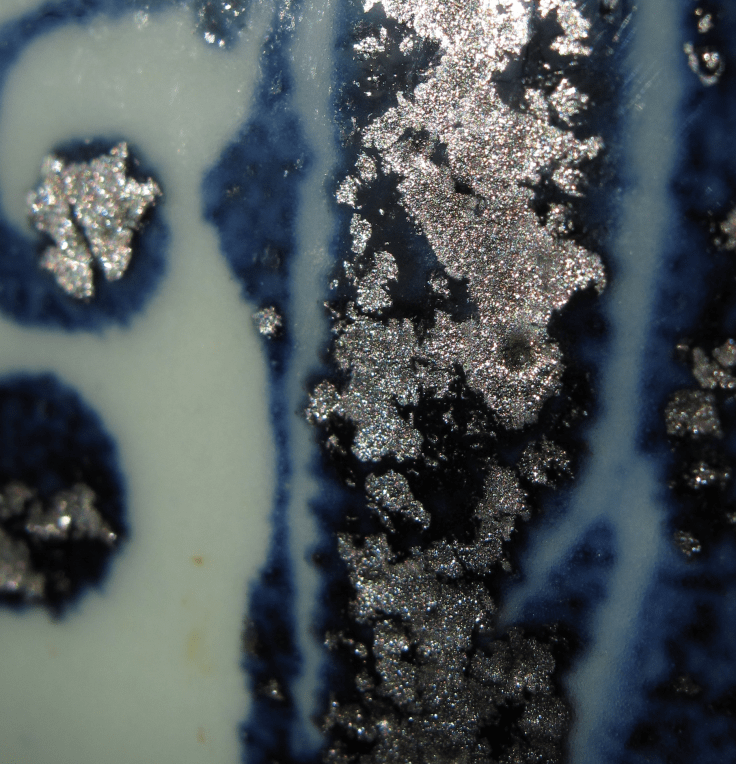 Figure 7
 Figure 8
Figures 3-8 show you the very varied appearances of these plaques. Note their coarse nature and the multi-color reflection of these plaques. In figure 6-8, I have deliberately included the part of the photo that is not in focus. It is these blurred parts that would allow you to see the multi-color reflections a lot more clearly. The color particles are no longer minute dots, they are now seen as hazy small circles, and you can see how colorful these small circles are. They are in blue, in green, in pink, in white and other colors. I don’t believe these plaques are impurities, as some experts have suggested. According to them, the plaques are getting less in Yongle B & Ws, and much less in Xuande era, because the process of purification of the dye pigments had improved with time, and much less impurities were in the dye pigments in those two later periods. This does not sound like a plausible theory. There is no impurities that can be that beautiful. It is just the nature of the dye that has changed. The exporters were continually changing their primary ingredients of the dye pigment, which, by the way, we have no idea what they are. At this point, I would like to tell you my suspicion. Can the primary ingredients be precious gemstones that were ground down into powder form?
In these photos of the plaques, it is difficult to tell if the potters were using different dyes in different parts of the bowl. But, if we were to look at the blue dye, the bubbles and the flare and dripping, it would tell another story.
 Figure 9
 Figure 10
 Figure 11
These three photos (Figures 9-11) were taken from the motif at the bottom of the bowl. That is to say, from the flat part of the ware. The first thing that catch your attention if the mottled appearance of the blue dye. The mottling is not the work of the painter, but rather random deposit of dye pigments at the bottom. This is a feature of the Sumali Blue dye, and, as I have explained before, such appearance generally associates with good quality dyes. Here you can see the very beautiful sapphire blue color.
Aside from the mottling, you can also see irregularities at the blue dye margins over many places. Sometimes, such irregularity can mimic the blade of a saw. Look at the edge of the leaf on the left hand side of Figure 11, and you will understand what I am trying to say. This is what we call flare, something very fundamental in Sumali Blue dyes. If the same leaf is drawn on the vertical part of the bowl, the flare will be exaggerated, and will become a dripping, as you will see.
We must now look at the bubbles. The bubbles are either large or small, with the large bubbles not unduly large, except for an occasional few. The small bubbles are far from tightly packed. Still, at places where there are more small bubbles, you can see the lacunae formation.
Now, let me show you photos that were taken from the inner side of the mouth of the bowl (Figure 12-15).
 Figure 12
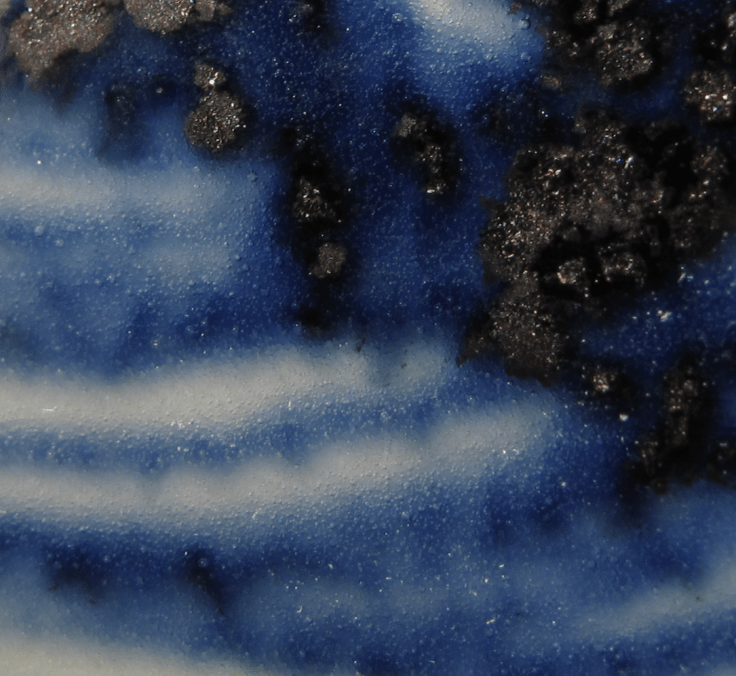 Figure 13
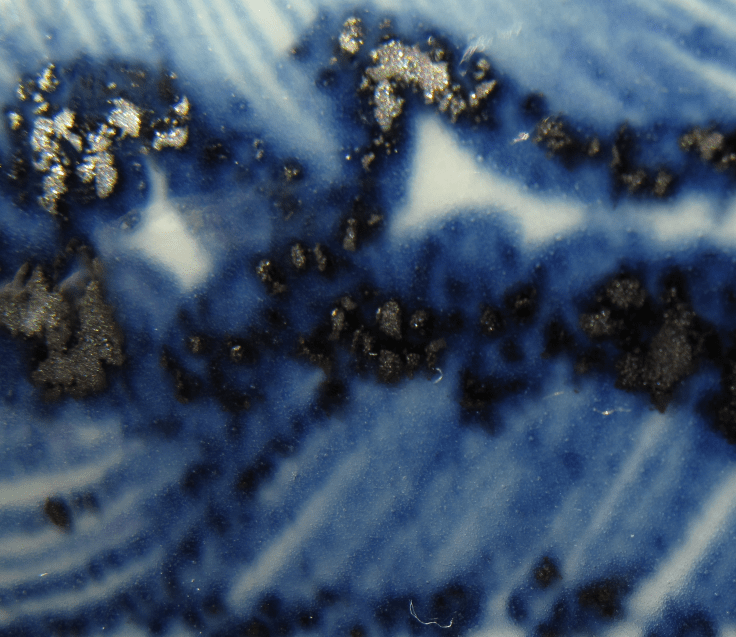 Figure 14
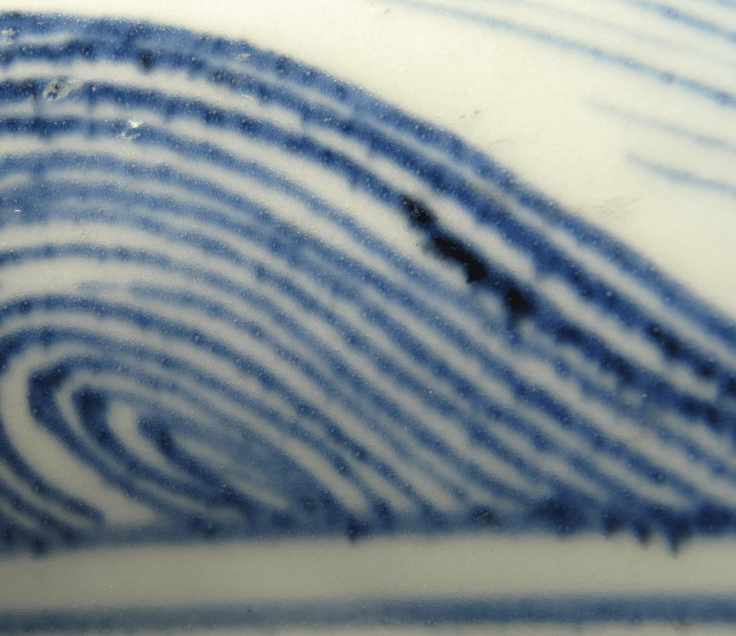 Figure 15
A look at these four photos will tell you that the shade of the blue color is different from that at the bottom of the bowl. There is no more mottling. Even though the rim of the mouth is not vertically down, it is still curving down at a rather steep angle, the flare that we see in the flat part of the ware is now exaggerated into drippings. Look at these four photos carefully, and you will not miss the dripping effect that is built on the flare phenomenon.
In figure 12, there are several places where we can see small, break-away thin plaques that originate from the main plaque nearby. This phenomenon, again, is only seen in good quality Sumali Blue dyes.
There are definitely more large bubbles in these three photos than the previous three, and you can find some large bubbles lurking around some plaques. Also note the translucent large bubbles. These are also features of the Sumali Blue dye. Can you find lacunae formation in some of these photos? Would you agree that the dye pigment here is different from that in the bottom?
Now, let me show you the bubbles and drippings at the drawings at the outer side of the bowl. The wall where the drawings are made obviously is a lot more vertical than the rim of the mouth of the inner side. And let us look at the flare, which is very much exaggerated into dripping by the force of gravity (Figures 16-18).
Look at the lower margin of the blue dye patches. The dripping is obviously more intense than those dripping appearing at the rim of the mouth. But they do not drip down very far. I believe this has much to do with the viscosity of the glaze. Pay attention to the greenish hue between the main plaques and those small break-away small ones that is apparent in many places. The presence of this greenish hue, as I have told you before, indicates that the dye is of good quality. Now, look at the large bubbles, which are not too many, and occasionally, you can see one that is distinctively large, as in the top of Figure 17. when you slightly enlarged these photos, at areas where the blue patch is large, lacunae formation is very clear. All these features are very different from the dye over the rim and at the bottom, and that is my reason to say that, in this large bowl, the potters must have used three different grades of Sumali Blue dye.
In these photos, though I demonstrate to you the presentation of the bubbles and flare and dripping, I have to remind you again that it would help you know the dye better if you will also look at the plaques and the rest carefully and get familiar with all the peculiar features of the different grades of the Sumali Blue dye
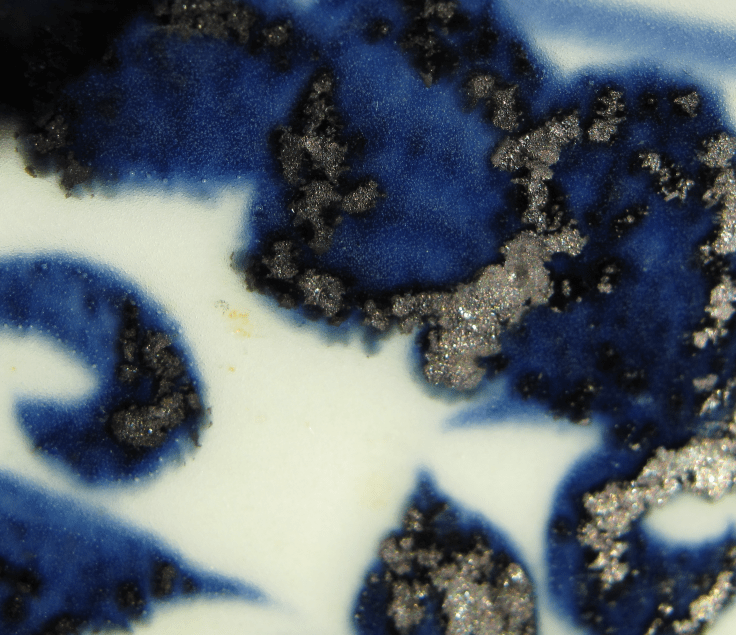 Figure 16
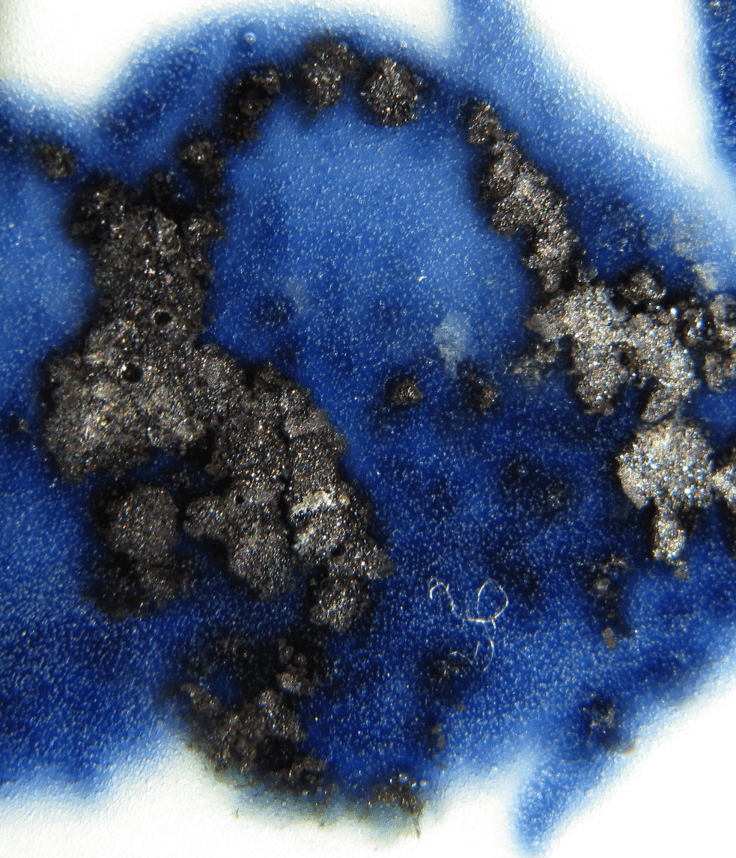 Figure 17
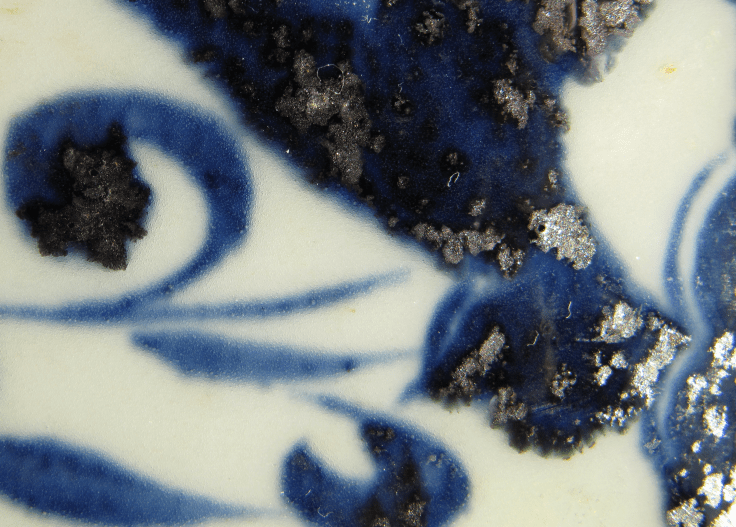 Figure 18
It is well known that under different lighting condition, the appearance of the photos changes significantly. Before we leave this bowl, I want to show you the appearance of the blue color and the plaques when the photos are taken under LED light. In this instance, the very dark blue color of the bowl shows a very nice blue color (Figures 19-21).
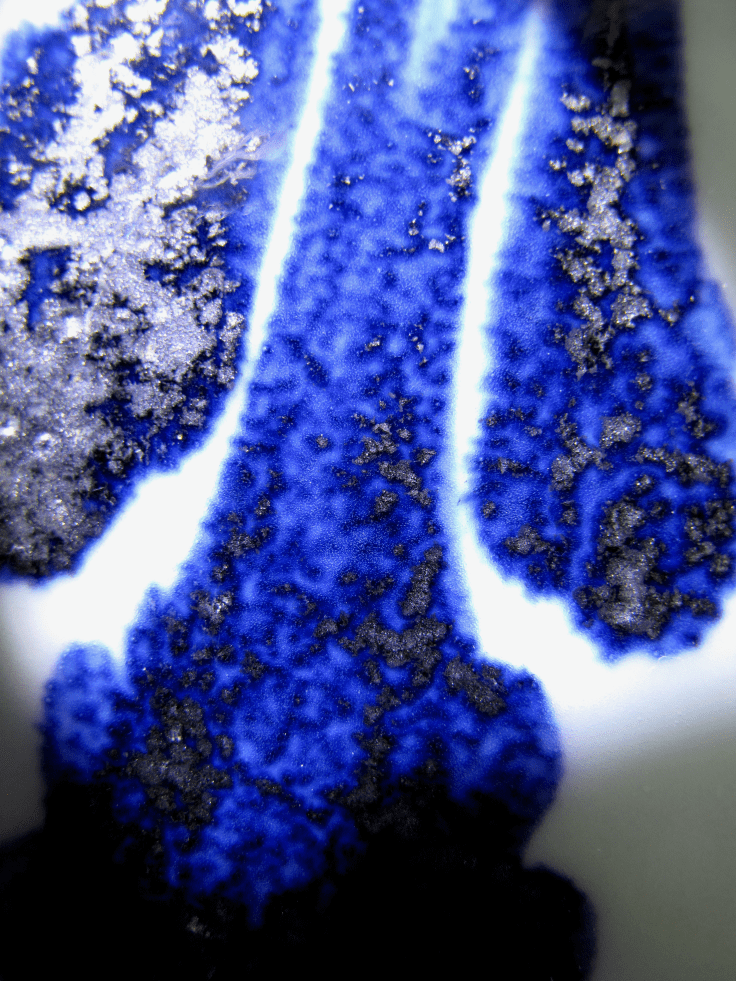 Figure 19
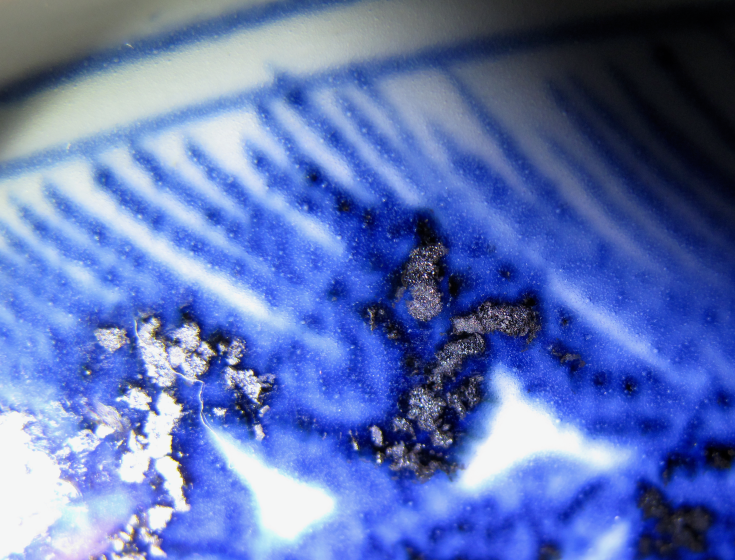 Figure 20
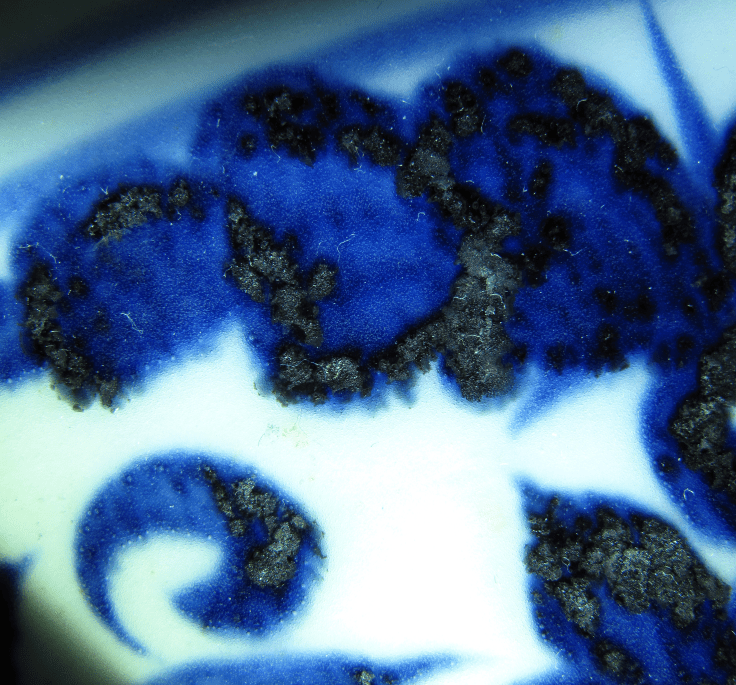 Figure 21
 yongleandxuande.com
I have been studying enlargements of your photographs and I see what looks like tiny fragments of hair (from the paint brush?) within the glaze in a few photos. I am wondering whether this is another sign of authenticity, due to the kiln temperatures at the time?
A Yuan B+W Large Bowl (Feb 4) figure 21
Yuan Jar with Dragon Design (March 1) figure 15
A Most Beautiful Yongle Charger (Nov 11) figure 14 and possibly figure 10.
Thank you
LikeLike
Thank you for asking.
I need to apologize for my somewhat sloppiness of some of my photos. The fragments of hair you referred to are actually filament of fibers that I failed to clean away on the surface of the ware. Any actual fragment of hairs from the brush would not have survived the high temperature in the kiln.
LikeLike
I can understand how the “hairs” would burn up, but I am wondering what the horizontal “lines”, which run
over the petals of the flower, (there are 2 of them pictured and one to the right of the flower) are? They appear to contain more of the larger bubbles too.
LikeLike
I am not exactly sure what you are referring to. Can you elaborate?
LikeLike
I am looking at the picture that was sent by TwoLittleVases. The lines appear like they might also be indented or craze marks in the porcelain? Not sure. Or, maybe they are a part of the over glaze? Over the Sumali Blue? I just don’t know what those are or what would cause those, so was wondering if you did.
LikeLike