
Collectors of Blue & Whites of the early Ming period all know that the blue pigment used in those periods is the Sumali Blue dye. As I have told you, we know very little about the dye pigment. We do not even know the place of origin of the dye. That is to say, we have no idea which country in fact exported the dye, not to say the nature of the dye. The only thing that we know is that exporters began exporting the dye to China sometime during the Yuan period, and by the end of the rule of Xuande, they stopped importing. Here again, we have no idea why the exporters decided to do that. But for potters in China, that meant something very crucial, and they have to look for a replacement. History tells us that the potters had failed in their endeavor, and no replacements they found had qualities that were anywhere close to the Sumali Blue dye. In short, the Sumali Blue dye are so different from all the subsequent replacement dyes that their characteristics are now cornerstones in establishing whether the Blue and White belongs to those periods or not.
History also tells us that not all Sumali Blue dye pigments are the same. There are some major differences among dyes in different periods, and to a lesser extend, dyes of the same period. There are many reasons for this, but the most important one, I make a guess here, is that the natural ingredients of the dye vary from batch to batch of the dye pigments that were imported. I will elaborate on some of these when we come to it.
Most of the Yuan B & Ws, among other things, have two features that stand out. They have prominent plaques, and the bubbles are smaller. We will discuss all these in more details as we go along, and this Yuan Jar is a good example to start.
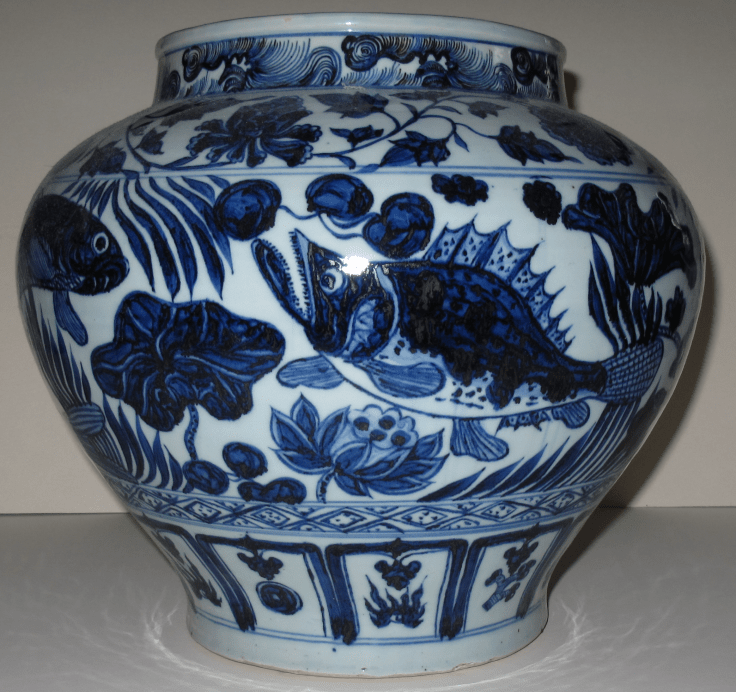 Figure 1
This jar is 11 5/8 inches in height. The motif is well drawn, and the blue color is as good as you can get in a Yuan B & W. Now, how do we tell that this is a genuine Yuan ware? The answer again is by looking at the features of the Sumali Blue dye. I have told you the prominent feature in the Yuan B & Ws is the plaques. The following photos will tell you exactly how prominent the feature is.
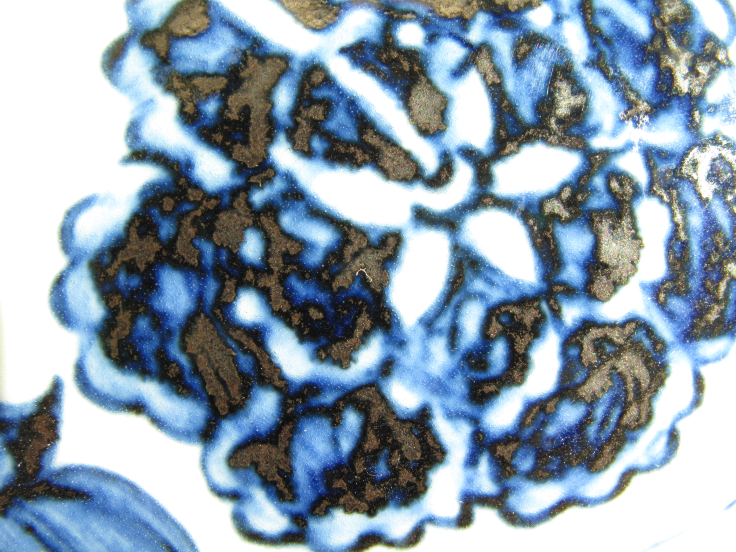 Figure 2
 Figure 3
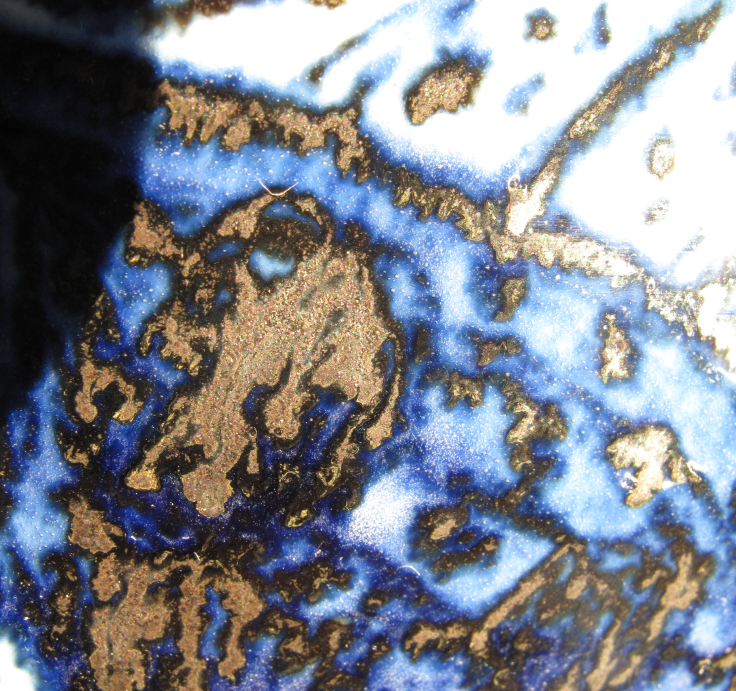 Figure 4
 Figure 5
Figures 2-5 give you an idea the meaning of the word prominent. In the old days, when description could only be done by words, the word prominent would be up to every reader’s imagination and interpretation, and there would be no consensus. This is how amazing technology can do to convey the meaning of the word.
If you are to look at the plaques in detail by enlarging the photos, you can see the differences between these plaques and those in the early Ming period. Let me enlarge some of these photos for you (Figures 6-11).
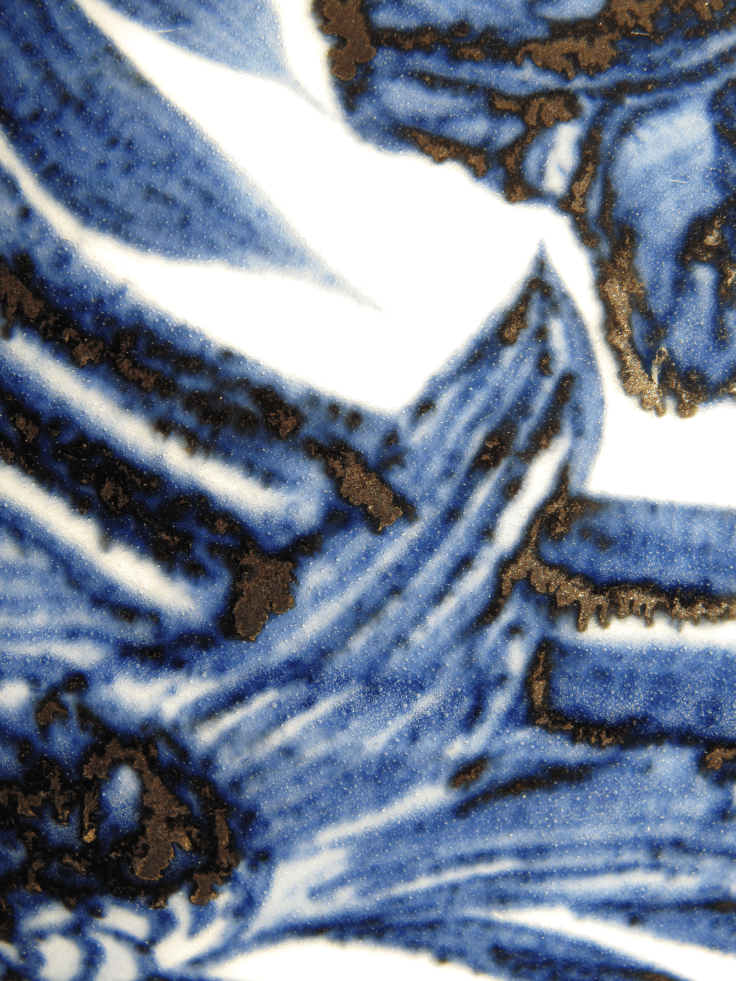 Figure 6
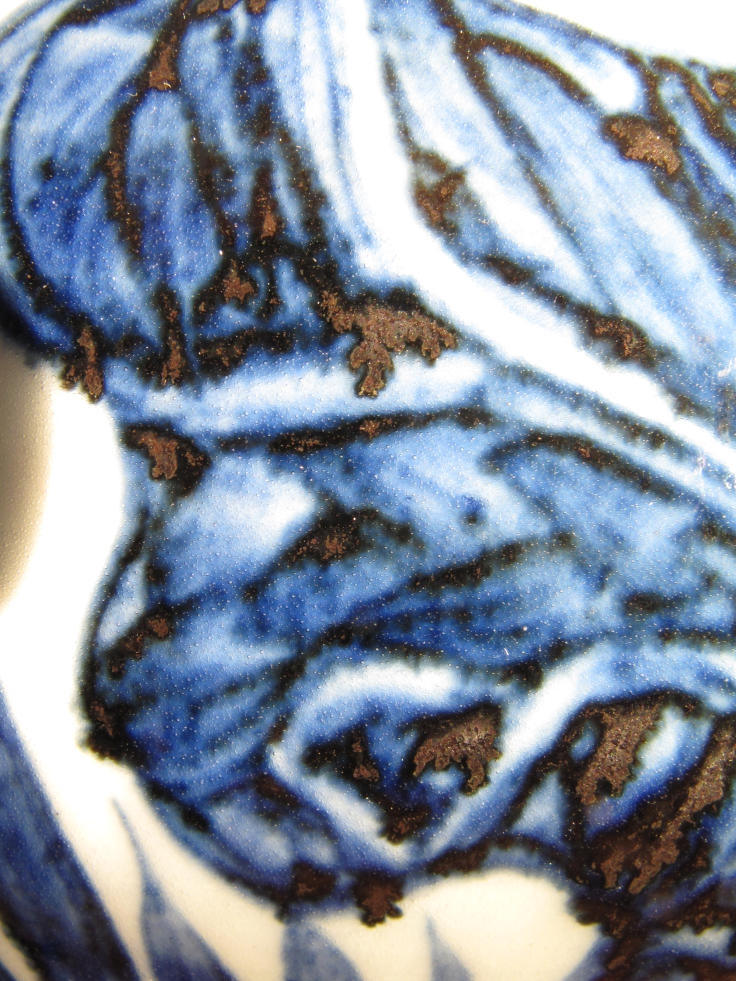 Figure 7
 Figure 8
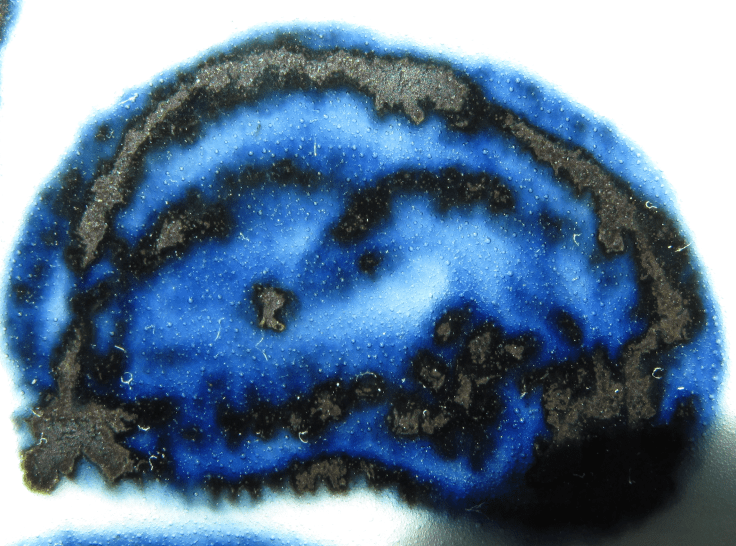 Figure 9
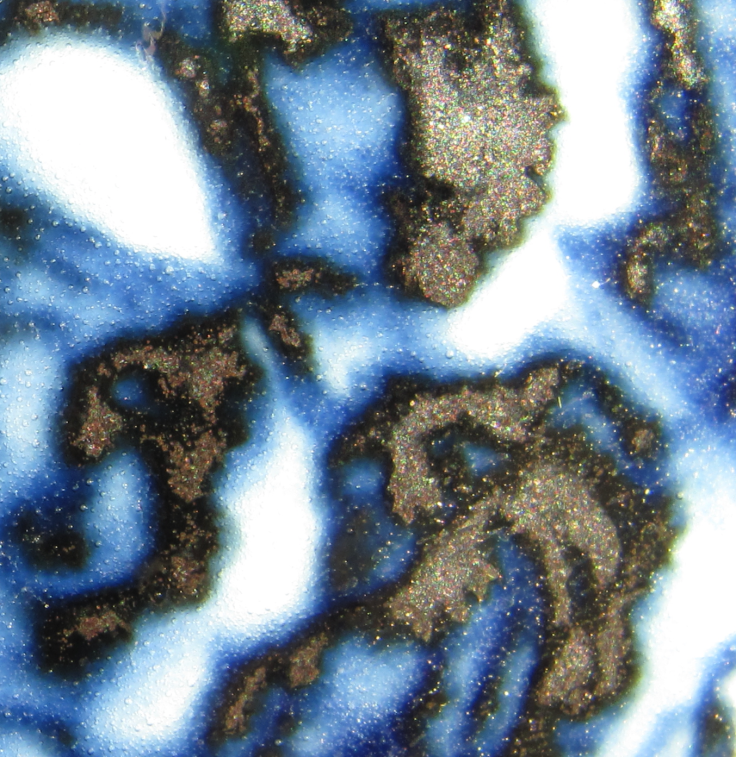 Figure 10
 Figure Figure 11
In the early Ming B & Ws, we know that plaques and drippings are closely associated, but this association is very much enhanced here. Look at Figure 6 and Figure 7 again. There, not only do you have drippings that are from the blue dye pigment, there are so many instances where the plaques are actually part of the dripping. That is to say, they form part of the dripping, many a time, for the most part of it, leaving only a small portion at the outermost region that is formed by the blue dye pigment. This is something you seldom see in early Ming B & Ws. Figures 8-10 are showing the same thing.
It is worth noting that the plaques-forming material in this Yuan jar is so abundant that, most of the time, the plaques are just one continuous sheet. I am sure one of the reasons that the plaques are dripping down is directly related to the excesses of this plaque-forming material. You will also note that the plaques appear to be a lot more coarse than those plaques that we see in the early Ming wares, though the reflections under sunlight have the same bright colorful element as those Sumali Blue dye pigments seen in the subsequent decades when the dye was imported (Figures 10 and 11). Again, it is important that you look at these photos carefully, and enlarge them as necessary, so that you will get familiar with their appearances in different shades of light.
Now, we must look at the bubbles. Let me show you three photos first.
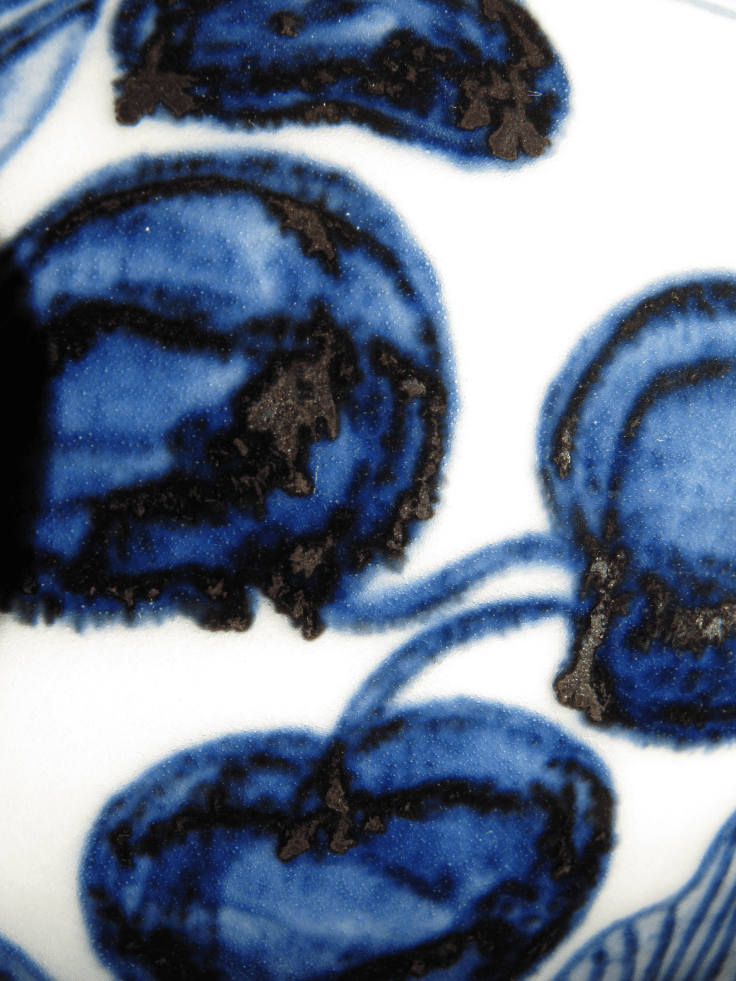 Figure 12
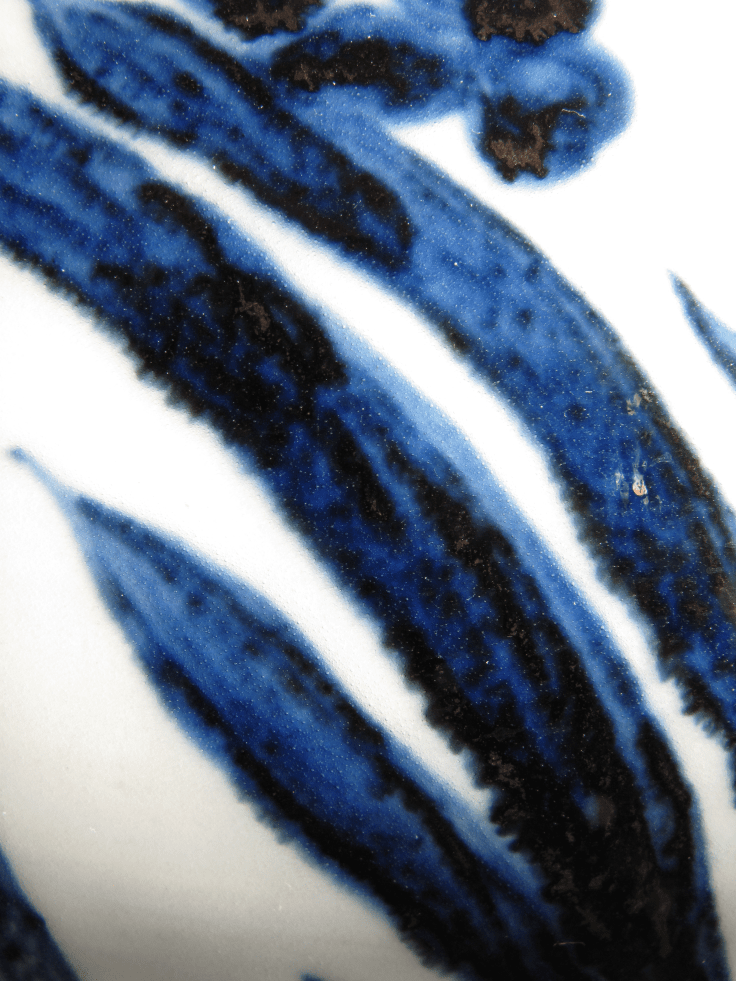 Figure 13
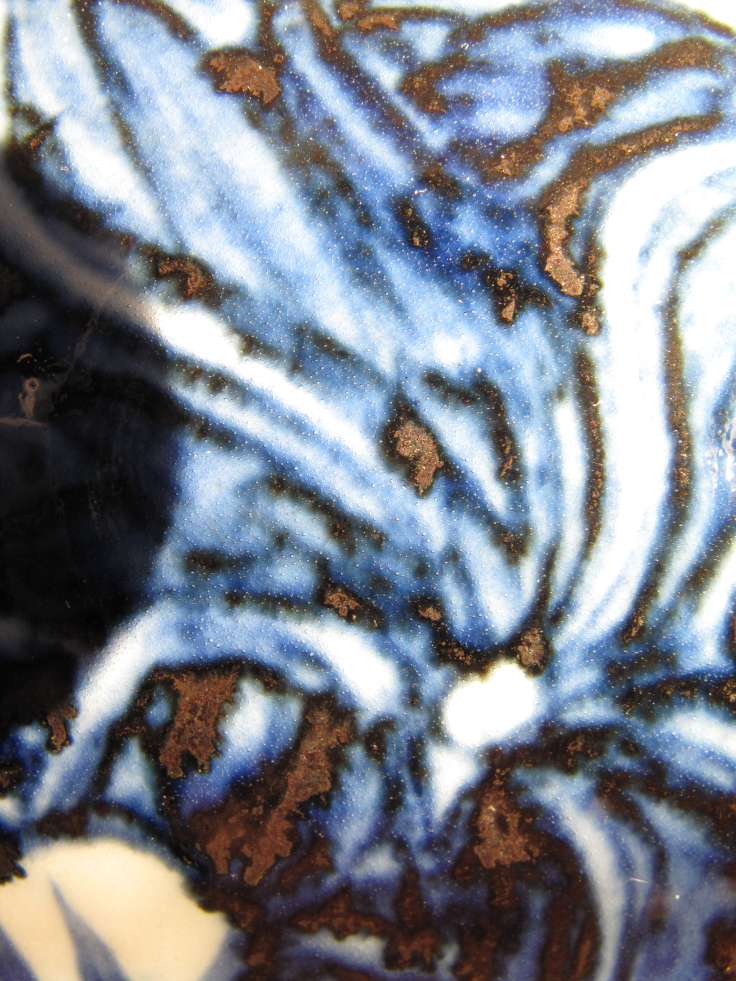 Figure 14
As you can see, bubbles in these three photos have large bubbles that are not too large, and small bubbles that are in rather small numbers. Even the strings of large bubbles in Figure 13 and Figure 14 over the margin are small compared to those strings of bubbles that we see in Yongle B & Ws. The small bubbles are not too much smaller than the large bubbles. The number of small bubbles are so few that you cannot find any lacunae formation. However, the bubbles retained the semi-translucent appearance that we see in wares painted with the Sumali Blue dye. You can go back and look at some of the photos showing you the plaques. Many of the photos show this pattern of behavior. In Yuan B & Ws, such appearances are not uncommon.
Now, I will show you a few other photos of the bubbles in this particular jar (Figures 15-17).
 Figure 15
 Figure 16
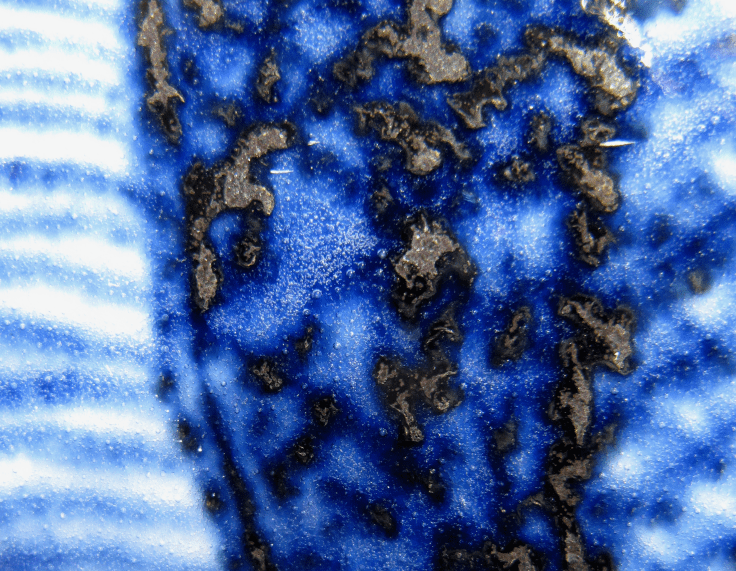 Figure 17
In these three photos, the bubbles are quite different from the previous three photos. Here, the contrast of the large and small bubbles is distinct. In many areas, there are very crowded small bubbles. In Figure 17, lacunae formation is very clear in some areas. You can also see short chain formation of large and small bubbles, features that are common in Sumali Blue dye. I would go so far as to say that the plaques in these last three photos are different from the previous three photos. They resembles plaques seen in Yongle and Xuande period.
Why is that? You may want to ask. I think the explanation is simple. It is a question of quality control. I have never read any literature on this topic, and I’ll try to come up with a theory. This is a Yuan B & W, there is little doubt about it. It is during the Yuan Dynasty that the Sumali Blue dye was first imported to China. As I have said, we know close to nothing about the dye except that it is very expensive. It must be something natural—an ore or, more likely, a mixture of several ores and minerals, some of which must be rather rare and pricey. The exporters, in an attempt to keep the ingredients secret, must have grinded down the ores into powder. When the exporters first made the dye, they were not quite sure what the outcome on a ceramic ware would look like. Then they found out that the blue hue was beautiful. What troubled them was the plaques. They marred the beauty of the ware, or so they thought. So, in the subsequent decades when the dye was exported, they made it a point to minimize the plaques with improved technology. They must have also tried on many different ores, the final aim being a beautiful blue color with as little plaque as possible. In a careful study of the Yuan, Yongle and Xuande B & Ws, we can actually see the improvement. Some Xuande B & Ws are almost without plaques. Along the way, because of the different materials used, the bubbles show a variety of presentation too.
In this Yuan jar, when the technology revolution was still at an early stage and on going, and the mixing of the pulverized ore minerals not done properly, the potters ended up with a B & W that has plaques and bubbles that are not the same on different parts of the ware.
You will also note that many large bubbles do not sit in a small pool of darker blue dye, a phenomenon that is almost the rule in Yongle and Xuande B & Ws. This is another question that you want to ask. Again, I have a theory of my own to explain this.
We need to understand that making a B & W is a very complicated process back then, and the technology was always revolving—in every step in the manufacturing process and in every ingredient that in involved in the making of it. The dye pigment, though they are all Sumali Blue dye, vary much from batch to batch, from year to year. The same is true with the glaze material. Though experts today don’t talk much about the glaze, I am sure potters at those times paid a lot of attention to it, and the material used must have evolved alongside with everything. Some glazes are thicker, others less viscous. I am sure the glaze in this jar is rather thin, not very viscous, otherwise the plaques would not be flowing down as if in lock-steps with the blue dye pigment components, as we have seen.
Then we have the kiln to consider. The design of kiln changed all the time. We will not be able to tell how a kiln looks like back in the Yuan dynasty. Then we want to know the material potters used to bring up the temperature. What is the temperature potters used? and for how long do they bake the wares? Nowadays, we always say that the temperature they used is 1350 degrees Celsius. I must tell you that this is pure speculation. The real answer is: we do not know. So is the number of hours potters baked their wares. We again do not know. There are so many unknowns here that critics purposely avoid mentioning them. They do not want to talk about all these. To me, even the position of the ware inside the kiln makes a difference to the outcome.
And in this particular jar, let us go back to the question of why some of the large bubbles are not sitting in a small pool of dark blue color. I think the reason may have some very closed association with all the above. The bubbles, as they were generated from some nidus of chemicals in the blue dye, began to rise to the surface. But under high temperature, within the thickness of the glaze, local tiny currents were formed. The current carried with it the bubbles—to wherever the current might drift. With all these and some more unknown factors playing a part, especially when the glaze was thin, some bubbles might drift far away from their origin, allowing them to end up anywhere.
I am going to show you a few more photos before I end this article. Again, look at them carefully, and try to remember how the plaques and bubbles present themselves.
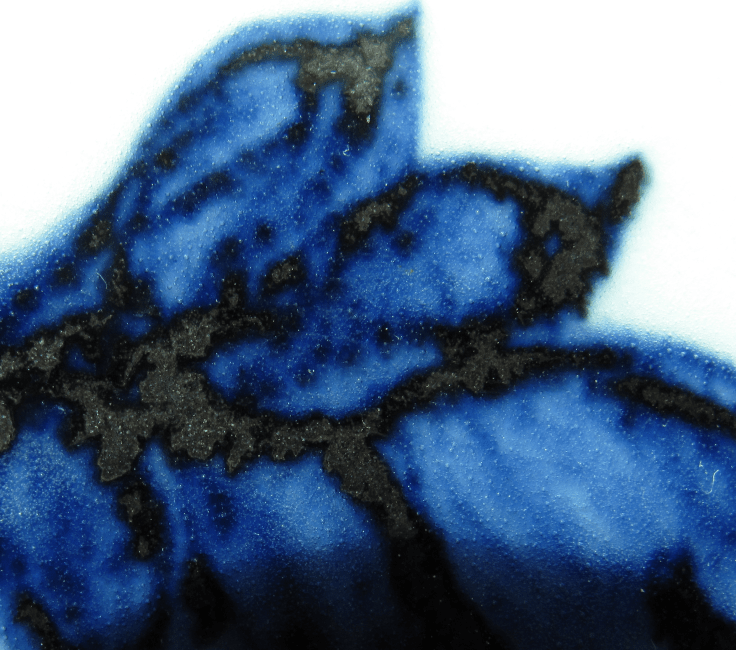 Figure 18
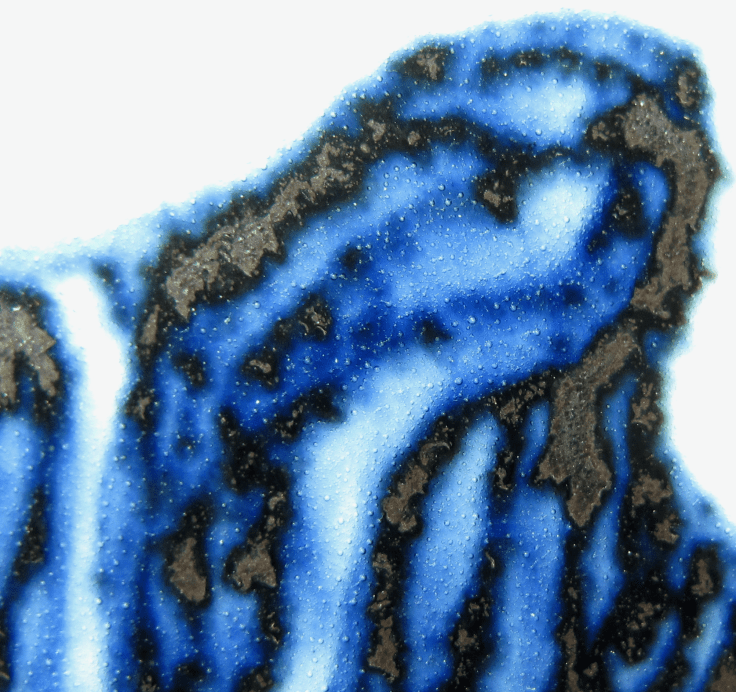 Figure 19
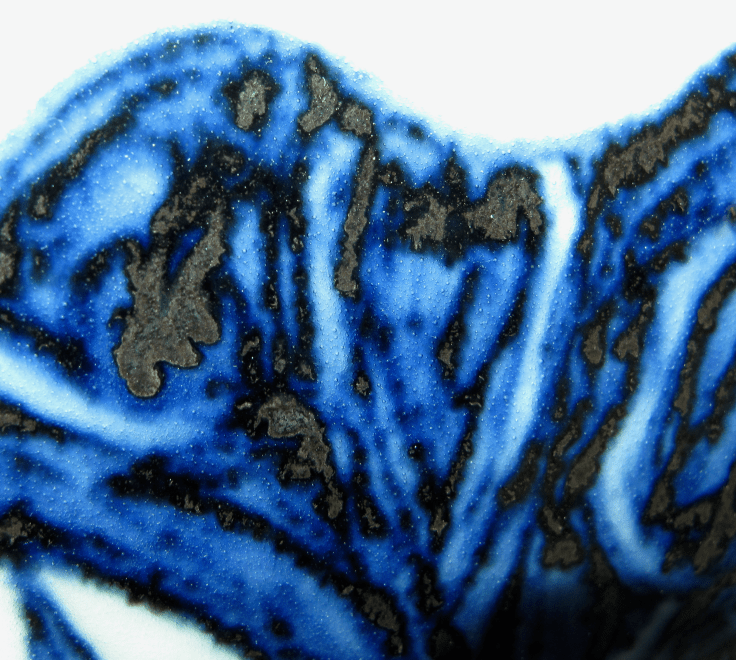 Figure 20
 yongleandxuande.com
Leave a comment